








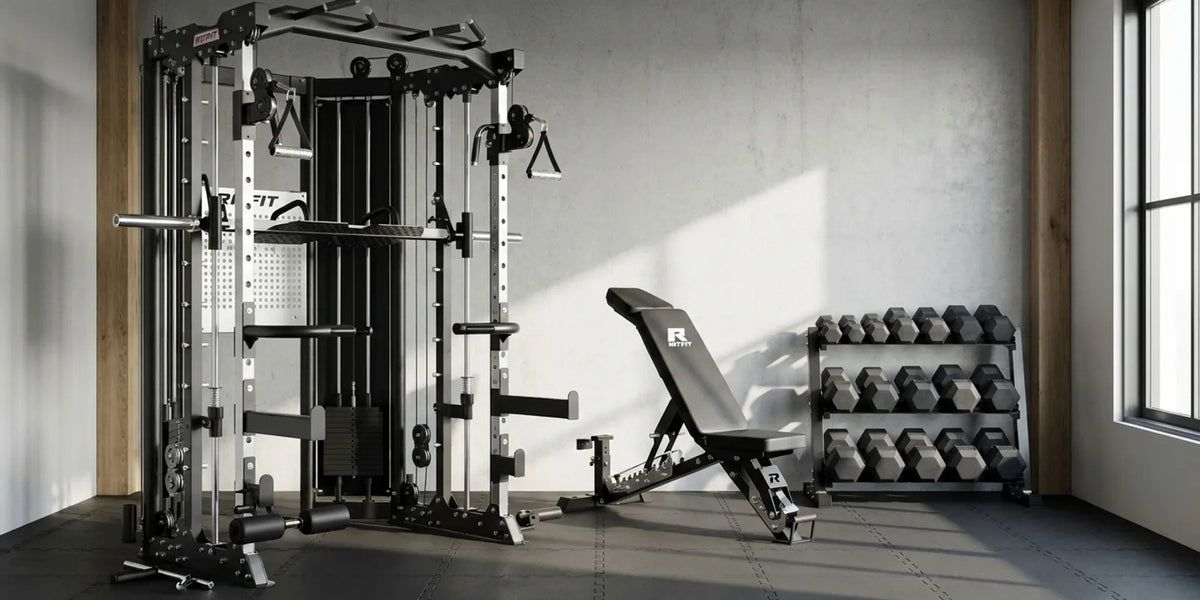
A 1:1 cable ratio Smith machine moves the loaded carriage at nearly the same rate your hands move, so the number pinned on the stack tracks the resistance felt at the handle. That detail separates the RitFit BPC06 from most machines at its price.
This guide covers what 1:1 changes during a working set, how it trades cable travel against load fidelity compared with 2:1, and how to confirm a ratio before you order. Measurements and capacities below come from the RitFit product page and its published ratio reference.
Quick Answer: A 1:1 cable ratio Smith machine keeps pulley load close to the number selected on the stack, which suits heavy compound cable work where honest load matters more than long cable travel. The RitFit BPC06 is the RitFit all-in-one that carries a documented 1:1 ratio, with a 260 lb stack, an all-aluminum pulley system, and 17 adjustable cable positions.
Key Takeaways
- Load fidelity is the point: at 1:1 the selected stack weight stays close to the resistance at the handle instead of being roughly halved the way a 2:1 system delivers it.
- Cable travel is the trade: a 2:1 cable can be pulled about twice as far per inch of carriage movement, so long-reach pulley work feels different on a 1:1 machine.
- RitFit publishes its ratios: the official ratio reference lists the BPC06 at 1:1 and the M1, M1 PRO, and Buffalo at 2:1, with the PSR05 split across stations.
- Verify before you pay: check the ratio reference, the spec block, the pulley sheave count, and a written reply from support, because retail listings rarely state a ratio.
- The BPC06 is built for heavy cable work: a 2000 lb upright rating, a 700 lb Smith bar rating, and a 260 lb selectorized stack leave headroom for a strength-focused program.
What Does a 1:1 Cable Ratio Change on a Smith Machine?
A 1:1 cable ratio keeps resistance at the handle close to the number pinned on the stack. That is the practical difference from a 2:1 pulley ratio, where the same pin setting delivers far less resistance at the handle in exchange for a longer cable travel distance. For a buyer, the ratio decides whether heavy compound lift work on cables remains programmable on a fixed stack.
RitFit publishes a per-model ratio list, which makes the difference unusually easy to check in this product family. The same company sells frames at both ratios, and the RitFit BPC06 All-in-One Smith Machine with 260 lb weight stacks is the one listed at 1:1.
- Load fidelity: the handle resistance tracks the pin setting, so a 100 lb selection feels much closer to 100 lb.
- Cable travel: shorter reach per inch of carriage movement, which matters on long-range movements such as a cable fly or a low-to-high chop.
- Progression: smaller jumps stay meaningful, which keeps progressive overload measurable instead of guessed when you extend time under tension.
- Stack sizing: a fixed stack at 1:1 buys more usable resistance than the same stack at 2:1, which is why heavy cable compound work favors it.
The full mechanics of sheaves, mechanical advantage, and cable routing sit in this explainer on what a pulley ratio actually means. This guide stays on the buying question: how to use the ratio as a test before you spend money.
1:1 vs 2:1 Cable Ratio on Heavy Compound Lifts
The ratio changes how much load you can actually put into a cable set, and load is where a ratio decision pays off. A network meta-analysis of resistance training found that loads at or above roughly 60 percent of one-rep max drive greater strength gains than lighter loads, while hypertrophy gains are broadly similar across a wide load range when sets are taken close to failure[1]. On a 2:1 machine with a fixed stack, reaching that heavier end of the range is simply harder, because the cable delivers a fraction of the pin setting.
Exercise selection shapes which muscles take the work, and a separate muscle activation comparison showed that squat variations differ in how they load the quadriceps and posterior chain[2]. The machine does not choose that selection for you, but it does set the load ceiling available to the movements you choose.
| What changes in the set | 1:1 cable ratio | 2:1 cable ratio |
|---|---|---|
| Resistance at the handle | Close to the pinned stack weight | Well below the pinned stack weight |
| Cable travel | Matches carriage travel more closely | Roughly double the carriage travel |
| Usable heavy load | Higher, since delivery is not divided | Lower for the same stack size |
| Long-reach movements | Shorter pull distance | Easier to reach full extension |
| Strength-focused cable work | Better fit | All-round default |
Comparison reflects how pulley ratio changes delivered load and cable travel, based on RitFit's published ratio reference and product specifications.
Neither column is a defect.
A 2:1 machine remains the sensible general choice for mixed training, which is exactly why most RitFit frames use it.
The 1:1 case is narrower and more specific: you train heavy on cables and want the stack to mean what it says.
"Few pieces of equipment in the home exercise industry are as comprehensive and versatile as this all-in-one gym system. The robust system provides a natural, centered bar path for compound lifts like squats, presses, and rows, and incorporates a dual cable crossover station with a full rack of precision-engineered attachments."
Tom Eskey, CF-L1, CPT, Home Gym Equipment Reviewer, Garage Gym Revisited, RitFit M1 Multi-functional Smith Machine: Our Review
How Do You Verify a Smith Machine Cable Ratio Before Buying?
Verification starts with the manufacturer's own documentation, because cable ratio is almost never printed on a retail listing. Four checks settle the question for nearly any machine, and they take about ten minutes in total before you commit to an order.
- Find the ratio reference: a published per-model list is the strongest single source, because it forces the maker to state a number for the exact model.
- Read the spec block: look for a pulley ratio line on the product page rather than a marketing phrase such as heavy-duty cable system.
- Count the sheaves: count the pulley wheels along the cable path, since each redirect changes the mechanical advantage the cable delivers.
- Ask in writing: confirm whether the stated ratio applies to every station on the machine, and keep the reply.
That last check matters more than it sounds. Mixed-ratio machines exist, and the RitFit PSR05 Smith Machine package is a real example, running 1:1 on the high pulley and 2:1 on the low row station.
Assume nothing about the station you plan to load heaviest. A written reply that names each station is worth more than any single headline ratio.
Marketplace titles are the weakest source of all, since a listing can describe a cable crossover system without ever stating a ratio. Treat any ratio claim you cannot trace to the maker's own documentation as unverified, and price the machine as though it were 2:1.
Which RitFit Smith Machines Use a 1:1 Ratio?
The RitFit BPC06 is the all-in-one in this family listed at 1:1. Every other Smith machine in the current RitFit range that publishes a ratio is listed at 2:1 or as a split across stations, which makes the lineup unusually simple to shop if ratio is your deciding factor.
| RitFit model | Cable ratio | What it ships with |
|---|---|---|
| BPC06 All-in-One Smith Machine | 1:1 | 260 lb stack, 130 lb per side |
| M1 Smith Machine with cable crossover | 2:1 | Cable crossover system |
| M1 PRO Smith Machine weight stack package | 2:1 | Selectorized weight stack |
| Buffalo Smith Machine with weight stack | 2:1 | All-in-one frame with a stack |
| PSR05 Smith Machine package | 1:1 high pulley, 2:1 low row | Split station ratios |
Ratio data comes from RitFit's published ratio reference, and stack details come from each model page. Confirm current availability on the RitFit Smith machine lineup.
The practical reading is that a 2:1 machine is the house default here, and 1:1 is the deliberate departure. If you are still weighing stack machines against plate-loaded frames, that separate trade-off is covered in this comparison of plates loaded versus weight stack Smith machines and in this roundup of Smith machines with weight stacks for home gyms.
Why the RitFit BPC06 All-In-One Smith Machine Meets the 1:1 Standard
The RitFit BPC06 qualifies because two independent RitFit sources state the same number rather than because a marketing page hints at one. Its product page lists a Cable Pulley Ratio of 1:1, and RitFit's published ratio reference names the BPC06 All-in-One Smith Machine with 260 lb weight stacks at 1:1 as well.
That is an unusually clean paper trail for a home gym machine, and the parts list backs it up. The cable runs on an all-aluminum pulley system rather than plastic wheels, which is the difference covered in this piece on why pulley material matters on a Smith machine.
- All-aluminum pulley system: aluminum sheaves hold their shape under repeated heavy loading, which is what a 1:1 system demands of every wheel in the path.
- 17 adjustable cable positions: the pulley carriage moves through 17 settings, so you can match cable height to a press, a row, a fly, or a chop without swapping hardware.
- PU-coated steel cable: the coating protects the cable where it wraps the sheaves, which is the wear point on any cable machine.
- Stainless steel cable guide rails: the carriage travels on stainless rails, and a predictable path gives the resistance profile a consistent feel set to set.
Together those parts answer the fair question a 1:1 buyer should ask: is the machine built well enough to justify a ratio that only matters when you load it heavily? Aluminum sheaves, stainless rails, and a coated cable are the components that decide whether the ratio still feels accurate after a year of heavy pressing and rowing.
"This machine is a solid all in one. The 1:1 ratio is nice, the pulleys feel smooth and the attachments that it comes with adds variety to the number of workouts you can do with it."
wisdom w. Verified Buyer, RitFit BPC06 All-In-One Smith Machine with Weight Stacks
Build Quality, Footprint, and Warranty of the BPC06 Frame
The BPC06 frame is rated for far more than the stack can deliver, which is the practical way to judge whether a 1:1 machine will hold its accuracy over time. Its uprights carry a 2000 lb rating, and the Smith bar itself is rated to 700 lb, so the cable system is never the weak link in a heavy session.
Durability on this frame comes down to steel and rated capacity rather than finish language. The uprights are 2x2 inch 13-gauge steel with 1 inch holes for rack attachments and 0.5 inch holes at the cable attachment points.
| Rated capacity | BPC06 rating |
|---|---|
| Uprights | 2000 lb |
| Smith bar | 700 lb |
| Pull-up bar | 305 lb |
| Safety arms | 660 lb |
| J-hooks | 660 lb |
| Dip bars | 700 lb |
| Plate storage | 350 lb per side |
| Selectorized stack | 260 lb total, 130 lb per side |
Capacity ratings and stack composition are taken from the RitFit BPC06 product page. Ratings apply to each named component separately.
Versatility is where an all-in-one frame earns its footprint. The BPC06 covers Smith machine work, a dual cable crossover station, lat pulldown and low row, pull-ups, dips, and landmine work on a single frame, and the 17 cable positions mean the same station serves both high and low cable movements.
Does an 87-Inch Frame Fit a Standard Garage Ceiling?
The BPC06 stands 87.1 inches tall, 53.9 inches wide, and occupies about 27.2 square feet, which fits a typical eight foot garage but can fail in a basement with dropped ceilings or ductwork. Measure to the lowest obstruction and allow headroom for the pull-up bar, or start with this guide to choosing small home gym equipment for limited space.
Warranty and support terms matter more at this price than at a bargain price, and RitFit lists free shipping, lifetime customer support, and a 35-day return window for the BPC06 rather than a headline frame warranty figure. Value lands at a list price of $2,699.99 with a promotional price of $2,294.99, which puts a 260 lb stack, an all-aluminum pulley system, and a 2000 lb rated frame in the same purchase.
"WORKS GREAT STRONG AND DURABLE MACHINE"
Ederlys F. Verified Buyer, RitFit BPC06 All-In-One Smith Machine with Weight Stacks
Who Should Choose a 1:1 Ratio and Who Should Stay With 2:1?
A 1:1 ratio suits a lifter who trains heavy on cables and wants the stack to mean what it says. A 2:1 pulley ratio remains the better fit for most home gyms, because its longer cable travel covers more movement variety on one machine, and that is a question about your program rather than about which ratio is superior.
Home training is a legitimate place to make that call, since structured home-based resistance training is an effective and safe way for adults to build and maintain functional strength without a commercial gym membership[3].
- Choose 1:1 if: your cable work is built around heavy pressing, rowing, and pulldown sets where you want a true, repeatable load.
- Choose 1:1 if: you already own plates and a bar and want the cable station to hold its own on strength days, not just accessory days.
- Stay with 2:1 if: your training leans on long-reach cable movements, high-volume accessory work, or lighter isolation sets.
- Stay with 2:1 if: you want maximum movement variety from a single frame and rarely push cable load toward a limit.
Both readings can be right at once, because 2:1 is the all-round default in this product family and 1:1 is the deliberate departure toward load accuracy. Readers who want the wider BPC06 picture, including assembly and programming, should start with the RitFit BPC06 functional trainer guide or the model comparison in how the BPC06 compares with the M3 PRO.
1:1 Cable Ratio Smith Machine Buying Checklist
A 1:1 ratio purchase comes down to verifying the ratio, matching the stack to your training, and confirming the machine physically fits the room before you order. Run each line below in order, because the later items are expensive to discover after delivery.
- Confirm the ratio in writing: a published per-model ratio page plus a spec block that names the model is enough, and a support reply covers any mixed-ratio station.
- Size the stack against your working loads: 260 lb total is 130 lb per side on the BPC06, and at 1:1 that load arrives at the handle rather than being divided.
- Check the ceiling: 87.1 inches of height needs an honest measurement to the lowest obstruction, not to the joists.
- Plan for one heavy box: the BPC06 ships as a single box measuring 89.57 by 33.66 by 17.72 inches at 884.05 lb, so arrange help and a clear path before it arrives.
- Confirm the return window and support terms: RitFit lists a 35-day return window and lifetime customer support, which sets your risk if the machine does not suit the room.
- Write down your program first: list the cable movements you actually train heavy, then check whether each one sits inside the cable travel and load range you are buying.
If the checklist points to the BPC06, the full RitFit BPC06 setup guide covers what happens after the box arrives. If it points away from 1:1, shop the family on ratio rather than on price alone and treat a 2:1 frame as the default rather than a compromise.
FAQs About 1:1 Cable Ratio Smith Machines
Is a 1:1 cable ratio better than 2:1 on a Smith machine?
Neither ratio is universally better, and 2:1 remains the all-round default for most home gyms because its longer cable travel suits a wider range of pulley exercises. A 1:1 cable ratio wins when weight fidelity matters, because the selected stack number matches the resistance felt at the handle, which helps heavy compound cable work and repeatable load progression. The RitFit BPC06 uses a 1:1 system, while several other RitFit Smith machines use 2:1, so the right call depends on your program.
Does the RitFit BPC06 really use a 1:1 cable ratio?
Yes. RitFit's official ratio reference lists the BPC06 All-in-One Smith Machine with 260 lb weight stacks at 1:1, and the product page states a Cable Pulley Ratio of 1:1 with an all-aluminum pulley system. That makes the BPC06 the RitFit all-in-one model where the published ratio and the product listing agree, so you can confirm it in two independent RitFit sources before ordering.
How do I check the cable ratio on a Smith machine before buying?
Start with the manufacturer's own ratio documentation rather than a marketplace title, because the label on a listing page rarely states it. Then read the spec block on the product page for a pulley ratio line, count the pulley sheaves on the cable path, and ask support directly in writing. Ask whether the stated ratio applies to every station, since mixed machines such as the RitFit PSR05 run 1:1 on the high pulley and 2:1 on the low row.
How do 1:1 and 2:1 differ in cable travel and stack movement?
At 2:1, one inch of handle travel moves the carriage about two inches, so the cable can be pulled roughly twice as far for the same stack displacement, which is useful for long range movements. At 1:1, handle travel and carriage travel match more closely, so the range you can pull is shorter but the load at the handle tracks the stack far more directly. Neither is a defect, they simply trade travel against load fidelity.
How much weight does the BPC06 cable system move at 1:1?
The BPC06 uses 26 plates at 10 lb each for a 260 lb total stack, which works out to 130 lb per side across 13 plates. Because the ratio is 1:1, the number you select on the stack is close to the resistance you feel at the handle rather than roughly half of it, which is what a 2:1 machine usually delivers. Heavy cable pressing, rowing and pulldown work therefore stays programmable within the stack.
How tall is the RitFit BPC06 and what ceiling height does it need?
The BPC06 stands 87.1 inches tall and measures 53.9 inches wide with a 27.2 square foot footprint. In a standard eight foot garage that leaves close to nine inches of clearance, but a basement with a dropped ceiling or ductwork can sit under 88 inches. Measure to the lowest obstruction, not to the joists, and leave room for the pull-up bar and any press movement above the frame.
Conclusion
A 1:1 cable ratio Smith machine earns its place when you train heavy on cables and want the stack to mean what it says. The RitFit BPC06 is the machine in this family where that ratio is documented in two separate RitFit sources, pairing a 260 lb stack with an all-aluminum pulley system.
Verify the ratio on the model you are considering, measure your ceiling before you order, and confirm the stack matches the loads you actually train. Check current pricing through the RitFit discount guide before you buy.
Disclaimer
This guide covers home gym equipment selection and is not medical or rehabilitation advice. Consult a qualified professional before starting a new resistance training program, particularly if you have an existing injury or health condition.
References
1. Lopez P, Radaelli R, Taaffe DR, et al. Resistance Training Load Effects on Muscle Hypertrophy and Strength Gain: Systematic Review and Network Meta-analysis. Med Sci Sports Exerc. 2021;53(6):1206-1216. doi:10.1249/MSS.0000000000002585. PMCID: PMC8126497
2. Bautista D, Durke D, Cotter JA, Escobar KA, Schick EE. A Comparison of Muscle Activation Among the Front Squat, Overhead Squat, Back Extension and Plank. Int J Exerc Sci. 2020;13(1):714-722. doi:10.70252/BTUH3630. PMCID: PMC7241624
3. De Maio M, Bratta C, Iannaccone A, et al. Home-Based Physical Activity as a Healthy Aging Booster before and during COVID-19 Outbreak. Int J Environ Res Public Health. 2022;19(7). doi:10.3390/ijerph19074317. PMCID: PMC8998434





