








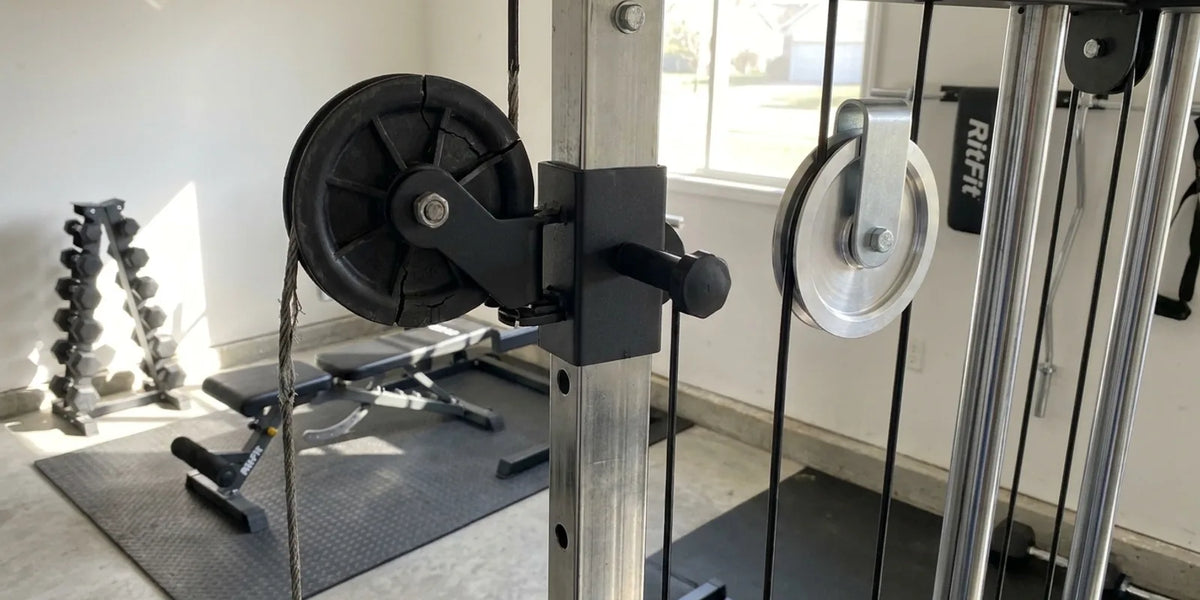
Plastic pulleys on a Smith machine are the cheapest component in the cable system and the one most likely to end its useful life early. A molded polymer sheave is built for light to medium loads, while a machined aluminum wheel is built for moderate to high loads.
This guide shows how the cheap version fails, how to identify pulley material in under two minutes, and which spec is worth paying for. It also covers the RitFit models that already ship with aluminum pulleys and the upgrade cost math.
Quick Answer: Plastic pulleys on a Smith machine are rated for light to medium loads, which sits below what a loaded cable stack actually sees, so molded polymer sheaves can wear, bind, and fray the cable long before the frame fails. Pay for machined aluminum on a sealed ball bearing.
Key Takeaways
- Material truth: Molded polymer sheave wheels are light to medium load parts and machined aluminum wheels are moderate to high load parts, and a Smith machine cable system sits firmly in the second category.
- The wheel wears first: The sheave and its bearing carry every loaded cable repetition, so they give out long before an 11-gauge frame or a welded upright ever does.
- Bearing is a separate decision: Plain bushings rely on sliding friction, which adds heat and drag as cable speed rises, while a sealed ball bearing rolls instead of slides.
- Two-minute test: A seam line, a dull matte finish, and a hollow tap mean molded polymer. Machined aluminum is brighter, shows tooling marks, and feels heavier in the hand.
- RitFit reference points: The M3 PRO cable system runs a 2:1 ratio through 16 aluminum pulleys with 180 lb stacks per side, and the rack attachment aluminum pulley set is the retrofit path for a rack you already own.
What Are Plastic Pulleys on a Smith Machine Made Of?
A cheap Smith machine pulley is a molded polymer sheave spinning on a plain bushing. Industrial pulley suppliers classify molded polymer wheels as light to medium load parts and machined aluminum wheels as moderate to high load parts.
Molded Polymer Sheaves Versus Machined Aluminum Wheels
Molded polymer is cheap to produce because the wheel is poured into a mold rather than cut from stock, and that is exactly why it shows up on price-led machines. Machining an aluminum wheel costs more, but it produces a rounder groove that holds cable tension without pinching the coating.
The Bearing Is a Separate Decision
One equipment-industry guide explains that rolling-element bearings cut rotational resistance compared with plain bushings, and that sliding-contact bushings generate more heat as speed rises. A cheap machine can have both problems at once, with a soft wheel riding on a bushing that has no rolling elements at all.
Why Do Plastic Pulleys Fail Under Smith Machine Cable Loads?
A plastic pulley fails because the sheave, not the frame, absorbs every loaded cable repetition. That risk profile matters because a 2023 systematic review of 28 studies reported resistance training injury incidence from 0.21 to 18.9 per 1000 hours and concluded that traditional strength training is the safest method [1].
Grooving, Heat, and Cable Fraying at the Sheave
Every pull drags the cable across the groove at the same angle, so a soft wheel slowly wears a flat spot where the cable sits. Once that groove is no longer round, the cable coating starts to peel and fray at the point of contact, and the pull turns jerky through part of the range.
Why This Is a Safety Problem, Not Just a Feel Problem
A 2025 review of resistance training injuries maps the common mechanisms and the prevention strategies that reduce them, and mechanical failure of worn equipment belongs in that prevention category [2]. A frayed cable at the sheave is the version of this failure you cannot see from the handle.
- Jerky travel: A flat spot makes the load catch and release through the stroke, which is worst on slow controlled movements like cable flyes.
- Premature cable wear: A rough groove acts like a file on the coating, so the cable becomes the next replacement item.
- Noise: Binding at the bushing produces a grinding or squealing sound that gets louder over months, not quieter.
None of these problems announce themselves on the spec sheet, which is why the on-the-spot check in the next section matters more than the marketing copy.
How Can You Tell a Plastic Pulley From an Aluminum One Before You Buy?
A molded polymer pulley gives itself away with a seam line, a dull finish, and a hollow sound. Machined aluminum looks brighter and feels heavier, and the whole check takes about two minutes on a floor model.
The Two-Minute Check on the Machine Itself
Spin the pulley by hand and watch the edge: a molded wheel shows a parting line where the two mold halves met, and a machined wheel shows fine concentric tooling marks instead. Tap the wheel with a fingernail and listen, because polymer answers with a hollow click while aluminum answers with a flat metallic note.
What to Look for in a Spec Sheet
Look for the words machined aluminum and sealed ball bearing rather than a vague claim about a smooth cable system. Our cable pulleys for gym equipment guide breaks down the system types this test applies to.
- Material wording: Machined aluminum, CNC aluminum, or alloy wheel are specific. Polymer, composite, and high-strength plastic are not.
- Bearing wording: Sealed ball bearing or sealed bearing is specific. Bushing, sleeve, or nylon bushing means sliding contact.
- Service parts: A brand that sells replacement pulley wheels expects them to be serviced rather than thrown away with the machine.
If a listing will not name the wheel material or the bearing type, treat that silence as the answer.
Which Cable Pulley Spec Is Actually Worth Paying For?
The spec worth paying for is a machined aluminum sheave running on a sealed ball bearing. That combination is rated for the load class a Smith machine cable system actually operates in, and everything below that line is a wear item on a timer.
Machined Aluminum Plus a Sealed Ball Bearing
A sealed bearing keeps dust and chalk out of the rolling elements, so the wheel keeps spinning freely without a lubrication routine. That matters in a garage gym, where humidity and temperature swings shorten the life of any unsealed sliding surface.
Pulley Ratio Changes What the Wheel Carries
A 2:1 pulley ratio halves the load you feel at the handle, but the sheave and the cable still carry the full stack weight plus friction, which is why the wheel rating is the number that protects the system. The what pulley ratio means guide covers the 1:1, 2:1, and 4:1 math in detail.
Which RitFit Smith Machines Ship With Aluminum Pulleys?
RitFit publishes the M3 PRO cable system as a 2:1 pulley ratio running through 16 aluminum pulleys. The same line also sells a bolt-on aluminum set for rack owners who want to retrofit, and the published cable spec is the column that should decide the purchase.
| RitFit machine | Cable spec to check | Who it fits |
|---|---|---|
| M3 PRO Smith Machine | 2:1 pulley ratio, 16 aluminum pulleys, 180 lb stacks per side, 29 trolley positions | Lifters who want the cable station to be the main event |
| M1 PRO Smith Machine | Smith bar, cable crossover, and squat rack on one frame, with a weight stack package option | One-frame home gyms where the rack and cables share the footprint |
| Buffalo Wild Smith Machine | Adjustable dual cable system | Buyers who want the cable arms to move to more positions |
| Rack Attachment Aluminum Pulley Set | Bolt-on aluminum pulley upgrade for a rack you already own | Upgrading an existing rack instead of replacing it |
Specs as published by RitFit on the linked product and category pages.
RitFit M3 PRO Smith Machine
The RitFit M3 Smith machine with cable crossover carries a 2:1 ratio, 16 aluminum pulleys, 180 lb stacks per side, and 29 trolley adjustment positions. Those 16 contact points are what a weekly lat pulldown, cable row, and cable fly rotation actually wears on.
"Very Solid 3x3 setup. Cables are smooth. Love that it came in pink. Great all in one piece. Hope you add more accessories and attachments for the m3 ! I use it daily!!!!"
Katharine B. Verified Buyer, M3 Power Rack Cable Crossover Smith Machine
RitFit M1 PRO Smith Machine
The RitFit M1 PRO Smith machine combines a Smith bar, a cable crossover, and a squat rack on a single frame, with a weight stack package option for buyers who want the stack built in. It suits a garage where one footprint has to cover both pressing and cable work.
"I absolutely love my pink M1 Pro with smith machine and weight stacks. It allows me to get the workout I need from home. It has everything I need to get it done here at home."
Casondra L. Verified Buyer, RitFit Pink M1 PRO Multi-Functional Smith Machine Home Gym Package
Where the RitFit Buffalo Wild Fits
The RitFit Buffalo Wild Smith machine runs an adjustable dual cable system, which is aimed at lifters who want cable arms that move rather than a fixed high and low point.
The full RitFit Smith machine lineup lists these machines side by side, and the dual action Smith machine guide explains how a dual pulley layout changes the exercise menu.
"The buffalo machine is so smooth and gets the job done every time. It has literally changed my life for the better."
Grant S. Verified Buyer, RitFit BUFFALO Smith Machine Home Gym Package with Lat Pull Down and Cable Crossover
What Does an Aluminum Pulley Upgrade Cost Over the Life of Your Machine?
An aluminum pulley upgrade costs a set of parts rather than a whole machine. That is why the retrofit path is worth pricing before you replace anything, and RitFit sells the RitFit Rack Attachment Aluminum Pulley Set for exactly that job.
Retrofit Path for a Rack You Already Own
A rack-mounted set has to match your upright size and hole spacing, so measure the uprights before ordering, and read the aluminum pulleys for home gyms guide for the install sequence and safety checks.
Replace-a-Machine Math
Replacing a machine because of worn pulleys means paying full freight a second time and repeating every hour of assembly you already spent. Checking the sheave material before the first order is the only version of this decision that costs nothing.
If you want cables without a Smith bar at all, the power rack with a pulley system comparison applies the same material test to rack-mounted stations.
Is a Cheaper Smith Machine With Plastic Pulleys Ever Worth It?
A cheaper Smith machine with plastic pulleys is worth buying only if the cables are a bonus. A randomized parallel trial compared machine-based and free-weight resistance training in novice male lifters, the same buyer profile that usually wants an all-in-one frame for its cables [3].
- Buy it when: You train almost entirely on the guided bar, the cables are a bonus, and the price gap is large enough to fund a separate cable station later.
- Skip it when: Lat pulldowns, rows, and cable flyes are already in your weekly plan, because that is the work that loads the sheaves hardest.
- Fix it first when: A rough cable pull on a machine you own is often alignment or routing rather than a worn wheel, so rule out the cheap causes first.
If the machine you already own sounds rough, the smooth cable crossover pulleys guide covers the alignment and maintenance checks worth doing before you spend anything.
"For $1,800, this machine delivers a combination of build quality, stability, and versatility that is rare at this price. The BUFFALO is not a machine that excels at one thing. It is a platform that lets you program an entire training week without ever stepping off the frame."
BJ Nelson, Head of Field Testing, The Iron Clinic, RitFit Buffalo Smith Machine Review
FAQs About Smith Machine Pulleys
Are plastic pulleys on a Smith machine always a dealbreaker?
For a machine that carries a loaded cable stack week after week, yes. Molded polymer wheels are rated for light to medium loads, so they sit below what a Smith machine cable system actually sees. A worn or cracked sheave can also fray the cable, which is a safety issue, not just a smoothness one.
What is a Smith machine pulley actually made of?
Cheaper machines use a molded polymer sheave, usually nylon or a blended thermoplastic, spinning on a plain bushing. Better cable systems use a machined aluminum wheel running on sealed ball bearings. The material and the bearing type are separate decisions, and the bearing is often the part you feel first during a pull.
How can you tell if a Smith machine has plastic pulleys?
Look at the wheel edge and the mounting bracket, not the marketing copy. Molded polymer wheels show a seam line and a dull matte finish, and they sound hollow when tapped. Machined aluminum is brighter, has visible tooling marks, and feels noticeably heavier when you spin it by hand.
Does the pulley material change how much weight I can lift?
It changes how much abuse the system survives, not the number on the stack. A 2:1 pulley ratio already halves the load you feel at the handle, so the sheave and bearing carry the stack weight plus friction. That is why the wheel and bearing ratings matter more than the cable rating alone.
Can you replace plastic pulleys with aluminum ones?
Sometimes, and a rack-mounted aluminum pulley set is the usual route for a power rack or cage. It has to match your upright size and hole spacing, so measure before ordering. On an all-in-one Smith machine with sealed pulley housings, the swap is usually a factory part decision, not a home retrofit.
Is a Smith machine still worth buying with cheap pulleys?
Only if the cable system is not why you are buying the machine. Most buyers want the cable station for lat pulldowns, rows, and cable flyes, and that is the exact work that loads the pulleys hardest. Paying once for the better spec usually costs less than replacing a machine early.
Conclusion
Plastic pulleys on a Smith machine are a false economy, because the sheave and its bearing carry every loaded cable repetition while the frame coasts. Buying the machined aluminum spec once keeps the cable station smooth for the life of the machine.
Compare the cable spec before you compare the price, and check the wheel material on any floor model you can reach. If you are still planning the purchase, the RitFit discount guide shows how to time it.
Disclaimer
This guide covers equipment selection and general training safety rather than medical advice, and it does not replace an evaluation by a qualified professional. Consult a physician or physical therapist before starting a new resistance training program, and inspect cables, pulleys, and hardware before every session.
References
1. Serafim TT, de Oliveira ES, Maffulli N, Migliorini F, Okubo R. Which resistance training is safest to practice? A systematic review. J Orthop Surg Res. 2023;18(1):296. doi:10.1186/s13018-023-03781-x. PMCID: PMC10099898
2. Kawa O, Zywiec W, Czyzewski B, et al. Most Common Injuries in Resistance Training: Mechanisms, Therapeutic Interventions, and Preventive Strategies. Cureus. 2025;17(10):e94035. doi:10.7759/cureus.94035. PMCID: PMC12591260
3. Aerenhouts D, D'Hondt E. Using Machines or Free Weights for Resistance Training in Novice Males? A Randomized Parallel Trial. Int J Environ Res Public Health. 2020;17(21). doi:10.3390/ijerph17217848. PMCID: PMC7662789





