








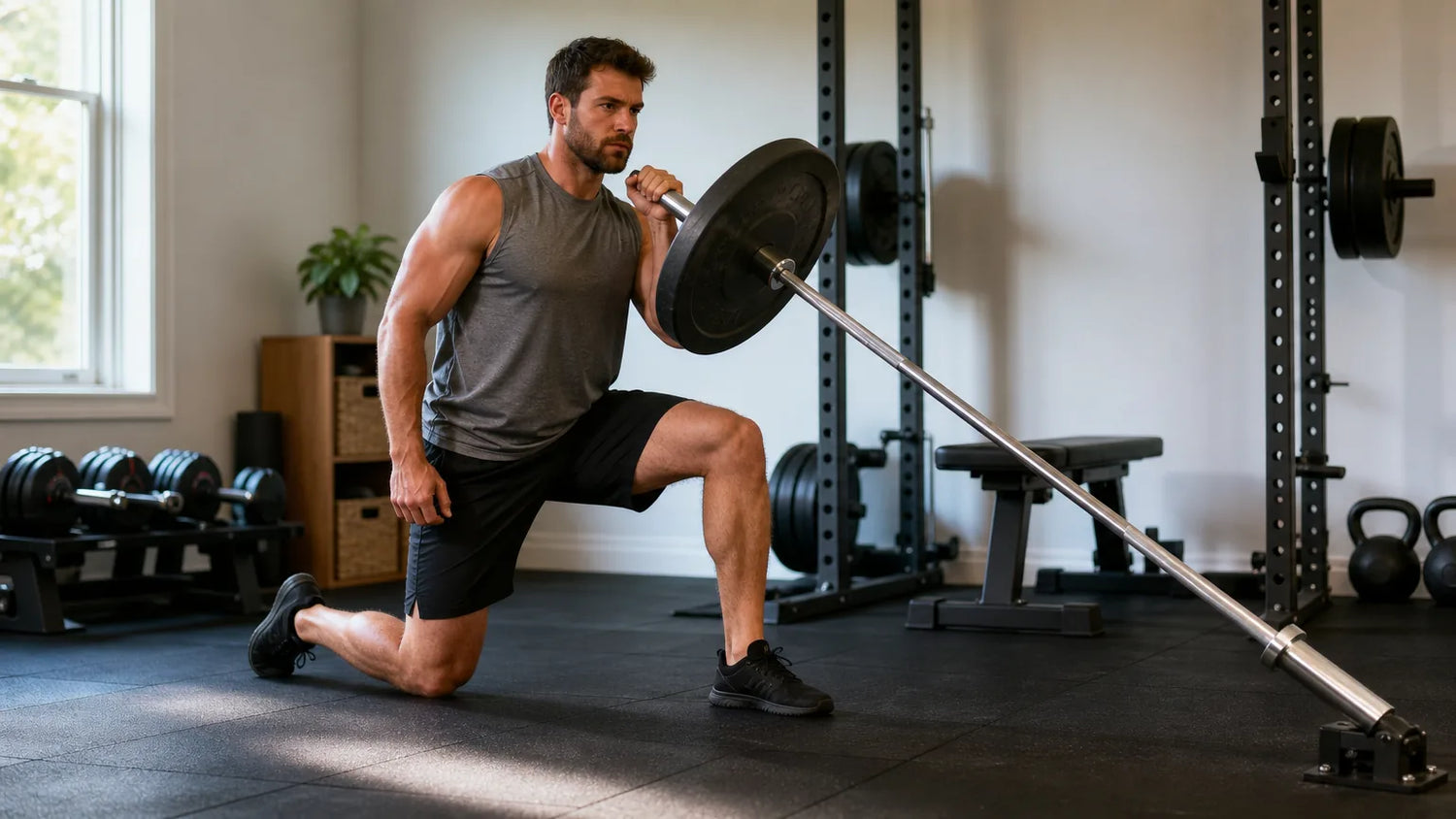
Choosing the best barbell for landmine training comes down to one non-negotiable spec: sleeve diameter. Get that wrong and your barbell won't seat properly in the landmine socket, turning an effective multi-joint exercise into a frustrating compatibility problem.
This guide walks home gym owners through every spec that matters, from sleeve diameter and bar length to knurling and tensile strength, then maps those specs to RitFit barbell options so you can build a landmine station that works safely on day one.
Quick Answer: The best barbell for landmine training is a standard 7 ft Olympic barbell with 2-inch (50mm) sleeves, since most landmine attachments are built around Olympic sleeve diameter. A stiffer shaft with solid tensile strength makes the same bar equally capable for rack-based squats, deadlifts, and the full landmine exercise library.
Key Takeaways
- Sleeve diameter is the deciding factor: Most landmine attachments require a 2-inch Olympic sleeve, so a standard Olympic barbell is the safest starting point for any home gym landmine setup.
- 7 ft is the minimum recommended length: Shorter bars limit exercise variety and reduce the leverage you need for moves like the landmine press and landmine squat.
- One bar can do it all: A quality Olympic barbell handles both rack-based lifts and landmine work, eliminating the need for a second dedicated bar.
- Bar whip matters less here: Landmine movements are controlled arc-based presses and rows, so a stiffer bar with high tensile strength is preferred over a flexible Olympic weightlifting bar.
- Landmine training delivers real performance results: Research published in Physical Activity and Nutrition found that adding barbell-based landmine exercises to a strength program improved explosive power more than resistance training alone.[3]
What Is a Landmine Attachment and Why Does Barbell Choice Matter?
A landmine attachment is a pivot device that anchors one end of a barbell to a fixed rack point or freestanding base, while the other end moves freely through an arc. The barbell sleeve must seat snugly inside the landmine socket to rotate cleanly, which makes barbell selection a functional, not cosmetic, decision.
The landmine press is a validated, measurable upper-body strength movement. A study published in Sensors confirmed strong correlations (r > 0.85) between landmine press kinematics and commercial linear transducer readings across velocity and power metrics.[1]
- Fixed end: The sleeve inserts into the landmine socket, which pivots as you move the bar through its range of motion.
- Loaded end: You load standard weight plates onto the opposite sleeve and grip the bar end to perform presses, rows, squats, and rotational movements.
- Rack-mounted vs freestanding: A rack-mounted landmine pins to your existing power rack and saves floor space. A freestanding unit stands independently, giving you placement flexibility anywhere in the gym.
- Why barbell choice matters: The wrong sleeve diameter means the bar won't seat properly. Too short a bar limits leverage and exercise variety.
Before purchasing a barbell accessory like a landmine attachment, confirm that your barbell's sleeve diameter matches the socket spec listed on the landmine product page.
What Barbell Specs Are Non-Negotiable for Landmine Compatibility?
Barbell compatibility with a landmine attachment depends on four specs: sleeve diameter, bar length, shaft stiffness, and tensile strength. Getting sleeve diameter right is the true non-negotiable, while the other three directly affect how comfortable and effective your landmine sessions will be.
Sleeve Diameter: The 2-Inch Rule
Most popular home gym landmine attachments are built around 2-inch (50mm) Olympic bar sleeves. Standard 1-inch barbells will not fit Olympic-only landmine sockets.
- Olympic 2-inch sleeve (50mm): The standard for virtually all serious home gym landmine attachments. The bar seats snugly with minimal play, ensuring smooth rotation under load.
- Standard 1-inch sleeve (25mm): Will not fit Olympic-only sockets. Some dual-sleeve landmine designs accept both sizes, but Olympic bars seat more snugly and are recommended for heavier loads.
- Dual-sleeve designs: A small number of landmine attachments accommodate both 1-inch and 2-inch bars, with an internal socket diameter of around 52mm. These cost slightly more but add flexibility if you train with mixed equipment.
If you're building a home gym from scratch, starting with a 2-inch Olympic barbell from the Olympic barbells collection ensures compatibility with the widest range of landmine attachments on the market. A study in the International Journal of Exercise Science found that Olympic barbells produced higher average concentric velocity than specialty bars at matched loads during high-intensity back squats, supporting their use as the go-to bar for dynamic pressing movements like the landmine press.[2]
Bar Length: Why 7 ft Is the Sweet Spot
Equipment guides consistently recommend a 7 ft (84-inch) barbell for landmine training. Shorter bars limit the range of exercises you can perform and reduce the leverage available for movements like the landmine press and landmine squat.
- 7 ft (84 inches): The standard length for Olympic power bars, and the ideal for landmine use. Provides enough shaft length for full range of motion in pressing, squatting, and rotational movements.
- Shorter bars (5-6 ft): Noticeably restrict exercise variety and reduce leverage during the arc-based movement pattern, limiting how much weight you can effectively use.
- Dual purpose: A 7 ft Olympic bar is also the standard bar for your squat rack or power rack, so one bar covers all your major lifts without needing a second purchase. Explore the full barbells collection for 7 ft options matched to different training goals.
For a deeper breakdown of what to look for in a full-size bar, the 7 ft Olympic barbell guide covers every key spec in detail.
Knurling, Shaft Diameter, and Tensile Strength
Shaft knurling and diameter affect how securely you grip the bar during landmine presses and rows, while tensile strength determines how well the bar holds up under repeated dynamic loading. A 28.5 or 29mm shaft offers the best long-term durability for home gym use.
- Knurling: Medium knurling is ideal for landmine work. Aggressive powerlifting knurl can be uncomfortable for single-arm pressing movements, while a bare shaft offers poor grip security under heavier loads.
- Shaft diameter: Standard Olympic power bars run 28-29mm in shaft diameter, which offers a solid grip for both rack lifts and landmine movements. Thicker shafts above 32mm can reduce grip comfort during single-arm work.
- Tensile strength: Look for bars with at least 150,000 PSI tensile strength for general home gym use. Higher tensile strength means the bar resists bending under repeated dynamic loading.
- Bar whip: High-whip bars designed for Olympic weightlifting are not ideal for landmine training. The arc-based movement pattern needs a stiffer, more predictable bar that maintains its line through the full range of motion.
Pair your barbell with Olympic barbell clamps to keep plates locked on the loaded sleeve during landmine movements, where lateral forces can cause plates to shift more than in vertical rack-based lifts.
"For home gym purposes, a 28.5 or 29mm bar will be the most durable and provide the best service over time. NEVER buy a 32mm bar."
Mark Rippetoe, Strength Coach and Author of Starting Strength, Starting Strength
Which RitFit Barbell Works Best for Landmine Training?
The right RitFit barbell for landmine training depends on your budget, available space, and primary training goals. All RitFit Olympic barbells feature 2-inch sleeves, making them compatible with standard landmine attachments, but different models suit different home gym configurations.
| Barbell Type | Sleeve Diameter | Landmine Compatible? | Best For |
|---|---|---|---|
| RitFit Olympic 7 ft Bar (standard) | 2-inch (50mm) | Yes, all standard landmine attachments | Most home gym users wanting rack + landmine versatility |
| 1-inch standard barbell | 1-inch (25mm) | No (Olympic-only sockets) | Not recommended for landmine use |
| Specialty bars (SSB, trap bar) | N/A (no landmine socket fit) | No | Dedicated rack-based use only |
Compatibility based on standard Olympic landmine attachment socket specs (2-inch / 50mm internal diameter).
Decision Matrix: Which RitFit Bar Should You Choose?
Your choice within the RitFit Olympic barbell lineup should reflect three factors: your primary lifts, how much floor space you have, and whether you want a single bar that handles all movements. For rack work plus landmine pressing in one buy, the RitFit Olympic training barbell pairs Olympic sleeves with a versatile grip for multi-purpose use.
- Budget-focused home gym builder: A standard RitFit 7 ft Olympic bar handles both rack work and landmine training without compromise. It's the highest-ROI single purchase for a home gym landmine setup.
- Strength-focused lifter: Prioritize tensile strength (150,000+ PSI) and a stiffer shaft for predictable bar path during heavy landmine pressing and rowing. A power bar spec suits this goal best.
- Space-constrained setup: If you're working in a garage or basement gym with limited footprint, a rack-mounted landmine attachment paired with your existing 7 ft Olympic bar is more space-efficient than adding a freestanding unit and a second bar.
- Versatility-first approach: One quality 7 ft Olympic bar covers squats, deadlifts, bench press, barbell rows, and the full landmine exercise library. Adding a barbells and weight plates bundle gets your landmine station fully equipped in one purchase.
Is One Barbell Enough for Both Rack and Landmine Work?
Yes, one quality 7 ft Olympic barbell handles both rack-based lifts and landmine training without needing a dedicated second bar. The same bar moves from your squat rack to your landmine attachment in seconds, making it a genuinely cost-effective choice for home gym owners who want maximum exercise variety from minimal equipment.
To store your bar safely between sessions, a RitFit barbell stand keeps it off the floor and protects the knurling from damage, extending the lifespan of your investment.
How Do You Set Up a Home Gym Landmine Station?
Setting up a home gym landmine station requires matching your landmine attachment to your rack type, verifying barbell sleeve compatibility, and clearing enough floor space for the bar's arc path. Getting these three things right before your first set prevents both compatibility problems and safety issues.
Rack-Mounted vs Freestanding: Which Should You Choose?
A rack-mounted landmine attachment pins directly to your power rack's uprights, saving floor space and providing a stable base without adding any extra footprint. A freestanding landmine unit stands independently on the floor, giving you placement flexibility anywhere in your gym space.
- Rack-mounted (recommended for most home gyms): Mounts to compatible rack uprights via a 5/8-inch peg (the industry baseline for cross-brand compatibility). No additional floor footprint, and the rack's mass provides stability during heavy pressing.
- Freestanding: Ideal if you don't own a power rack or want the freedom to move the landmine station to different areas. Requires more floor space and relies on base weight or floor anchoring for stability under load.
- Mounting peg compatibility: Before purchasing, verify your rack's upright tube size (2x2, 2x3, or 3x3 inches), hole spacing, and peg diameter. Most aftermarket landmine attachments target the 33-series 5/8-inch peg for widest cross-brand fit.
Step-by-Step Landmine Station Setup
Follow these steps to get your landmine station set up correctly before loading any weight.
- Step 1: Measure your space. Clear at least 7-8 ft of floor space in the direction the bar will travel during pressing movements. Check that the arc path won't contact walls, ceiling beams, or other equipment at the top of the movement.
- Step 2: Mount or position your landmine. If rack-mounted, insert the attachment pin into the correct upright hole at roughly mid-rack height. If freestanding, place the base on a rubber mat to protect your floor and prevent sliding under load.
- Step 3: Insert the barbell. Slide one sleeve of your 7 ft Olympic bar into the landmine socket. The sleeve should seat fully inside the socket with smooth rotation, not wobble or bind. Review the barbell clips and collars guide to choose the right collar for the loaded sleeve.
- Step 4: Load and collar the bar. Add weight plates to the opposite sleeve and secure with a collar or clamp. Always use a collar on the loaded end for landmine movements, since the arc path creates lateral force that can cause unsecured plates to shift.
- Step 5: Confirm bar path before your working sets. Perform 2-3 unloaded reps through the full range of motion to verify the bar tracks smoothly without hitting any obstacles at the top or bottom of the arc.
Common Mistakes to Avoid
Most landmine setup problems trace back to one of four avoidable errors that compromise safety, bar path, or equipment longevity.
- Using the wrong sleeve diameter: A 1-inch standard barbell in an Olympic-only socket creates unsafe wobble during pressing movements. Always confirm the spec match before your first session.
- Skipping collars on the loaded end: Landmine movements generate lateral forces that rack-based lifts don't. Skipping the collar is the most common cause of plates sliding off mid-set.
- Using a bar that's too short: Bars under 6 ft don't provide enough leverage for full-range landmine pressing and squatting. The movement feels cramped and puts excess stress on your wrists.
- Ignoring rack peg compatibility: Buying a landmine attachment without checking your rack's upright tube size and hole spacing is the fastest way to end up with an unusable accessory. Measure first, then order.
- Corner loading without a proper base: Wedging a bare bar sleeve into a wall corner works in a pinch, but it damages walls, floors, and the bar sleeve over time. A proper landmine base costs less than the repair bill.
For guidance on maximizing your barbell's range of exercises beyond landmine work, the article on how to barbell row properly covers technique and setup for one of the best pulling movements in your landmine library.
What Are the Best Landmine Exercises to Start With?
The landmine attachment transforms a single Olympic barbell into a full upper and lower body training tool. The arc-based movement pattern is particularly effective for shoulder-friendly pressing, rotational core work, and hip-dominant pulling patterns that complement traditional rack-based lifts.
- Landmine press (single-arm): Stand in a staggered stance, hold the bar end at shoulder height, and drive it up and forward through the arc. The angled press path reduces shoulder impingement risk compared to straight overhead pressing, making it accessible for lifters with limited overhead mobility. See the training comparison guide for how arc-based movements fit into a broader lower-body program.
- Landmine squat: Hold the bar end at chest height with both hands and squat down, keeping the bar vertical throughout the descent. The counterbalance effect makes this an excellent beginner squat variation for learning the movement pattern with reduced spinal load.
- Landmine row: Hinge at the hips, grip the bar end, and row it toward your hip. This movement shares mechanics with a standard barbell row but the arc path encourages better scapular retraction. Check the barbell snatch guide for context on pulling mechanics that transfer to landmine rowing.
- Landmine rotation: Hold the bar end with both hands, arms extended, and rotate the bar from hip to hip in a controlled arc. This is one of the most effective anti-rotation and core strength exercises available in a home gym.
A study in Physical Activity and Nutrition found that adding barbell-based landmine exercises to a 16-week linear strength program produced a significant improvement in countermovement jump performance compared to resistance training alone, suggesting landmine movements contribute meaningfully to explosive power development.[3]
"The Single-Arm Landmine Press is one of the best movements with the landmine for fixing muscular imbalances, sharpening core strength, and finally pressing for strength without wrecking your joints."
Jeff Cavaliere, MSPT, CSCS, Physical Therapist and Strength Coach, Athlean-X
To build a well-rounded barbell-based training program around your landmine station, the best Olympic barbell for women guide covers bar selection considerations that apply to any lifter prioritizing overhead pressing and pulling movements.
FAQs About Best Barbell for Landmine
What sleeve diameter barbell do I need for a landmine attachment?
Most landmine attachments require a 2-inch Olympic barbell sleeve. Standard 1-inch barbells will not fit Olympic-only landmine sockets. Always verify your landmine's sleeve compatibility spec before purchasing a barbell, as dual-sleeve designs that accept both sizes do exist but cost more upfront.
Can I use a short barbell with a landmine attachment?
A 7 ft barbell is the recommended minimum length for landmine training. Shorter barbells limit the range of exercises you can perform and reduce the leverage available for moves like the landmine press and landmine squat, making the setup feel awkward and under-loaded for most users.
Does bar whip matter for landmine training?
Bar whip matters less for landmine training than for Olympic lifting, since landmine movements are controlled arc-based presses and rows. A stiffer bar with higher tensile strength is still preferred for heavy landmine pressing to ensure stability and consistent feel through the full range of motion.
Can I use my existing Olympic barbell for landmine training?
Yes, your existing 7 ft Olympic barbell with 2-inch sleeves works perfectly with a standard landmine attachment. The same barbell serves both your rack work and landmine station, making it a cost-effective choice for home gym owners who want a versatile single-barbell setup without buying a second dedicated bar.
What is the difference between a rack-mounted and freestanding landmine attachment?
A rack-mounted landmine pins to your existing power rack, saving floor space and providing a stable base without extra footprint. A freestanding landmine stands independently, giving you placement flexibility anywhere in your gym, which is ideal if you train without a rack or want to move the station between exercises.
How do I set up a landmine station in a small home gym?
Choose a rack-mounted landmine attachment to minimize floor space usage and measure at least 7-8 ft of clear space in front of your rack for bar travel. Insert the barbell sleeve into the landmine socket, secure with a collar on the loaded end, and start with lighter weights to confirm bar path clearance before adding heavier plates.
Conclusion
Choosing the best barbell for landmine training starts with one spec: a 2-inch Olympic sleeve on a 7 ft bar. That combination is compatible with virtually every landmine attachment on the market and handles both rack-based lifts and landmine movements without compromise.
Start with a quality RitFit Olympic barbell, add a rack-mounted or freestanding landmine attachment, and use the setup guide in this article to build your landmine station correctly from day one. Check the RitFit discount guide before you order.
Disclaimer
The information in this article is intended for general fitness and equipment guidance only and does not constitute professional training, medical, or safety advice. Always inspect your equipment before use, follow the manufacturer's load limits and assembly instructions, and consult a qualified fitness professional if you are new to strength training or have existing physical limitations.
References
1. Zhao R, Cong R, Zhou R, Lin K, Yang J, Kui T, Zhang J, Wang R, Dong R. Landmine Press Kinematics Measured with an Enhanced YOLOv8 Model and Mathematical Modeling. Sensors (Basel). 2026;26(4):1161. doi:10.3390/s26041161
2. Staheli N, Cowley JC, Lawrence MM. Comparison of Olympic and Safety Squat Bar Barbells on Force, Velocity, and Rating of Perceived Exertion During Acute High-Intensity Back Squats in Recreationally Trained Men. Int J Exerc Sci. 2024;17(7):1120-1133. doi:10.70252/QTXB6775
3. Jang MY, Seon SY, et al. The effects of a 16-week periodized linear strength training program incorporating landmine exercises on physical performance in professional female volleyball players. Phys Act Nutr. 2025;29(4):75-82. doi:10.20463/pan.2025.0037





