The best cardio for bodybuilding is low-impact, steady-state work that raises energy expenditure without digging into recovery, not the hardest session you can survive. A 2022 pooled analysis of 43 trials reported no loss of muscle hypertrophy or maximal strength when cardio was added to an unchanged lifting program.
This guide covers which modes cost the least muscle, how much to do in a bulk versus a cut, and where to place sessions around lifting. You also get a four-day combo plan and clear stop conditions for pulling volume back.
Quick Answer: The best cardio for bodybuilding is low-impact steady-state work such as incline walking, cycling, or the elliptical, done in two to three short sessions per week. Lift first or train cardio at least three hours later, and add volume only when fat loss stalls.
Key Takeaways
- Muscle cost stays low when volume stays low: across 43 pooled trials, adding aerobic work to an unchanged lifting program did not reduce muscle hypertrophy or maximal strength.
- Explosive strength is the one exception: the same pool showed a small attenuation of explosive strength, and the dip grew when cardio and lifting shared a single session.
- Mode matters at the fiber level: fiber hypertrophy carried a small negative effect overall, and it was larger for type I fibers when the aerobic work was running rather than cycling.
- Order and spacing carry real weight: lifting before cardio produced a 6.91 percent greater change in lower-body dynamic strength than the reverse order.
- Bodybuilding cardio is a dosed tool: the best muscle building cardio is dull on purpose, so start at two or three easy sessions per week and add duration before you add extra sessions.
What Is the Interference Effect and Why Does It Matter for Bodybuilders?
The interference effect is the tendency for endurance training to blunt some strength and size adaptations.[1] For a bodybuilder the practical question is narrower: does adding cardio cost muscle when the lifting program stays identical, and the pooled answer is mostly no.
- Hypertrophy held steady: the pooled effect of concurrent aerobic and strength training on muscle hypertrophy was -0.01 standardized mean difference, which is effectively zero.
- Maximal strength held steady: the pooled effect for maximal strength was -0.06, again far from a meaningful loss.
- Explosive strength dipped: the pooled effect for explosive strength was -0.28, a small attenuation that matters more to power athletes than to physique goals.
- Most moderators stayed neutral: cycling versus running, weekly training frequency, training status, and age did not significantly change the picture.
That last point is the reason this article focuses on dose, modality, and placement rather than on avoiding cardio altogether, and why the cardio and bodybuilding conversation is really about dosing and scheduling. Build the lifting half first, because a 4 day workout split sets the weekly frame that every cardio decision hangs on.
Best Cardio for Muscle Gain: Which Cardio Type Preserves Muscle Best?
The best cardio for building muscle is cycling, incline walking, or the elliptical. These modes add energy expenditure with almost no eccentric damage, and a pooled analysis of 15 studies found only a small negative effect of concurrent training on muscle fiber hypertrophy, one that grew larger for type I fibers when the aerobic work was running rather than cycling.[2]
| Cardio mode | Impact per step | Eccentric load | Best used for |
|---|---|---|---|
| Incline walking | Low | Near zero | Daily easy volume with the least soreness cost |
| Stationary cycling | None | Minimal | Protecting type I fiber size while adding weekly minutes |
| Rowing | None | Moderate | Shorter sessions with more upper-body involvement |
| Elliptical | Low | Minimal | Joint-friendly sessions when running irritates knees or hips |
| Stair climber | Low to moderate | Low | Time-efficient work when perceived effort is not a problem |
| Sled push | None | Zero | Conditioning on days that do not precede leg training |
| Kettlebell swing | None | Moderate | Hinging the posterior chain when space and budget are tight |
Impact and eccentric columns describe mechanical loading of the mode itself, not a ranking of calorie burn.
Modality also interacts with intensity. A network meta-analysis of 40 studies and 841 participants found that every concurrent training modality trailed strength training alone for lower-body maximal strength, and that high-intensity interval running was the modality that limited the damage best.[3]
In practice the best cardio for gaining muscle is the mode you can repeat two or three times a week without soreness bleeding into leg day, which is usually steady incline walking or easy cycling.
How to pick intensity without guessing
Use a hard ceiling instead of a target, so easy days stay genuinely easy and do not borrow from the next lifting session.
- Talk test: you can speak a full sentence but not sing through the line.
- Heart rate reserve: roughly 60 to 70 percent of the way between resting and maximum heart rate.
- Session RPE: keep steady-state work at 4 to 6 out of 10, and reserve 8 or higher for genuinely short intervals.
- Recovery check: if the mode leaves your legs heavy for the next 24 hours, drop intensity before you drop the session.
If you still want high-intensity work, keep it inside the limits in this HIIT workouts for cardio breakdown. Use benchmark conditioning workouts when you want a fixed yardstick for progress instead of a new random session each week.
How Much Cardio Should You Do While Bulking?
Two or three easy sessions of 20 to 40 minutes per week is enough for most lifters in a surplus. During a bulk, cardio earns its place through cardiovascular health, appetite control, and work capacity, not through fat loss, so dose it low and keep it boring.
If you want a single default, the best cardio workout for muscle gain during a surplus is 25 minutes of incline walking twice a week, adjusted only when appetite or conditioning demands it.
Starting dose and how to progress it
Treat the first two weeks as a measurement block, then move one variable at a time.
- Start at two sessions: 20 to 30 minutes of incline walking or cycling on days that sit furthest from leg training.
- Add duration before frequency: push sessions toward 40 minutes before you add a fourth session.
- Keep intensity steady: bulking is the wrong time to introduce sprint intervals that leave your hamstrings sore for days.
- Watch the scale: if weight gain stalls on a fixed surplus, food is usually the variable to change first, not cardio.
Common Mistakes That Cost Muscle
Almost every avoidable problem comes from four habits rather than from cardio itself.
- Cardio before lifting: it costs working-set quality in the session that actually drives growth.
- Stacking hard intervals on leg day: sprint work right after squats adds soreness without adding fat loss.
- Treating cardio as a fat loss tool in a bulk: in a surplus the calorie target controls weight gain, not the treadmill.
- Jumping volume too fast: going from zero sessions to six in one week is the change most likely to flatten your lifts.
Pairing easy aerobic work with high-volume machine lifting is a common garage setup, and this 2 in 1 combo machine workouts guide shows how two training modes share one station without long changeovers.
How Should You Schedule Cardio Around Lifting Days?
Lift first, then do cardio, or separate the two by at least three hours. Doing cardio immediately before lifting is the worst arrangement for strength, and same-session pairing attenuates explosive strength more than split sessions do.[4]
Getting that order right is most of what combining cardio with bodybuilding requires; the rest is keeping the aerobic dose small enough to recover from.
- Same session, right order: resistance work before endurance work produced a 6.91 percent greater change in lower-body dynamic strength than the reverse order.
- Minimum separation: when sessions were separated by at least three hours, the attenuation of explosive strength was no longer significant.
- Worst case: a hard cardio session immediately before lifting degrades the quality of every working set that follows.
- Rest days are not cardio days: if a rest day exists to protect recovery, keep it free of structured intervals.
One coach interview suggests capping most lifters at roughly two to three cardio sessions per week, favoring low-impact and low-eccentric modes, and separating them from resistance training whenever the schedule allows.
"In my personal practice, I typically don't have people do more than one, two, three cardio sessions per week. Certainly not more than one or two, maybe three HIIT sessions. I am trying to make sure that it's low impact, low eccentric action, and that it's separated from resistance training if possible."
Eric Helms, PhD, Exercise Scientist and Bodybuilding Coach, MASS Research Review, Dr. Eric Helms Answers: What's the Best Way to Combine Cardio and Weightlifting?
Can You Build Muscle With Smith Machine Work and Cardio in One Plan?
A Smith machine anchor handles the heavy work, and cardio shifts away from leg days. Keep the two separated by time or by day and the combo holds.
For a four- or five-day week, the best cardio workout for bodybuilders is short and low impact: 20 minutes of incline walking after an upper-body session.
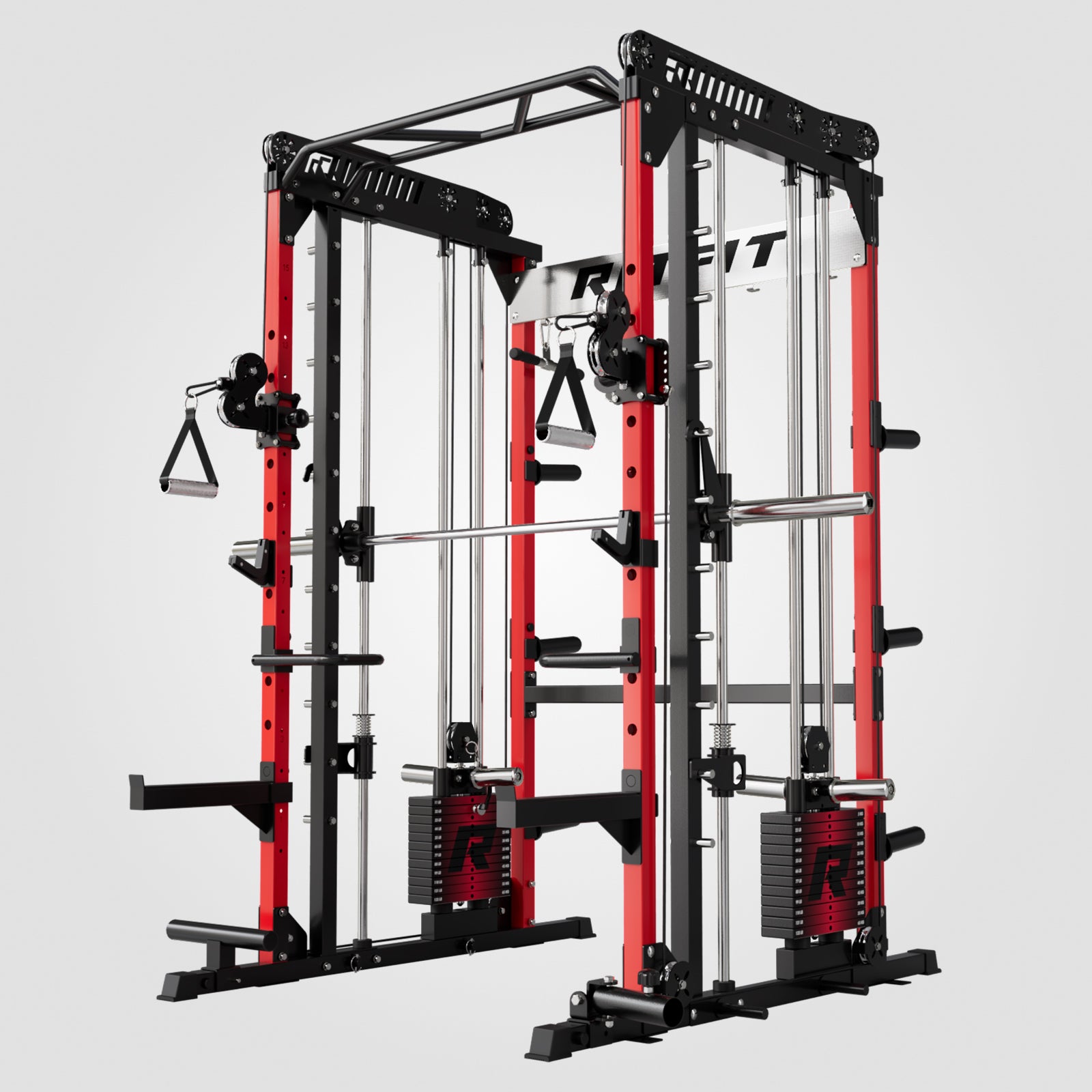
Most garage setups run this pattern around a RitFit Buffalo Smith Machine home gym package, because a fixed bar path makes heavy squats and presses repeatable without a spotter. If you are still comparing frames, browse the full range of Smith machines before you commit to a footprint.
A four-day garage gym combo week
The split below keeps cardio on the days that sit furthest from the heaviest lower-body session.
- Day 1, lower strength: Smith machine squats and Romanian deadlifts, 4 sets of 6 to 8 reps, no cardio.
- Day 2, upper strength: Smith machine incline press and rows, 3 sets of 8 to 10 reps, then 20 minutes of incline walking.
- Day 3, off or easy: 30 minutes of easy cycling, kept below an effort of 5 out of 10.
- Day 4, lower volume: a 3 in 1 leg press and hack squat package for quad volume with less lower-back fatigue, no cardio after.
- Day 5, upper volume: accessories plus 15 minutes of kettlebell swings or sled pushes.
Keep the lifting sessions themselves progressive. These Smith machine chest workouts and this Smith machine back workout warm up routine give the upper half enough structure to keep adding load while cardio volume creeps up.
What Does a Weekly Cardio Plan Look Like During a Cut?
Start a cut with three weekly cardio sessions of 25 to 30 minutes, then add time before adding sessions. Weekly volume should rise only when fat loss stalls for two straight weeks, and it should fall when lifting performance drops.
- Week 1 to 2: three sessions of 25 minutes, low impact, placed after lifting or on non-lifting days.
- Week 3 to 4: extend each session to 35 minutes if weekly weight loss has stalled.
- Week 5 onward: add a fourth short session only after duration has been pushed to 40 minutes.
- Diet first: a modest calorie reduction protects training quality longer than a large cardio increase does.
Low-equipment conditioning keeps the cut flexible when you travel or train at home, and this beginner kettlebell workout guide covers the technique before you load heavier. A single pair of kettlebells covers swings and carries without taking up floor space.
How Do You Know Cardio Is Eating Your Gains?
Rising soreness, flat working weights, and worse sleep are the three clearest signs that cardio volume has outrun recovery. Pull volume back before you rewrite the lifting program.
- Soreness that never clears: legs still heavy 48 hours after a session that used to leave you fresh.
- Working weights that stall or slide: the same load feels heavier for two or three sessions in a row.
- Sleep and appetite changes: difficulty falling asleep or a sharp drop in appetite on a fixed surplus.
- Resting heart rate creep: a resting heart rate several beats above your normal baseline for a week or more.
- Stop conditions: joint pain that changes how you squat, or any sharp pain during cardio, means stop that mode and get it assessed rather than pushing through.
When two or more of these appear together, cut cardio volume by a third for one week and hold the lifting program constant, so you can see which variable caused the change.
FAQs About Best Cardio for Bodybuilding
What is the best cardio for bodybuilding?
Low-impact steady-state work such as incline walking, cycling, or the elliptical is the best cardio for bodybuilding because it adds energy expenditure with minimal eccentric loading and next-day soreness. Keep sessions short, place them away from heavy lifting, and treat them as a recovery-friendly tool rather than a second training session.
Does cardio kill muscle gains?
No. When the strength program stays identical, adding aerobic training does not compromise muscle hypertrophy or maximal strength. Explosive strength may be slightly attenuated, especially when cardio and lifting happen in the same session. Total cardio volume, session timing, and recovery decide whether your gains hold.
How much cardio should a bodybuilder do?
Most bodybuilders do well with two to three sessions per week of 20 to 40 minutes, kept low impact and separated from lifting. Start at the low end during a bulk, add sessions only when fat loss stalls, and cut volume first when recovery or lifting performance dips.
Is it better to do cardio before or after lifting?
Do cardio after lifting or at least six hours apart. Pooled data from ten controlled trials show a 6.91 percent greater change in lower-body dynamic strength when resistance training comes first. Cardio first leaves you fatigued for the lifts that actually build muscle.
Can you do cardio and lift on the same day?
Yes, but keep them apart. Same-session training blunts explosive strength gains more than split sessions do, so separate cardio and lifting by three to six hours when possible. If you must stack them, lift first, keep cardio to 20 or 30 easy minutes, and pick a low impact mode.
Do bodybuilders do cardio?
Yes, but as a measured tool rather than a second sport. Most physique-focused lifters keep two or three low-impact sessions of 20 to 40 minutes per week, placed after lifting or on non-lifting days. Aerobic work stops being an asset when weekly volume grows faster than recovery can absorb it.
What counts as good cardio for bodybuilders?
Good cardio for bodybuilders is low impact, low eccentric, and short: incline walking, stationary cycling, or the elliptical for 20 to 40 minutes. If a mode leaves your legs heavy for the next 24 hours, it is costing more recovery than it returns, so shorten it or swap the mode.
How should cardio workouts for bodybuilders be scheduled?
Cardio workouts for bodybuilders belong on non-lifting days or after lifting, never before. Keep the hardest aerobic session at least three hours away from leg training, and put the longer, easier sessions on upper-body days so the next lower-body session still has fresh legs to work with.
Conclusion
The best cardio for bodybuilding is the cardio you recover from. Keep it low impact, keep it short, lift first or separate sessions by at least three hours, and let weekly volume grow only when fat loss actually stalls.
Pick one mode you can repeat in your garage, log sessions alongside your lifts, and change one variable at a time. For current offers on the hardware side of the plan, check the RitFit discount guide.
Disclaimer
This article provides general fitness education about cardio programming for physique-focused lifters and is not medical advice. Consult a qualified physician or licensed professional before starting or changing any training, cardio, or nutrition program, especially if you have a heart, joint, or metabolic condition.
References
1. Schumann M, Feuerbacher JF, Sünkeler M, et al. Compatibility of Concurrent Aerobic and Strength Training for Skeletal Muscle Size and Function: An Updated Systematic Review and Meta-Analysis. Sports Med. 2022;52(3):601-612. doi:10.1007/s40279-021-01587-7. PMCID: PMC8891239
2. Lundberg TR, Feuerbacher JF, Sünkeler M, Schumann M. The Effects of Concurrent Aerobic and Strength Training on Muscle Fiber Hypertrophy: A Systematic Review and Meta-Analysis. Sports Med. 2022;52(10):2391-2403. doi:10.1007/s40279-022-01688-x. PMCID: PMC9474354
3. Chen Y, Feng X, Huang L, Wang K, Mi J. Comparative efficacy of concurrent training types on lower limb strength and muscular hypertrophy: A systematic review and network meta-analysis. J Exerc Sci Fit. 2024;22(1):86-96. doi:10.1016/j.jesf.2023.12.005. PMCID: PMC10767279
4. Eddens L, van Someren K, Howatson G. The Role of Intra-Session Exercise Sequence in the Interference Effect: A Systematic Review with Meta-Analysis. Sports Med. 2018;48(1):177-188. doi:10.1007/s40279-017-0784-1. PMCID: PMC5752732