








Love handles are the pockets of fat that sit along the sides of your waist, just above the hips. They are stubborn, but they are not permanent.
This guide explains what love handles really are, why isolated ab moves alone will not erase them, and which oblique exercises build the strongest, most defined midsection. You will also get a simple weekly plan that pairs targeted core work with the fat loss that makes obliques visible.
Table of Contents
Key Takeaways
- What they are: Love handles are subcutaneous fat over the oblique muscles at the sides of the waist.
- No magic move: Isolated ab exercises tone the obliques but cannot melt the fat above them on their own.
- Fat loss drives it: A consistent calorie deficit from full-body strength and cardio is what makes the area shrink.
- Train rotation: Side planks, woodchops, Pallof presses, and Russian twists train all functions of the obliques.
- Be patient: Visible change takes weeks to months of steady training, sensible eating, and good sleep.
What Are Love Handles?
Love handles are deposits of subcutaneous fat that sit over the oblique muscles at the sides of your waist. They form when overall body fat rises, influenced by genetics, hormones, age, and lifestyle.
The muscles underneath are the external and internal obliques, which rotate and side-bend the trunk. Building them creates definition, while losing fat reveals it, as covered in our guide to the best exercises to lose belly fat.
- Location: Fat stored at the flanks, hanging over the waistband.
- Drivers: Total calorie balance, genetics, hormones, sleep, and stress.
- Muscles below: External and internal obliques plus the transverse abdominis.
Can You Spot-Reduce Love Handles?
Largely no. You cannot choose to burn fat from one specific spot with isolated ab work alone, so reducing love handles needs an overall calorie deficit paired with full-body training.
The picture has some nuance, though. A randomized controlled trial in 16 overweight men found that 10 weeks of abdominal-region aerobic endurance training reduced trunk fat by roughly 7 percent, more than treadmill running alone, hinting that localized fat use is possible when training is matched for energy expenditure.[1]
- The honest takeaway: Direct your energy toward whole-body fat loss, not endless side crunches.
- Why obliques still matter: Strong, developed obliques look sharp once the overlying fat comes down.
Machines can make the calorie burn easier to sustain, as covered in our roundup of exercise machines for belly fat loss and core strength.
“While you can't spot reduce love handle fat, doing obliques exercises will help you tone the sides of your abs so that once you've reduced fat in that area, the oblique muscles will show.”
— Jeff Cavaliere, MSPT, CSCS, Physical Therapist & Strength Coach, former Head PT for the NY Mets, Athlean-X, 《How To Get Rid of Love Handles》
The Best Exercises for Love Handles
The most effective moves train the obliques through their three functions, rotation, lateral flexion, and anti-rotation. Variety beats repeating one favorite move.
EMG testing helps rank how hard a move works the obliques. A self-oblique exercise performed at 70 percent effort in the supine position reached about 80.4 percent of maximal voluntary contraction in the external oblique, exceeding standard crunches and planks in a pilot study of 20 men.[2]
Side Plank and Side Plank Hip Lifts
This isometric hold builds endurance in the obliques and the deep stabilizers without loading the spine in flexion. Add slow hip lifts to make it dynamic.
Cable or Band Woodchops
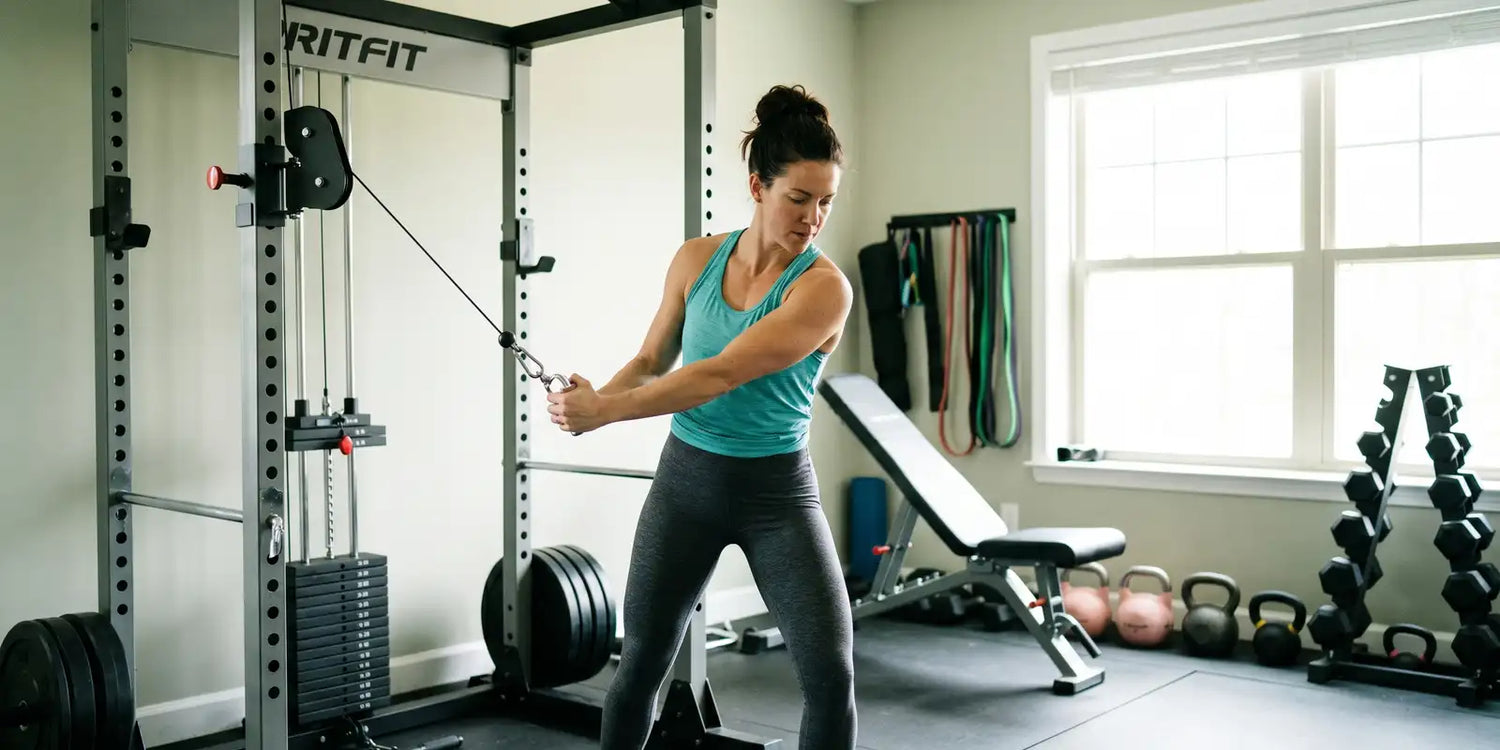
Woodchops train rotation through a full range, from high to low and low to high. A simple setup with cable machine handles for woodchops lets you progress the load over time.
Pallof Press
The Pallof press is an anti-rotation move that forces the obliques to resist twisting. It builds core control without spinal compression.
Russian Twists and Bicycle Crunch
Both add rotational load to the trunk and recruit the obliques alongside the rectus abdominis. Keep the spine braced and move with control rather than speed.
Plank with Abdominal Hollowing
Adding an abdominal hollowing maneuver to a standard prone plank significantly increased internal and external oblique activation compared with a normal plank.[3]
The video below walks through a complete, no-equipment oblique routine you can follow at home.
For a low-impact alternative that still hits the core, try these Pilates exercises for core strength.
How to Program Your Weekly Plan
Pair oblique training with the activity that actually burns fat. Public-health guidance recommends at least 150 minutes per week of moderate-intensity aerobic activity plus two or more days of muscle-strengthening exercise.
Build your week around full-body strength sessions, regular cardio, and two or three focused core workouts. To raise the calorie burn efficiently, add intervals from our HIIT for fat loss and conditioning guide.
- Strength: 2 to 3 full-body sessions including squats, rows, and carries.
- Cardio: 150 minutes of moderate work, or shorter HIIT bouts across the week.
- Core: 2 to 3 oblique sessions, with a rest day between hard ones.
Nutrition, Sleep, and Stress
Exercise creates the demand, but diet decides whether fat actually leaves. A modest, sustainable calorie deficit built on whole foods, lean protein, and fiber is the foundation.
Sleep and stress matter too, since poor sleep and chronically high cortisol can drive cravings and abdominal fat storage. Aim for 7 to 8 hours of sleep and manage stress with daily movement.
- Protein and fiber: Keep you full and protect muscle in a deficit.
- Hydration: Swap sugary drinks for water to cut easy liquid calories.
- Recovery: Consistent sleep supports appetite control and training quality.
Home Equipment That Helps
You can train obliques with zero gear, but a little resistance speeds progress. Bands, dumbbells, and cable attachments let you add load to rotations and presses.
A sturdy bench expands your options for weighted core work, as shown in our weight bench exercises for abs routine.
- Bands: Cheap, portable, and ideal for Pallof presses and woodchops.
- Dumbbells: Add load to weighted twists, carries, and side bends.
- Cable or bench: Lets you progress resistance as you get stronger.
FAQs About Love Handles
Can you get rid of love handles with ab exercises alone?
Not by themselves. Oblique exercises strengthen and define the muscles under love handles, but the overlying fat only shrinks when you maintain an overall calorie deficit through full-body strength training, regular cardio, and sensible nutrition. Combine targeted core work with whole-body fat loss for visible results.
What is the single best exercise for love handles?
There is no single magic move. Rotational and anti-rotation exercises such as cable woodchops, Pallof presses, Russian twists, and side planks all train the obliques effectively. The best choice is a varied routine that hits flexion, rotation, and anti-rotation, paired with cardio to burn the surrounding fat.
How long does it take to lose love handles?
It depends on your starting body-fat level, diet, and consistency. Most people need several weeks to a few months of steady training and a calorie deficit before love handles noticeably shrink. Fat loss happens body-wide and gradually, so patience and consistency matter more than any quick fix.
Do you need equipment to train your obliques?
No. Side planks, Russian twists, and bicycle crunches need no equipment at all. That said, a cable machine, resistance band, or dumbbell adds resistance for woodchops and weighted rotations, which can increase oblique activation and progress your training over time as you get stronger.
How often should I train my obliques each week?
Two to three sessions per week is plenty for most people, with at least a day of recovery between hard core workouts. Pair these with two or more total-body strength days and at least 150 minutes of moderate cardio weekly to drive the fat loss that reveals your obliques.
Conclusion
Love handles respond to a plan, not a single exercise. Train the obliques through rotation and anti-rotation, then drive overall fat loss with strength work, cardio, and steady nutrition.
Start with two or three core sessions a week, keep your calories in a modest deficit, and stay consistent. The definition shows up as the fat comes down.
Disclaimer
This article is for general educational purposes only and does not replace personalized medical or fitness advice. Consult a qualified healthcare or training professional before starting a new program, especially if you have back, hip, or other health concerns.
References
1. Brobakken MF, Krogsaeter I, Helgerud J, Wang E, Hoff J. Abdominal aerobic endurance exercise reveals spot reduction exists: A randomized controlled trial. Physiological reports. 2023;11(22):e15853. https://pmc.ncbi.nlm.nih.gov/articles/PMC10680576/
2. Nakai Y, Kawada M, Miyazaki T, Araki S, Takeshita Y, Kiyama R. A self-oblique exercise that activates the coordinated activity of abdominal and hip muscles-A pilot study. PLoS One. 2021;16(8):e0255035. https://pmc.ncbi.nlm.nih.gov/articles/PMC8360586/
3. García-Jaén M, Cortell-Tormo JM, Hernández-Sánchez S, Tortosa-Martínez J. Influence of Abdominal Hollowing Maneuver on the Core Musculature Activation during the Prone Plank Exercise. International Journal of Environmental Research and Public Health. 2020;17(20):7410. https://pmc.ncbi.nlm.nih.gov/articles/PMC7600276/





