








Pilates for core strength and flexibility at home takes nothing more than a mat, controlled breathing, and eleven slow mat exercises you can learn in a single afternoon. This guide shows you exactly how to do each move, how often to practice, and when to progress safely.
Every exercise below includes step by step form cues, beginner modifications, and the muscles worked, so you can build a complete no equipment routine in your living room. If any movement ever feels sharp, painful, or dizzying, stop and use the easier version instead.
Quick Answer: Pilates for core strength and flexibility at home needs only a mat and these 11 exercises: The Hundred, Roll Up, Single Leg Circles, Shoulder Bridge, Dead Bug, Toe Taps, Spine Stretch Forward, Cat Cow, Mermaid Stretch, Cobra, and Saw. Practice 3 sessions of 15 to 25 minutes per week, keep every rep slow and controlled, and progress only when your breathing and alignment stay steady.
Key Takeaways
- Best core exercises: The Hundred, Roll Up, Single Leg Circles, Shoulder Bridge, Dead Bug, and Toe Taps build deep trunk control.
- Best flexibility exercises: Spine Stretch Forward, Cat Cow, Mermaid Stretch, Cobra, and Saw improve spinal and hip mobility.
- Best beginner approach: Start with breathing, neutral spine, slow reps, and modified ranges before increasing difficulty.
- Best home setup: A supportive mat, open floor space, and comfortable fitted clothing are enough for most beginner Pilates workouts.
- Best safety rule: Pilates should feel controlled and challenging, not sharp, painful, dizzying, or stressful on the neck or lower back.
What Is Pilates?
Pilates is a low impact exercise method that uses precise movement, breath control, and alignment to build strength from the center of the body. A review published in Muscles Ligaments Tendons J describes the method through six principles, concentration, control, centering, flow, precision, and breathing, with every movement starting from the powerhouse, the trunk region between your ribs and pelvis.[1] The method prizes movement quality over speed, heavy resistance, or high repetition volume.
The core principles of Pilates help beginners move with control instead of momentum.
- Concentration: Focus on each movement so your body does not rush or compensate.
- Control: Move deliberately through every phase of the exercise.
- Centering: Start each movement from your deep core, pelvic floor, and trunk stabilizers.
- Flow: Transition smoothly between exercises without collapsing your posture.
- Precision: Prioritize clean alignment over a larger range of motion.
- Breathing: Use steady breathing to support abdominal engagement and spinal control.
Why Pilates Works for Core Strength and Flexibility
Pilates works for core strength because it trains the transverse abdominis, obliques, pelvic floor, and spinal stabilizers to fire together as one unit. It supports flexibility because most exercises combine slow strength work with spinal articulation, hip mobility, and controlled stretching, so one well-built session improves both qualities at once.
One 2015 pilot study found that 25 post-menopausal women who did supervised mat Pilates twice per week for 12 weeks improved abdominal strength by 30.81%, the 30-second chair sit-to-stand by 23.41%, and handgrip strength by 8.22%.[2] In a 2022 randomized controlled trial, 33 healthy adults who did online Pilates 3 days a week for 6 weeks improved trunk proprioception and every core muscle endurance test, while a non-exercising control group did not improve.[3]
Pilates is not uniquely superior, however. A 2022 systematic review of 11 randomized controlled trials found no significant difference between Pilates and other exercise modalities for dynamic, isometric, or resistance strength, balance, or flexibility, so the best method is simply the one you will practice consistently.[4]
What You Need for Pilates at Home
You only need a clear floor area, a supportive mat, and comfortable fitted clothing to begin Pilates at home. If your floor is hard, a thicker mat reduces pressure on the spine, hips, and knees during rolling and kneeling movements.
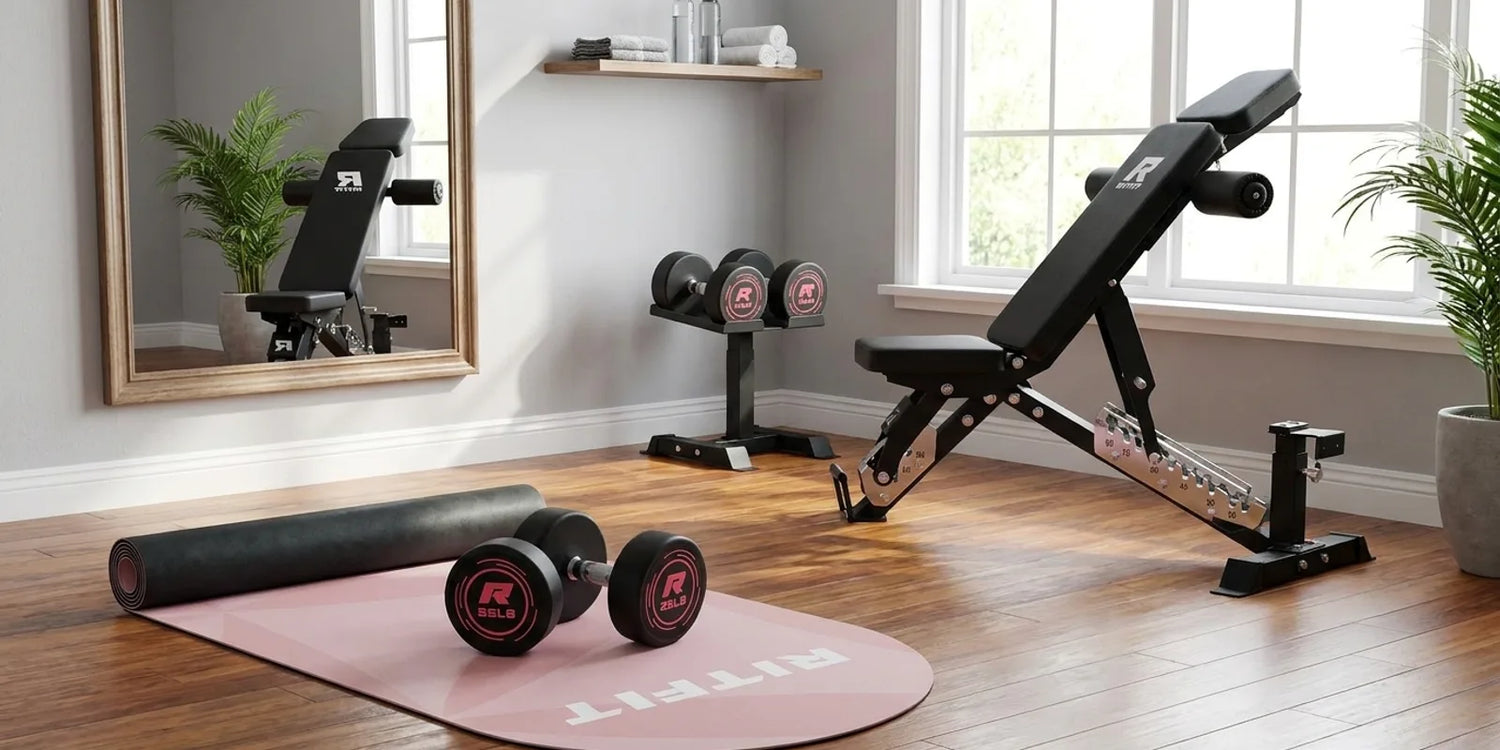
- Supportive mat: Use a cushioned mat such as the RitFit non slip yoga mat for better grip and comfort.
- Open space: Choose an area where your arms and legs can extend without hitting furniture.
- Comfortable clothing: Wear fitted clothing that lets you see your spine, ribs, shoulders, and hip alignment.
- Optional support: Use a small towel under the head or knees if you need extra comfort.
If you are building a broader workout space over time, this home gym equipment guide for beginners and this home gym flooring guide cover the decisions worth making before you buy anything. When you are ready to add strength equipment later, the RitFit strength collection lists options that pair well with mat work.
6 Best Pilates Exercises for Core Strength
The six best Pilates exercises for core strength are The Hundred, Roll Up, Single Leg Circles, Shoulder Bridge, Dead Bug, and Toe Taps. Each exercise teaches your trunk to stay stable while your arms, legs, and spine move, so start with the easiest version and progress only when your breathing and alignment stay steady.
1. The Hundred
The Hundred is a classic Pilates exercise for deep abdominal endurance, breath rhythm, and trunk control.
- How to do it: Lie on your back, bring your knees to tabletop, curl your head and shoulders up, and reach your arms by your sides.
- Breathing cue: Pump your arms while inhaling for 5 counts and exhaling for 5 counts.
- Reps: Complete up to 10 breath cycles for 100 total arm pumps.
- Muscles worked: Transverse abdominis, rectus abdominis, obliques, hip flexors, and deep spinal stabilizers.
- Beginner modification: Keep your feet on the floor if your lower back arches or your neck strains.
- Common mistake: Do not pull from the neck or let the ribs flare upward.
2. The Roll Up
The Roll Up trains abdominal strength and spinal articulation by asking the spine to move one segment at a time.
- How to do it: Lie on your back with arms overhead, then curl up slowly until you reach toward your feet.
- Control cue: Roll down one vertebra at a time instead of dropping quickly to the mat.
- Reps: Perform 5 to 8 slow repetitions.
- Muscles worked: Rectus abdominis, deep core, hip flexors, spinal stabilizers, and hamstrings.
- Beginner modification: Bend your knees or hold the backs of your thighs for support.
- Common mistake: Do not swing the arms or use momentum to force the body upward.
3. Single Leg Circles
Single Leg Circles build core stability by challenging the trunk to stay still while one leg moves.
- How to do it: Lie on your back, extend one leg toward the ceiling, and draw small controlled circles.
- Control cue: Keep both hips heavy on the mat and avoid rocking side to side.
- Reps: Circle 5 times each direction, then switch legs.
- Muscles worked: Deep core, hip flexors, inner thighs, outer thighs, and pelvic stabilizers.
- Beginner modification: Bend the moving knee slightly or make the circles smaller.
- Common mistake: Do not chase a large circle if your pelvis moves.
4. Shoulder Bridge
Shoulder Bridge strengthens the glutes and hamstrings while improving spinal mobility and pelvic control.
- How to do it: Lie on your back with knees bent, feet hip width apart, and arms by your sides.
- Movement cue: Lift your hips by rolling the spine off the mat, then lower one vertebra at a time.
- Reps: Perform 8 to 10 slow repetitions.
- Muscles worked: Glutes, hamstrings, pelvic floor, deep core, and spinal extensors.
- Beginner modification: Lift only halfway if your lower back feels compressed.
- Common mistake: Do not push so high that your ribs flare or your weight shifts into the neck.
5. Dead Bug
Dead Bug is a beginner friendly core exercise that teaches spinal stability during opposite arm and leg movement.
- How to do it: Lie on your back with legs in tabletop and arms reaching toward the ceiling.
- Movement cue: Lower one arm and the opposite leg while keeping your ribs and pelvis steady.
- Reps: Perform 6 to 10 controlled reps per side.
- Muscles worked: Transverse abdominis, rectus abdominis, obliques, hip flexors, and pelvic floor.
- Beginner modification: Tap one heel down instead of extending the leg fully.
- Common mistake: Do not let the lower back lift away from the mat.
6. Toe Taps
Toe Taps are one of the best beginner Pilates moves for learning abdominal control without neck strain.
- How to do it: Lie on your back with knees in tabletop, then slowly tap one toe to the floor.
- Breathing cue: Exhale as the foot lowers and inhale as it returns.
- Reps: Perform 8 to 12 reps per side.
- Muscles worked: Deep abdominals, hip flexors, pelvic stabilizers, and lower abdominal fibers.
- Beginner modification: Start with one foot on the floor and lift only one knee at a time.
- Common mistake: Do not let the movement become fast or heavy.
For more core focused progressions outside of Pilates, use this core workouts guide for every fitness level or this deep core routine with a bench. Both options show you how to keep building trunk strength once these six moves feel steady.
5 Best Pilates Exercises for Flexibility
The five best Pilates exercises for flexibility are Spine Stretch Forward, Cat Cow, Mermaid Stretch, Cobra, and Saw. Each move improves range of motion by combining breathing, control, and gentle movement, so these should feel like active lengthening rather than forced stretching.
7. Spine Stretch Forward
Spine Stretch Forward improves spinal mobility, hamstring length, and awareness of how the back rounds with control.
- How to do it: Sit tall with legs extended and feet hip width apart.
- Movement cue: Exhale and round forward through the spine, then inhale to stack back upright.
- Reps: Perform 5 to 8 slow repetitions.
- Muscles worked: Spinal stabilizers, hamstrings, deep abdominals, and upper back muscles.
- Beginner modification: Sit on a folded towel if your hamstrings limit your posture.
- Common mistake: Do not collapse the chest or force the head toward the knees.
8. Cat Cow
Cat Cow is a gentle Pilates friendly mobility drill that connects spinal movement with breathing.
- How to do it: Start on hands and knees with wrists under shoulders and knees under hips.
- Movement cue: Inhale to lengthen and gently arch, then exhale to round the spine upward.
- Reps: Perform 8 to 10 smooth cycles.
- Muscles worked: Spinal extensors, abdominals, shoulders, and deep trunk stabilizers.
- Beginner modification: Move through a smaller range if your wrists or back feel sensitive.
- Common mistake: Do not force the lower back into an extreme arch.
9. Mermaid Stretch
Mermaid Stretch opens the side body and improves lateral flexibility through the ribs, waist, and hips.
- How to do it: Sit with both legs folded to one side and reach one arm overhead.
- Movement cue: Lift through the ribs before bending sideways so the spine stays long.
- Hold: Breathe for 20 to 30 seconds per side.
- Muscles worked: Obliques, intercostals, latissimus dorsi, hip muscles, and spinal stabilizers.
- Beginner modification: Sit cross legged if the folded leg position feels uncomfortable.
- Common mistake: Do not sink into the bottom shoulder or twist aggressively.
10. Cobra
Cobra improves spinal extension and helps counter the rounded position many people develop from sitting.
- How to do it: Lie face down with hands near the ribs and elbows close to the body.
- Movement cue: Press lightly through the hands and lift the chest while keeping the neck long.
- Reps: Perform 5 to 8 controlled lifts.
- Muscles worked: Spinal extensors, glutes, upper back, shoulders, and deep core stabilizers.
- Beginner modification: Lift only a few inches and keep the lower ribs close to the mat.
- Common mistake: Do not jam the lower back or shrug the shoulders toward the ears.
11. Saw
The Saw combines spinal rotation, hamstring flexibility, and abdominal control in one seated Pilates movement.
- How to do it: Sit tall with legs wide and arms reaching out to the sides.
- Movement cue: Rotate the torso and reach one hand toward the opposite foot with control.
- Reps: Perform 5 to 6 reps per side.
- Muscles worked: Obliques, hamstrings, spinal rotators, upper back, and hip stabilizers.
- Beginner modification: Bend the knees or sit on a folded towel to keep the spine upright.
- Common mistake: Do not round forward before rotating the torso.
For posture and upper back support beyond Pilates, this back workouts at home guide helps balance core training with pulling strength. Tight hips also limit many of these moves, so these hip exercises for strength and mobility make a useful daily pairing.
11 Pilates Exercises Compared
The comparison table below lists all 11 Pilates exercises by primary focus, key muscles, difficulty, and suggested starting volume so you can pick the right moves for each session.
| Exercise | Primary focus | Key muscles | Difficulty | Starting volume |
|---|---|---|---|---|
| The Hundred | Core endurance | Transverse abdominis, obliques, hip flexors | Beginner | Up to 10 breath cycles |
| Roll Up | Spinal articulation and abs | Rectus abdominis, hip flexors | Intermediate | 5 to 8 reps |
| Single Leg Circles | Pelvic stability | Deep core, hip and pelvic stabilizers | Beginner | 5 circles each way per leg |
| Shoulder Bridge | Glutes and spinal control | Glutes, hamstrings, pelvic floor | Beginner | 8 to 10 reps |
| Dead Bug | Anti-extension stability | Transverse abdominis, obliques | Beginner | 6 to 10 reps per side |
| Toe Taps | Lower ab control | Deep abdominals, hip flexors | Beginner | 8 to 12 reps per side |
| Spine Stretch Forward | Spine and hamstring mobility | Spinal stabilizers, hamstrings | Beginner | 5 to 8 reps |
| Cat Cow | Spinal mobility | Spinal extensors, abdominals | Beginner | 8 to 10 slow cycles |
| Mermaid Stretch | Lateral flexibility | Obliques, intercostals | Beginner | 20 to 30 seconds per side |
| Cobra | Spinal extension | Spinal extensors, upper back | Beginner | 5 to 8 controlled lifts |
| Saw | Rotation and hamstring length | Obliques, hamstrings | Intermediate | 5 to 6 reps per side |
Suggested volumes are beginner starting points, not targets; reduce the reps whenever your form, breathing, or alignment breaks down.
15 Minute Beginner Pilates Routine at Home
The 15 minute beginner Pilates routine below trains core control, spinal mobility, and flexibility without requiring machines. Practice it 3 to 4 times per week and keep every rep slow enough to breathe smoothly.
- Pilates breathing: 6 slow breaths to connect the ribs, belly, and pelvic floor.
- Pelvic tilt: 10 reps to learn neutral spine and imprint control.
- Heel slides: 8 reps per side to train core stability during leg movement.
- The Hundred: 5 to 10 breath cycles based on control.
- Single Leg Circles: 5 circles each direction per leg.
- Shoulder Bridge: 8 slow reps for glutes and spinal articulation.
- Dead Bug: 8 reps per side for trunk stability.
- Cat Cow: 8 cycles for spinal mobility.
- Spine Stretch Forward: 6 reps for hamstrings and back mobility.
- Mermaid Stretch: 30 seconds per side for lateral flexibility.
Once this routine feels easy, add reps before adding harder variations. If you want simple conditioning on off days, this full body circuit training guide for beginners fits the same home floor space.
How Often Should You Do Pilates?
Most beginners get meaningful results from 15 to 25 minutes of Pilates 3 times per week. Consistency matters more than long sessions, especially when your goal is core control and flexibility.
- Week 1 to 2: Learn breathing, neutral spine, pelvic tilts, heel slides, and modified tabletop work.
- Week 3 to 4: Add The Hundred, Shoulder Bridge, Dead Bug, and Single Leg Circles.
- Week 5 to 8: Build smoother transitions and increase reps only when form stays steady.
- Week 9 and beyond: Add harder variations, light resistance, or strength training on separate days.
By week nine and beyond, most people are ready for light resistance or harder variations. These resistance band exercises at home and this strength training for women at home guide show how to add that load without giving up mat work.
Pilates Positions for Beginners
Beginner Pilates positions teach you to control the spine, pelvis, ribs, shoulders, and neck before adding harder movement. Learning these setups first makes every Pilates exercise safer and more effective.
- Neutral spine: Keep the natural curve of your lower back without pressing it flat or arching it high.
- Imprint position: Gently soften the lower back toward the mat during exercises that require extra support.
- Tabletop: Stack knees over hips with shins parallel to the floor and ribs controlled.
- Pilates stance: Bring heels together and turn toes slightly out when a movement calls for it.
- Long neck: Slightly tuck the chin and keep the back of the neck lengthened.
- Wide collarbones: Slide the shoulders away from the ears and avoid rounding the chest.
Which Pilates Exercises Are Best for Your Goal?
Core strength goals call for The Hundred, Dead Bug, Toe Taps, Roll Up, and Shoulder Bridge. Flexibility goals call for Spine Stretch Forward, Cat Cow, Mermaid Stretch, Cobra, and Saw, so use your primary goal to choose the weekly focus, then rotate emphasis as your control improves.
- Core strength: Focus on The Hundred, Dead Bug, Toe Taps, Roll Up, and Shoulder Bridge.
- Flexibility: Prioritize Spine Stretch Forward, Cat Cow, Mermaid Stretch, Cobra, and Saw.
- Posture: Combine core control with upper back strength, spinal mobility, and breathing drills.
- Weight management: Use Pilates as a low impact strength and consistency tool, then combine it with cardio, resistance training, and nutrition.
- Back support: Pilates may help some people improve core activation and function, but back pain should be assessed by a qualified professional.
For strength cross-training on separate days, these weight bench exercises at home keep total body strength balanced while your Pilates practice builds the deep core.
Will Pilates Exercises Burn Belly Fat?
Pilates core exercises will not directly burn belly fat, but they will strengthen and grow your abdominal and core muscles so definition becomes visible once overall body fat drops. Fat loss depends most on a sustained calorie deficit built through overall activity, resistance training, nutrition, and sleep, and Pilates supports that process as a consistent, low impact practice you can keep up at home.
"Doing ab exercises won't directly burn belly fat, but they will strengthen and grow your abdominal and core muscles, making them more prominent. Once total body fat is reduced through a sustained calorie deficit, that increased muscle definition will become more visible, creating a leaner and more sculpted look."
Amy Dockery, RD, Registered Dietitian (BC & Alberta), NutriProCan, Fat Loss Facts: The Biggest Myths Busted By A Dietitian (NutriProCan)
Common Pilates Mistakes
The most common Pilates mistakes happen when beginners move too quickly, hold their breath, or chase range of motion before control. Slow down first, then increase difficulty only when alignment stays consistent.
- Rushing reps: Pilates rewards control, not speed.
- Holding your breath: Breath supports trunk control and reduces unnecessary tension.
- Overusing the neck: Support the head when abdominal endurance is not ready yet.
- Arching the lower back: Reduce the leg range if your ribs lift or your back strains.
- Forcing flexibility: Stretch only to the point where breathing stays calm.
- Skipping setup: Use a mat, stable floor, and enough open space before starting.
Who Should Be Careful With Pilates
Pilates is low impact, but it is not automatically safe for every body or every condition. Modify exercises or seek professional guidance if movement causes pain, pressure, dizziness, numbness, or unusual symptoms.
- Back or neck pain: Avoid loaded flexion or extension if it increases symptoms.
- Pregnancy: Ask a qualified healthcare professional which core exercises are appropriate for your stage.
- Recent surgery: Return to exercise only after medical clearance.
- Joint sensitivity: Use extra cushioning and smaller ranges of motion.
- New exercisers: Start with breathing, pelvic tilts, heel slides, and Cat Cow before advanced movements.
A 2023 systematic review found that Pilates may help improve core muscle activation in some people with chronic low back pain, although study methods and populations vary.[5] That potential is exactly why ongoing back pain should be assessed by a qualified professional before you start any new routine.
FAQs About Pilates Core Strength and Flexibility
What are the best Pilates exercises for beginners?
The best Pilates exercises for beginners are pelvic tilts, heel slides, The Hundred, Shoulder Bridge, Dead Bug, Cat Cow, and Spine Stretch Forward. These moves teach breathing, alignment, and core control before you progress to harder exercises.
Can Pilates strengthen your core at home?
Yes. Pilates can strengthen your core at home when you practice slow controlled movements with steady breathing. Exercises like The Hundred, Dead Bug, Toe Taps, and Roll Up train the deep abdominal muscles that support posture and trunk stability.
Is Pilates good for flexibility?
Yes. Pilates is good for flexibility because it combines active stretching, spinal mobility, controlled breathing, and strength through range of motion. Moves like Spine Stretch Forward, Mermaid Stretch, Cat Cow, Cobra, and Saw can help improve mobility over time.
How often should beginners do Pilates exercises?
Beginners can do Pilates exercises 3 times per week for 15 to 25 minutes per session. This frequency gives your body enough practice to improve control while leaving time for recovery, walking, strength training, or gentle mobility work.
Do you need equipment for Pilates moves at home?
No. You do not need special equipment for most beginner Pilates moves at home. A supportive mat, open floor space, and comfortable clothing are enough, while bands, small balls, or light weights can be added later for variety.
Should Pilates exercises hurt your lower back?
No. Pilates exercises should not hurt your lower back. Mild muscle effort is normal, but sharp pain, pressure, or radiating discomfort means you should stop, reduce the range, use a beginner modification, or ask a qualified professional for guidance.
Can Pilates help with posture?
Yes. Pilates can support better posture by improving core control, spinal awareness, breathing mechanics, and upper back engagement. It works best when combined with regular movement breaks, balanced strength training, and a workstation setup that does not force rounded shoulders.
Is Pilates enough for weight loss?
No. Pilates alone is usually not enough for weight loss. It can support consistency, muscle endurance, posture, and body awareness, but fat loss depends most on overall activity, resistance training, nutrition, sleep, and a sustainable calorie balance.
How long does it take to see results from Pilates?
Most beginners notice better breathing control, posture, and movement awareness within the first few weeks of consistent practice. One 2022 randomized controlled trial reported improved trunk proprioception and core muscle endurance after six weeks of online Pilates performed three days per week, while a 2015 pilot study measured strength gains after twelve weeks of mat Pilates.
What is the powerhouse in Pilates?
The powerhouse is the center of the body in Pilates, the zone from the lower ribs to the pelvis that includes the deep abdominals, pelvic floor, obliques, and spinal stabilizers. Pilates movements start from this zone, so strong powerhouse control supports better posture, safer bending and lifting, and steadier balance in daily life.
Conclusion
The best Pilates exercises for core strength and flexibility are the ones you can perform slowly, safely, and consistently. Start with the beginner moves in this guide, master breathing and alignment, then progress toward harder variations only when your spine, ribs, hips, and neck stay controlled.
Bookmark this routine, schedule your first three sessions this week, and check the RitFit discount guide before you add any equipment to your home setup.
Disclaimer
This article is for general educational purposes only and is not medical advice. If you are pregnant, recovering from injury, managing back pain, or living with a medical condition, consult a qualified healthcare professional before starting Pilates or any new exercise routine.
References
1. Kloubec J. Pilates: how does it work and who needs it?. Muscles Ligaments Tendons J. 2011;1(2):61-6. PMCID: PMC3666467
2. Bergamin M, Gobbo S, Bullo V, et al. Effects of a Pilates exercise program on muscle strength, postural control and body composition: results from a pilot study in a group of post-menopausal women. Age (Dordr). 2015;37(6):118. doi:10.1007/s11357-015-9852-3. PMCID: PMC5005852
3. Suner-Keklik S, Numanoglu-Akbas A, Cobanoglu G, Kafa N, Guzel NA. An online pilates exercise program is effective on proprioception and core muscle endurance in a randomized controlled trial. Ir J Med Sci. 2022;191(5):2133-2139. doi:10.1007/s11845-021-02840-8. PMCID: PMC8556804
4. Pinto JR, Santos CS, Souza Soares WJ, et al. Is pilates better than other exercises at increasing muscle strength? A systematic review. Heliyon. 2022;8(11):e11564. doi:10.1016/j.heliyon.2022.e11564. PMCID: PMC9681646
5. Franks J, Thwaites C, Morris ME. Pilates to Improve Core Muscle Activation in Chronic Low Back Pain: A Systematic Review. Healthcare (Basel). 2023;11(10). doi:10.3390/healthcare11101404. PMCID: PMC10218154





