








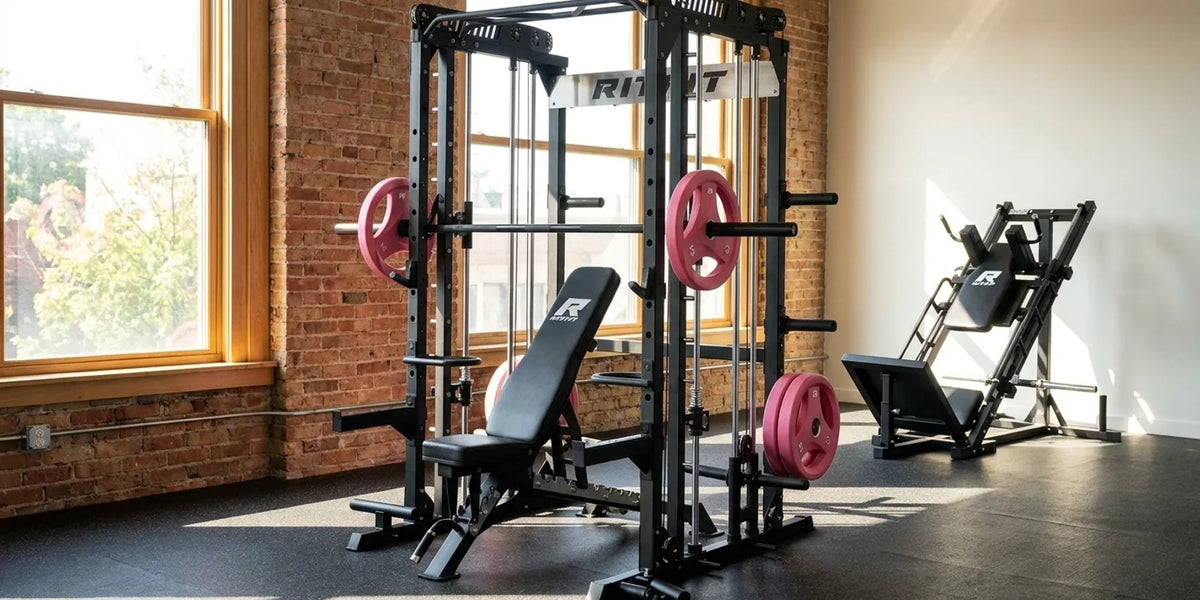
The best plate loaded hip thrust setup for most home gyms is not always a single purpose hip thrust machine. A stable Smith machine setup lets you train glutes safely while saving floor space and supporting full body work.
This guide covers setup steps, key specs, safety checks, and buying advice for a plate loaded hip thrust machine. You will also learn which glute exercises pair well with a Smith machine at home.
Quick Answer: The best plate loaded hip thrust setup for a home gym is a guided Smith machine, because the fixed bar path removes rolling while keeping Olympic plate loading. This machine type also supports cable glute work, so one station can cover hip thrusts and full body training at home.
Key Takeaways
- Best overall use case: The RitFit M1 Pro suits home gym owners who want hip thrusts, squats, presses, rows, and cable glute work from one machine.
- Main hip thrust benefit: The guided Smith bar reduces bar rolling and setup friction compared with a loose barbell setup.
- Best training match: It supports progressive overload with Olympic plates and safer solo training.
- Important limitation: It is not a dedicated commercial hip thrust machine, so bench position and bar height still matter.
- Best supporting accessories: A stable bench, bar pad, collars, and 2 inch Olympic plates make the setup more comfortable and secure.
Why Add Hip Thrusts to a Home Gym Routine?
Hip thrusts deserve a place in a home gym routine because they train hip extension with a strong focus on the gluteus maximus. A 2023 study reported that hip thrust and back squat training produce similar gluteus hypertrophy when programmed consistently.[1]
- Glute focus: Hip thrusts place the lifter in a position where the glutes can work hard near full hip extension.
- Progressive loading: A plate loaded setup lets users increase resistance gradually as strength improves.
- Lower setup complexity: A guided bar can make the exercise easier to repeat consistently in a garage gym or basement gym.
- Accessory pairing: Hip thrusts pair naturally with cable glute kickbacks, pull throughs, Romanian deadlifts, and abduction work.
For home lifters, the practical value is simple. You get targeted glute loading without the balance and bar path demands of many standing lower body lifts.
"Many gyms have machines that allow for this. If you find one that feels right, then go really hard on these and make them a staple movement and go for progressive overload over time. The 4-way hip machine can work well."
Bret Contreras, PhD, PhD in Sports Science, known as The Glute Guy, Contreras Strength Institute
What Makes Traditional Barbell Hip Thrust Setups Frustrating?
A traditional barbell hip thrust can work well, but it often feels inconvenient in a home gym. You need a bench, barbell, plates, collars, a bar pad, and enough open floor space to roll the bar into position.
- Rolling bar issue: A free barbell can shift before the first rep, especially on smooth flooring or thin mats.
- Bench stability issue: A bench that slides during the set can reduce confidence and change body position.
- Comfort issue: Heavy loading without a thick pad can create hip pressure before the glutes become the limiting factor.
- Space issue: A separate barbell setup may interfere with racks, plates, dumbbells, and walkways in a compact home gym.
The biggest frustration is not the exercise itself. It is the repeated setup, bar movement, plate loading space, and difficulty getting in and out of position when training alone.
Why Does the RitFit M1 Pro Work as a Plate Loaded Hip Thrust Setup?
The RitFit M1 Pro Smith Machine Home Gym Package works well for hip thrusts because the guided Smith bar gives the movement a predictable path. This helps users focus on hip extension, glute contraction, and controlled loading instead of bar balance.
- Guided bar path: The Smith bar helps reduce side to side bar movement during hip thrusts.
- Plate loaded resistance: The setup supports Olympic plates, making progressive overload straightforward for strength focused glute training.
- Adjustable starting height: Multiple bar positions help users find a safer entry and exit point.
- Integrated cable training: The cable system adds glute kickbacks, pull throughs, hip abduction, and upper body accessory work.
- Home gym efficiency: The machine can replace several separate training stations for users building one compact strength area.
It is also more versatile than a single purpose hip thrust machine. The same station supports Smith machine lower body work, cable glute accessories, pressing, rowing, and full body strength training.
How to Set Up Smith Machine Hip Thrusts on the RitFit M1 Pro?
Proper setup matters because hip thrusts should load the glutes without forcing the lower back or neck into uncomfortable positions. Start light, confirm bench stability, and adjust the bar before adding heavier plates.
- Step 1, Place the bench: Position a stable adjustable bench behind the Smith bar so your upper back can rest securely on the edge. The bench should not slide when you drive through your feet.
- Step 2, Set the bar height: Set the Smith bar low enough to rest across the hips when seated, but high enough to enter and exit without twisting. Use a thick bar pad for comfort.
- Step 3, Set your feet: Place your feet about shoulder width with knees bent and heels planted. At the top, your shins should feel close to vertical and your torso should form a strong bridge line.
- Step 4, Lift with control: Drive through the midfoot and heel, extend the hips, and squeeze the glutes at the top. Keep the ribs down to avoid turning the movement into a lower back arch.
- Step 5, Lower and reset: Lower the bar under control until the hips return near the start position. Reset your brace before the next rep and stop the set if hip or back discomfort appears.
For a visual walkthrough, see this Smith machine hip thrust guide before your first loaded session.
Which Specs Matter Most for Hip Thrust Training?
For hip thrusts, the most important specs are bar control, plate compatibility, frame stability, bench pairing, and enough space to load plates safely. These details connect directly to how a lifter trains, not to empty spec sheet numbers.
- Smith bar weight: The 33 lb Smith bar gives users a clear starting point for tracking progressive overload.
- Plate compatibility: The setup is designed around 2 inch Olympic plates, which are common in home strength training systems.
- Loading capacity: The Smith system supports heavy plate loading for users who outgrow light glute bridge variations.
- Frame construction: The 2 inch by 2 inch 14 gauge steel frame supports stable home gym training when assembled and used correctly.
- Bench compatibility: A stable adjustable bench helps create the right shoulder support angle for hip thrusts.
Users comparing plate options can also review the RitFit barbells and weight plates collection to match the machine with compatible Olympic plates.
Smith Machine vs Barbell vs Dedicated Hip Thrust Machine: Which Is Best?
The best choice depends on your training goal, available space, and how much setup friction you tolerate. A Smith machine is usually the best middle ground for home users who want glute training plus full body versatility.
| Option | Best For | Main Advantage | Main Limitation |
|---|---|---|---|
| Smith Machine Hip Thrust | Home gym users who want stability and versatility | Guided bar path and repeatable setup | Requires careful bench and bar height setup |
| Free Barbell Hip Thrust | Lifters who already own a barbell and open floor space | Simple equipment list and natural free weight feel | Bar can roll and setup can be inconvenient |
| Dedicated Hip Thrust Machine | Users who only want one fixed glute station | Purpose built setup | Limited exercise variety and permanent floor space use |
Comparison based on typical home gym setups for plate loaded hip thrust training.
For users still comparing rack styles, this Smith machine vs power rack guide can help clarify whether a guided bar system or open rack fits your training style better.
Who Should Choose the RitFit M1 Pro for Hip Thrusts?
The M1 Pro is a strong fit for lifters who want a safer and more repeatable home hip thrust station without buying a single purpose machine. It is especially useful for people building a full body strength area in a garage, basement, or spare room.
- Solo lifters: The guided Smith bar can make setup and reracking feel more controlled when training without a spotter.
- Glute focused users: The machine supports hip thrusts, cable kickbacks, pull throughs, Romanian deadlifts, and lower body accessories.
- Compact home gym owners: One frame can support many movement patterns instead of requiring separate stations.
- Progressive overload lifters: Olympic plate loading helps users increase resistance in clear, trackable steps.
Who May Prefer Another Option?
The M1 Pro is not the right choice for every user. If you only want a fixed commercial hip thrust station and do not need squats, presses, cable work, or rack style training, a dedicated machine may be simpler.
- Single exercise buyers: A dedicated hip thrust machine may be more direct if hip thrusts are the only movement you plan to train.
- Very small spaces: Measure ceiling height, rack width, plate loading clearance, and bench space before buying any Smith machine.
- Free weight purists: Some lifters prefer the feel and stabilization demand of a traditional barbell setup.
What Glute Exercises Pair Best With Smith Machine Hip Thrusts?
A complete glute program should not rely on one movement only. A systematic review reported that several loaded lower body exercises produce high gluteus maximus activation, including hip thrusts, squats, deadlifts, and lunges.[2]
- Cable glute kickback: Use light to moderate resistance and focus on controlled hip extension without rotating the pelvis.
- Cable pull through: Train the hinge pattern with a strong glute squeeze and less setup than a loaded barbell hinge.
- Smith Romanian deadlift: Use a controlled hip hinge to train glutes and hamstrings with a predictable bar path.
- Smith split squat: Add unilateral leg work to challenge glutes, quads, balance, and hip stability.
- Standing hip abduction: Use the cable system to target the side glutes and improve lateral hip control.
The M1 Pro gives users several ways to train hip extension, knee dominant strength, and cable based isolation from one station. For more movement ideas, see this Smith machine hip thrust glute workout.
If you want a full machine based routine, the Smith machine with cable system workout guide gives more ways to connect Smith and cable exercises in one session.
What Should You Check Before Loading Heavy?
Safety should come before load selection because hip thrusts can feel stable while still placing stress on the hips, spine, and bench setup. A body weight exercise review also reported that exercise setup can influence gluteus maximus excitation, so position quality matters before progression.[3]
- Check bench movement: Push against the bench before your set to confirm it does not slide.
- Use collars: Secure plates before every working set to prevent shifting during the lift.
- Use a bar pad: A thick pad improves comfort and helps you maintain consistent bar placement.
- Control the top position: Finish with glutes squeezed and ribs down instead of overextending the lower back.
- Progress gradually: Increase weight only after your setup, range of motion, and rep control feel consistent.
How Does the M1 Pro Fit a Complete Home Gym?
The M1 Pro is more than a hip thrust station. It belongs in the broader category of all in one Smith machines because it combines guided bar training, rack style lifts, cable work, and storage friendly home gym planning.
- Lower body work: Smith squats, hip thrusts, Romanian deadlifts, lunges, calf raises, and split squats.
- Upper body work: Bench press, incline press, shoulder press, upright row, shrugs, and supported rows.
- Cable work: Lat pulldowns, rows, triceps pressdowns, curls, cable flys, glute kickbacks, and pull throughs.
- Accessory expansion: Compatible attachments can help turn one rack into a more complete training station.
Users building a complete setup can compare more systems in the RitFit Smith machine collection and explore broader strength options in the RitFit strength machines collection.
For users comparing resistance styles, the weight plate loaded vs weight stack Smith machine guide explains how loading systems affect feel, setup, and training flow.
What Should a Buying Checklist Include for a Home Hip Thrust Setup?
Before choosing any plate loaded hip thrust setup, match the equipment to your floor space, training goals, and loading needs. This prevents buying a machine that fits the keyword but not your real home gym.
- Measure total working space: Include rack footprint, bench length, plate loading room, and walking clearance.
- Confirm ceiling height: Leave enough room above the pull up bar and enough space to move safely around the frame.
- Plan plate storage: Keep plates close enough for loading but far enough away from the hip thrust path.
- Choose the right bench: Use a stable bench that supports your upper back without wobbling or sliding.
- Think beyond one exercise: Choose a Smith machine if you want hip thrusts plus full body strength training.
FAQs About Plate Loaded Hip Thrust Machines
Is a Smith machine good for plate loaded hip thrusts?
Yes.
A Smith machine can be good for plate loaded hip thrusts because the guided bar helps reduce rolling and setup problems.
The key is using a stable bench, correct bar height, a thick pad, collars, and controlled reps before adding heavier plates.
Can the RitFit M1 Pro replace a dedicated hip thrust machine?
Yes.
The RitFit M1 Pro can replace a dedicated hip thrust machine for many home gym users who also want squats, presses, rows, and cable exercises.
A dedicated machine may still feel simpler if hip thrusts are the only movement you plan to train.
How should I set the bar height for Smith machine hip thrusts?
Set the bar low enough to rest across your hips when seated, but high enough to enter and exit without twisting. Start with light weight, test your bench position, and adjust until the first rep feels smooth, stable, and repeatable.
What accessories do I need for Smith machine hip thrusts at home?
You need a stable bench, Olympic plates, collars, and a thick bar pad for most Smith machine hip thrust setups. A rubber floor mat can also help reduce bench movement, protect the floor, and make plate loading easier in a garage or basement gym.
Are hip thrusts better than squats for glute growth?
No. Hip thrusts are not automatically better than squats for every lifter. Evidence indicates both can support glute growth when programmed well, while squats add more knee dominant lower body work and hip thrusts give a more targeted hip extension setup.
Should beginners use the RitFit M1 Pro for hip thrusts?
Yes.
Beginners can use the RitFit M1 Pro for hip thrusts if they start light and learn proper setup first.
The guided bar may make the movement easier to control, but beginners still need stable bench placement, slow reps, and gradual loading.
How much space do I need for a Smith machine hip thrust setup?
You need enough space for the rack footprint, bench length, plate loading room, and safe walking clearance. Measure ceiling height, width, and depth before buying, because the hip thrust position adds extra working space beyond the machine dimensions and the bench setup alone.
Conclusion
The RitFit M1 Pro is a strong plate loaded hip thrust setup for home gym owners who want glute training without dedicating space to a single purpose machine. It gives users a guided Smith bar, Olympic plate loading, cable accessory options, and enough versatility to support full body strength training.
If your goal is a compact home gym that can train hip thrusts, squats, presses, rows, and cable glute work, the M1 Pro is a practical solution worth considering. Start light, set your bench and bar height carefully, and add progressive overload as your setup becomes consistent.
Disclaimer
This article is for general fitness education and equipment selection guidance only, not medical advice, physical therapy advice, or a substitute for coaching from a qualified professional. Stop any exercise that causes pain, use proper safety equipment, and consult a qualified health or fitness professional if you have injuries, medical concerns, or uncertainty about exercise technique.
References
1. Plotkin DL, Rodas MA, Vigotsky AD, et al. Hip thrust and back squat training elicit similar gluteus muscle hypertrophy and transfer similarly to the deadlift. Front Physiol. 2023;14:1279170. doi:10.3389/fphys.2023.1279170
2. Neto WK, Soares EG, Vieira TL, Aguiar R, Chola TA, Sampaio VL, et al. Gluteus maximus activation during common strength and hypertrophy exercises: a systematic review. J Sports Sci Med. 2020;19(1):195-203.
3. Macadam P, Feser EH. Examination of gluteus maximus electromyographic excitation associated with dynamic hip extension during body weight exercise: a systematic review. Int J Sports Phys Ther. 2019;14(1):14-31. doi:10.26603/ijspt20190014
4. Martín-Fuentes I, Oliva-Lozano JM, Muyor JM. Electromyographic activity in deadlift exercise and its variants. A systematic review. PLoS One. 2020;15(2):e0229507. doi:10.1371/journal.pone.0229507





