








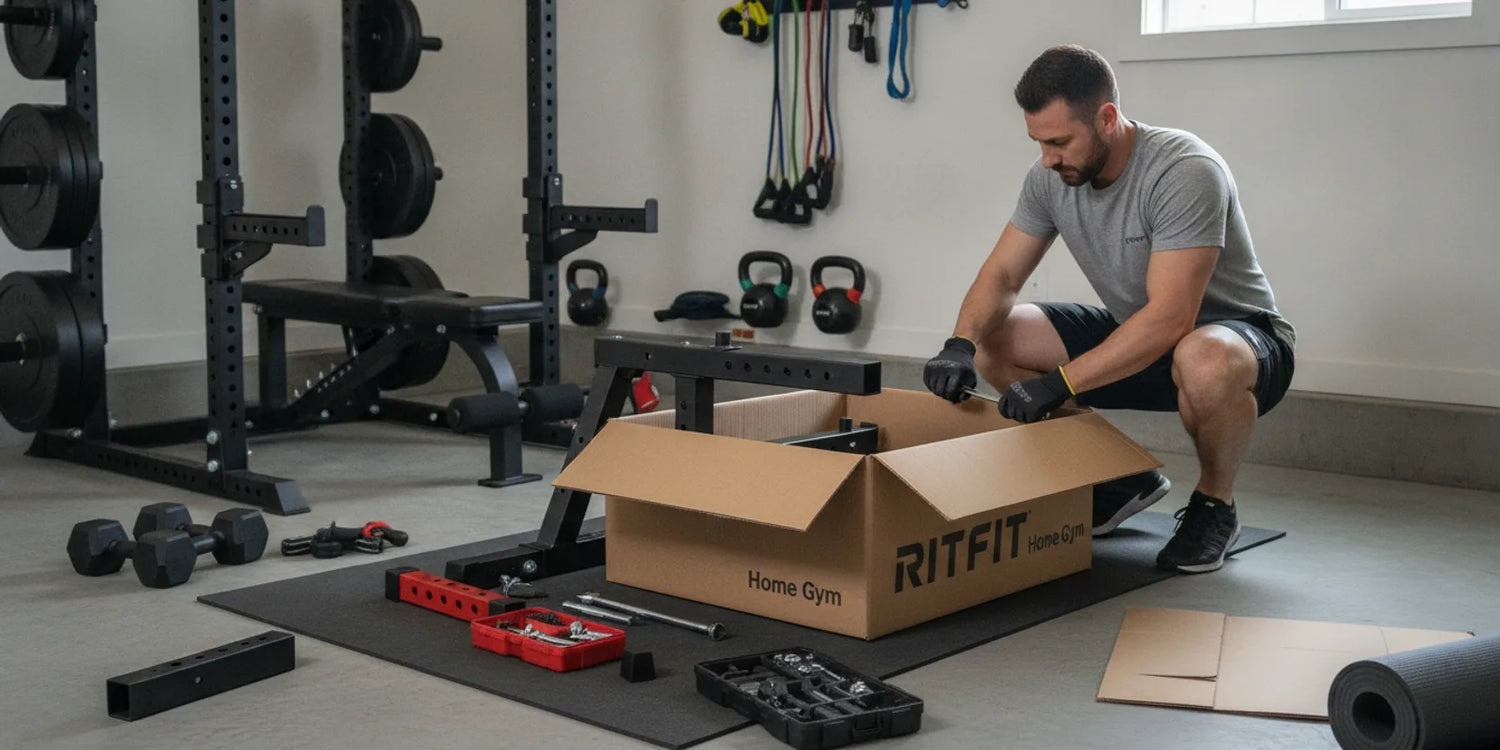
Pre-assembled home gym sets promise to skip the weekend-long build, but assembly time still varies widely between packages advertised as ready to use.
This guide explains what pre-assembled actually means, how to judge assembly difficulty before buying, and which RitFit home gym package fits a buyer with limited time or DIY confidence.
Quick Answer: The best pre-assembled home gym sets for smooth assembly are ones with pre-installed cable pulleys and a mostly built frame, typically taking 30 minutes to two hours to finish, and RitFit's M1 and PSR05 home gym packages are built around this lower-assembly-friction approach for first-time buyers and small spaces.
Key Takeaways
- Assembly Time Range: Most pre-assembled home gym packages take 30 minutes to two hours to finish, depending on how many parts arrive pre-installed.
- Pre-Installed Cables Matter: A frame with the cable pulley system already mounted assembles noticeably faster than one shipped in separate modular pieces.
- Tools Are Usually Included: Most packages ship with the exact hex keys or wrenches needed, so extra tool purchases are rarely required.
- A Second Set of Hands Helps: Taller uprights and heavy base plates on power rack or Smith machine packages are safer to assemble with a helper.
- Assembly Speed Is Not a Quality Signal: A quick build and a high weight capacity are not mutually exclusive, so check steel gauge and warranty terms too.
Why Does Assembly Difficulty Matter More Than It Seems?
Assembly friction determines whether a new home gym gets used in the first week or sits half-built in a garage corner. A structured home-based training program has been shown to be accessible, effective, and safe for improving fitness, but that only holds once the equipment is actually set up and ready to train on.[1]
- Momentum Loss: A stalled multi-hour build often means the first workout gets pushed to next weekend, and next weekend becomes next month.
- Return Risk: Confusing instructions or missing pre-installed parts are common reasons buyers request refunds or exchanges on home gym equipment.
- Space Planning: A pre-assembled frame is easier to test-fit in a room before committing to permanent floor anchors.
Reading a full home gym guide before buying helps set realistic expectations for both space and setup time.
What Does Pre-Assembled Actually Mean?
Pre-assembled home gym packages do not necessarily arrive fully built, they arrive with most of the labor-intensive steps already finished at the factory. Some multi-station home gym listings advertise being approximately 90 percent pre-assembled out of the box, leaving mainly a handful of bolt-on attachments to finish.
In one independently conducted product test, a reviewer timed unboxing a compact all-in-one home gym at about 5 minutes, with roughly 15 minutes total to have it set up and ready to use.
- Fully Pre-Assembled: The frame, cable pulleys, and main structure arrive already built, leaving only a few attachments to bolt on.
- Modular Bolt-Together: Major sections are pre-formed but shipped separately, requiring more hardware and a longer build.
- Build-From-Parts: Every piece ships loose, which offers the most customization but the longest assembly time.
Pairing a low-assembly frame with a simple dumbbell set for a home gym keeps the whole setup light on tools, and browsing home gym ideas beforehand helps confirm the frame will actually fit the space.
How Can You Judge Assembly Difficulty Before You Buy?
Assembly difficulty can be judged before purchase by checking four listing details: the number of pre-installed components, the included tool list, the manual's page count, and whether the cable routing is already threaded. A narrative review in Sports Medicine notes that machines tend to be more time-efficient for inexperienced lifters because their fixed movement pattern requires less coordination, and fewer independent moving parts to route generally means fewer steps to bolt together.[2]
- Component Count: A shorter parts list on the listing usually means less time spent sorting hardware.
- Tool List: Packages that specify the included hex keys and wrenches signal fewer surprise trips to a hardware store.
- Manual Length: A concise, diagram-heavy manual is usually easier to follow than a dense text-only one.
- Pre-Threaded Cables: A cable and pulley system that ships already routed through the frame saves one of the fussiest assembly steps.
For safety-focused installation tips once the frame is together, the home gym safety, assembly, and maintenance guide covers anchoring and stability checks, and a free weight set for a home gym can round out the setup without adding assembly steps.
Which RitFit Home Gym Package Fits Your Assembly Tolerance?
Buyers with the least assembly tolerance generally fit best with a Smith machine package that ships with its cable and pulley system pre-mounted, while buyers with more DIY confidence can consider a standalone frame with more attachment points. The right choice depends on budget, available space, and how much building a buyer is willing to do.
| Package | Assembly Profile | Best For |
|---|---|---|
| RitFit M1 Home Gym Package | Smith machine plus bundled accessories, moderate assembly with pre-drilled uprights | First-time home gym buyers |
| RitFit PSR05 Home Gym Package | Compact power rack Smith machine package, smaller footprint suited to garages | Space-constrained rooms |
| M1 Multi-Functional Smith Machine | Expandable multi-station frame with more attachment points | Buyers wanting a long-term upgrade path |
Profiles reflect RitFit's own product listings only.
- Budget First-Timer: Choose the M1 Home Gym Package for a first Smith machine and a straightforward, guided build.
- Small Space: Choose the PSR05 Home Gym Package for a garage bay or a spare bedroom with a tight footprint.
- Long-Term Upgrader: Choose the M1 Multi-Functional Smith Machine if attaching extra stations later matters more than the fastest possible first build.
Rounding out a new rack with a budget dumbbell set with rack is a common next step once the main frame is anchored.
What Does Smooth Assembly Actually Look Like in Practice?
Smooth assembly in practice usually means unpacking labeled hardware bags, following a diagram-first manual, and tightening bolts in the sequence the instructions specify rather than at random. Watching a completed setup in action before buying helps set realistic expectations for both the build and the resulting workout space.
This walkthrough shows a finished RitFit home gym package in daily use, illustrating the kind of compact footprint a well-assembled Smith machine package should have once installed.
What Common Assembly Mistakes Turn a Short Job Into a Weekend?
Common assembly mistakes include fully tightening bolts before the frame is square, skipping the manual's suggested sequence, and forcing a mismatched hex key into the wrong-sized bolt head. Each of these can turn a listed one-hour build into an afternoon of backtracking.
- Tightening Too Early: Snug every bolt loosely first, then fully tighten only after the whole frame is square.
- Skipping the Manual Order: Steps are usually sequenced so heavier panels are supported before smaller brackets go on.
- Wrong Tool Size: Forcing an almost-fitting hex key can strip a bolt head and turn a five-minute step into a hardware store trip.
- Assembling Alone on Tall Sections: Uprights taller than shoulder height are easier and safer to lift into place with a second person.
- Ignoring Floor Clearance: Skipping an overhead and side clearance check before placing the frame can mean disassembling a finished build to shift it.
Pairing the finished rack with a properly sized set of weight plates for a home gym or a hex dumbbell set with rack avoids repeating the same clearance mistakes with a second piece of equipment.
Is It Worth Paying More for Easier Assembly?
Paying more for easier assembly is worth it for most first-time buyers, since a home gym that gets set up correctly and quickly is a home gym that actually gets used. A randomized controlled trial found that home-based and gym-based training sessions of matched duration and frequency produced comparable fitness outcomes, which only matters once the home setup is finished and accessible in the first place.[3]
The math shifts for buyers planning to add stations later. A slightly longer initial build on an expandable frame can cost less over time than replacing an entry-level, fully closed unit once training goals outgrow it.
"Consistency, just like with any training program, consistency is key. Make your workouts a non-negotiable part of your routine."
Jeff Cavaliere, MSPT, CSCS, Athlean-X
FAQs About Pre-Assembled Home Gym Sets
How long does it take to assemble a pre-assembled home gym set?
Most pre-assembled home gym packages take between 30 minutes and two hours to finish, depending on how many components arrive already bolted together. A frame with pre-installed cables and pulleys, like many Smith machine packages, usually goes together faster than a fully modular kit that ships in separate boxes.
What tools are needed to assemble a home gym package?
Most pre-assembled home gym packages ship with the specific hex keys, wrenches, or Allen keys sized to their hardware, so you rarely need to buy extra tools. Having a rubber mallet, a step stool for taller uprights, and a helper on hand for heavier panels makes the process noticeably smoother.
Can one person assemble a home gym alone?
Many compact, pre-assembled home gym sets are designed for solo setup, especially when the frame arrives mostly built. Larger power rack or Smith machine packages with tall uprights and heavy base plates are safer and faster to assemble with a second person, particularly when lifting sections into place.
What is the difference between pre-assembled and modular home gym kits?
Pre-assembled home gym sets arrive with the frame, cable pulleys, or main structure already built, leaving only a handful of bolt-on attachments. Modular kits ship as separate parts you build from scratch, which offers more customization but typically adds significantly more assembly time and required tools.
Does a longer assembly time mean better build quality?
Not necessarily, since assembly time mostly reflects how many parts ship pre-installed rather than the strength of the steel or welds. A well-engineered home gym can be quick to assemble and still rated for a high weight capacity, so check gauge steel and warranty terms instead of judging quality by setup speed alone.
Conclusion
Assembly friction is a legitimate buying filter for a pre-assembled home gym set, not an afterthought. Checking pre-installed components, tool lists, and manual clarity before buying predicts the real setup time better than marketing claims alone.
Match the package to actual assembly tolerance rather than the longest feature list, then browse the RitFit Smith machine collection to compare pre-assembled options directly.
Disclaimer
This article is for general informational purposes and reflects publicly available product descriptions and general assembly practices, not a guarantee of any specific package's build time. Always follow the manufacturer's included manual and safety warnings, and consult a professional installer if unsure about anchoring heavy equipment.
Save on your next RitFit order
Tap the button to copy your code, then paste it at checkout.
References
1. Hu P, Zhang W, Ripley-Gonzalez JW, et al. Exercise intensity and energy expenditure of a multicomponent home-based training program: Xiangya hospital circuit training (X-CircuiT). Front Public Health. 2022;10:909766. doi:10.3389/fpubh.2022.909766.
2. Iversen VM, Norum M, Schoenfeld BJ, Fimland MS. No Time to Lift? Designing Time-Efficient Training Programs for Strength and Hypertrophy: A Narrative Review. Sports Med. 2021;51(10):2079-2095. doi:10.1007/s40279-021-01490-1.
3. Melo X, Simão B, Catela C, et al. Home- vs gym-based exercise delivery modes of two multicomponent intensity training regimes on cardiorespiratory fitness and arterial stiffness in adults with intellectual and developmental disability during the COVID-19 pandemic - a randomized controlled trial. J Intellect Disabil. 2025;29(1):66-85. doi:10.1177/17446295241242507.





