








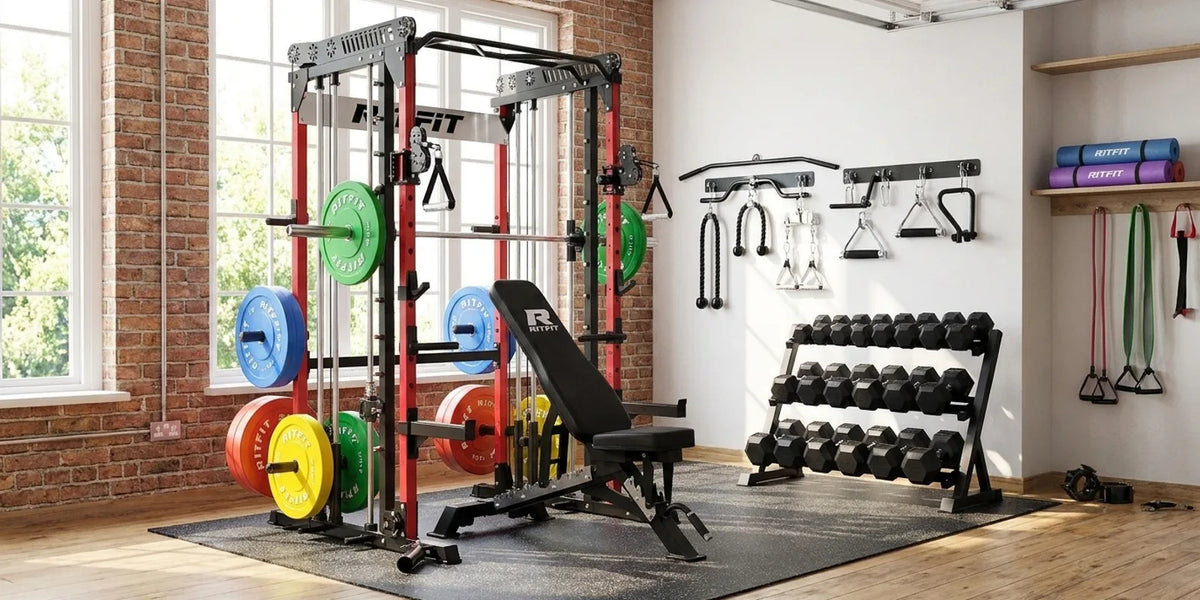
The best Smith machine for cyclists at home is the RitFit M1 PRO Smith Machine Home Gym Package, because it puts heavy lower-body loading, single-leg work, and cable resistance in one frame that fits a single garage bay. Cyclists already build endurance on the bike, and what pedaling cannot supply is maximal force plus the left-right balance work that off-bike lifting delivers.
This guide covers the muscles that drive pedal torque, how to close a stubborn left-right gap, which cable movements replace what cycling skips, and what the M1 PRO package costs.
Quick Answer: The RitFit M1 PRO Smith Machine Home Gym Package is the strongest fit for most cyclists training at home, pairing a 352 lb capacity Smith system with a 15-hole cable crossover on a 20.9 square foot footprint. Riders who need free-weight bar path practice or a plate-loaded leg press should look elsewhere.
Key Takeaways
- Off-bike strength is the missing stimulus: pedaling for hours builds endurance and not maximal force, so heavy lower-body work belongs in the week even when ride volume is high.
- Asymmetry is common and trainable: single-leg work is the lever, and a guided bar path keeps it stable enough to load hard when nobody is spotting.
- Cables cover the neglected patterns: anti-rotation core work and horizontal pulling replace what a folded-over bike position never trains.
- Two sessions is the realistic dose: one or two short strength sessions fit around ride volume, and the race season usually runs on maintenance work only.
- Budget the whole package: the M1 PRO package runs $2,099.99 with the 260 lb plate set, and its 20.9 square foot footprint and 85.3 inch height decide whether it fits your space.
Why Do Cyclists Need Off-Bike Strength Training at Home?
Off-bike strength training gives cyclists the maximal force and efficiency gains that endurance riding alone does not produce. A 2026 systematic review with meta-analysis of 17 studies and 262 participants found heavy strength training at 80 percent of one-rep max or above improved cycling performance with an effect size of 0.463 and cycling efficiency with an effect size of 0.353.[1]
- Ride time is the real constraint: a rider already logging long hours on the bike cannot bolt a bodybuilding split onto the week, so the plan has to fit two short sessions that do not compete with ride volume.
- Pedaling trains endurance rather than maximal force: turning the cranks at 80 to 100 rpm for hours is a low-force, high-repetition pattern, which is why strength can stall while aerobic fitness keeps climbing.
- Recovery sets the ceiling: stacking a heavy squat day onto the biggest ride week adds fatigue faster than it adds force, so hard lifting belongs away from the longest rides.
Understanding the muscles a cycling workout actually trains makes the gap easy to see, because the bike builds local leg endurance while hip extension power, trunk stiffness, and upper-body pulling stay undertrained. A garage machine only earns its floor space if it closes those specific gaps in a session short enough to survive a real training week.
Which Muscles Produce Pedal Torque and How Do You Load Them?
Pedal torque comes mostly from the quadriceps, glutes, and hamstrings, and peak force arrives at a surprisingly low cadence. In 52 trained male cyclists, maximal dynamic force during leg pedaling averaged 13.4 N per kg of body mass and was reached at about 21 rpm, while the highest power output came near 110 rpm.[2]
- Quadriceps: the vastus group extends the knee through the power phase, so Smith machine squats load that tissue with a fraction of the repetitions a ride demands.
- Glutes and hamstrings: hip extension drives the top of the stroke, which is why Romanian deadlifts and hip thrusts carry over to the torque a rider needs late in a long effort.
- Calves and ankles: loaded calf raises build the ankle stiffness that keeps force going into the pedal instead of collapsing through the foot.
A guided bar is the practical choice because a cyclist usually lifts alone, and the 10 best Smith machine leg workouts cover the squat, Romanian deadlift, and split squat patterns that map onto the pedal stroke. Keep the heavy sets in the 3 to 5 rep range at 80 percent of one-rep max or above, then leave the high-repetition work to the bike.
How Do You Train Around Left-Right Leg Asymmetry?
Unilateral work is the practical way to close a left-right strength gap, and a Smith machine makes single-leg loading controllable without a spotter. A 2025 meta-analysis of 8 randomized controlled trials with 157 participants found unilateral plyometric training significantly reduced lower-limb asymmetry, improving single-leg countermovement jump with an SMD of 0.51.[3]
- Both legs rarely carry the same load: in 31 resistance-trained men, split-load leg press produced a 14.29 percent bilateral deficit against 5.16 percent for bilateral leg press, and measured asymmetry ranged from 5.17 percent in leg press to 17.84 percent in eccentric hip extension.[4]
- Higher performers are more symmetrical: a 3D scanning study of 48 top-level male road cyclists found high-performance riders carried fewer morphological asymmetries than lower-performance riders, an association rather than proof that symmetry causes results.[5]
- A fixed bar path removes the wobble: one leg can be loaded hard without the bar drifting sideways when the weaker side starts to fatigue under the working set.
Run a Bulgarian split squat with the back foot on the bench, a single-leg Romanian deadlift, and a single-leg cable press each week, starting on the weaker leg and matching the rep count on the stronger one. The Smith machine lunge setup is the easiest entry point, and the safety arms should sit just under the bottom position before the first working set.
What Cable Work Fills the Gaps Cycling Leaves Behind?
The cable crossover station adds the pulling and anti-rotation work that a bike position never asks for. Cycling loads the legs in one plane for hours, so the upper back, chest, and trunk rotation patterns stay undertrained relative to the lower body.
- Anti-rotation core: Pallof presses and cable chops train the trunk to resist twist, which is closer to holding a stable pelvis under a hard effort than any crunch variation.
- Horizontal pulling: cable rows and face pulls balance the hours spent folded over the bars and give the shoulders something to do beyond gripping the hoods.
- Single-arm and single-leg variations: a 2 to 1 pulley ratio with 15 cable adjustment holes and a 420 lb single-side pulley load lets a rider set the line of pull for chest press, row, and single-leg work on one frame.
A cable station also survives a heavy training week better than a barbell-only setup, because lighter loads add volume without adding the recovery cost of a second heavy leg day. The Smith machine cable system workout guide covers the movement library, and cable machine attachments widen what the same station can do.
Is the RitFit M1 PRO All-in-One Smith Machine Home Gym Package a Smart Buy for Cyclists?
The RitFit M1 PRO Smith Machine Home Gym Package covers the three jobs a cyclist needs from one frame: guided lower-body loading, single-leg work, and cable resistance. RitFit lists a 1,600 lb frame capacity in 2 inch by 2 inch 14-gauge steel, a 352 lb Smith capacity with 11 height settings, and a cable crossover with a 2 to 1 pulley ratio and 15 adjustment holes.
- Durability: the frame is rated to 1,600 lb in 14-gauge steel, which is well beyond what a 352 lb Smith capacity can demand, so the structure stops being the limiter once a rider is pushing heavy 3 to 5 rep sets.
- Versatility: the same frame carries the Smith bar, a pull-up bar rated to 465 lb, 12 upright holes per side, storage for three Olympic bars and six plate holders, and the cable station, which is what lets squats, unilateral work, and pulling happen in one session.
- Warranty: RitFit publishes 3 years on frame and welding with 1 year on bolts and pulleys, rated for home and light commercial use, alongside 35-day returns.
- Performance: verified buyers describe the Smith and cable assemblies as running smoothly and the frame as stable under load, which is exactly what a rider lifting alone at home needs.
- Value: at $2,099.99 with the 260 lb plate set the package replaces a rack, a Smith machine, a cable station, and a bench, so the budget goes into one frame instead of four separate purchases.
The honest limitation is the bar path itself, because a guided Smith bar trains force production without teaching balance, so a rider who also races criteriums or cyclocross should keep some free-weight or single-leg balance work in the plan. Compare the package against the rest of the RitFit Smith machine line before committing, and measure your ceiling first because the frame stands 85.3 inches tall including the pull-up bar.
"Few pieces of equipment in the home exercise industry are as comprehensive and versatile as this all-in-one gym system. The robust system provides a natural, centered bar path for compound lifts like squats, presses, and rows, and incorporates a dual cable crossover station with a full rack of precision-engineered attachments."
Tom Eskey, CF-L1, CPT, Home Gym Equipment Reviewer, Garage Gym Revisited, RitFit M1 Multi-functional Smith Machine Review, Garage Gym Revisited
"The RitFit M1 PRO is a strong value-for-money all-in-one home gym that combines a Smith machine, power rack, dual cable system, pull-up station, and storage into a relatively compact footprint. Its smooth linear-bearing Smith bar, versatile cable setup, and extensive exercise options make it ideal for lifters who want a complete home gym without buying multiple machines."
Tiffany, Verified Buyer, RitFit M1 PRO Smith Machine Home Gym Package
A Two-Day Strength Plan for Base and Build Phases
Two short sessions carry a cyclist through a base phase and a build phase, with loads climbing and total volume shrinking as the race season approaches. A 2025 survey of 147 professional UCI road cyclists found the common pattern was two strength sessions per week in the off- and pre-season, dropping to one maintenance session per week during the race season, with travel, fatigue, and racing the biggest barriers.[6]
- Day 1 in the base phase: Smith machine squat 3 sets of 8, Romanian deadlift 3 sets of 8, Bulgarian split squat 2 sets of 8 per leg, calf raise 3 sets of 12.
- Day 2 in the base phase: Smith machine bench press 3 sets of 8, cable row 3 sets of 10, Pallof press 3 sets of 10 per side, single-leg cable press 2 sets of 10 per leg.
- Build phase switch: drop to 3 sets of 3 to 5 reps on the squat and Romanian deadlift at 80 percent of one-rep max or above, hold the single-leg work at 2 sets of 6 per leg, and cut accessory volume in half.
- Race season: keep one session built around two or three lifts at 2 sets of 3 reps, and place it at least 48 hours before a target event.
The plan only works if it stays clear of the biggest ride days, because stacking heavy leg work onto a long endurance ride adds fatigue without adding force. Riders unsure how much the bike already covers should read what bike riding works out before adding volume to either side of the week.
How Much Does the RitFit M1 PRO Package Cost, and Who Should Skip It?
The M1 PRO package runs $2,099.99 with the 260 lb plate set and $2,399.99 with the 370 lb set, both including the BWB01 adjustable bench. That price covers a frame, a Smith system, a cable crossover, a pull-up bar, and plate storage inside a 20.9 square foot footprint.
- Skip it if you want free-weight bar path practice: a guided Smith bar does not train the balance and stabilizer work that a barbell squat demands.
- Skip it if you need a plate-loaded leg press: the frame covers squats, split squats, and deadlift patterns, but a horizontal leg press is a different machine.
- Skip it if your ceiling is low: at 85.3 inches tall including the pull-up bar, the frame needs real headroom for standing work.
- Skip it if you never train at home: the value case for any home machine disappears if your lifting already happens in a gym.
| Rider profile | Recommended M1 PRO configuration | Why it fits |
|---|---|---|
| Road or track cyclist lifting twice a week in a garage | 260 lb plate set at $2,099.99 | Covers squat, Romanian deadlift, and split squat loads for a rider starting structured strength work |
| Rider already squatting heavy and running short of plates | 370 lb plate set at $2,399.99 | Adds a 55 lb pair plus extra 10 to 45 lb pairs for progressive overload on 3 to 5 rep sets |
| Rider who wants stack resistance and less plate handling | M1 PRO Weight Stack package at $2,399.99 | Runs cable and Smith resistance from an integrated stack instead of storing plates on the frame |
Configuration and pricing details from the RitFit product pages, checked September 2026.
Long-term cost is mostly attachments rather than the frame, because RitFit sells additional attachments for the M1 PRO separately, so budget for those as the training plan grows instead of assuming the base package is the final spend. The RitFit M1 vs Buffalo comparison is the next read if two RitFit Smith machines are still on your shortlist.
"M1 Pro is extremely well built. Easy to install. The weight stacks are a must and enhance the performance. Very satisfied. Should have purchased much sooner."
Anthony G. Verified Buyer, RitFit M1 PRO Smith Machine Weight Stack Home Gym Package
FAQs About the Best Smith Machine for Cyclists at Home
Why do cyclists need strength training if riding already builds leg fitness?
Riding builds aerobic capacity and local endurance rather than maximal force. A 2026 systematic review that pooled 17 studies reported that heavy strength training at 80 percent of one-rep max or above improved cycling performance with an effect size of 0.463 and cycling efficiency with an effect size of 0.353.
How much space does the RitFit M1 PRO Smith Machine Home Gym Package need?
The package is one upright Smith machine with a cable crossover, a pull-up bar, and storage, so it takes a single training zone rather than several. RitFit lists a soft footprint of 20.9 square feet and an overall height of 85.3 inches including the pull-up bar, so measure your lowest beam before ordering.
Can you build cycling leg strength on a Smith machine instead of a barbell?
Yes. A guided bar removes the balance demand, so you can push closer to a true one-rep max squat or Romanian deadlift without a spotter and without the bar drifting forward. Free weights teach stabilizers the machine does not, so treat the Smith machine as the heavy lower-body tool and keep single-leg work in the plan.
How often should cyclists lift weights during race season?
A 2025 survey of 147 professional UCI road cyclists found the common pattern was two strength sessions per week in the off- and pre-season, dropping to one maintenance session per week during the race season. Start at one session and add a second only if recovery holds.
Is a Smith machine safe for single leg training without a spotter?
Yes, provided you set the safety arms correctly. A fixed bar path keeps the bar from drifting sideways when one leg is under load, which is why single-leg work is easier to control on a Smith machine than with a free bar. Set the catches just under the bottom position and stop the set when control breaks.
What cable exercises help cyclists the most?
Prioritize anti-rotation core work such as the Pallof press and cable chops, plus horizontal pulling for the upper back that cycling never loads. Add single-arm and single-leg cable variations for the glutes and hamstrings. The M1 PRO cable station offers a 2 to 1 pulley ratio and 15 adjustment holes so you can match pulley height to each movement.
How much weight should a cyclist lift on a Smith machine squat?
Start around 60 percent of one-rep max for three sets of 8 to 10 reps, and add load only when every set feels controlled with two reps left in reserve. Heavy strength work that drives cycling gains sits at 80 percent of one-rep max or above for 3 to 5 reps, so build toward that range over several weeks.
Conclusion
The RitFit M1 PRO Smith Machine Home Gym Package is the practical answer for most cyclists training at home, because it delivers heavy guided lower-body work, controllable single-leg loading, and cable resistance in one 20.9 square foot footprint.
Pair two short sessions with your ride week, start the single-leg work on the weaker side, and let the race season shrink the plan to maintenance volume. Check the RitFit discount guide before you order.
Disclaimer
This article offers general fitness information for healthy adult riders and is not medical or rehabilitation advice. Consult a qualified health professional before starting a strength program if you have an injury, a medical condition, or any concern about training load.
References
1. Llanos-Lagos C, Ramirez-Campillo R, Saez de Villarreal E. Heavy strength training effects on physiological determinants of endurance cyclist performance: a systematic review with meta-analysis. Eur J Appl Physiol. 2026;126(1):193-222. doi:10.1007/s00421-025-05883-2. PMCID: PMC12881108
2. Rodriguez-Rielves V, Barranco-Gil D, Buendia-Romero A, et al. Torque-Cadence Profile and Maximal Dynamic Force in Cyclists: A Novel Approach. Sensors (Basel). 2024;24(6). doi:10.3390/s24061997. PMCID: PMC10976056
3. Sun W, Li H, Qu L, et al. Unilateral plyometric training effectively reduces lower limb asymmetry in athletes: a meta-analysis. Front Physiol. 2025;16:1551523. doi:10.3389/fphys.2025.1551523. PMCID: PMC12014563
4. Pisz A, Blazek D, Stastny P. Hip and Knee Bilateral Deficit Across Bilateral, Unilateral, and Split-Load Leg Press Conditions. J Funct Morphol Kinesiol. 2026;11(2). doi:10.3390/jfmk11020216. PMCID: PMC13301863
5. Rauter S, Simenko J. Morphological Asymmetries Profile and the Difference between Low- and High-Performing Road Cyclists Using 3D Scanning. Biology (Basel). 2021;10(11). doi:10.3390/biology10111199. PMCID: PMC8615123
6. Vikestad V, Lyngstad IK, Dalen T. Strength training among professional UCI road cyclists: Practices, challenges, and rationales. PLoS One. 2025;20(7):e0328195. doi:10.1371/journal.pone.0328195. PMCID: PMC12244580





