If you want a home Smith machine for heavy lifting, the best choice is the one that stays stable under load, protects solo training, and still earns its floor space. The RitFit M2 stands out when you want guided bar work, cable training, and rack style versatility in one all in one setup, not just a basic fixed path machine.
Key Takeaways
- The RitFit M2 is strongest as an all in one home training station for lifters who want guided bar work, cable work, and safer solo sessions in one footprint.
- For heavy lifting, stability, safety arm placement, room fit, and exercise usability matter more than flashy marketing language.
- A Smith machine can absolutely support strength and hypertrophy goals, but it should not be treated as a direct replacement for competition style free bar practice.
- The M2 makes the most sense for busy home gym users who value efficient setup, repeatable training, and multi use versatility.
- Before buying, verify your ceiling clearance, preferred exercise list, and whether you want a standard Smith feel or a 3D Smith feel.
What Heavy Lifters Need from a Home Smith Machine
Heavy lifters need a home Smith machine that feels planted, repeatable, and safe when the work sets get serious. If the frame, safeties, and exercise positions do not inspire confidence, the machine will never feel truly heavy duty in practice.
- Load readiness: If maximal strength is a priority, the machine has to support high load training and consistent execution, because higher load resistance training tends to maximize strength gains more effectively than lighter prescriptions.[2]
- Stable setup: The frame should feel composed during squats, presses, rows, lunges, and rack work, not just when it is standing empty on the floor.
- Safe solo training: A home machine should reduce the stress of unracking, reracking, and training near hard effort when no training partner is present.
- Useful exercise range: A machine is only as good as the lifts it actually supports well, especially bench variations, rows, hip dominant work, and lower body compounds.
- Room efficiency: A serious home unit has to justify its footprint by replacing several separate stations, not by looking impressive in photos.
Overview of the RitFit M2 Smith Machine
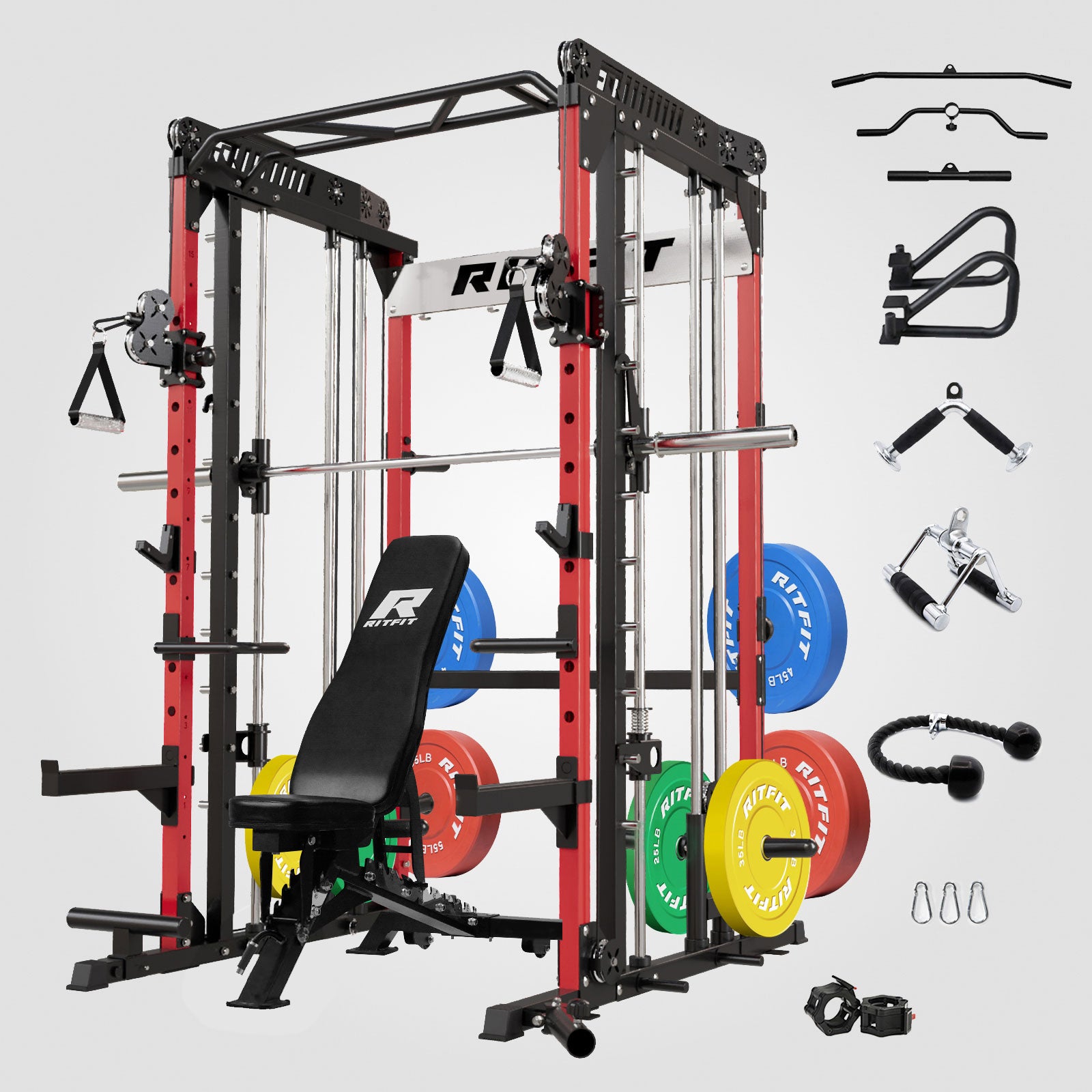
The RitFit M2 Multi-Functional Modular Home Gym Smith Machine is best understood as a modular strength station, not just a guided bar. It is built for lifters who want Smith training, cable work, storage, and rack style versatility in one central piece.
- Best fit: The M2 appeals most to lifters who want one anchor machine for squats, presses, rows, accessories, and progressive home gym training.
- Buying logic: It is a stronger fit for versatility first buyers than for purists who want every lift to mimic a competition barbell setup.
- Programming value: It works best when used as the main station for heavy compounds plus cable based accessory work.
- Expansion path: Buyers who want to compare platform direction can also review RitFit M1 vs M2 Smith Machine before deciding how much modularity they actually need.
- Research path: If you are still comparing categories, the broader RitFit Smith machine collection helps place the M2 inside the full lineup.
Why the RitFit M2 Stands Out for Heavy Lifting at Home
It prioritizes repeatability over chaos
The biggest advantage of a heavy home Smith machine is repeatability, because a guided setup can help you reproduce bar position, stance, and start height from session to session. That matters when your goal is not just to move weight once, but to build progress safely over months of home training.
- More consistent setup: Heavy lifters benefit when working positions are easier to reproduce across squats, presses, lunges, and rows.
- Less wasted time: Fast transitions between main lifts and accessory work make the M2 more attractive for busy home gym users.
- Better session flow: One machine that handles several movement categories reduces setup fatigue and keeps effort where it belongs, on the training.
It can still support real strength and size goals
Machine based and free weight training can both support hypertrophy, while strength gains remain specific to the tool and test being used, which means a Smith machine can be highly productive without pretending to be identical to free bar competition lifting.[1] In other words, the M2 can absolutely help build muscle and strength, but the most direct carryover will depend on the lifts you perform most often.
- Good use case: The M2 is a strong option for lifters who want hard sets on squats, presses, lunges, rows, shrugs, and cable accessories.
- Realistic boundary: It is less ideal if your top priority is maximal specificity for competition squat, bench, and deadlift technique.
- Better expectation: Think of the M2 as a productive home training tool, not a perfect substitute for every free bar demand.
It solves a real solo training problem
For many home lifters, the smartest reason to buy a Smith machine is not novelty, but the confidence to train hard alone. That is also why content such as safe solo workouts at home continues to resonate with buyers who care about practical safety more than gym theater.
- Safer hard efforts: Solo lifters often value easier reracking and clearer safety positions on difficult work sets.
- Lower mental friction: Feeling secure under the bar often leads to better commitment on presses, squats, and overloaded accessories.
- Better home gym logic: One safer central station often makes more sense than piecing together several disconnected solutions.
It fits a busy home gym lifestyle
Time efficient strength plans can still produce excellent results when they revolve around challenging sets, smart exercise order, and reliable equipment, which is exactly why all in one stations appeal to experienced home lifters.[4] The M2 stands out when your schedule favors efficient sessions, not long equipment changes.
- Less equipment sprawl: Fewer separate stations usually means less wasted floor space and less wasted setup time.
- Faster exercise pairing: Heavy compound work can flow into cable accessories without leaving the main station.
- Higher consistency: Home users are more likely to train regularly when setup is simple and exercise selection is broad.
Features and Attachments Relevant to Heavy Lifters
Heavy lifters do not need endless accessories, they need the right ones that improve training usefulness. On the M2, the real value is whether the platform supports the lifts you actually program and the accessory work you truly repeat.
- Heavy lower body work: The platform makes sense for Smith squats, split squats, lunges, and hinge variations when you want a more controlled path than a free bar setup.
- Pressing variety: Flat, incline, and overhead pressing options matter because pressing is one of the most common reasons lifters want guided support at home.
- Pulling volume: Rows and cable based upper back work help round out a heavy program without forcing you to buy a separate pull station, which is why pages like Smith machine row remain useful reference content.
- Expandable use: If you want deeper programming ideas, content such as build muscle effectively with a Smith machine helps frame what the platform can realistically do well.
Pros and Cons of the RitFit M2 for Heavy Lifting
The M2 has clear strengths, but it also has buying boundaries that serious lifters should acknowledge before ordering. That honesty improves the decision, because the best home gym purchase is the one that fits your training style and room, not the one with the loudest promise.
Pros
- Strong all in one logic for guided bar work, cable work, and organized home training.
- Better suited to safe solo lifting than many basic rack and barbell only setups.
- Useful for lifters who want repeatable setup on squats, presses, rows, and lunges.
- More efficient than buying several single purpose stations one by one.
Cons
- It will not feel as specific as a traditional free bar setup for competitive powerlifting goals.
- Room planning still matters, especially for ceiling clearance, bench angles, and movement comfort.
- Like most large home gym systems, it demands patient assembly and realistic expectations about setup time.
- Some buyers may still prefer a simpler rack if they do not need guided bar work or cable versatility.
RitFit M2 vs Other Smith Machines for Heavy Home Use
The right comparison is not just M2 versus another Smith machine, it is M2 versus the training experience you want most. If your real debate is guided support versus full free bar specificity, start with Smith machine vs power rack before you obsess over minor feature differences.
- Versus budget Smith machines: The M2 makes more sense if you want one more complete station instead of a bare minimum guided bar.
- Versus a pure power rack: A rack wins for barbell specificity, while the M2 wins for guided safety, cable access, and all in one efficiency.
- Versus simpler RitFit options: The M2 is easier to justify when you want more modularity and more long term flexibility than a smaller entry platform.
Setting Up the RitFit M2 for Safe Heavy Lifting at Home
Assembly and room planning come first
Before you think about PRs, confirm your room layout, ceiling clearance, bench movement space, and loading paths around the machine. A home unit only feels premium when it actually fits the room and lets you use your best lifts comfortably.
- Measure more than once: Check the highest and lowest ceiling points, because many home rooms are uneven or crowded by fixtures.
- Protect the floor: Dense gym flooring helps control noise, improves footing, and protects the surface under heavy work.
- Plan the workflow: Leave enough space for plate changes, bench positioning, and movement around both sides of the machine.
Technique and safety setup matter more than hype
Technique quality, controlled range, and stable exercise setup all influence how efficiently hard sets load the target muscles, which is why adjustment quality matters more than flashy language in a product description.[3] Use your first sessions to dial in safety arm height, bench position, and start height before you chase load.
- Test with lighter loads first: Confirm your squat depth, bench touch point, and row start position before moving into heavy work.
- Set safeties for the lift: Your safety position should match the actual lift, not a generic middle setting.
- Use collars and consistent setup: Small setup habits matter more as the weight rises.
Sample Heavy Lifting Workouts on the RitFit M2
Time efficient programs built around hard sets on compound lifts can still be highly effective, which is one reason all in one home stations are attractive to serious lifters.[4] The point is not to do everything, it is to do the right movements hard and repeat them consistently.
- Lower body heavy day: Smith squat, Romanian deadlift, reverse lunge, and calf work create a strong lower body session without needing multiple machines. If you want form references, the Smith machine squat pattern is a useful starting point.
- Upper body heavy day: Flat press, incline press, overhead press, Smith machine row, and cable pulling give you a practical push pull structure in one station.
- Accessory emphasis day: Rows, shrugs, split squats, triceps work, curls, and rear delt cable work help raise weekly volume without turning every day into a max effort session.
Who Should Buy the RitFit M2 and Who Should Not
The M2 is a strong buy for the right user, but not every lifter needs this much machine in the room. The smartest purchase comes from matching the platform to your actual training priorities, not to a trend list.
- Ideal for: Home lifters who train alone, want guided bar support, value cable versatility, and prefer one central training station.
- Also ideal for: Busy users who want productive heavy sessions without building a gym out of several separate pieces.
- Less ideal for: Lifters whose main goal is competition specific free bar practice with the fewest movement constraints possible.
- Also less ideal for: Buyers with very tight rooms who would rather keep the space open with a simpler rack only setup.
FAQs About the Best Smith Machine for Heavy Lifting at Home
Is the RitFit M2 Smith machine good for heavy lifting at home?
Yes. It is a strong option for home lifters who want guided bar work, cable training, and safer solo sessions in one station. It makes the most sense when you value repeatable setup, controlled bar travel, and all in one versatility more than pure competition style free bar specificity.
How much ceiling height do you need for a heavy lifting home Smith machine?
You need enough clearance for the rack, your pull up work, and your plate loading space, not just the posted machine height. Measure your room at multiple points, then leave extra overhead room so setup, cable travel, and head position never feel cramped during presses, pull ups, or installation.
Should you choose a Smith machine or a power rack for heavy lifting at home?
Choose a Smith machine if solo safety, repeatable bar path, and quick transitions matter most in your training. Choose a power rack if your top priority is competition specific barbell practice, maximal freedom of movement, and the most direct carryover to traditional squat, bench, and deadlift patterns.
Can you build real strength and muscle with the RitFit M2?
Yes. You can build real strength and muscle on a guided system if you use progressive overload, enough weekly volume, and hard sets with good technique. The M2 is especially useful for squats, presses, rows, lunges, and accessory cable work that would otherwise require several separate machines.
What exercises are best on a home Smith machine for heavy lifting?
The best heavy lifting choices are Smith squats, bench presses, incline presses, Romanian deadlifts, rows, lunges, and shrugs. These movements let you load the pattern hard, manage setup safely, and keep your training efficient, especially when your home gym space and equipment list are still limited.
Does the 3D Smith option matter for serious home training?
It matters if you want a more natural path and more movement freedom than a strictly vertical track provides. The standard version is still practical for many lifters, but the 3D option can feel better for users who want guided support without a completely fixed bar path.
Final Verdict: Is the RitFit M2 the Best Smith Machine for Heavy Home Lifting in 2026?
The RitFit M2 is a smart pick if heavy home training means safe solo work, guided bar efficiency, and all in one versatility, not pure powerlifting specificity. Choose it if you want one central station that can carry squats, presses, rows, accessories, and progressive cable work, but choose a traditional rack first if your main priority is free bar competition practice.
Disclaimer: This guide is for educational and product comparison purposes only. It does not replace medical advice, injury assessment, or in person coaching. Always confirm official specifications, room measurements, and safety settings before buying or lifting heavy at home.
References
- Haugen ME, Vårvik FT, Larsen S, et al. Effect of free weight vs machine based strength training on maximal strength, hypertrophy and jump performance: a systematic review and meta analysis. BMC Sports Science, Medicine and Rehabilitation. 2023;15(1):103. doi:10.1186/s13102-023-00713-4
- Currier BS, McLeod JC, Banfield L, et al. Resistance training prescription for muscle strength and hypertrophy in healthy adults: a systematic review and Bayesian network meta analysis. British Journal of Sports Medicine. 2023;57(18):1211-1220. doi:10.1136/bjsports-2023-106807
- Korakakis PA, Wolf M, Coleman M, et al. Optimizing resistance training technique to maximize muscle hypertrophy: a narrative review. Journal of Functional Morphology and Kinesiology. 2024;9(1):9. doi:10.3390/jfmk9010009
- Iversen VM, Norum M, Schoenfeld BJ, et al. No Time to Lift? Designing time efficient training programs for strength and hypertrophy: a narrative review. Sports Medicine. 2021;51(10):2079-2095. doi:10.1007/s40279-021-01490-1