








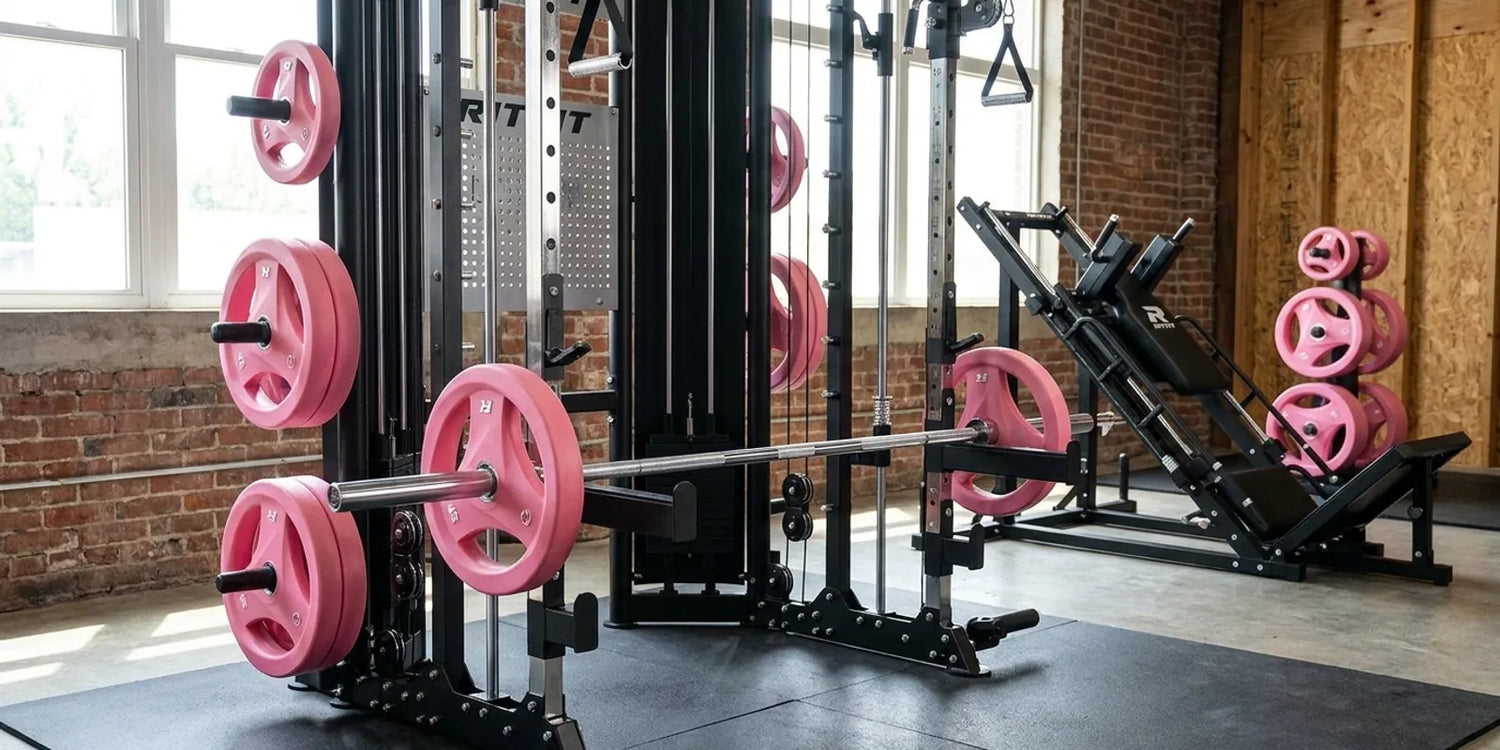
The best Smith machine forearm exercises include reverse curls, supported wrist curls, reverse wrist curls, static holds, and strapless rows. Together, these movements train wrist flexion, wrist extension, elbow flexion, and support grip for stronger and more balanced forearms.
This guide covers eight exercises, correct setup, recommended repetitions, weekly programming, progression, and safety. Test the unloaded bar first because Smith machine starting resistance, hook positions, and bar mechanics vary between models.
Table of Contents
Key Takeaways
- Complete development: Combine wrist flexion, wrist extension, elbow flexion, and support grip instead of repeating only wrist curls.
- Strong all around option: Reverse curls train the elbow flexors while requiring the wrists to remain stable under an overhand grip.
- Grip specificity: Static holds improve support grip, while grippers and plate pinches are better suited to crush grip and pinch grip.
- Smart scheduling: Perform direct forearm exercises after larger pulling movements so grip fatigue does not weaken your main workout.
- Safe progression: Add repetitions before weight, use the safety stops, and stop when pain or neurological symptoms appear.
Can a Smith Machine Build Your Forearms?
Yes, a Smith machine can build stronger and more muscular forearms when your routine trains several functions of the wrist, fingers, and elbow. The guided bar also provides a repeatable starting position for curls, wrist movements, rows, shrugs, and timed holds.
The machine does not remove the need for good technique. Your grip width, wrist position, elbow path, range of motion, safety setting, and loading still determine whether an exercise feels controlled and productive.
- Wrist flexion: Palm up wrist curls train the muscles that bend the palm toward the forearm.
- Wrist extension: Reverse wrist curls train the muscles that lift the back of the hand toward the forearm.
- Elbow flexion: Reverse curls and drag curls train the elbow flexors, including the brachioradialis.
- Support grip: Static holds, rows, and shrugs train your ability to keep the fingers closed around a loaded bar.
Smith machine work does not fully cover every type of grip strength. Use RitFit's hand grip exercise guide when you also want focused crush grip training.
Forearm Muscles and Grip Functions Explained
The forearm contains multiple muscles that control the wrist, fingers, and forearm position. Organizing exercises by function produces a more complete routine than choosing movements only by how much forearm burn they create.
| Muscle or Function | Primary Role | Relevant Exercises |
|---|---|---|
| Wrist flexors | Flex the wrist and assist finger closing | Supported wrist curl, standing wrist curl |
| Wrist extensors | Extend and stabilize the wrist | Reverse wrist curl, reverse curl |
| Brachioradialis | Assists elbow flexion and forearm positioning | Reverse curl, reverse drag curl |
| Finger flexors | Keep the fingers closed around the bar | Static hold, shrug hold, strapless row |
| Support grip | Maintain a closed grip for time | Static hold, row, shrug |
| Crush grip | Close the hand forcefully | Hand grippers and gripping tools |
Forearm position changes how the wrist flexors and extensors contribute during wrist movement. Research found different muscle activity patterns across pronated, neutral, and supinated forearm positions, supporting the use of more than one wrist orientation.[1]
Grip position also changes the excitation pattern of the elbow flexors during curling exercises. This does not prove that one grip guarantees more growth, but it supports using varied grips when building a balanced arm program.[2]
8 Best Smith Machine Forearm Exercises
Begin with light resistance and learn how your machine moves before adding plates. Smaller forearm muscles can recover quickly, but the wrist and elbow tendons may react poorly when load or volume increases too fast.
1. Smith Machine Reverse Curl
The Smith machine reverse curl trains the elbow flexors while challenging the wrist extensors to maintain a stable overhand grip. It is a practical all around exercise for upper forearm size and controlled curling strength.
- Set the bar around upper thigh height.
- Grip the bar slightly wider than shoulder width with your palms facing down.
- Unrack the bar and keep your elbows close to your torso.
- Curl the bar toward the lower chest without extending the wrists.
- Lower the bar slowly until the elbows are almost straight.
- Recommended volume: Perform 3 sets of 8 to 12 repetitions.
- Coach cue: Keep your knuckles aligned with your forearms.
- Common mistake: Avoid using the hips to launch the bar upward.
2. Smith Machine Reverse Drag Curl
The reverse drag curl keeps the bar close to the torso while the elbows move slightly behind the body. This path reduces forward bar travel and gives you another controlled way to train the upper forearm.
- Hold the bar with an overhand shoulder width grip.
- Stand tall and keep your wrists straight.
- Move the elbows backward as the bar travels close to your torso.
- Stop when the bar reaches the lower chest or the movement becomes restricted.
- Lower the bar without allowing the shoulders to roll forward.
- Recommended volume: Perform 2 or 3 sets of 10 to 15 repetitions.
- Coach cue: Slide the bar upward instead of curling it away from the body.
- Common mistake: Do not bend the wrists to complete the top position.
3. Supported Smith Machine Wrist Curl
The supported wrist curl uses a palm up grip to emphasize the wrist flexors. Supporting the forearms on a bench limits unnecessary elbow and shoulder movement.
- Place a flat bench across the Smith station.
- Set the bar slightly above the bench surface.
- Kneel behind the bench and rest your forearms on the pad.
- Grip the bar with your palms facing up and your hands beyond the bench edge.
- Lower the bar through a comfortable range, then flex the wrists upward.
- Recommended volume: Perform 2 or 3 sets of 12 to 20 repetitions.
- Coach cue: Keep your fingers firmly closed around the bar.
- Common mistake: Do not force a deeper range when the wrist feels compressed.
4. Supported Smith Machine Reverse Wrist Curl
The reverse wrist curl targets the wrist extensors on the back of the forearm. These muscles usually require less resistance than the stronger palm side wrist flexors.
- Use the same bench position as the supported wrist curl.
- Grip the bar with your palms facing down.
- Support the full length of your forearms on the bench.
- Lower the knuckles slightly toward the floor.
- Lift the back of the hands toward the forearms without moving the elbows.
- Recommended volume: Perform 2 or 3 sets of 15 to 25 repetitions.
- Coach cue: Use a slow lowering phase and a small controlled range.
- Common mistake: Avoid turning the movement into an elbow curl.
5. Standing Smith Machine Wrist Curl
The standing wrist curl provides a simple palm up option when a bench setup is unavailable. Its controlled range makes it better suited to moderate or higher repetitions than maximum loading.
- Set the bar around upper thigh height.
- Use an underhand grip with your hands around shoulder width.
- Unrack the bar and hold your arms straight.
- Lower the hands only as far as you can control.
- Flex the wrists upward and pause briefly.
- Recommended volume: Perform 2 sets of 15 to 20 repetitions.
- Coach cue: Keep the elbows still throughout the set.
- Common mistake: Do not allow the bar to roll toward the fingertips.
6. Smith Machine Static Grip Hold
The static grip hold directly trains support grip, which is the ability to keep a loaded bar secure for time. This quality matters when the hands fatigue before the back, hips, or legs during pulling exercises.
- Set the bar around mid thigh height.
- Position the safeties directly below the working height.
- Use a shoulder width overhand grip.
- Unrack the bar, stand tall, and squeeze firmly.
- Hold for the planned time, then rotate the bar securely into the hooks.
- Recommended volume: Perform 3 holds of 15 to 30 seconds.
- Coach cue: Maintain even pressure through every finger.
- Common mistake: Do not select a load that prevents a controlled rerack.
7. Smith Machine Shrug with a Timed Hold
The Smith machine shrug primarily trains the upper trapezius, but a timed hold also challenges support grip. It is useful when you want forearm work without adding another isolated wrist movement.
- Set the bar around mid thigh height.
- Use an overhand grip and keep the elbows straight.
- Lift the shoulders toward the ears without rolling them.
- Hold the top position for 2 or 3 seconds.
- Lower the shoulders completely while maintaining your grip.
- Recommended volume: Perform 3 sets of 8 to 12 repetitions.
- Coach cue: Keep the hands firm while the shoulders create the movement.
- Common mistake: Avoid bending the elbows or wrists during the shrug.
8. Strapless Smith Machine Bent Over Row
The bent over row is mainly a back exercise, but performing it without straps places meaningful demand on the finger flexors and support grip. Complete the movement with a load that does not cause the wrists to collapse.
- Set the bar below knee height.
- Use a shoulder width overhand grip.
- Hinge at the hips and brace your trunk.
- Pull the bar toward the lower ribs.
- Pause briefly, then lower the bar until the elbows are straight.
- Recommended volume: Perform 3 sets of 8 to 12 repetitions.
- Coach cue: Keep the bar deep in the hands instead of hanging from the fingertips.
- Common mistake: Do not perform direct forearm work before your main row sets.
Review the complete Smith machine row guide for additional setup, torso position, and back training instructions.
Smith Machine Forearm Exercise Comparison
The right exercise depends on whether your main goal is muscle size, wrist balance, support grip, or combined pulling strength. Use the table below to select movements that cover different functions instead of repeating the same stimulus.
| Exercise | Primary Emphasis | Suggested Range | Best Use |
|---|---|---|---|
| Reverse curl | Elbow flexors and wrist stabilization | 8 to 12 repetitions | Upper forearm development |
| Reverse drag curl | Elbow flexion with reduced forward bar travel | 10 to 15 repetitions | Controlled accessory volume |
| Supported wrist curl | Wrist flexors | 12 to 20 repetitions | Palm side forearm growth |
| Reverse wrist curl | Wrist extensors | 15 to 25 repetitions | Balanced wrist development |
| Standing wrist curl | Wrist flexors | 15 to 20 repetitions | Simple workout finisher |
| Static hold | Support grip | 15 to 30 seconds | Bar retention strength |
| Shrug hold | Support grip and upper traps | 8 to 12 repetitions | Combined trap and grip work |
| Strapless row | Support grip and back | 8 to 12 repetitions | Compound pulling strength |
Smith Machine Forearm Workout and Progression
Most lifters do not need a separate forearm day. Add a short routine after back, biceps, or full body training so tired hands do not reduce your performance on heavier compound exercises.
Beginner Smith Machine Forearm Workout
This routine combines an elbow flexion movement, two wrist movements, and one support grip exercise. Complete it once or twice per week according to your recovery.
| Exercise | Sets | Repetitions or Time | Rest |
|---|---|---|---|
| Reverse curl | 3 | 8 to 12 repetitions | 60 seconds |
| Supported wrist curl | 2 | 12 to 20 repetitions | 45 seconds |
| Reverse wrist curl | 2 | 15 to 20 repetitions | 45 seconds |
| Static hold | 2 | 20 to 30 seconds | 60 seconds |
A small eight week study involving physically inactive male students found that specific forearm training improved grip strength, hanging time, and pull up performance more than the comparison routines. The narrow participant group means these findings should support programming decisions rather than be treated as a universal guarantee.[3]
How to Progress the Workout
Use repetition progression before increasing weight because small forearm exercises often respond poorly to large load jumps. Keep two or three controlled repetitions available during most working sets.
- Select a load that allows the minimum recommended repetitions with stable technique.
- Add repetitions across the following sessions.
- Reach the top of the recommended range on every set.
- Add the smallest practical amount of weight.
- Return to the lower end of the repetition range.
- Reduce volume when wrist or elbow soreness continues between sessions.
Record the resistance of your Smith machine separately from your free barbell numbers. Starting resistance varies between machines, so review the Smith machine bar weight guide before comparing loads.
Common Mistakes and Safety Tips
Most forearm training problems come from excessive loading, uncontrolled wrist movement, poor exercise order, or too much weekly volume. Correcting these issues usually improves both comfort and exercise quality.
Using More Weight Than the Wrists Can Control
The resistance is too heavy when the shoulders, hips, or elbows create most of the movement. Reduce the load until every repetition follows the same path and tempo.
Allowing the Wrists to Collapse During Reverse Curls
Keep the knuckles aligned with the forearms instead of allowing the hands to bend backward. A stable wrist position keeps the movement controlled and reduces unnecessary joint stress.
Training Only the Wrist Flexors
Wrist curls usually feel stronger because the palm side muscles can handle more resistance. Include reverse wrist curls to train the extensor side and create a more balanced routine.
Training Forearms Before Heavy Pulling
Fatigued hands can limit rows, deadlifts, pull ups, and pulldowns before the larger target muscles receive enough work. Complete direct forearm exercises near the end of the workout.
Using Straps During Dedicated Grip Sets
Straps reduce the gripping demand that makes timed holds useful for support grip development. Use the RitFit lifting strap guide to understand when straps support back training and when they interfere with grip training.
Ignoring the Safety Stops
Set the safety stops before wrist curls, rows, and static holds. Confirm that you can rotate the bar into the hooks from the exact body position used during the exercise.
Forcing an Uncomfortable Range of Motion
Your usable wrist range depends on anatomy, training history, grip width, and machine setup. A deeper range is not better when it causes joint pressure, tingling, or loss of control.
Stop the set: Stop immediately if you feel sharp pain, numbness, tingling, sudden weakness, swelling, or discomfort that increases with every repetition. Do not use exercise to diagnose or treat persistent wrist, hand, or elbow symptoms.
Do not perform dead hangs from a rotating Smith bar unless the equipment manufacturer specifically approves that use. Use a dedicated pull up bar for hanging exercises.
Choosing a Smith Machine for Forearm Training
You do not need a specialized machine for forearm work, but several Smith machine features make direct exercises easier to set up and progress. Evaluate the entire home gym system rather than choosing a machine only for wrist curls.
- Adjustable safeties: The safety positions should support low wrist curl setups and mid thigh static holds.
- Smooth carriage movement: The bar should travel consistently during light isolation exercises.
- Small load increments: Small increases are more practical for wrist exercises than large plate jumps.
- Bench clearance: A flat bench should fit close enough to the bar for supported wrist curls.
- Comfortable bar diameter: An excessively thick bar may turn every exercise into a grip endurance test.
- Accessible hooks: You should be able to rerack the bar without forcing the wrists into an awkward angle.
Compare current configurations through the RitFit Smith machine collection. For broader programming ideas, review these full body Smith machine exercises.
A complete grip routine may also include grippers, carries, and pinch holds. RitFit's hand grip strengthener guide explains how crush grip work can complement Smith machine support grip exercises.
FAQs About Smith Machine Forearm Exercises
Can Smith machine forearm exercises build bigger forearms?
Yes. Smith machine wrist curls, reverse wrist curls, reverse curls, and timed holds can train the main forearm functions. Muscle growth still depends on progressive loading, enough weekly volume, controlled technique, nutrition, and recovery. Use both wrist and grip focused movements for more balanced development.
Which Smith machine forearm exercise is best for grip strength?
The static bar hold is the most direct Smith machine exercise for support grip strength. Set the bar near mid thigh height, use a secure overhand grip, stand tall, and hold without straps. Choose a load that still allows a calm and controlled rerack.
How often should beginners perform Smith machine forearm exercises?
Beginners should train forearms about twice per week, with at least one recovery day between sessions. Place direct forearm work after rows, deadlifts, or pull ups, so tired hands do not reduce performance on larger exercises. Start with modest volume and increase only when recovery remains comfortable.
Should I use lifting straps during Smith machine forearm training?
No. Do not use straps during sets designed to improve grip, because straps reduce the work required from the fingers and forearms. Straps can still help during heavy back training when grip limits the target muscles. Keep some pulling sets strap free to maintain grip practice.
Is a Smith machine safe for wrist curls?
Yes. Smith machine wrist curls can be safe when the bench, bar height, safeties, grip width, and range fit your body. Test the unloaded bar first and move slowly. Stop if you feel sharp pain, numbness, tingling, swelling, or increasing discomfort around the wrist or elbow.
How much weight should I use for Smith machine wrist curls?
Use the unloaded Smith bar or the smallest practical load until every repetition stays smooth. Smith machines have different starting resistance, so do not assume the bar weighs the same as a free barbell. Increase weight only after reaching the top of the repetition range without joint discomfort.
Do Smith machine forearm exercises replace hand grippers and carries?
No. Smith machine exercises can train wrist flexion, wrist extension, elbow flexion, and support grip, but they do not fully cover crush grip or pinch grip. Add hand grippers, plate pinches, or carries when complete grip development is the goal. Keep total weekly volume appropriate for your recovery.
Conclusion
The best Smith machine forearm routine combines reverse curls, wrist curls, reverse wrist curls, and timed holds. This combination develops upper forearm size, wrist balance, and support grip without relying on one repeated movement.
Start with two short sessions per week, complete them after heavier pulling work, and add repetitions before weight. Use grippers, carries, or plate pinches when you also want crush grip and pinch grip development.
Disclaimer
This article provides general fitness education and does not replace medical assessment or individualized coaching. Stop exercising and consult a qualified healthcare professional if wrist or elbow pain, numbness, tingling, weakness, or swelling persists.
References
- Ikeda K, Kaneoka K, Matsunaga N, Ikumi A, Yamazaki M, Yoshii Y. Effects of forearm rotation on wrist flexor and extensor muscle activities. J Orthop Surg Res. 2025;20(1):53. doi:10.1186/s13018-024-05363-x. https://pmc.ncbi.nlm.nih.gov/articles/PMC11740565/
- Coratella G, Tornatore G, Longo S, Toninelli N, Padovan R, Esposito F, Cè E. Biceps brachii and brachioradialis excitation in biceps curl exercise, different handgrips, different synergy. Sports. 2023;11(3):64. doi:10.3390/sports11030064. https://pmc.ncbi.nlm.nih.gov/articles/PMC10054060/
- Sepehri Rahnama H, Ganji S, Vadasz K, Prokai J. Comparative effects of core versus forearm training on pull up repetition performance in physically inactive males. Sports. 2025;13(12):433. doi:10.3390/sports13120433. https://pmc.ncbi.nlm.nih.gov/articles/PMC12736907/





