








Smith machine hamstring exercises turn one guided bar into a complete back-of-the-leg station. This guide covers seven moves that genuinely load the hamstrings, with setup cues and honest limits for each one.
The hamstrings do two jobs, hip extension and knee flexion, and the machine trains only the first. You will also find programming guidelines, common mistakes, and the honest answer on when a leg curl is still worth owning.
Quick Answer: The best smith machine hamstring exercises are Romanian deadlifts, good mornings, deficit and single leg hinges, plus split squat and reverse lunge variations you bias toward the hips. The machine loads hip extension beautifully but cannot load knee flexion, so pair these moves with a leg curl when you can.
Key Takeaways
- Hip extension is the job: Every move on this list trains the hamstrings as hip extensors, which is the one function a smith machine loads well.
- Leg curls fill the gap: The bar cannot load knee flexion, so the short head of the biceps femoris needs a curl from a cable or a dedicated machine.
- Setup decides the bias: Hips back with feet under you keeps the hamstrings working, while feet forward turns the same pattern into a quad builder.
- Single leg work helps: Staggered hinges, split squats, and lunges improve the balance between hamstrings and quadriceps that two-leg squats miss.
- Progress with patience: Add load only when every rep keeps the same tempo and back position, and stop the set for sharp posterior thigh pain.
How Hamstrings Work and What a Smith Machine Can Train
The hamstring complex produces hip extension and knee flexion, and a smith machine only trains the hip extension side of that job. Three muscles share the work, the semitendinosus, semimembranosus, and biceps femoris, and they also act as dynamic stabilizers of the knee joint.[1] That split is why this list runs hip hinges first and squat or lunge offsets second.
- Hip extension work: The long heads run from the ischial tuberosity down past the knee, and every hinge on this list challenges them in a long stretch at the hip.
- Knee flexion work: Curls pull from the shin side of the joint and reach the short head of the biceps femoris, which starts at the femur and never crosses the hip.
- Knee-dominant patterns: Squats and lunges hire the hamstrings as helpers rather than leaders, so stance and stride decide how much of the set they take.
Nothing on this machine pulls from the shin side of the knee, so the knee flexion job belongs to a lying or seated leg curl. Our lying versus seated leg curls guide covers that choice when you are ready to fill the gap.
Hip-Dominant Exercises: the Smith Machine Hinge Family
The hip hinge family does most of the heavy lifting in smith machine hamstring training, because hip extension with quiet knees challenges the long heads in their lengthened position. The five variations below change one variable at a time, from range of motion to stance to balance demand.
A 2021 systematic review of 29 studies covering 114 exercises and 507 participants grouped hamstring work into deadlifts, good mornings, lunges, leg curls, and squats, and it found the highest biceps femoris activation in Nordic and isokinetic categories at over 60% of maximal voluntary isometric contraction.[2] Those categories need equipment this machine does not have, so the hinge variations below are the strongest bar-only options.
1. Smith Machine Romanian Deadlift
The Romanian deadlift is the anchor movement here, since the hip hinge loads the hamstrings hardest in their stretched position and the guided bar keeps the path honest. Set the bar just below the hooks and move only from the hips.
- Setup: Unrack at mid-thigh height with feet hip-width apart under the bar.
- Execution: Push the hips back with soft knees until the back of the thighs stretches hard, then drive the hips forward.
- Common mistake: Squatting the hinge, if the knees travel forward the quads take the set over.
- Form deep dive: Our full Romanian deadlift form guide covers grip, foot height, and tempo.
2. Smith Machine Good Morning
The good morning keeps the same hinge but moves the load to your upper back, which lengthens the lever and makes the hamstrings work harder at lighter weights. It earns the second slot when the Romanian deadlift starts feeling heavy.
- Setup: Rest the bar across the rear shoulders and set the safety catches just above knee height.
- Execution: Unlock the hips and fold forward with a flat spine until the torso nears parallel, then stand tall.
- Common mistake: Chasing depth with a rounded lower back, cut the range before the spine bends.
- Form deep dive: Our good morning technique breakdown walks through bar placement and safety pins.
3. Smith Machine Deficit RDL
The deficit Romanian deadlift stands you on a bumper plate or low platform so the bar travels past the usual stop and deepens the stretch at the hip. That extra range is the whole point of this variation.
- Setup: Stand on a plate that gives a one to two inch deficit to start.
- Execution: Run the same hinge as the standard version with a slower descent and a pause at the bottom.
- Common mistake: Trading a deeper stretch for a soft spine, keep the deficit small until your range improves.
4. Smith Machine Staggered-Stance RDL
The staggered stance, also known as the B-stance Romanian deadlift, loads one leg hard while the trail foot only balances. It gives you near single-leg work without the balance tax, which suits lifters training alone.
- Setup: Put the working foot under the bar and set the trail toe one short step back and one foot-width to the side.
- Execution: Hinge over the working leg and let the trail heel float.
- Common mistake: Letting the trail leg carry the load, keep most of the work on the front foot.
5. Smith Machine Single-Leg RDL
The single-leg Romanian deadlift is the purest unilateral hinge on the machine, and the guided bar removes most of the balance problem that free weights create. Keep the working knee soft and square the hips to the floor through every rep.
- Setup: Center the working foot under the bar at mid-thigh height.
- Execution: Kick the free leg back as the torso folds forward, then pull the hips level to stand.
- Common mistake: Letting the hips rotate open, the fixed bar path rewards square hips and punishes twisting.
Knee-Dominant Exercises: Squat and Lunge Variations for the Hamstrings
Knee-dominant patterns earn hamstring work only when the setup hands it over, because two-leg squats mostly feed the quadriceps. Long strides, vertical shins, and hip-led finishes shift the demand toward the hamstrings and glutes.
In a systematic review of closed-chain exercises on healthy female knees, two-leg squats showed poor co-activation between the two muscle groups, while single-leg exercises performed between 30 and 90 degrees of knee flexion reached the protective hamstring-to-quadriceps ratio of 0.6 or greater.[3] The two variations below lean on that single-leg logic.
6. Smith Machine Bulgarian Split Squat
The Bulgarian split squat puts the trail foot on a bench, and a long stride with a slight forward lean turns it into a hip-extensor builder. The guided bar gives you enough stability to chase real depth on the working leg.
- Setup: Take a long stride forward and set the trail foot on the bench with the front shin near vertical at the bottom.
- Execution: Sit down and back until the rear knee gently touches the floor, then drive through the front heel.
- Common mistake: A short stride with an upright torso, which hands the set back to the quads.
"Solid all in one rack. The pulleys and smith machine are so smooth. Ample room to store attachments and barbells. Time consuming assembly but easy"
Khristian P. Verified Buyer, RitFit M1 PRO Multi-Functional Smith Machine with Cable Crossover System and Squat Rack for Home Gym
7. Smith Machine Long-Stride Reverse Lunge
The long-stride reverse lunge steps back under the bar and finishes every rep with hip extension, so the hamstrings and glutes carry the set. It also works as the regression for the single-leg hinge on days when balance is the limiter.
- Setup: Start tall under the unracked bar and step back far enough that the front shin stays vertical in the bottom position.
- Execution: Lower until both knees sit close to right angles, then push the floor away through the front foot.
- Common mistake: Short chopping steps that turn the set into a quad balance drill.
The hamstrings and glutes share the load in both variations, and our smith machine glute exercises guide trains the partner muscle on the same station.
"You're going to have more joint torque at the knee and less joint torque at the hip. The further forward you shift your feet, in general, the more quads you're going to get."
Joe Bennett, Hypertrophy Coach, Independent. Hypertrophy Coach Breaks Down Jay Cutler's Quad Training
Choosing a Smith Machine for Hamstring Training
Any machine with a full-length guided bar and adjustable safety hooks can run this list, because these exercises need bar travel and catch points more than attachments. A cable column in the same room covers the one job the bar leaves open.
- Bar travel: The bar needs room to pass the knees on deficit hinges and to follow the torso on single-leg work.
- Adjustable hooks and safeties: Fast rerack points matter when you train alone and a hinge goes wrong.
- A low pulley: A cable column with an ankle strap delivers leg curls and closes the knee flexion gap inside the same footprint.
Should You Choose the RitFit M1 PRO for These Hamstring Exercises?
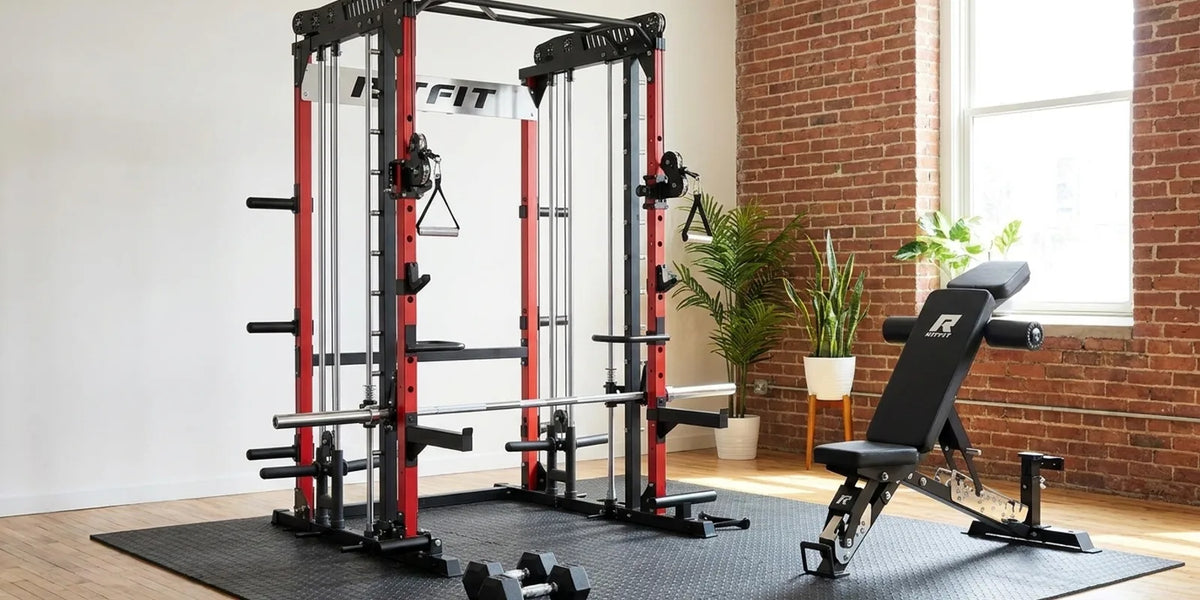
The RitFit M1 PRO runs this whole list in one station, since its guided Smith bar and adjustable hooks handle every hinge and split squat variation here. Its built-in cable crossover system answers the leg curl question as well, so curls happen next to the hinges instead of on a separate machine.
- Worth it if: Your home gym wants hinges, biased squats, and leg curls handled by one footprint.
- Pass if: You already own a full rack and cable stack that cover bar travel and curls.
Still shopping hardware? The Smith machines collection shows every frame in the lineup, and the M1 home gym package bundles the bench and plates these moves need.
"M1 Pro is extremely well built. Easy to install. The weight stacks are a must and enhance the performance. Very satisfied. Should have purchased much sooner."
Anthony G. Verified Buyer, RitFit M1 PRO Smith Machine Weight Stack Home Gym Package
How to Program These Exercises: Sets, Reps, and Progression
Two focused hamstring sessions per week fit most home lifters, with three to four sets of six to ten reps on the hinge patterns. Run split squats and lunges for eight to twelve reps per side, and add load only when every rep keeps the same tempo and back position.
- Weight selection: Start hinges with an empty bar plus light plates and pick a load you can pause with at the bottom of the stretch.
- Progression: Add the smallest plate you own once the top of the rep range feels routine for two sessions in a row.
- Frequency: Train the pattern twice a week with at least two rest days between hinge sessions.
Swapping Movements Without Losing the Pattern
Any swap should stay inside the same family, so trade hinge for hinge and single-leg pattern for single-leg pattern. On the road, our hamstring exercises without machines guide keeps the hip extension emphasis with no equipment at all.
"My wife wanted some quality dumbbells for a decent price and these hit the mark on both points. She loves them and is happy we ordered them."
Daniel H. Verified Buyer, RitFit Rubber Hex Dumbbells Pairs and Sets
Common Mistakes and When to Stop
Most smith machine hamstring setbacks start as form drift in the hinge family, and the fixes are small setup changes rather than new exercises. The three habits below are the ones that show up most often across the seven moves.
- Adding load before range: Lifters chase heavier bars before hinge depth holds up, and the lower back pays for it first. Earn the range first, then earn the load.
- Bouncing out of the stretch: The bottom of a hinge is the valuable part of the rep, so lower under control instead of rebounding.
- Ignoring the pain line: Dull stretch discomfort belongs to the movement and sharp posterior thigh pain does not, and the difference decides whether you rack the bar.
Nearly one-third of people who tear a hamstring reinjure within a year of getting back to sport. Sharp posterior thigh pain during a rep is the classic strain sign, so rack the bar immediately and let a clinician clear the return to loading.
FAQs About Smith Machine Hamstring Exercises
Can you build your hamstrings with only a smith machine?
Yes, as long as you lean on hip hinge patterns like Romanian deadlifts, good mornings, and single leg variations, which train the hamstring long heads through hip extension and respond well to progressive loading. What the machine cannot do is load knee flexion, so add a cable leg curl when you can.
What smith machine exercise is best for hamstrings?
The smith machine Romanian deadlift is the anchor movement because it loads the hamstrings in their lengthened position at the hip and lets you add weight safely without a spotter. Good mornings and single leg variations then round out the pattern from different angles each week.
How do you target hamstrings instead of quads on a smith machine?
Push your hips back and let the knees stay soft but quiet, because shifting the feet further forward moves joint torque toward the knees and grows the quads instead. Long strides and a slight forward lean on split squats and lunges shift demand back toward the hip extensors.
Do you need a leg curl machine if you have a smith machine?
No, not at first, since hinge work covers the hip extension job of the hamstrings well. For complete development though, knee flexion work reaches the short head of the biceps femoris and the lower end of the muscle near the knee, so a lying or seated leg curl rounds out the picture.
How often should you train hamstrings?
Two focused sessions per week works well for most home lifters, for example three to four sets of six to ten reps on hinges plus eight to twelve reps on split squats or lunges. Add a small load increase only when every rep keeps the same tempo and back position.
Are smith machine Romanian deadlifts good for hamstrings?
Yes, the fixed bar path keeps the load over your midfoot so the hamstrings and glutes do the work while your balance demands stay low. Keep the bar close, push the hips back, and stop the descent when your lower back starts to round.
When should you stop a hamstring exercise because of pain?
Stop the set when you feel sharp posterior thigh pain, since that is the classic sign of a hamstring strain and continuing risks a worse tear. Cut the range of motion, lighten the load, and if walking or sitting hurts afterward, rest and get it checked before loading again.
Conclusion
Smith machine hamstring work lives in the hinge family, with squat and lunge variations earning their place only when the setup pushes the demand toward the hips. Run the seven moves twice a week, add load slowly, and keep some form of leg curl in the rotation.
Ready to build the rest of the leg? Start with our full smith machine leg workout and check the RitFit discount guide before you order the next piece.
Disclaimer
This article is general training information and is not medical advice or a rehabilitation program. Consult a qualified physician or physical therapist before starting a new exercise program, especially if you have a history of hamstring or lower back injuries.
References
1. Widodo AF, Tien CW, Chen CW, Lai SC. Isotonic and Isometric Exercise Interventions Improve the Hamstring Muscles' Strength and Flexibility: A Narrative Review. Healthcare (Basel). 2022;10(5). doi:10.3390/healthcare10050811. PMCID: PMC9140507
2. Llurda-Almuzara L, Labata-Lezaun N, López-de-Celis C, et al. Biceps Femoris Activation during Hamstring Strength Exercises: A Systematic Review. Int J Environ Res Public Health. 2021;18(16). doi:10.3390/ijerph18168733. PMCID: PMC8393607
3. Dedinsky R, Baker L, Imbus S, Bowman M, Murray L. EXERCISES THAT FACILITATE OPTIMAL HAMSTRING AND QUADRICEPS CO-ACTIVATION TO HELP DECREASE ACL INJURY RISK IN HEALTHY FEMALES: A SYSTEMATIC REVIEW OF THE LITERATURE. Int J Sports Phys Ther. 2017;12(1):3-15. PMCID: PMC5294945





