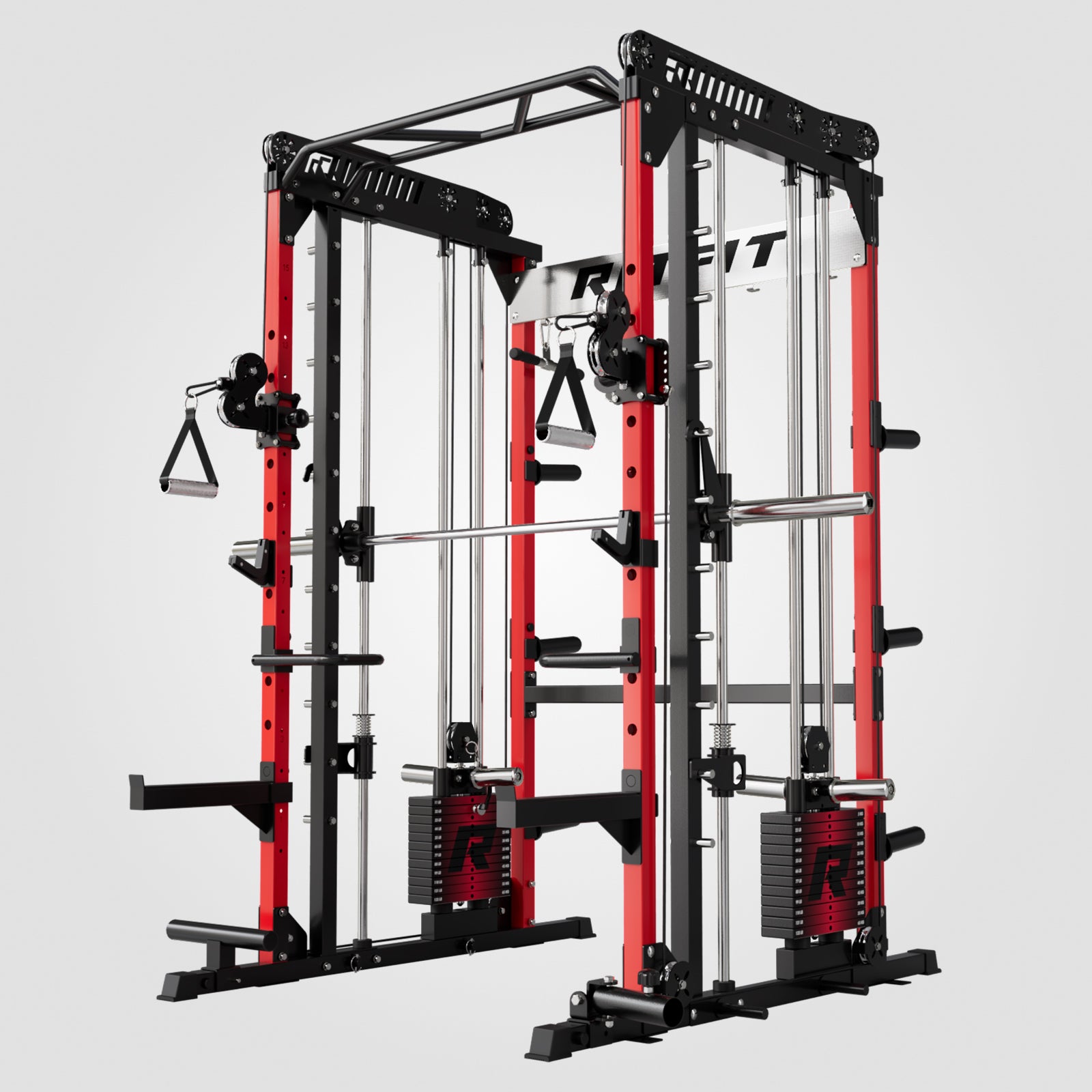
The search for the best smooth Smith machine for home gym training usually ends at one question, which guide system actually feels fluid under a loaded bar. This guide answers it with the RitFit M3 Pro, a 3x3 steel all-in-one platform that sells for $3,099.99 and packs a power rack, cable crossover, and Smith station into 21.5 sqft.
Inside, you will learn what smoothness actually is, how the M3 Pro guide system delivers it, which RitFit model fits your budget, and what ownership costs look like after checkout.
Quick Answer: The best smooth Smith machine for home gym use in 2026 is the RitFit M3 Pro, which combines a stainless quick-rack Smith system, 16 aluminum pulleys at a 2:1 ratio, and balanced 360 lb built-in stacks inside a 21.5 sqft footprint. At $3,099.99 it targets lifters who want commercial-grade smoothness without a commercial footprint.
Key Takeaways
- Smoothness is mechanical: A Smith machine feels smooth because of its guide system, consistent bar path, pulley quality, and balanced weight stack, not marketing language.
- M3 Pro guide system: Stainless hanging plates, 10 quick-rack positions, and an 86.8 in Olympic-length Smith bar deliver the guided training feel.
- Verified capacities: The frame carries a 2,500 lb static rating, the Smith module 352 lb dynamic, and the safety arms 650 lb static for solo lifting.
- Compact platform: Three stations fit a 21.5 sqft footprint with an 84 in overall height, covering users from 4 ft 9 in to 6 ft 5 in.
- Lineup placement: At $3,099.99 the M3 Pro sits at the top of the RitFit Smith machine range, with M1 Pro and M2 Pro routes for smaller budgets.
What Makes a Smith Machine Feel Smooth?
A Smith machine feels smooth when the bar travels a consistent path with minimal friction or rattle. Four components decide that feel: the guide system, the bar path, the pulleys, and the stack balance.
- Guide system: Guide rods with linear bearing carriages appear in many premium designs, while plate-style systems use hanging steel plates to hold the bar on its line. Both aim for the same result, a bar that glides instead of catching midway through a rep.
- Bar path: A fixed vertical or near-vertical path removes balance work so you can focus on load and technique. One study comparing resistance training across different stability requirements found comparable strength development between guided and free-weight execution modes[1].
- Pulleys: Aluminum pulleys with consistent cable routing keep resistance even from the first inch of travel to lockout, which is what separates a fluid cable crossover from a sticky one.
- Stack balance: A stack that moves evenly, guided by a smaller top plate and balance screws, prevents the jerky resistance changes that break rep rhythm.
Guided lifting is a legitimate primary training mode, not a compromise. In a study of elite sprinters, squats and countermovement jumps were compared directly between Smith machine and free-weight execution modes across a range of loads[2].
Smoothness also matters for safety at home, where most lifters train alone. A fixed path plus quick racking points gives you a controlled bail-out option on heavy sets, and consistent equipment behavior reduces the surprise factor mid-rep.
"Few pieces of equipment in the home exercise industry are as comprehensive and versatile as this all-in-one gym system. The robust system provides a natural, centered bar path for compound lifts like squats, presses, and rows, and incorporates a dual cable crossover station with a full rack of precision-engineered attachments."
Tom Eskey, CF-L1, CPT, Home Gym Equipment Reviewer at Garage Gym Revisited, RitFit M1 Multi-functional Smith Machine Review
Why the RitFit M3 Pro Guide System Feels So Smooth
The M3 Pro feels smooth because its plate-style Smith, balanced stacks, and aluminum pulleys share one rigid frame. Per RitFit's spec sheet, the RitFit M3 Pro mounts every component on uniform 3x3 11-gauge A36 steel uprights rated for 2,500 lb.
- Quick-rack Smith system: The Smith bar rides a plate-style system with stainless hanging plates and 10 quick-rack positions, so you can re-rack instantly at any point in a set. The 86.8 in bar is full Olympic length with a knurled grip, not a shortened replica.
- Balanced dual stacks: Each side carries a 180 lb built-in stack, 360 lb total, guided by a smaller top plate and four balance screws that keep resistance even through every rep.
- 16 aluminum pulleys: The cable crossover runs 16 aluminum pulleys at a 2:1 ratio, with 29 trolley positions that adjust single-handed between exercises.
- Uniform 3x3 steel: Front, middle, and rear posts all use the same 3x3 11-gauge tubing, where many multi-functional racks step down to lighter steel on middle and rear posts. The frame's 1,093.5 lb of steel mass keeps it planted under heavy squats and presses.
One tech outlet's coverage of the M3 series makes the same point, noting that the platform fits three stations into 21.5 square feet and backs the steel with a five-year structural warranty handled directly by the company.
For a garage lifter, that rigidity is the difference between a rack you trust at 300 lb and one you babysit. A planted frame means no rattle during heavy bench presses and cable heights that change in seconds when you superset.
"Very Solid 3x3 setup. Cables are smooth. Love that it came in pink. Great all in one piece. Hope you add more accessories and attachments for the m3 ! I use it daily!!!!"
Katharine B. Verified Buyer, M3 Power Rack Cable Crossover Smith Machine
How Smooth Is the M3 Pro for Squats, Presses, and Rows?
The M3 Pro handles heavy squats, presses, and rows with a 352 lb dynamic Smith rating and long safety arms. Static ratings reach 572 lb on the Smith module, and the 650 lb static safety arms cover solo training.
- Squats: Ten Smith bar positions and a 2,205 mm Olympic-length bar let you set catch height precisely, while the 22 in safety arms give a controlled bail-out when no spotter is around.
- Presses: Sandwich-style J-hooks rated at 650 lb static hold the bar for bench and overhead work inside the rack, and the Smith path adds a fixed-line press option for controlled overload.
- Rows and cable work: The low pulley and 29-position trolleys cover rows, flyes, and pulldowns with no plate handling between sets, thanks to the built-in stacks.
Technique and load management still matter on a guided bar. A 2025 review of resistance training injuries identifies improper technique and excessive loading as key contributing factors and recommends managed progressive overload[3].
Home equipment safety also depends on supervision. A US emergency department study estimated about 70,302 mechanical home exercise equipment injuries over 2007-2011 and found unsupervised children at higher risk[4], which matters when a rack lives in a shared family space.
"This machine is fabulously sturdy and gives the opportunity to do a complete body workout in one place!"
Charla W. Verified Buyer, M3 Power Rack Cable Crossover Smith Machine
How Much Space Does an All-in-One Home Gym Rack Need?
The M3 Pro needs a 21.5 sqft footprint and 84 in of vertical clearance including its pull-up bar. It measures 60.4 in wide and 86.5 in long, and suits users from 4 ft 9 in to 6 ft 5 in.
- Garage corner: The 21.5 sqft platform fits a parked-SUV-sized floor area, so one corner of a one-car garage can hold a power rack, cable crossover, and Smith station at once.
- Basement fit: The highest upright hole sits at 78 in, which keeps J-hooks and safety arms usable under ceilings that stop most full-size rigs.
- Room to work: Leave clearance around the frame for a bench during presses and for the Quick Mount Landmine during rotational work.
The platform shares its layout with the M3 Home Gym Smith Machine with Cable Crossover, and full dimensions are published on the official M3 Home Gym Smith Machine page.
Which RitFit Smith Machine Should You Buy in 2026?
RitFit's lineup splits by budget: M1 Pro for entry budgets, M2 Pro for mid-range, and M3 Pro for maximum capacity. The comparison below uses RitFit's own published specifications.
| Model | Price | Smith Type | Built-in Stack | Steel | Frame Capacity | Footprint | Cable Positions |
|---|---|---|---|---|---|---|---|
| M1 Pro with Stack | $2,199.99 | Basic Smith | 264 lb | 2x2 14-gauge | 1,600 lb | 20.9 sqft | 15 |
| M2 Pro | $2,799.99 | Basic Smith | 286 lb | 2.36x2.36 13-gauge | 2,000 lb | 22.8 sqft | 16 |
| M2 Pro 3D | $3,099.99 | 3D Smith | 286 lb | 2.36x2.36 13-gauge | 2,000 lb | 22.8 sqft | 16 |
| M3 Pro | $3,099.99 | Basic Smith | 360 lb | 3x3 11-gauge | 2,500 lb | 21.5 sqft | 29 |
Source: RitFit product page comparison specifications.
- First serious home gym: The RitFit M1 Pro Smith Machine Weight Stack Package delivers a 264 lb stack and guided lifting at $2,199.99.
- Floating bar path fans: The M2 Pro 3D adds a 3D Smith that travels in multiple planes, inside the RitFit M2 modular Smith Machine family at the same $3,099.99 price as the M3 Pro.
- Maximum capacity and stability: The M3 Pro is the only option in the table with uniform 3x3 11-gauge steel, a 2,500 lb frame rating, and 29 cable positions.
- Value-first platform: The RitFit Buffalo Smith Machine package with weight stack remains a lower-cost route into all-in-one training.
You can compare every current option on the Smith Machine collection page, or browse multifunctional Smith Machines for other form factors.
For a real owner's view of the entry-level platform, RitFit's channel follows one lifter's training journey with the RitFit M1 Smith Machine.
Is the RitFit M3 Pro Worth $3,099.99?
The M3 Pro justifies $3,099.99 for lifters wanting three stations and 360 lb of built-in stacks in one compact frame. At the time of writing it sells for $3,099.99 against a regular price of $3,399.99, with free continental US shipping.
- What the price includes: power rack, cable crossover, Smith station, 360 lb of stacks, sandwich J-hooks, extended safety arms, a knurled carbon-steel pull-up bar, storage rods, a rear pegboard, and a Quick Mount Landmine in one crate.
- Who should buy: advanced home lifters, heavier trainees, and shared family gyms that need three stations inside a 21.5 sqft footprint.
- Who should step down: once-a-week lifters and tighter budgets are better served by the RitFit Home Gym Package M1 Smith Machine or the compact BPC06 All-in-One Smith Machine package.
- Costs after checkout: The built-in stacks feed the cable stations, so plan on Olympic plates over time for Smith bar and rack work. Four storage rods are already built in to hold them.
Measured as spec per dollar, the M3 Pro compares within RitFit's own range rather than against outside brands. If a full machine is more than your room allows, the RitFit PSR05 Smith Machine package offers a rack-based alternative.
"Very Solid 3x3 setup. Cables are smooth. Love that it came in pink. Great all in one piece. Hope you add more accessories and attachments for the m3 ! I use it daily!!!!"
Katharine B. Verified Buyer, M3 Power Rack Cable Crossover Smith Machine
What About Warranty and Long-Term Ownership Costs?
The M3 Pro carries a 5-year steel warranty, a 2-year wearing parts warranty, and direct service from RitFit. Claims are handled by the company itself rather than third-party resellers.
- Coverage: Five years on steel frame parts and two years on wearing parts like cables, pads, and hardware.
- Returns and delivery: A 35-day return window and free continental US shipping, with everything arriving in one wooden crate so parts do not scatter across carriers.
- Maintenance: Actual noise and smoothness depend on assembly quality, floor surface, and regular maintenance, per RitFit's own product guidance.
- Expansion: Four 11.8 in storage rods rated 330 lb static each, a 10-hook rear pegboard, and a Quick Mount Landmine slot let the rack grow without new floor space.
Long-term cost planning comes down to plates and attachments rather than the machine itself. Buy the frame once, add weight as your total training volume earns it.
FAQs About Smooth Smith Machines
What makes a Smith machine feel smooth?
Smoothness comes from the guide system, not the weight stack. Consistent guide rods or plates, a balanced stack that moves evenly, quality pulleys, and precise racking points all reduce friction and rattle. A smooth machine lets you focus on the rep instead of fighting sticky spots, wobble, or catching during squats and presses.
Does the RitFit M3 Pro come with weight stacks?
Yes. Each side of the M3 Pro includes a 180 lb built-in weight stack, 360 lb total, made of 18 plates at roughly 10 lb each. The stack uses a smaller top plate with four balance screws so resistance stays even through every rep, and a 2 to 1 cable ratio keeps cable work smooth.
How much weight can the M3 Pro Smith machine hold?
The Smith bar is rated for 352 lb dynamic and 572 lb static use, while the full A36 steel frame carries a 2,500 lb static capacity. Safety arms hold 650 lb static and J-hooks are rated 650 lb static each, so the rack covers heavy squats, presses, and rack pulls for most home lifters.
How much space does the M3 Pro need?
The M3 Pro fits a power rack, cable crossover, and Smith machine into a 21.5 sqft footprint, roughly the floor space of a parked SUV. The rack stands 84 in tall including the pull-up bar and suits users from 4 ft 9 in to 6 ft 5 in, which fits most garages and basements.
Is the RitFit M3 Pro good for beginners?
The M3 Pro is built for advanced lifters and heavier training, but the guided Smith system, 10 Smith bar positions, and 29 cable trolley positions make it usable across skill levels. Beginners get a fixed bar path and built-in safety points, although the size and price suit buyers planning a long-term home gym.
What warranty does the RitFit M3 Pro have?
RitFit covers the M3 Pro with a 5-year warranty on steel frame parts and a 2-year warranty on wearing parts like cables, pads, and hardware. Service is handled directly by RitFit rather than third-party resellers, and the company offers 35-day returns plus free shipping within the continental United States.
Conclusion
The best smooth Smith machine for home gym training is the one whose guide system, pulleys, and stack balance you can verify on a spec sheet. The RitFit M3 Pro puts all three in writing, pairing a stainless quick-rack Smith with balanced 360 lb stacks inside a 2,500 lb rated 3x3 steel frame.
Measure your space, list the lifts you actually train, and choose the RitFit model that matches both. Before checkout, check current offers on the RitFit discount guide.
Disclaimer
This article is for general fitness information only and does not provide medical, training, or professional advice. Consult a qualified physician or certified trainer before starting any resistance training program, especially if you have pre-existing conditions, injuries, or specific health concerns.
References
1. Saeterbakken AH, Olsen A, Behm DG, Bardstu HB, Andersen V. The short- and long-term effects of resistance training with different stability requirements. PLoS One. 2019;14(4):e0214302. doi:10.1371/journal.pone.0214302. PMCID: PMC6443166
2. Loturco I, Mcguigan MR, Freitas TT, et al. Squat and countermovement jump performance across a range of loads: a comparison between Smith machine and free weight execution modes in elite sprinters. Biol Sport. 2022;39(4):1043-1048. doi:10.5114/biolsport.2022.112085. PMCID: PMC9536377
3. Kawa O, Zywiec W, Czyzewski B, et al. Most Common Injuries in Resistance Training: Mechanisms, Therapeutic Interventions, and Preventive Strategies. Cureus. 2025;17(10):e94035. doi:10.7759/cureus.94035. PMCID: PMC12591260
4. Graves JM, Iyer KR, Willis MM, Ebel BE, Rivara FP, Vavilala MS. Emergency department-reported injuries associated with mechanical home exercise equipment in the USA. Inj Prev. 2014;20(4):281-5. doi:10.1136/injuryprev-2013-040833. PMCID: PMC4306571