








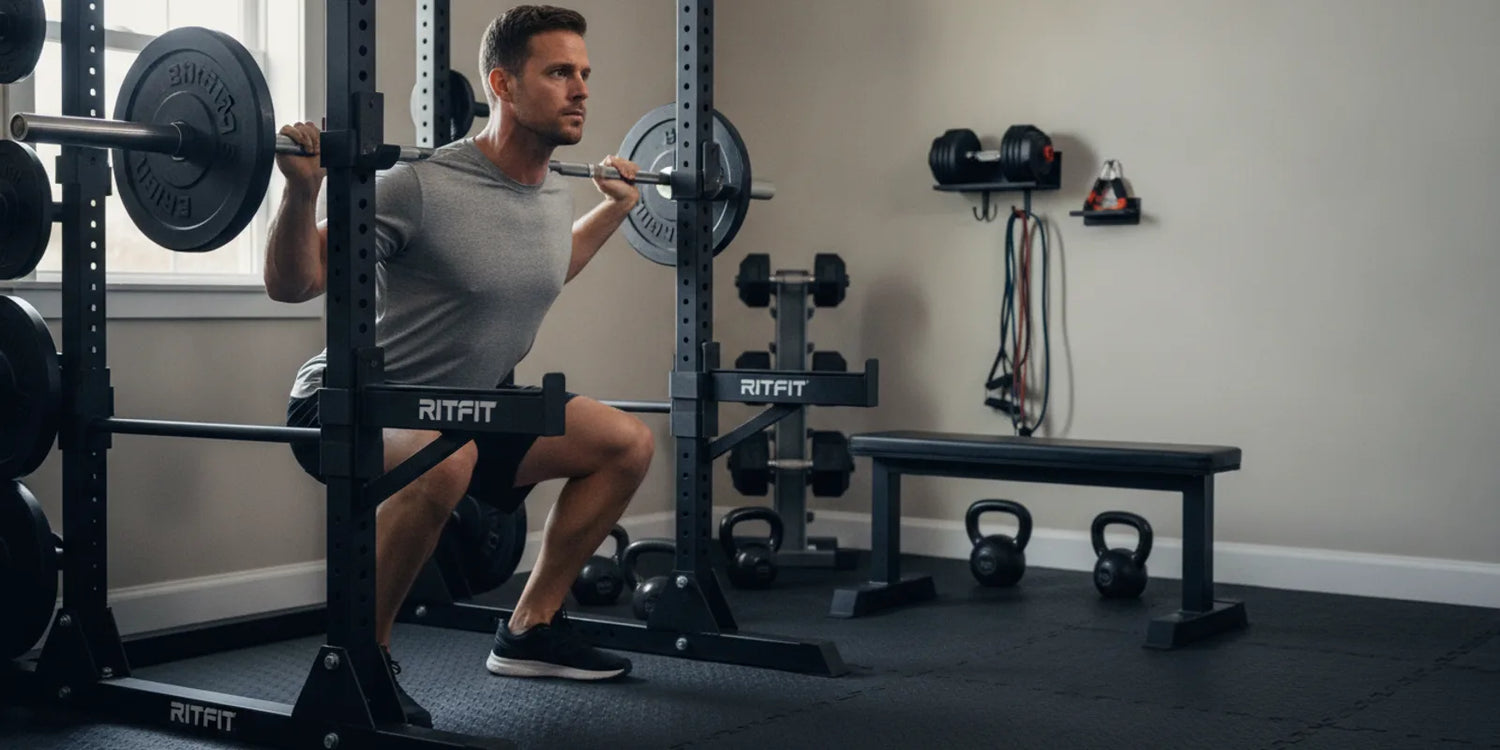
The best squat cages for 2026 give you a safe, enclosed frame for heavy barbell training at home, without needing a gym membership or a spotter standing by. Whether you are building a garage gym from scratch or upgrading from open squat stands, the right power cage transforms every major lift.
This guide covers what separates a squat cage from a squat rack, which key specs actually matter, and how to match a RitFit cage to your space, budget, and training goals.
Quick Answer: The best squat cages combine a rigid steel frame, safety bars rated for 700 to 1,200 lbs, and adjustable J-cups for back squats, bench press, and overhead press. Look for 11-gauge 3x3-inch steel for premium stability, confirm your ceiling clears the rack height by at least 12 inches, and choose a four-post design for maximum safety when lifting solo.
Key Takeaways
- Safety first: A four-post squat cage with built-in safety bars is the safest way to train heavy with a barbell when no spotter is available.
- Steel spec matters: 11-gauge 3x3-inch steel frames offer significantly greater rigidity than 14-gauge 2x2 options and are the standard for serious home gym builds.
- Space planning is essential: Most full power cages occupy around 16 to 18 square feet and require a ceiling clearance of at least 84 to 96 inches.
- Match the model to your goals: The RitFit P3 Power Cage suits serious lifters, while the folding rack suits space-constrained setups.
- Training versatility: A squat cage enables back squats, bench press, overhead press, pull-ups, deadlifts, and cable work from a single footprint.
What Is a Squat Cage and How Does It Differ from a Squat Rack?
A squat cage, also called a power cage, is a four-post steel enclosure that surrounds the lifter and includes integrated safety bars or spotter arms to catch a failed rep. A squat rack uses only two posts in an open-sided frame, which reduces footprint but removes the full-perimeter safety net a cage provides.
Power Cage: Four Posts, Maximum Safety
The four-post power cage is the standard for solo training with heavy barbell loads, because the safety bars act as a mechanical spotter on every set.
- Four vertical posts: Full enclosure means the bar has a catch point at any angle of a failed lift.
- Adjustable safety bars: Set them just below your lowest squat depth so the bar lands safely without hitting the floor.
- Attachment ecosystem: Most quality cages accept a lat pulldown, cable crossover, dip bars, and landmine attachments via the same uprights.
- Weight capacity: Premium cages are typically rated 700 to 1,200 lbs, handling loads well beyond what most home gym users will ever reach.
Squat Rack: Open Frame, Compact Footprint
A squat rack sacrifices the enclosed safety design in exchange for a smaller footprint and lower price, making it a reasonable starting point for lighter training volumes.
- Two uprights only: No side rails mean the bar can travel forward or sideways on a failed rep without a catch point.
- Lighter construction: Easier to move and store, but less rigid under heavy loads.
- Lower ceiling demand: Some squat racks fit under ceilings as low as 78 inches, which a full cage cannot.
For a deeper comparison of frame types, see our guide to Power Rack Vs Squat Rack.
Half Rack: Middle Ground
A half rack adds a rear stabilizer cross-bar to a two-post design, improving rigidity without the full four-post footprint of a power cage.
- More stable than squat stands: The cross-bar braces the structure but does not provide full side-to-side safety bar coverage.
- Good for experienced lifters: Suitable for those confident in their ability to safely bail a lift without full cage protection.
- Space efficient: Typically 20 to 30 percent shallower than a full four-post cage of comparable width.
Who Actually Needs a Squat Cage?
A squat cage is the right choice for any home gym user who trains with a barbell alone, lifts beyond 135 lbs regularly, or plans to do bench press without a spotter, because the safety bars eliminate the most dangerous outcome of a failed lift.
Beginners and Intermediate Home Gym Users
First-time home gym builders benefit most from a squat cage because the enclosed frame lets them push intensity safely while learning proper form.
- No spotter required: Safety bars make solo max-effort sets possible from the very first workout.
- Room to learn: Beginners who are still dialing in squat depth and bar path need a reliable catch point while their technique develops.
- Multi-exercise base: One cage covers squats, bench press, overhead press, and pull-ups so beginners do not need to buy multiple pieces of equipment.
Serious Strength Athletes and Powerlifters
Advanced lifters need 11-gauge 3x3-inch steel frames and high weight capacity ratings to train near their competitive maxes without the cage flexing or rattling under load.
- Heavy loading tolerance: Quality power cages rated at 1,000 to 1,200 lbs provide a comfortable buffer above any realistic working weight.
- Westside hole spacing: One-inch spacing in the bench zone allows micro-adjustments for optimal bar path on competition lifts.
- Attachment compatibility: Experienced lifters benefit from adding a cable system or lat pulldown to expand accessory exercise options within the same footprint.
Small-Space and Garage Gym Builders
Compact and folding squat cage designs let garage gym owners reclaim floor space when not training, without sacrificing safety during sessions.
- Folding wall-mount options: Some cages fold flat against the wall, reducing active footprint to near zero when stored.
- Low-ceiling variants: Shorter cage heights of 71 to 83 inches accommodate standard residential garage ceilings of around 84 to 96 inches.
- Portable enough to reposition: Lighter 2x2 steel cages in the 100 to 150 lb range can be repositioned for car access or dual-use floor areas.
See our full breakdown of the Best Squat Rack For Small Space for compact-specific options.
RitFit Squat Cage Lineup: Which Model Fits Your Goals?
The RitFit squat cage range covers three distinct needs: serious strength training with cable integration, space-efficient folding design, and entry-level budget builds, so most home gym setups can find a fit within the lineup without overpaying for unused capacity.
| Model | Steel Frame | Weight Capacity | Cable System | Best For |
|---|---|---|---|---|
| RitFit P3 Power Cage | 11-gauge 3x3" | 1,200 lb | Yes (smooth pulley) | Serious lifters, all-in-one home gym |
| RitFit Folding Squat Rack PMW02 | 2x2" steel | 700 lb | No | Small spaces, dual-use rooms, garage gyms |
| RitFit Budget Power Cage | 14-gauge 2x2" | 500 lb | No | Beginners, lighter training volumes |
Specifications based on RitFit product listings. Pricing and availability subject to change.
Best Overall: RitFit P3 Power Cage
The RitFit P3 Power Cage is built with 11-gauge 3x3-inch steel and rated to 1,200 lbs, making it the right choice for intermediate to advanced lifters who want a durable, attachment-ready cage that handles any barbell movement.
- Integrated smooth cable system: Enables cable rows, pulldowns, and crossover movements without purchasing a separate machine.
- 1,200 lb capacity: Provides a comfortable margin above the highest realistic home gym working weight.
- Attachment-ready uprights: Compatible with dip bars, landmine, and additional pulley accessories.
Best for Small Spaces: RitFit Folding Squat Rack PMW02
The RitFit Folding Squat Rack PMW02 folds flat against the wall when not in use, reclaiming nearly all of its floor footprint for garages, home offices, or living spaces that serve double duty.
- Wall-mounted fold-away design: Active footprint collapses to near zero when stored, with the rack deploying in under a minute.
- 700 lb capacity: Handles all typical home gym barbell loads including squats, bench, and overhead press.
- Adjustable height settings: Multiple J-cup positions accommodate different bar heights for squats and bench without retooling.
Best Budget Option
The entry-level RitFit budget cage uses 14-gauge 2x2-inch steel rated to 500 lbs, which is adequate for beginners and lighter intermediate training but less suitable once working weights regularly exceed 300 lbs.
- Lower price point: Accessible starting investment for first-time home gym builders not yet ready for premium steel.
- Pull-up bar included: Adds upper body work without extra accessories.
- Upgrade path exists: The 500 lb capacity ceiling means most users will eventually want to move to a heavier-gauge cage as strength increases.
Browse the full RitFit Squat Racks Collection to compare current models and pricing.
What Specs Should You Check Before Buying a Squat Cage?
The most important specs for a squat cage are steel gauge, weight capacity, hole spacing, and ceiling clearance, because these four factors determine whether the cage is safe, adjustable, and physically compatible with your space before a single bolt is tightened.
Steel Frame: Gauge and Dimensions
Equipment reviewers and coaches consistently note that 11-gauge 3x3-inch steel is the mark of a quality power cage, offering greater rigidity and longevity than lighter 14-gauge 2x2-inch frames common in budget options.
- 11-gauge 3x3 inch: Thick-walled, heavy-duty construction that handles repeated heavy loads without flex or rattle at the joints.
- 14-gauge 2x2 inch: Lighter and more affordable, suitable for beginners or moderate loads, but noticeably less rigid when approaching 300 lbs and above.
- Weld quality: Look for fully welded joints rather than bolted connections at the main post-to-foot interface for maximum long-term stability.
Adjusting bar placement and stance width affects which muscle groups a squat emphasizes, according to a peer-reviewed study of high-bar and low-bar squat kinematics, which means hole spacing that allows micro-adjustments is a genuine performance variable, not just a convenience feature.[1]
Weight Capacity: What You Really Need
Most high-quality power cages list a weight capacity of 700 to 1,000 lbs, and equipment guides suggest this range handles the realistic maximum loads of the vast majority of home gym users.
- 500 lb capacity: Adequate for beginners and lighter intermediate training.
- 700 lb capacity: Sufficient for most intermediate to advanced home gym lifters across all major compound movements.
- 1,000 to 1,200 lb capacity: Appropriate for competitive powerlifters or anyone regularly training above 400 lbs and wanting a wide safety margin.
Hole Spacing and J-Cup Compatibility
Standard hole spacing of 1 to 2 inches across the uprights allows the J-cups and safety bars to be positioned precisely for each lift, while tighter Westside-style 1-inch spacing in the bench zone gives the finest control for competition setups.
- 1-inch spacing (Westside): Allows the most precise J-cup adjustment for bench press and is the standard on premium cages.
- 2-inch spacing: Common on mid-range cages, still accurate enough for home gym squatting and pressing.
- J-cup material: UHMW-lined J-cups protect bar finish and reduce noise; bare steel J-cups are functional but harder on knurling over time.
See our reference guide to Squat Rack Dimensions for specific height and depth measurements by frame type.
Safety Arms and Spotter Bars
Pin-pipe safety bars are the most common and affordable safety attachment, while bolt-on spotter arms extend outward for lifts performed partially outside the cage such as bench press or floor press.
- Pin-pipe safeties: Slide horizontally through post holes, set them at the correct depth for your squat or bench, and they catch the bar reliably on a failed rep.
- Spotter arms: Extend outward from the cage uprights, ideal for bench press where the bar path may not align perfectly with the safety rail inside the cage.
- Setting height correctly: Safety bars should sit one to two inches below the lowest point of your squat so you can dump the bar without bouncing it off the floor.
Ceiling Height and Footprint Requirements
Equipment guides note that most standard power cages fit under a ceiling height of 96 inches and occupy a footprint of roughly 16 to 18 square feet, but you need additional clearance on all sides to load the bar and move safely around the rack.
- Minimum ceiling clearance: Leave at least 12 inches of overhead clearance above the rack's stated height for pull-up bar use and comfortable bar racking.
- Side clearance: Allow at least 2 feet on each side of the cage for safe barbell loading and unloading.
- Total floor area: Budget a minimum of 8 feet by 6 feet for the cage plus operating space around it.
Attachments and Future Upgrades
A squat cage with an open-standard 3x3 or 2x2 upright accepts bolt-on accessories that expand training options without requiring a second machine purchase.
- Lat pulldown: Adds vertical pulling to the cage footprint with a cable system installed on the top crossbar.
- Dip bars: Bolt into the uprights at chest height for tricep dips, Bulgarian split squats, and L-sit holds.
- Belt squat attachment: The RitFit AT03 Belt Squat Attachment converts compatible 2x2, 2x3, and 3x3 racks into a belt squat station for leg work without spinal loading.
- Hack squat rack attachment: The RitFit AT02A Hack Squat Rack Attachment adds a guided hack squat motion to existing cage uprights.
Is a Squat Cage Worth the Investment?
A squat cage is worth the investment for any lifter who trains consistently with a barbell, because the one-time equipment cost replaces a recurring gym membership while adding safety, convenience, and training availability that a commercial gym cannot match for solo sessions.
"The squat and bench press are the two lifts most people care about most, and they both require a rack. If you want to get strong, you need a rack."
Greg Nuckols, MA, Strength Researcher and Coach, Stronger By Science
Cost Per Year vs. Gym Membership
A quality squat cage purchased once and used for many years typically costs less per year than a mid-range gym membership, with no commute, no wait times, and full availability at any hour.
- One-time purchase: A mid-range power cage spread over years of use results in a modest annual cost that most gym memberships exceed within a few months.
- Gym membership comparison: Commercial gym fees accumulate monthly without guaranteeing access to a squat rack when you arrive during peak hours.
- Training consistency benefit: A study found that squat training produced significant lower body strength gains over 6 weeks of consistent training, and access to your own rack removes every scheduling barrier to that consistency.[2]
Long-Term Upgrade and Expansion Costs
The long-term cost of a squat cage ecosystem extends beyond the initial frame purchase to include barbell, weight plates, flooring, and optional attachments, so planning total build cost from the start avoids budget surprises.
- Barbell and plates: A standard 45 lb Olympic barbell and 300 lb plate set typically adds $250 to $500 to the initial build cost.
- Gym flooring: Rubber mats or interlocking flooring tiles protect concrete and reduce noise, adding $100 to $300 for a standard cage footprint area.
- Attachments over time: Budget $50 to $200 per attachment as training evolves, since a quality 3x3 cage upright can accept accessories for years after purchase.
- Cage longevity: Premium 11-gauge steel cages from quality manufacturers are designed as a buy-once investment with no planned obsolescence in the frame itself.

How to Set Up Your Squat Cage Safely
Setting up a squat cage safely requires measuring your floor space and ceiling clearance before assembly, anchoring or ballasting the base before any loaded lift, and setting safety bars to the correct height for each specific exercise.
Space Requirements: Measuring Your Area
Measure the floor area and ceiling height of your intended gym space before ordering any cage, since most returns are due to sizing mismatches that a 5-minute measurement would have prevented.
- Floor dimensions: Measure length and width of the open area, then subtract the cage footprint to confirm at least 2 feet of clearance remain on all four sides.
- Ceiling height: Measure from floor to the lowest obstruction (beams, joists, ductwork) rather than to the open ceiling, then add 12 inches over the cage height to confirm pull-up bar clearance.
- Door clearance: Confirm that the cage height allows it to pass through your entry door if assembly is done outside the gym room.
Reference our guide to Squat Rack Dimensions for model-specific footprint and height data.
Anchoring and Flooring
Flat-foot cage designs are stable without floor anchoring for most home gym use, but anchoring to concrete or using a weighted base plate is strongly recommended for any heavy barbell work in garages or on uneven surfaces.
- Concrete anchor bolts: Most effective method on garage floors, using 3/8-inch expansion anchors through the cage base plate into concrete.
- Weight plate base: Stacking 45 lb plates on the cage feet provides sufficient ballast for moderate loads without permanent floor modification.
- Rubber flooring first: Install interlocking rubber gym tiles under and around the cage before mounting, as post-installation flooring is nearly impossible to fit neatly.
Safety Bar Height Setup
The safety bars should be set one to two inches below the bar's lowest point at the bottom of your squat, so the bar lands on the safeties rather than collapsing onto you on a failed rep.
- Squat setup: Unrack the bar, squat to your normal depth, note the bar height at the bottom, then set safeties one to two inches lower than that point.
- Bench press setup: Lie on your bench, lower the bar to your chest, and set safeties at that height so the bar rolls onto the safeties if you lose control.
- Test without weight: Always test the safety bar height with the empty bar before loading plates to confirm the catch point is correct.
For complete technique guidance, see How To Use A Squat Rack.
What Exercises Can You Do in a Squat Cage?
A squat cage supports every major compound barbell movement plus a range of bodyweight and cable exercises, making it the highest-return single piece of equipment in any home gym by exercises-per-square-foot.
- Back squat: The primary use case, with safety bars catching any failed rep at full depth.
- Front squat: The clean grip or cross-arm position requires the same safety bar setup as a back squat. EMG data found greater quadriceps activation in free-weight front squats compared to machine-based leg exercises.[3] See our form guide on How To Do A Front Squat.
- Bench press: Set the J-cups at the correct height and the safety bars one inch below chest level for safe solo pressing.
- Overhead press: Standing or seated, the cage uprights provide a rack height for the starting position without a separate press station.
- Barbell row: The cage functions as a barbell storage point for loading, and the safety bars double as a dead-stop surface at knee height for strict row resets.
- Pull-up: Most cages include an integrated pull-up bar on the top crossbar, covering vertical pulling without a wall-mounted bar.
- Deadlift: The cage interior gives enough depth for a standard deadlift setup, with the safety bars usable as a pin-pull starting position for rack pulls.
If you are new to barbell training, start with our guide on How To Squat With A Bar For Beginners before your first loaded session in the cage.
To understand the strength differences between squat variation styles, see our breakdown of Hack Squat Vs Barbell Squat.
FAQs About Best Squat Cages
What is the difference between a squat cage and a squat rack?
A squat cage has four vertical posts that fully enclose the lifter, with integrated safety bars to catch the bar on a failed rep. A squat rack uses two posts in an open design, offering less protection but a smaller footprint. For solo heavy lifting, the four-post cage is the safer choice.
How much ceiling height do I need for a squat cage?
Most squat cages require a ceiling height of at least 84 to 96 inches to fit the rack and allow safe bar racking, so add 12 inches of overhead clearance above the stated cage height for pull-up bar use. Always measure to the lowest obstruction, not the open ceiling, before ordering.
What weight capacity should I look for in a home gym squat cage?
A cage rated 700 to 1,000 lbs is more than sufficient for most home gym users, including intermediate and advanced lifters. Beginners can start with a 500 lb rated budget cage, but most users outgrow that capacity within two to three years of consistent strength training progress.
Is 11-gauge or 14-gauge steel better for a squat cage?
11-gauge steel with a 3x3-inch frame is the premium standard for squat cages, offering greater rigidity and durability under heavy loads. 14-gauge 2x2-inch steel is more affordable and suits lighter training, but noticeably flexes more when working weights regularly exceed 250 to 300 lbs.
Can I use a squat cage without bolting it to the floor?
Many flat-foot squat cage designs are stable without floor anchoring for typical home gym use. Anchoring to concrete or using a weight plate base is strongly recommended for heavy barbell work in garages or on uneven surfaces, as it eliminates any possibility of the cage shifting under load.
What exercises can I do in a squat cage besides squats?
A squat cage supports back squats, front squats, bench press, overhead press, barbell rows, deadlifts, pull-ups, and dips. With optional attachments such as a cable pulley system, lat pulldown, or belt squat attachment, a single cage becomes a comprehensive training station for nearly every major movement pattern.
How much space does a squat cage take up?
A standard four-post power cage typically occupies around 16 to 18 square feet of floor space, roughly 4 feet wide by 4 feet deep. Budget at least 2 to 3 feet of clearance on each side for safe barbell loading, making the total recommended floor area approximately 8 feet by 8 feet.
Conclusion
The best squat cages pair a rigid steel frame with the right capacity and footprint for your space, turning any garage or basement into a safe, complete training environment. Prioritize 11-gauge 3x3 steel if your budget allows, confirm ceiling clearance before ordering, and set your safety bars correctly from the first session.
Ready to build your home gym around a quality power cage? Browse the full RitFit Squat Racks Collection to find the right model for your space and training goals.
Disclaimer
The information in this article is intended for general fitness and equipment guidance purposes only and does not constitute professional fitness, medical, or safety advice. Always consult a qualified fitness professional or structural engineer before installing and loading heavy gym equipment in your home.
Save on your next RitFit order
Tap the button to copy your code, then paste it at checkout.
References
1. van den Tillaar R, Andersen V, Saeterbakken AH. Effects of Stance Width and Barbell Placement on Kinematics, Kinetics, and Myoelectric Activity in Back Squats. Front Sports Act Living. 2021;3:719005. doi:10.3389/fspor.2021.719005. PMCID: PMC8440835
2. Nigro F, Bartolomei S. A Comparison Between the Squat and the Deadlift for Lower Body Strength and Power Training. J Hum Kinet. 2020;73:145-152. doi:10.2478/hukin-2019-0139. PMCID: PMC7386153
3. Bautista D, Durke D, Cotter JA, Escobar KA, Schick EE. A Comparison of Muscle Activation Among the Front Squat, Overhead Squat, Back Extension and Plank. Int J Exerc Sci. 2020;13(1):714-722. doi:10.70252/BTUH3630. PMCID: PMC7241624





