








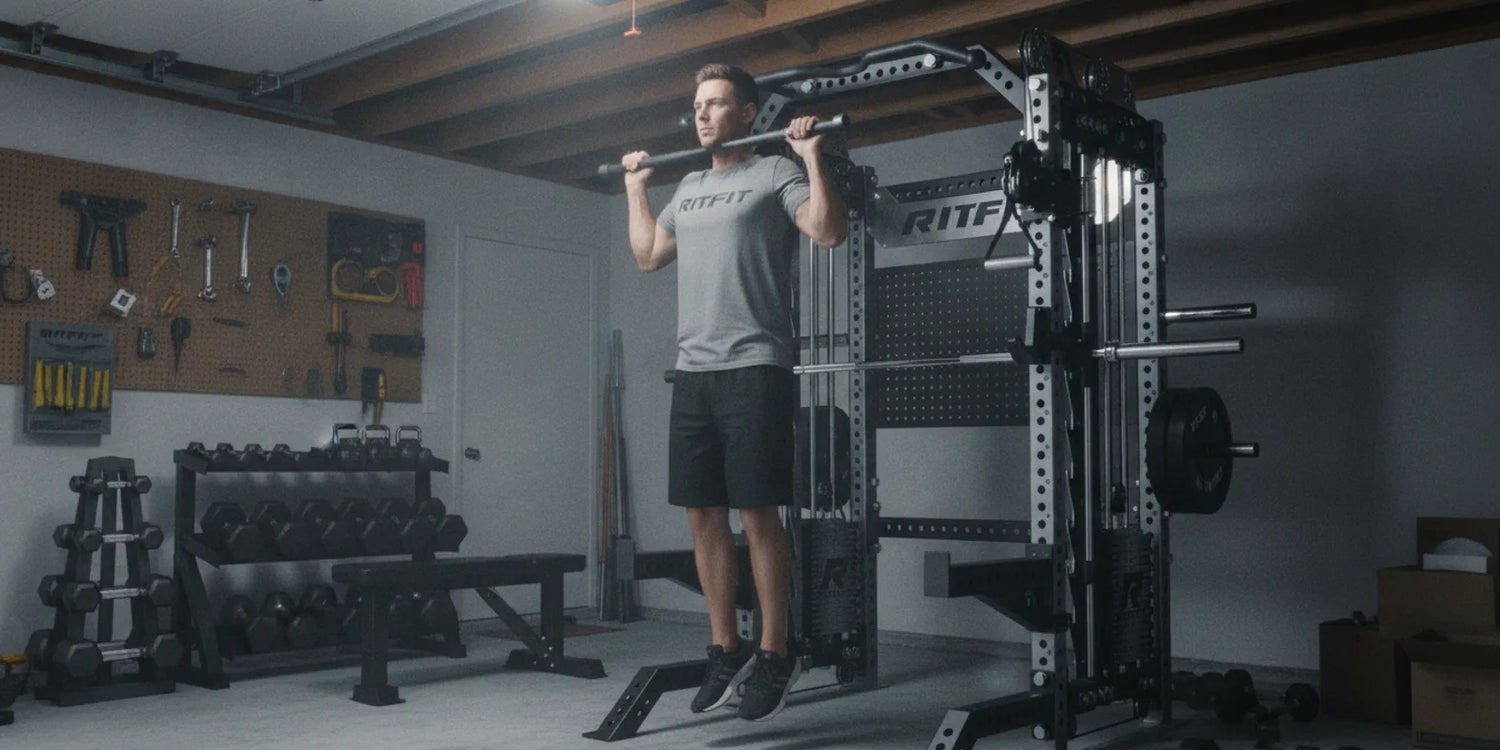
The best workout cage for a small home gym is a compact power cage such as the RitFit P3. It fits a squat station, bench setup, pull-up bar, and cable system into about 17.5 square feet, so you get full cage functionality without needing a dedicated garage.
This guide is written for small space lifters training in an apartment, one car garage, or low ceiling basement. It compares real footprint numbers, ceiling height, exercise variety, and price, so you can pick equipment that actually fits your room.
Quick Answer
The best workout cage for a small home gym is a compact model like the RitFit P3 Power Cage. It needs about 17.5 square feet of floor space and 81 inches of height, works with roughly 8 feet of ceiling clearance for pull-ups, covers squats, bench, and cable training in one frame, and costs about $720.
Key Takeaways
- Footprint: The RitFit P3 Power Cage needs about 17.5 square feet of floor space, small enough for a one car garage corner or a basement nook.
- Ceiling clearance: Plan on at least 8 feet of ceiling height for an 81 inch tall cage so pull-ups do not feel cramped.
- Attachments save floor space: A hack squat, belt squat, or hip thrust attachment adds a new exercise to an existing rack with zero extra footprint.
- No spotter required: Adjustable safety bars let you train alone and still catch a failed squat or bench rep.
- Budget range: A full compact cage runs about $720, while individual space saving attachments run roughly $110 to $260.
What Makes a Workout Cage the Best Fit for a Small Home Gym?
The best workout cage for a small home gym is the one whose footprint and ceiling clearance actually match your room, not the one with the highest weight rating. Home-based resistance training with the right equipment can effectively maintain strength without a commercial gym membership.[1]
- Footprint that fits the room: A small-space cage should list an exact base footprint, not just a vague "compact" label.
- Ceiling clearance: The frame height plus your own height should leave room for a full pull-up.
- Room to add attachments later: Extra rack holes let you bolt on a hack squat or belt squat unit without buying a second machine.
The RitFit P3 Power Cage checks all three boxes for most small home gyms. Browse the full power cage lineup if you need a slightly larger or smaller footprint.
How Much Space Does a Power Cage Actually Need?
A power cage sized for a small home gym needs roughly 15 to 20 square feet of floor space and at least 7 to 8 feet of ceiling height. The RitFit P3 fits that range with a 67.2 inch by 59.1 inch base, about 17.5 square feet, and an 81 inch frame height.
- Floor footprint: Measure the exact base, not the overall product page dimensions, since some listings include the padded floor mat.
- Ceiling clearance: Add at least 12 inches above the frame height for a comfortable pull-up bar path.
- Loading clearance: Leave 2 to 3 feet on the open side of the cage for loading and unloading plates.
If even a 17 square foot footprint will not fit your room, a standalone strength machine may suit your space better than any cage. Compare options in the strength machines collection before committing to a rack.
RitFit P3 Power Cage vs. Attachment-Based Racks: Which Fits a Tight Room?
Choose the RitFit P3 Power Cage if you have one dedicated 17.5 square foot spot and want squats, bench, pull-ups, and cable training in a single frame. Choose attachment-based racks such as the hack squat or belt squat unit if you already own a compatible rack and want new exercises without claiming additional floor space.
| Option | Extra Floor Space | Height Adjustment | Price | Best For |
|---|---|---|---|---|
| RitFit P3 Power Cage | About 17.5 sq ft | 81 inch frame | $719.99 | All-in-one squat, bench, pull-up, and cable station |
| AT02A Hack Squat Attachment | None, mounts on existing rack | 7 adjustable positions | $259.99 | Adding hack squat work without a second machine |
| AT03 Belt Squat Attachment | None, mounts on existing rack | Adjustable pin height | $109.99 | Lower back friendly squats and rows |
| PAT01 Hip Thrust Attachment | None, mounts on the P3 cage | Fixed pad height | $129.99 | Hip thrusts and seated curls without a bench |
Prices and dimensions reflect RitFit product listings at time of publication and may change.
The hack squat rack attachment and belt squat attachment add two more exercises to a rack you already own, and the hip thrust and bicep curl attachment does the same for a P3 cage. Browse the full rack attachments collection to see every option that adds capability without adding footprint.
What Exercises Can You Do in a Compact Power Cage?
A compact power cage covers the major compound lifts and more. It handles back and front squats, rack pulls, overhead press, bench press off the J-hooks and safety bars, strict pull-ups on the integrated bar, and cable moves like rows and curls through the pulley system.
Free-weight squat variations performed inside a rack activate the quadriceps and posterior chain more than machine-based isolation moves.[2] Adding a resistance band loop above the knees during squats increases glute activation without changing squat depth or knee mechanics.[3]
- Squat family: Back squat, front squat, overhead squat, and pin squats using the adjustable safety bars.
- Press and pull: Overhead press, bench press off J-hooks, and strict or band assisted pull-ups.
- Cable work: Rows, curls, tricep pushdowns, and cable crossovers through the built-in pulley system.
For form cues on two of the moves above, see our bench press guide and our dips workout guide for using the pull-up bar and attachments for dips.
Do You Need a Spotter When Training Alone in a Home Cage?
No, you do not need a spotter to train safely in a home power cage. Properly set adjustable safety bars are built to catch a failed squat or bench rep, which is the entire reason a cage exists for solo training.
"What I advise in most cases is, instead of looking for a spotter to take you through those areas of a lift that are more difficult, think of other ways you can improve your ability to complete that lift, if strength is your goal."
Jeff Cavaliere, MSPT, CSCS, Athlean-X
Set the safety bars just below your lowest squat depth, or just above your chest for bench press, so a missed rep stops the bar within an inch or two of travel.
How Much Should You Budget for a Small-Space Power Cage?
Budget about $700 to $750 for a full compact power cage like the RitFit P3, plus $110 to $260 per attachment if you add hack squat, belt squat, or hip thrust movements later. Loading strategy matters more than the price tag once the rack is in place.
Network meta-analytic evidence shows that training loads at or above roughly 60% of one-rep max drive greater strength gains than lighter loads, while hypertrophy gains stay similar across a wide load range when sets are taken close to failure.[4]
- Spend first on safety bars and J-hooks: These are the parts you load into every session, so quality here pays off immediately.
- Add attachments as your program grows: A hack squat or belt squat attachment is cheaper than buying a second machine later.
- Skip extras you will not use: Landmine attachments and extra pegs are nice to have but are not worth the budget in a tight space.
The RitFit P3 Power Cage in pink offers the same footprint with a different finish if color matters to you. Pair your new cage with our metcon workouts guide for circuit-style sessions that suit a single small-space setup.
FAQs About the Best Workout Cage for Small Home Gyms
What is the best workout cage for a small home gym?
The RitFit P3 Power Cage is the best fit for most small home gyms, since its 17.5 square foot footprint and 81 inch height clear a standard garage or basement corner, while still supporting squats, bench work, pull-ups, and cable training in one frame, without needing a dedicated workout room.
How much ceiling height do you need for a power cage?
Plan on at least 7 to 8 feet of ceiling clearance for a cage around 81 inches tall, which leaves enough headroom for pull-ups without the bar path feeling cramped, and gives a little extra room for a pull-up bar attachment or ceiling mounted light fixture.
How much floor space does a power cage need?
A compact cage like the RitFit P3 needs about 17.5 square feet of floor space, roughly a 5.5 foot by 5 foot area, plus 2 to 3 feet of clearance on the open side for loading and unloading weight plates during a normal training session.
Is a rack attachment better than a full cage for a tight space?
If you already own a compatible rack, attachments like a hack squat or belt squat unit add new exercises with zero extra footprint, which makes them the better choice once your floor space is already fully used by an existing rack or bench.
What exercises can you do in a compact power cage?
A compact cage covers squats, rack pulls, overhead presses, and bench press using J-hooks and safety bars, plus pull-ups on the integrated bar and cable exercises like rows, curls, and tricep pushdowns through its pulley system, covering most strength training needs.
Do you need a spotter to use a power cage safely at home?
No, a power cage's adjustable safety bars are designed to catch a failed rep so you can train alone, though new lifters should still set the safety bars close to their working range of motion before starting a heavy set.
How much does a good small-space power cage cost?
A full cage like the RitFit P3 runs about $720, while individual space saving attachments for an existing rack range from roughly $110 to $260 depending on which exercise they add, so most small home gyms can build a complete station for well under $1,000 total.
Can one power cage replace multiple gym machines?
Yes, a cage with an integrated cable system and interchangeable attachments can replace a squat rack, a bench, a pull-up station, and a cable machine, which is exactly why a single compact cage fits a small home gym better than several separate machines.
Conclusion
For a small home gym, the best workout cage is the one whose footprint and ceiling height match your actual room, not the biggest rack you can find online. The RitFit P3 Power Cage fits most apartments, garages, and basements in about 17.5 square feet, and attachments like the hack squat, belt squat, or hip thrust unit let you add exercises later without adding floor space.
Start by measuring your ceiling and floor space, then browse the rack package deals to build a complete small-space setup in one order.
Disclaimer
This article is for general educational and informational purposes only and is not medical or professional training advice. Always consult a physician before starting a new strength training program, and use a qualified spotter or properly set safety bars any time you lift near your limit.
Save on your next RitFit order
Tap the button to copy your code, then paste it at checkout.
References
1. De Maio M, Bratta C, Iannaccone A, et al. Home-Based Physical Activity as a Healthy Aging Booster before and during COVID-19 Outbreak. Int J Environ Res Public Health. 2022;19(7). doi:10.3390/ijerph19074317. https://pmc.ncbi.nlm.nih.gov/articles/PMC8998434/
2. Bautista D, Durke D, Cotter JA, Escobar KA, Schick EE. A Comparison of Muscle Activation Among the Front Squat, Overhead Squat, Back Extension and Plank. Int J Exerc Sci. 2020;13(1):714-722. doi:10.70252/BTUH3630. https://pmc.ncbi.nlm.nih.gov/articles/PMC7241624/
3. Foley RCA, Bulbrook BD, Button DC, Holmes MWR. EFFECTS OF A BAND LOOP ON LOWER EXTREMITY MUSCLE ACTIVITY AND KINEMATICS DURING THE BARBELL SQUAT. Int J Sports Phys Ther. 2017;12(4):550-559. https://pmc.ncbi.nlm.nih.gov/articles/PMC5534145/
4. Lopez P, Radaelli R, Taaffe DR, et al. Resistance Training Load Effects on Muscle Hypertrophy and Strength Gain: Systematic Review and Network Meta-analysis. Med Sci Sports Exerc. 2021;53(6):1206-1216. doi:10.1249/MSS.0000000000002585. https://pmc.ncbi.nlm.nih.gov/articles/PMC8126497/





