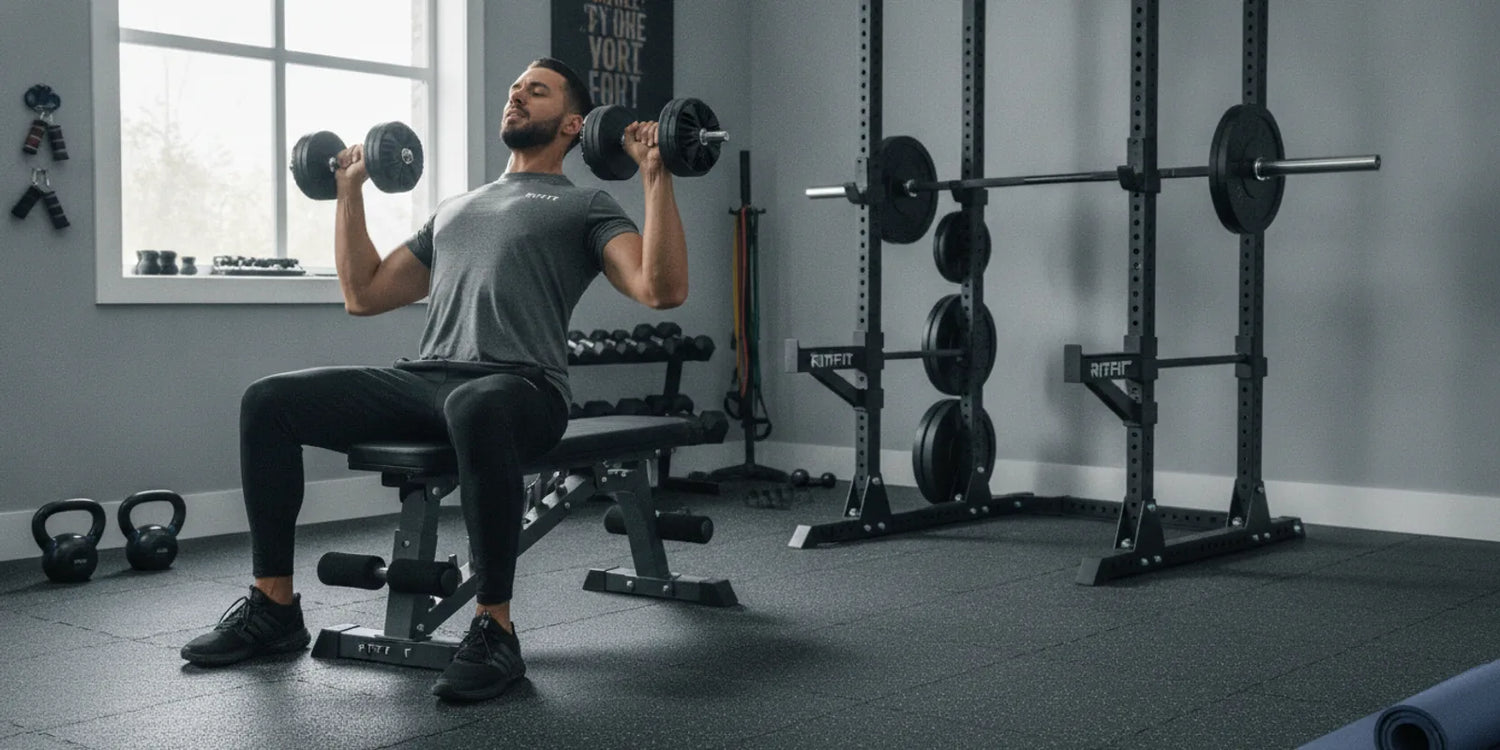
A bench workout uses one adjustable weight bench and a pair of dumbbells to train your whole body, from chest and back to legs and core. This guide gives you a complete, progressable routine you can run at home.
You will learn which bench angle hits which muscles, how to set your sets, reps and load, how to swap moves for any level, and when to add weight or stop if something hurts.
Quick Answer: A bench workout uses one adjustable weight bench and a pair of dumbbells to train your full body at home, covering presses, rows, squats, and core moves. Do two to three sessions per week with three sets of 8 to 12 reps per exercise, and add weight only when you hit every rep with clean form.
Key Takeaways
- One bench is enough: An adjustable bench plus dumbbells covers every major movement pattern for a full body session.
- Angles matter: Flat targets the mid chest, incline shifts work to the upper chest and front shoulders, decline aids core moves.
- Load by effort: Pick a weight that leaves one or two reps in reserve, since muscle grows across many loads when effort stays high.
- Progress slowly: Add the smallest weight increment only after you complete all sets and reps with clean form.
- Stop on pain: Sharp joint pain means stop the set, not push through, and reassess your form or load.
What Is a Bench Workout and Why One Adjustable Bench Is Enough?
A bench workout is a full body training session built around an adjustable weight bench, using it as a platform to press, row, squat against, and brace your core. One bench and a pair of dumbbells can replace several machines for home training.
- Versatility: Flat, incline and decline positions turn one piece of gear into a press station, a rowing support and a step platform.
- Space saving: A folding bench stores easily, making it ideal for apartments and small home gyms.
If you are building a setup, browse our adjustable weight benches and pair one with dumbbells to start. Beginners can follow our full-body workouts with a home bench for more routines.
Which Muscles Does a Bench Workout Train?
A bench workout trains the chest, shoulders, triceps, back, legs and core, with the bench angle deciding the emphasis. Flat pressing loads the mid chest and triceps, while incline pressing shifts more work onto the upper chest and front shoulders.
- Flat bench: Even chest and triceps loading for presses and bench-supported rows.
- Incline bench: Greater upper chest and anterior deltoid involvement during presses.
- Decline or low setting: A stable base for core moves and hip thrusts.
Dumbbell pressing also demands more stability than barbell pressing, recruiting extra stabilizer muscle activity to control each weight independently.[1] The bench also supports single-arm rows that build the lats and mid back.
What Exercises Make a Complete Full Body Bench Workout?
A complete full body bench workout pairs one upper body press, one back row, two lower body moves and one core exercise. This covers every major pattern in a single session lasting roughly 30 to 45 minutes.
Upper Body Moves
Use flat and incline dumbbell presses for the chest and shoulders, then add bench-supported single-arm rows for the back to balance pushing and pulling.
Lower Body Moves
Bulgarian split squats with the rear foot on the bench, bench step-ups, and bench-supported hip thrusts train the quads, glutes and hamstrings.
Core Moves
Finish with decline sit-ups on the bench and planks with feet elevated on the bench to challenge the abs and stabilizers. For more ideas, see our bench ab workout.
The follow-along video below demonstrates a 20 minute full body dumbbell and bench session you can copy at home.
For lower body focus days, our leg workouts at home with a bench add more variations.
How Many Sets, Reps and How Much Weight Should You Use?
Most lifters do well with 3 sets of 8 to 12 reps per exercise, choosing a weight that leaves one or two reps in reserve on the first set. The right load challenges the muscle without breaking your form.
- Sets and reps: 3 sets of 8 to 12 reps for upper body, 3 sets of 10 to 15 for legs.
- Choosing weight: If the last rep feels easy, go heavier, if form breaks down early, go lighter.
- Rest: Rest 60 to 90 seconds between sets for most moves.
You do not have to lift heavy to grow, as research indicates muscle can be built across a wide range of loads when sets are taken close to failure with high effort.[2] The key is genuine effort, not just the number on the dumbbell.
"With lighter loads, the first number of repetitions are very easy to complete and, if it's easy to complete, you're really not doing much for challenging. You must challenge the muscle."
Brad Schoenfeld, PhD, Exercise Science Researcher, CUNY Lehman College
Build your collection with a sturdy RitFit 1300lb adjustable weight bench so you can load presses with confidence as you progress.
How Do You Progress and When Should You Add Weight?
Add weight only after you can complete every prescribed set and rep with clean form while still feeling a rep or two in reserve. Then increase the load by the smallest available increment and rebuild your reps.
- Double progression: First add reps within your range, then add weight once you hit the top of the range.
- Small jumps: Increase by the smallest dumbbell increment, often 2 to 5 lb per hand, to keep form intact.
- Track sessions: Note your sets, reps and load so progress is deliberate, not guesswork.
For structured plans that scale over weeks, see our best bench workout routines guide.
How Can You Swap Exercises for Your Level?
You can swap any bench exercise for an easier or harder version while keeping the same movement pattern. Beginners regress to bodyweight or floor variations, while advanced lifters add range of motion or single-limb loading.
- Press swap: Trade two-dumbbell presses for a single-dumbbell version to increase the demand on one side.
- Squat swap: Replace Bulgarian split squats with bench step-ups if balance is a challenge.
- Triceps swap: Progress from bench dips to a fuller dips workout as strength builds.
Using a single dumbbell during a unilateral chest press can also allow a greater range of motion than two dumbbells, based on a study of 20 participants.[3] The folding RitFit Gator adjustable bench suits tighter spaces, and our hamstring workouts with a bench add lower body swaps.
What Are Common Bench Workout Mistakes and When Should You Stop?
The most common bench workout mistakes are flaring the elbows too wide, using momentum, and choosing a weight that wrecks your form. You should stop a set immediately if you feel sharp joint pain rather than normal muscle fatigue.
- Elbow angle: Keep elbows around 45 degrees from the body during presses to protect the shoulders.
- Control the weight: Lower for two to three seconds, avoid bouncing the dumbbells.
- Stop signals: Stop on sharp or pinching pain, dizziness, or form that fully breaks down.
Muscle soreness a day or two after training is normal, but joint pain during a lift is a signal to reduce load or check your setup.
How Often Should You Train With a Sample Weekly Split?
Most beginners train with the full body bench workout two to three times per week, leaving at least one rest day between sessions. This frequency trains each muscle group often enough while allowing recovery.
- Beginner: Two full body sessions per week, such as Monday and Thursday.
- Intermediate: Three full body sessions, like Monday, Wednesday and Friday.
- Advanced: Split into upper and lower body days across four sessions.
Rest days are when muscles repair and grow, so resist the urge to train the same pattern hard every single day.
FAQs About Bench Workouts
Can I get a full body workout with just a bench and dumbbells?
Yes, one adjustable bench and a pair of dumbbells cover every major movement pattern.
You press for the chest, shoulders and triceps, row for the back, do split squats and step-ups for the legs, hip thrusts for the glutes, and decline sit-ups for the core.
That is a complete full body session at home.
How many days per week should I do a bench workout?
Most beginners do well with two to three full body bench sessions per week, leaving at least one rest day between them so muscles can recover and adapt while still training each area often enough. As you advance you can split upper and lower body across more days, but three quality sessions is plenty to build strength.
What weight should I start with on dumbbell bench exercises?
Pick a weight that lets you complete your target reps while leaving one or two reps in reserve on the first set, since a last rep that feels easy means it is too light. If your form breaks down before you finish, the weight is too heavy, so start light and add load gradually.
Is an incline bench press better than a flat bench press?
Neither is strictly better, they emphasize different areas.
A flat bench press loads the mid chest and triceps evenly, while an incline shifts more work to the upper chest and front shoulders.
A complete bench workout includes both angles so you train the chest fully rather than favoring one region over another.
How do I know when to add more weight?
Add weight once you can complete all your prescribed sets and reps with good form and still feel you had a rep or two in reserve.
A common approach is to increase the load by the smallest available increment, then drop back a rep or two and build up again.
Progress steadily rather than jumping up too fast.
Conclusion
A bench workout turns one adjustable bench and a pair of dumbbells into a complete full body system. Press, row, squat and brace across flat and incline angles, then load each move by effort rather than ego.
Start with two or three sessions a week, progress in small steps, and stop on any sharp pain. Explore the folding RitFit Gator 1600lb adjustable bench and start training today.
Disclaimer
This article is for general informational and educational purposes only and is not medical or professional training advice. Consult a qualified healthcare or fitness professional before starting any new exercise program, especially if you have an injury or health condition.
References
1. Melani A, Gobbi G, Galli D, et al. Muscle Activation in Traditional and Experimental Barbell Bench Press Exercise: A Potential New Tool for Fitness Maintenance. Sports (Basel). 2019;7(10). doi:10.3390/sports7100224. PMCID: PMC6835758
2. Luczak J, Bosak A, Riemann BL. Shoulder Muscle Activation of Novice and Resistance Trained Women during Variations of Dumbbell Press Exercises. J Sports Med (Hindawi Publ Corp). 2013;2013:612650. doi:10.1155/2013/612650. PMCID: PMC4590897
3. Patterson JM, Vigotsky AD, Oppenheimer NE, Feser EH. Differences in unilateral chest press muscle activation and kinematics on a stable versus unstable surface while holding one versus two dumbbells. PeerJ. 2015;3:e1365. doi:10.7717/peerj.1365. PMCID: PMC4627906