








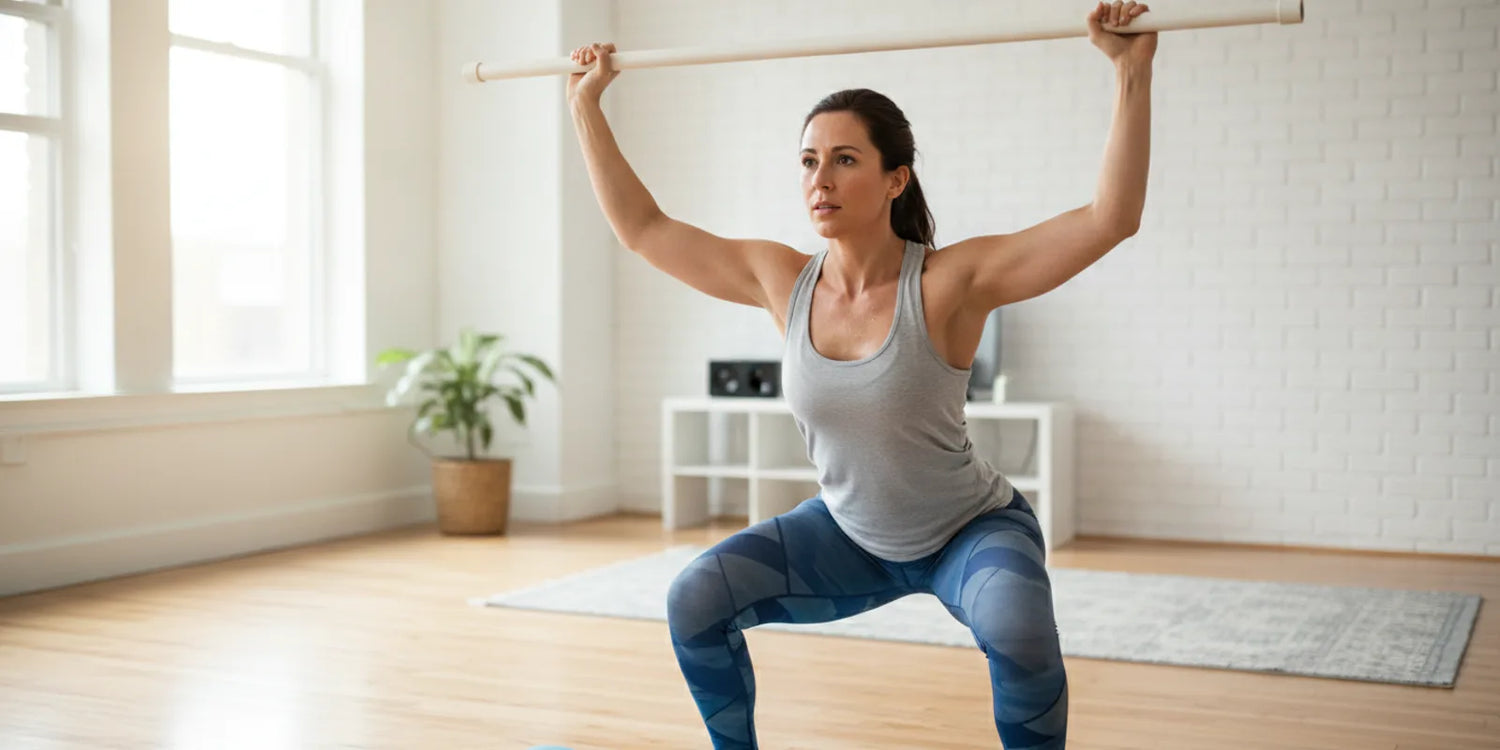
A PVC pipe workout turns a plastic pipe worth less than $10 into a real tool for a lean, fat-burning, full-body circuit you can do in a small apartment with zero other equipment. This guide breaks down exactly which pipe exercises work, how to structure them into a circuit, and what results you can realistically expect.
It also covers pipe sizing and safety so you avoid a cracked or splintering prop, plus common mistakes and a clear upgrade path once bodyweight and an unweighted pipe stop challenging you.
Quick Answer: A PVC pipe workout can help you get lean and burn fat because it powers a continuous bodyweight circuit of squats, rotational twists, and pass-throughs that raises your heart rate and challenges multiple muscle groups. The pipe adds no special fat-burning power on its own, so consistent training combined with a genuine calorie deficit is what actually delivers visible results.
Key Takeaways
- Zero-cost tool: A Schedule 40 PVC pipe costing $10 or less can power a genuine full-body, fat-burning circuit with no gym membership or equipment budget required.
- Circuit beats the pipe: The fat-burning effect comes from the circuit's intensity and consistency, not any special property of the pipe itself; a calorie deficit still drives fat loss.
- Safety first: Only use uncracked, thick-walled Schedule 40 PVC with sanded, capped edges to avoid splintering injuries during overhead and loaded moves.
- Structure matters: Short, frequent sessions, such as 2-3 rounds of about 8 minutes performed 3 times a week, have been linked to measurable body composition changes in trials.
- Clear upgrade path: Once pipe squats and rows feel easy for 15-20 reps, light dumbbells or resistance bands let you keep progressing with more resistance.
What Is a PVC Pipe Workout, and Why Does It Help You Get Lean?
A PVC pipe workout is a bodyweight training circuit that uses a lightweight plastic pipe as a prop for mobility drills, squats, twists, and hinge movements instead of dumbbells or a barbell. The pipe adds just enough length and light resistance to guide proper form and increase range of motion, which helps you move through full-body exercises that burn calories and build lean muscle in a small apartment or budget home gym.
- Zero cost of entry: A section of PVC pipe costs a few dollars at any hardware store, compared with $50 or more for a barbell or adjustable dumbbell set.
- Full-body reach: The pipe's length lets you cue squats, rotational core work, and hinge patterns that are harder to load correctly with just your hands.
- Portable and quiet: It works on carpet, hardwood, or a small patch of apartment floor, with no dropped weights or motor noise to disturb neighbors.
This approach fits best for renters, dorm residents, or anyone testing a new training habit before committing to bigger purchases. If you want another no-cost cardio option to pair with pipe training, aerobic step exercises to burn fat and get toned use a similarly low-equipment approach.
Does a PVC Pipe Workout Actually Burn Fat? Setting Realistic Expectations
A PVC pipe workout can contribute to fat loss, but the pipe itself does not target or burn fat directly, since fat loss depends on sustaining an overall calorie deficit over time. The circuit raises your heart rate and adds light resistance, which supports the calorie-burn and muscle-building side of the equation for a beginner or renter alike, but nutrition and consistency carry most of the weight.
A common misconception is that certain exercises can preferentially strip fat from one area of the body, such as the stomach, which is not supported by how fat loss actually works, as reviewing what workouts target belly fat confirms. What is realistic is pairing the circuit with a plan for how many calories you should burn a day for fat loss to build a deficit you can sustain.
"There is research showing that exercise can reduce visceral fat without actually causing weight loss. So it is a good idea to exercise in general, but specific exercises are not going to target preferentially belly fat. The real key to losing fat is just getting into a caloric deficit consistently and doing it for long enough."
Layne Norton, PhD, Physique Coach and Powerlifter, BioLayne
How to Choose and Set Up a Safe PVC Pipe for Training
The safest PVC pipe for training is a 3 to 4 foot length of half-inch to one-inch diameter Schedule 40 pipe with no cracks, thin spots, or sharp cut edges. Schedule 40 is the standard thickness sold at hardware stores and holds up well to overhead passes, squats, and light loaded movements like rows in any budget home gym.
- Length: 3-4 feet gives enough leverage for pass-throughs and squats without hitting the ceiling or furniture in a small space.
- Diameter: Half-inch to three-quarter-inch pipe suits mobility work, while three-quarter-inch to one-inch feels sturdier for loaded moves such as RDLs and rows.
- Prep: Sand any rough cut edges and cap both ends with standard PVC end caps to remove sharp burrs before your first session.
Inspect the pipe before every session for new cracks or stress marks and replace it immediately if you notice any, since a cracked pipe under load is a real splintering risk. Pair your setup with a non-slip yoga mat so your footing stays stable during squats and lunges.
The Best PVC Pipe Exercises for a Full-Body, Fat-Burning Circuit
The best PVC pipe exercises for a full-body, fat-burning circuit are pipe pass-throughs, overhead pipe squats, rotational twists, Romanian deadlift to bent-over row, and lateral lunges. Cycling through these five movements trains the shoulders, legs, core, and posterior chain in one no-equipment session with a single lightweight prop.
Pipe Pass-Throughs (Shoulder Mobility Warm-Up)
Hold the pipe with a wide overhand grip and slowly raise it overhead and behind your back, then return to the front, keeping your arms as straight as comfortable. Start with 10-12 slow reps to open up the shoulders and warm up before heavier circuit work.
Overhead Pipe Squats
Press the pipe overhead with a wide grip, then squat down while keeping the pipe stable above your head and your chest tall. This variation forces better core bracing and ankle mobility than a bodyweight squat alone, typically for 12-15 reps.
Pipe Rotational Twists (Core)
Hold the pipe across your shoulders like a barbell and rotate your torso side to side in a controlled twist, keeping your hips mostly square. Aim for 15-20 total twists to target the obliques and deep core stabilizers.
Pipe RDL to Bent-Over Row
Hinge at the hips with the pipe held at thigh level for a Romanian deadlift, then pull the pipe into your torso for a row at the bottom of the hinge before standing back up. This combination move works the hamstrings, glutes, and upper back in one fluid pattern for 10-12 reps.
Pipe Lateral Lunges
Step out to the side into a lateral lunge while holding the pipe across your shoulders or straight out in front for balance, then push back to center. Alternate sides for 10-12 reps per leg to build the inner and outer thigh muscles that a straight-ahead squat misses.
Once you can complete all five moves with good form, you have the full circuit you need for the fat-burning workout below. If you want a comparison of other equipment-free cardio options, check whether walking on a treadmill burns belly fat as effectively as a resistance-based circuit.
The 20-Minute PVC Pipe Fat-Burning Circuit
The 20-minute PVC pipe fat-burning circuit runs all five exercises back to back for 3-4 rounds with 30-60 seconds of rest between rounds, repeated 3 times a week on non-consecutive days, a schedule that suits beginners and busy schedules alike. This short, frequent structure mirrors the format used in circuit-training research on fat loss and body composition.
- Warm-up: 1 round of pipe pass-throughs (10-12 reps) to prep the shoulders.
- Main circuit: Overhead pipe squats, rotational twists, pipe RDL to bent-over row, and lateral lunges performed back to back with minimal rest between exercises.
- Rounds: Repeat the main circuit 3-4 times, resting 30-60 seconds between full rounds.
- Cool-down: 1-2 minutes of light pass-throughs and stretching to finish.
A 2024 trial found that high-intensity circuit sessions built from 2-3 rounds of about 8 minutes each, performed 3 times a week for 8 weeks by 36 sedentary workers, improved body composition and muscular strength.[1] A small pilot study of just 8 previously sedentary obese men found that 3 circuit-style sessions of 30 minutes per week for 4 weeks, only 6 total hours of training, was enough to shift body composition and blood health markers.[2]
Over a longer 60-day randomized controlled trial, 70 adults with mild-to-moderate obesity who did circuit training showed significant improvements in body weight, BMI, and waist circumference.[3] Together, these trials suggest that short, consistent circuit sessions, not marathon workouts, are what move the needle.
Common Mistakes to Avoid With PVC Pipe Training
The most common mistake with PVC pipe training is using a cracked, thin-walled, or unfinished pipe, which raises the risk of it snapping or splintering under load. Rushing through reps with poor form is a close second mistake, especially among beginners, since it turns a useful mobility and strength tool into a source of shoulder or lower back strain.
- Skipping the inspection: Not checking the pipe for cracks or stress marks before every session.
- Overhead ego lifting: Muscling the pipe overhead with a rounded lower back instead of bracing the core first.
- Ignoring pain: Continuing a set through sharp shoulder or lower back pain instead of stopping and resetting form.
- No progression plan: Sticking with the same reps and rounds indefinitely instead of adding volume or moving to added resistance.
If a movement causes sharp or radiating pain rather than normal muscle fatigue, stop the set immediately and reassess your form, pipe condition, or range of motion before continuing.
When to Upgrade: From a Free Pipe to Light Dumbbells or Resistance Bands
You should upgrade from a free PVC pipe once pipe squats, rows, and lunges start feeling easy for 15-20 reps in a row, since the unweighted pipe no longer provides enough resistance to keep challenging your muscles. Adding light dumbbells or resistance bands lets you keep the same circuit structure while progressively increasing load, even in a small apartment or budget home gym.
- Light dumbbells: A pair of adjustable dumbbells adds real, progressive load to the same squat, row, and lunge patterns you already learned with the pipe.
- Resistance bands: Bands pack flat, travel easily, and layer extra tension onto bodyweight moves without needing floor space for a rack.
Browsing affordable home gym equipment for home workouts is a good next step once you are ready to spend beyond a free pipe, and reviewing resistance band exercises you can do at home or resistance band workouts for all body parts shows how directly the pipe circuit translates. If you eventually outgrow both bands and dumbbells, the best machines to burn fat at home is the logical next stop.
FAQs
Can a PVC pipe workout really help you burn fat and get lean?
Yes, when the pipe powers a continuous circuit of squats, twists, and pass-throughs, it raises your heart rate and works multiple muscle groups like any bodyweight circuit. Circuit-style training has been linked to real body composition improvements in trials, but consistent effort and an overall calorie deficit are still what actually drive fat loss.
What size PVC pipe should I use for home workouts?
A 3-4 foot length of half-inch to one-inch diameter Schedule 40 PVC pipe works well for most pass-throughs, squats, and rotational drills. Lighter, thinner pipe suits mobility work, while a slightly thicker pipe feels sturdier for loaded movements like Romanian deadlifts and rows.
How often should I do a PVC pipe circuit to see results?
Aim for three sessions per week on non-consecutive days, similar to the frequency used in circuit-training research on fat loss and body composition. Give yourself at least one rest day between sessions so muscles recover, and expect to combine the circuit with consistent daily activity and nutrition for visible results.
Is it safe to use a random PVC pipe for exercise?
Not every pipe is safe, avoid pipe that is cracked, thin-walled, or has sharp cut edges, since it can snap or splinter under load. Choose Schedule 40 PVC, sand any rough edges, and cap the ends, or buy a purpose-made fitness bar once you are ready to upgrade.
What are the best PVC pipe exercises for a full-body circuit?
A solid circuit includes pipe pass-throughs for shoulder mobility, overhead pipe squats, rotational twists for the core, Romanian deadlift to bent-over row, and lateral lunges. Cycling through these five movements for multiple rounds builds a genuine full-body, fat-burning workout with just one prop.
When should I upgrade from a PVC pipe to real equipment?
Once pipe squats and rows start feeling easy for 15-20 reps, it is time to add resistance with light dumbbells or resistance bands. Both let you keep the same circuit structure while progressively increasing load, which is necessary once bodyweight and an unweighted pipe stop challenging your muscles.
Conclusion
A PVC pipe workout is a genuinely useful, near-zero-cost way to run a full-body, fat-burning circuit while you are short on space, budget, or gym access. Choose a sound Schedule 40 pipe, run the five-move circuit 3 times a week, and pair it with a calorie deficit for real results.
Start with the warm-up pass-throughs and build up to the full 3-4 round circuit over your first two weeks. Once the circuit feels easy, browse shop resistance bands to add progressive resistance without losing the simplicity of your current routine.
Disclaimer
This article is for general informational purposes only and is not medical or professional fitness advice, so consult a physician before starting a new exercise program, especially if you have an existing injury or health condition. Stop any exercise immediately if you feel sharp pain and seek guidance from a qualified professional.
Save on your next RitFit order
Tap the button to copy your code, then paste it at checkout.
References
1. Ho SY, Chung YC, Wu HJ, Ho CC, Chen HT. Effect of high intensity circuit training on muscle mass, muscular strength, and blood parameters in sedentary workers. PeerJ. 2024;12:e17140. doi:10.7717/peerj.17140
2. Miller MB, Pearcey GE, Cahill F, et al. The effect of a short-term high-intensity circuit training program on work capacity, body composition, and blood profiles in sedentary obese men: a pilot study. Biomed Res Int. 2014;2014:191797. doi:10.1155/2014/191797
3. Seyam MK, Alqahtani M, Sirajudeen MS, Muthusamy H, Kashoo FZ, Salah MM. Effect of circuit training with low-carbohydrate diet on body composition, cardiometabolic indices, and exercise capacity in adults with mild to moderate obesity in Saudi Arabia: A randomized control trial. Medicine (Baltimore). 2022;101(33):e30054. doi:10.1097/MD.0000000000030054




