








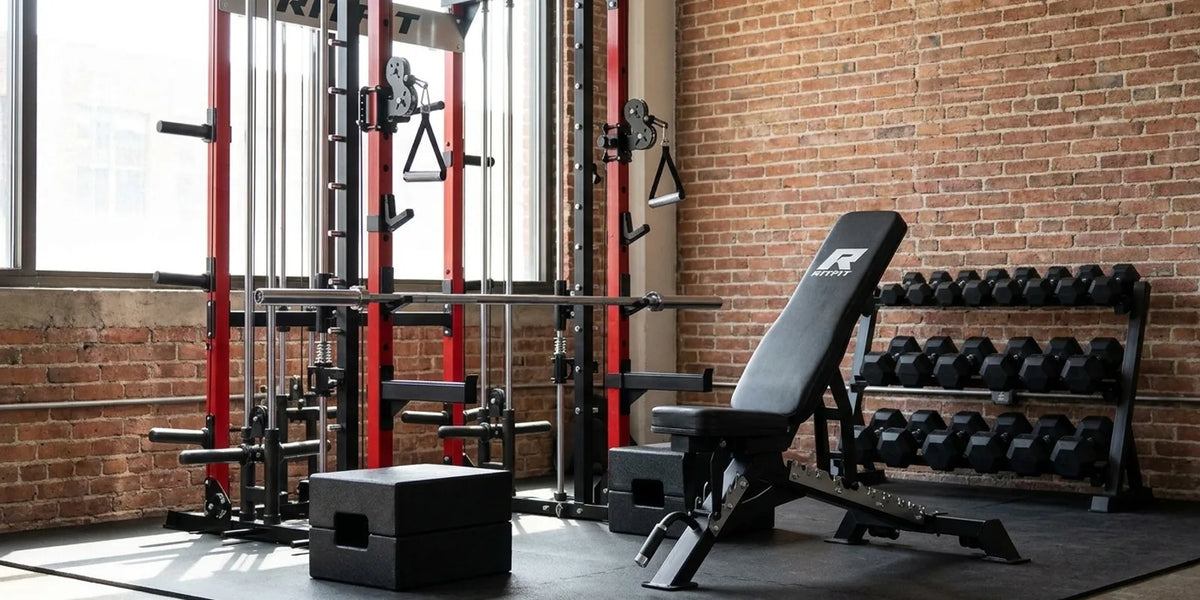
Block pulls on a Smith machine give you a true powerlifting block pull without a single lifting block in sight. The safety catches hold the bar at knee height for a dead-stop pull to lockout along the guided rails.
This guide covers catch height, stance, bracing, and loading, then shows how block pulls differ from a full Smith machine deadlift, a Romanian deadlift, a pin press, and stiff-leg pulls. Treat the movement as a lockout accessory and stop any set where your lower back rounds.
Quick Answer: Yes, block pulls on a Smith machine work because the safety catches act like lifting blocks, holding the bar at mid-shin to just below knee height for dead-stop pulls that overload the lockout. Set a catch height, unrack, and pull each rep to full hip and knee extension.
Key Takeaways
- Catches replace blocks: Smith safety catches hold the bar at mid-shin to below knee height, the same start position that traditional 1-6 inch blocks create.
- Lockout specialist: The shortened range of motion overloads knee-to-lockout strength, the zone where many deadlifts stall.
- Expect more weight: One training guide estimates lifters handle about 10-30% more than a full deadlift, so start lighter and build up gradually.
- Accessory, not a replacement: Keep full-range deadlifts in your program and run block pulls in focused 3-4 week blocks.
- Machine fit: The RitFit M1 PRO offers 11 Smith height settings and safety arms rated to 575 lb, which covers heavy partial pulls for most home lifters.
Can You Do Block Pulls on a Smith Machine?
Block pulls work on a Smith machine because the safety catches hold the bar at knee height the same way lifting blocks or rack pins do. Set the catches so the bar rests at mid-shin to just below the knee, and every rep becomes a dead-stop pull to full lockout along the guided rails.
A block pull is simply a deadlift with the bar raised off the floor, traditionally on blocks set 1-6 inches high. One strength coach describes the movement as an elevated deadlift that overloads the top end of the pull.
On a Smith machine the safety catches play the role of those blocks, and the fixed bar path keeps every rep in the same groove so lockout strength gets full attention. This setup mirrors a rack pull, where the bar starts on pins inside a power rack.
Traditional blocks usually put the bar between mid-shin and just below the knee, and the notches along a Smith upright let you match that height notch by notch. In a bench press study of 42 strength-trained men, one-rep max increased as range of motion decreased, and the sticking region appeared only in the full-range lift[1].
If you are still deciding whether the machine suits pulling at all, start with our overview of can you deadlift on a Smith machine. The block pull then layers on top as the lockout specialist of the family.
What Muscles Do Block Pulls Work?
Block pulls work the glutes, quads, hamstrings, erector spinae, trapezius, and lats through the top half of a hip hinge. The glutes drive hip extension from knee height to lockout, which is exactly the range this variation overloads.
One training guide places the quads in charge from the start to knee height and the glutes in charge from the knee to the top. The trapezius and erector spinae assist by holding the spine and shoulders in position.
The knee position matters because deadlift strength depends on force at that exact height. In a study of 23 healthy adults, hex bar deadlift one-rep max correlated strongly with peak force at lift-off and knee-passing positions, with r = 0.695-0.879[2].
- Glutes: Drive hip extension through the lockout, the part of the pull that block pulls overload most.
- Quads: Break the bar off the catches from a dead stop at knee height.
- Erector spinae and trapezius: Hold the spine and shoulders while the bar travels up.
- Lats and grip: Keep the bar close to the legs and control the return to the catches.
Because the bar starts at knee height, every rep trains the exact range where lockout strength is decided.
How to Do a Smith Machine Block Pull Step by Step
Smith machine block pulls run in five steps, from setting the catch height to lowering the bar back onto the catches under control. Each rep starts dead still on the catches, so the dead-stop effect never gets lost.
- Step 1: Set the catch height: Rest the bar between mid-shin and just below the knee, matching the height traditional blocks would give.
- Step 2: Load the bar and set your stance: Stand feet hip width with shins close to the bar, shoulders over or slightly in front of the bar, and hands just outside the legs.
- Step 3: Wedge in and pull out the slack: Brace your abs, pull your chest up, and build tension before the bar leaves the catches, with hips higher than a squat start.
- Step 4: Drive to lockout: Push the floor away, keep the bar close to the legs, and finish by squeezing the glutes and quads into full hip and knee extension.
- Step 5: Lower under control: Return the bar to the catches, reset your brace, and start the next rep from a complete stop.
Keep your shoulders roughly in line with the bar and hold a slight forward torso lean through the pull. Bouncing the bar off the catches defeats the purpose of the movement.
Any Smith machine with safety catches can host this exercise, including the multifunctional Smith machine line with its adjustable catch heights.
How Much Weight Should You Use for Smith Machine Block Pulls?
Start Smith machine block pulls near your floor deadlift working weight and add load gradually, since the shortened range lets most lifters handle about 10-30% more weight. Lock in your bar path and bracing before you chase heavy singles from the catches.
One training guide estimates that block pulls let most lifters move about 10-30% more weight than floor deadlifts, and one strength coach reports pulling 110% of his one-rep max from 4.5 inch blocks. Both numbers describe trained lifters easing into the variation over several weeks.
The tradeoff is scope, because the top end of the pull is only one piece of deadlift strength. The ACSM position stand reports that voluntary strength improves with loads at or above 80% of one-rep max for 2-3 sets at least 2 sessions per week through a complete range of motion[3].
Heavier partial reps still earn their place in a program. A study of 12 elite Paralympic powerlifters found that partial range of motion training enables higher workloads with lower loss of muscle function, lifting 130% of one-rep max in the partial range versus 90% in the full range[4].
- Sets and reps: Run 3-4 sets of 3-6 reps for strength, or 2-3 sets of 6-8 reps when you want more volume in the lockout range.
- Frequency: Place block pulls once or twice a week after your main deadlift work, inside focused 3-4 week blocks.
- When to add weight: Move up 5-10 lb once every rep locks out with the hips fully extended and the bar under control.
- When to hold the load: If your lower back rounds or the bar drifts forward off the catches, keep the weight and clean up the form first.
Lifters who plan to grow into heavy partial pulls can start on a complete setup like the Buffalo Smith machine home gym package, which pairs the machine with the plate storage the movement needs.
"In a 12-week block of training, I might use block pulls for 3-4 weeks. My training partner and I generally hit these the month before a meet, or the month before hitting weights off the floor upwards towards 90-100%."
Greg Robins, Strength Coach at The Strength House, in "How to Use Block Pulls to Improve Your Deadlift" at EricCressey.com
How Block Pulls Differ From Smith Machine Deadlifts, RDLs, and Stiff-Leg Pulls
Block pulls differ from other Smith machine deadlift variations by starting at knee height with a dead stop, shifting the work toward lockout strength. Each neighboring lift trains a different range and a different weakness.
| Movement | Where the bar starts | Range of motion | Main emphasis | Best for |
|---|---|---|---|---|
| Smith machine block pull | Mid-shin to below knee on the catches | Top half of the pull | Lockout and knee-passing strength | Deadlifts that stall above the knee |
| Smith machine deadlift | Floor | Full pull | Off-the-floor strength and overall load | Building complete pulling strength |
| Smith machine Romanian deadlift | Thighs, bar never touches down | Stretch to standing | Hamstrings and hip hinge control | Hip hinge and hamstring stretch strength |
| Smith machine stiff-leg deadlift | Floor or shin with straighter knees | Long pull with minimal knee bend | Hamstring stretch strength | Posterior chain length work |
| Smith machine pin press | Chest height on the pins | Push instead of pull | Pressing strength off the chest | Chest, shoulders, and triceps dead-stop power |
Variations compared by start position, range of motion, and the weakness each one trains.
A full Smith machine deadlift starts from the floor and builds strength through the entire pull, while the block pull cuts the bottom half away to overload the top.
The Smith machine Romanian deadlift keeps a soft knee and never lets the bar touch down, so it trains the hamstring stretch rather than a dead-stop lockout.
Stiff-leg deadlifts on a Smith machine sit closer to the RDL family, with straighter knees and a long stretch. The block pull deliberately shortens that range to focus on the knee-to-lockout zone.
The Smith machine pin press shares the dead-stop idea but pushes instead of pulls, loading the chest, shoulders, and triceps off the pins.
The closest free-weight cousin is the rack pull, and one guide notes it rests the bar on pins or safety arms the same way a Smith machine block pull rests on the catches. Lifters who want both worlds can run free-weight pulls and Smith block pulls on one frame with the M3 power rack and cable crossover Smith machine.
Does the RitFit M1 PRO Smith Machine Work for Block Pulls?
The RitFit M1 PRO Smith machine handles block pulls well because its 11 Smith height settings and heavy-duty safety catches cover the knee-height start this movement needs. Official specs list a 352 lb Smith capacity and safety arms with a 575 lb static load rating.
The frame uses 2 x 2 inch 14-gauge steel rated to 1,600 lb, so the machine stays steady while you pull heavy partial reps in a garage or basement gym. The 33 lb Smith bar rides on linear bearings with spring-back protection, which keeps the bar path smooth when the bar settles on the catches.
Those 11 height settings double as your block heights, letting you match a mid-shin start one day and a below-knee start the next without extra equipment. The same catches hold the bar for shrugs and other above-knee pulls.
For home lifters who want one machine for block pulls and full deadlifts alike, the M1 Smith machine home gym package adds the plates and bench pieces in one delivery.
"Extremely happy with my M1 pro smith machine, the weight stacks is a must! So much to do especially for someone who is barely starting a fitness journey."
FRANCISCO, Verified Buyer, RitFit M1 PRO Smith Machine Weight Stack Home Gym Package
Common Mistakes for Smith Machine Block Pulls
The most common block pull mistakes are setting the bar too high, letting the hips sag too low, and jerking the bar off the catches instead of building tension. Each one costs you the lockout training the movement exists to provide.
- Bar too high: Starting above the knee cuts the range until the glutes barely work, so keep the bar between mid-shin and just below the knee.
- Hips too low: A squat-like setup makes the hips shoot up first and dumps load into the lower back.
- Jerking the bar: Yanking from the catches kills the dead-stop effect and yanks the spine out of position.
- Hands too wide or too narrow: Keep the hands just outside the legs so the knees and arms clear each other.
- Bouncing off the catches: Reset to a full stop between reps so every pull trains the same dead-stop start.
Stop the set immediately if you feel sharp lower back pain, if the bar drifts forward away from your legs, or if your spine rounds under load. Treat block pulls as an accessory, and if joint pain sticks around between sessions, have a qualified professional check your setup before adding weight.
FAQs About Block Pulls on a Smith Machine
Can you do block pulls on a Smith machine?
Yes. Smith machine block pulls work because the safety catches hold the bar at knee height just like blocks in a powerlifting gym. Set the catches so the bar rests at mid shin to just below the knee, then pull every rep from a dead stop to full lockout.
What is the difference between a block pull and a rack pull?
A block pull raises the bar on blocks or plates under the weights, while a rack pull rests the bar on pins or safety arms inside a rack. On a Smith machine the safety catches play the pin role, and the guided bar path adds stability that free-weight pulls lack.
How high should the bar be for Smith machine block pulls?
Rest the bar at mid shin to just below the knee, which matches the one to six inch heights most lifters use for traditional block pulls. Choose the lower position if your lockout is strong and the higher position if the top end is where your deadlift stalls.
How much weight should I use for Smith machine block Pulls?
Start near your floor deadlift working weight and build up gradually, because the shortened range of motion lets most lifters handle roughly 10-30% more than a full deadlift. Lock in your bracing and bar path before you chase heavier singles from the catches.
Are Smith machine block pulls good for lockout strength?
Yes. Block pulls overload the top half of the pull, where knee height and lockout strength decide the lift. A study links deadlift max strength to peak force at the knee position, so training dead-stop pulls from the catches directly targets the range where most deadlifts stall.
How often should you do block pulls?
Run block pulls as an accessory for three to four weeks at a time, about once or twice a week after your main deadlift work. Strength guidelines favor at least two lifting sessions per week, but treat block pulls as a focused overload tool rather than an everyday lift.
Do block pulls build muscle?
Yes. Block pulls train the glutes, quads, hamstrings, erector spinae, and traps through the hip extension that finishes every deadlift. The shortened range also lets you handle more load with less fatigue, which adds training volume for the upper back and hip extensors that stabilize the lockout.
Conclusion
Block pulls on a Smith machine are a practical way to train the top end of your deadlift, and the safety catches make the setup almost automatic. Pick your catch height, brace hard, and finish every rep with a solid lockout.
Run the movement in a focused 3-4 week block, keep full-range deadlifts in your program, and browse the Smith machine lineup when you are ready for a machine of your own. Check the RitFit discount guide before you order.
Disclaimer
This article is for general training information and is not medical or rehabilitation advice. Stop any exercise that causes pain and consult a qualified healthcare or coaching professional before starting a new loading program.
References
1. Martínez-Cava A, Morán-Navarro R, Hernández-Belmonte A, et al. Range of Motion and Sticking Region Effects on the Bench Press Load-Velocity Relationship. J Sports Sci Med. 2019;18(4):645-652. PMCID: PMC6873133
2. Miller BA, Arroyo E, Tagesen EC, Jajtner AR. Relationships Between Hex Bar Deadlift One-Repetition Maximum and Maximal Isometric Pulls. Int J Exerc Sci. 2022;15(4):45-57. doi:10.70252/BPGM4852. PMCID: PMC9987429
3. Currier BS, D'Souza AC, Singh MAF, et al. American College of Sports Medicine Position Stand. Resistance Training Prescription for Muscle Function, Hypertrophy, and Physical Performance in Healthy Adults: An Overview of Reviews. Med Sci Sports Exerc. 2026;58(4):851-872. doi:10.1249/MSS.0000000000003897. PMCID: PMC12965823
4. Mendonça TP, Aidar FJ, Matos DG, et al. Force production and muscle activation during partial vs. full range of motion in Paralympic Powerlifting. PLoS One. 2021;16(10):e0257810. doi:10.1371/journal.pone.0257810. PMCID: PMC8513888





