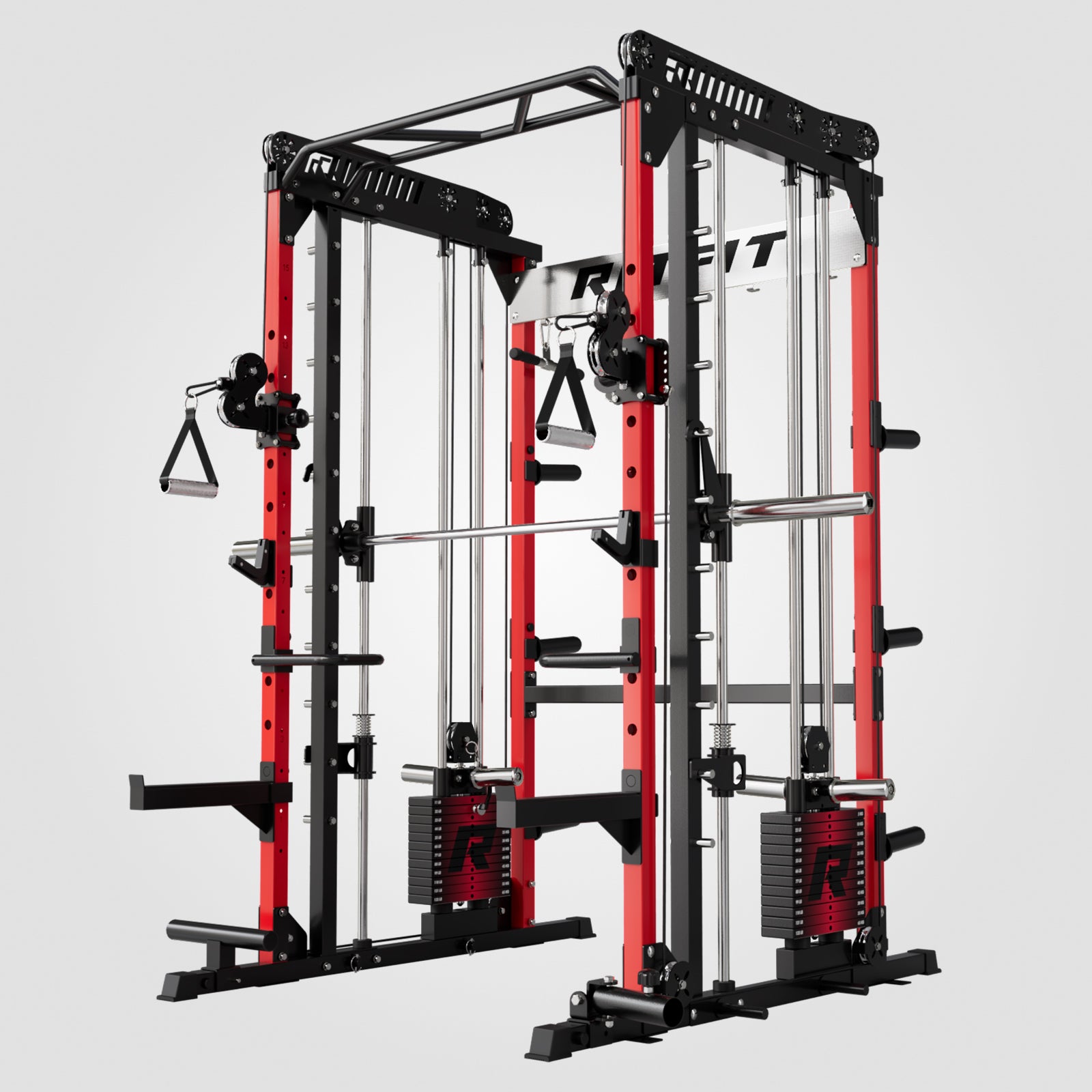

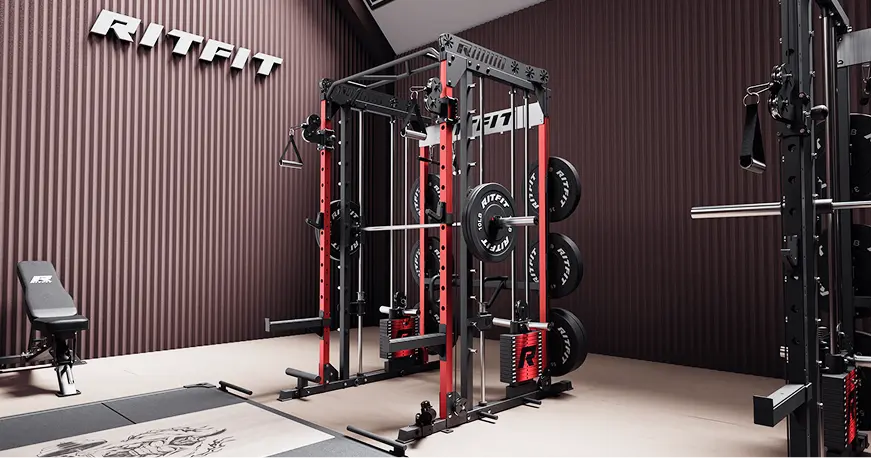
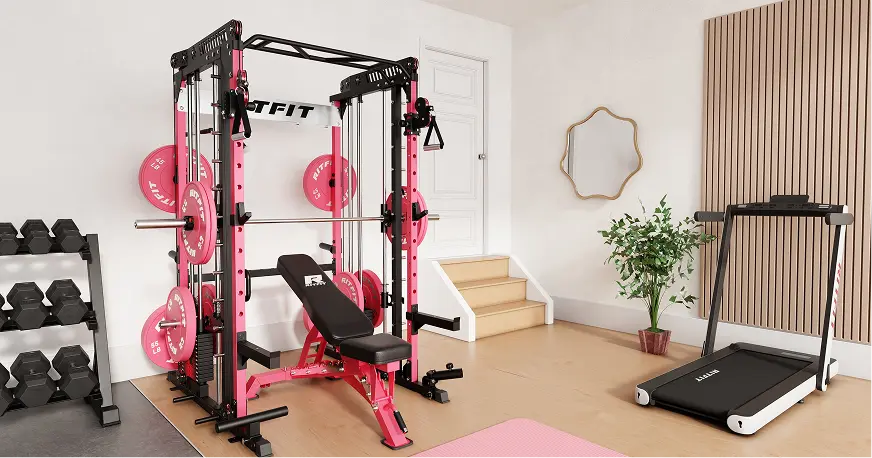
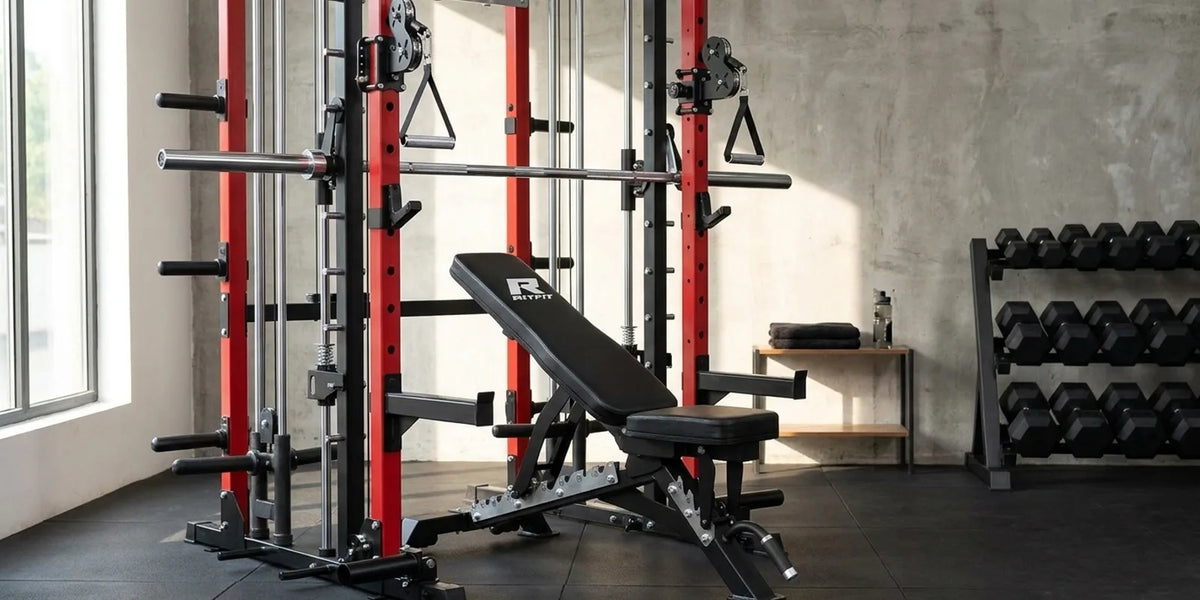
A Smith machine pin press is a bench press variation that starts from a dead stop on the machine's safety catches instead of on the chest. The catches slide up the uprights, so the same hardware that protects a failed rep becomes the pin you press from.
This guide covers catch height, the length of the dead-stop pause, how much lighter to load, and how to add weight week to week. It also explains why a guided bar makes solo pin pressing a normal training choice rather than a workaround.
Quick Answer: The Smith machine pin press is a dead-stop press performed on the machine's adjustable safety catches, which you set about one to two inches above your chest. Lower the bar until it rests on the catches, pause one to two seconds, then press from that full stop, and begin ten to twenty percent lighter than your touch-and-go bench press weight.
Key Takeaways
- Catches become pins: The adjustable safety catches on a Smith machine set the starting height of a pin press, so no separate rack with fixed pins is needed.
- Dead stop, never a bounce: A one to two second pause on the catches removes the countermovement, so every repetition starts from zero velocity.
- Chest height is the default: One to two inches above the chest trains the bottom range, while higher catches shift the work toward the mid-range and lockout.
- Load lighter than a bench press: Start ten to twenty percent below your touch-and-go working weight and add five to ten pounds only when every rep leaves the pins cleanly.
- Built for solo training: When a rep stalls, the bar returns to the catches instead of pinning you, which is the main reason this variation fits a garage gym.
What Is a Smith Machine Pin Press?
A Smith machine pin press is a partial-range press that begins from a dead stop with the bar resting on the machine's safety catches. The catches are pinned at the same height on both uprights, and the bar settles onto them before each repetition. With no touch and no rebound, the bottom of the movement carries no momentum at all.
- Range: The press usually starts one to two inches above the chest, which covers the bottom third of a full bench press.
- Setup speed: On a Smith machine the pins are already part of the frame, so the height change takes seconds instead of moving a bar in and out of a rack.
- Purpose: It is a strength and technique drill for the start of the press, not a replacement for full-range pressing.
The movement builds directly on the Smith machine bench press form most lifters already use, with one change: the bottom of the rep stops on the catches rather than at the chest.
How Do You Set the Safety Catches for a Pin Press?
Setting the safety catches for a pin press takes about thirty seconds: both catches go to the same height, then the bar tells you where they belong. The default target is one to two inches above the chest at the bottom position, which puts the start of the press inside the hardest part of the range.
- Step 1: Set both catches to the same numbered hole on the uprights before you add any weight.
- Step 2: Lie on the bench with your eyes under the bar, shoulder blades down and back, and feet planted.
- Step 3: Lower the empty bar slowly until it settles on both catches, then note the gap between the bar and your chest.
- Step 4: Raise or lower both catches one hole at a time until the bar rests one to two inches above the chest.
- Step 5: Re-check the height after your first working set, because a bench that shifts a few inches changes where the bar lands.
| Catch height above the chest | What it trains | Starting load |
|---|---|---|
| 1 to 2 inches | Bottom range and the sticking region | 10 to 20 percent under touch-and-go weight |
| 4 to 6 inches | Mid-range pressing and lockout strength | 5 to 15 percent under touch-and-go weight |
| At chest contact | Full range with a dead pause | Paused bench press weight |
Starting loads are practical coaching ranges rather than fixed rules, since bar weight, tempo, and training age all shift the right number.
Measure nothing else. The bar tells you where the pins belong, and a catch height that lets the shoulders collapse is too low for a loaded pin press.
How Do You Perform a Smith Machine Pin Press Step by Step?
A Smith machine pin press is performed by setting the catches, resting the bar on them, pausing, and then pressing without any bounce. The sequence is short, and the only unusual part is that the bar spends a full second doing nothing at the bottom.
- Step 1: Set the catches one to two inches above your chest and load a weight you could control for five clean full-range reps.
- Step 2: Unhook the bar, then lower it under control until it contacts both catches at the same moment.
- Step 3: Let the bar settle for one to two seconds while keeping your setup tight and your arms relaxed.
- Step 4: Press the bar up along the guided path without lifting the hips, keeping the shoulder blades pinned to the bench.
- Step 5: Lock out, lower back to the catches, and repeat for three to five sets of three to six repetitions.
The video below demonstrates the pin press from a rack with fixed pins, and the same dead stop applies when the bar rests on Smith machine catches instead.
Train it the way you would train any solo press: catches in place, collars on, and the safety habits for Smith machine training at home checked before the first working set.
Why Is the Bottom of a Pin Press the Hardest Point?
The bottom of a press is the hardest point because the bar sits farthest from the shoulder joint there, which lengthens the moment arm the chest has to overcome. Every inch closer to the chest adds leverage demand rather than reducing it.
"The size of the external flexor moment you have to overcome to lift a weight depends on two things: the load itself and the length of the moment arm. This is why lifting heavier weights is harder than lifting lighter weights."
Greg Nuckols, MA, Strength Researcher and Coach, Stronger By Science
A study of maximal bench presses showed that a sticking region still appears in pure concentric lifts that begin from a dead stop, which led the authors to trace it to a poor mechanical force position rather than to lost elastic energy.[1] Sports medicine literature names that position the sticking point, the place in a lift where difficulty rises out of proportion to the rest of the range and where a failed attempt usually stalls.[2]
That finding is the argument for pin pressing. The dead stop removes the bounce, the bar has to be accelerated from zero, and the exact position where most presses fail gets trained with a load you control.
Why Is the Smith Machine Built for Dead-Stop Pressing?
The Smith machine suits dead-stop pressing because the safety catches already work as adjustable pins and the fixed bar path drops the bar onto the same spot on every repetition. Nothing has to be built, bolted, or borrowed to make the variation work.
- Rep-to-rep consistency: A guided bar cannot drift left or right, so the contact point on the catches stays identical even as fatigue builds.
- Built-in pin function: The catches adjust in numbered positions along the uprights, which is the same job a pair of rack pins does in a rack.
- Solo safety: If a press stalls, the bar travels back down to the catches instead of trapping you, so a spotter is optional rather than required.
- Bar weight caveat: A Smith bar can start lighter than a standard 45 lb Olympic bar on machines with a counterweight system, so check the guided bar path and how it changes bench pressing before you calculate plates.
The clip below shows an upper body session run entirely on a Smith machine, which is the same solo, catch-assisted pattern a pin press block follows.
How Much Weight Should You Use for Pin Presses?
Start ten to twenty percent lighter than your touch-and-go bench press weight, because a dead stop removes the countermovement that normally helps you off the chest. The bar weight that feels honest on the pins is usually lighter than lifters expect.
A study of repeated bench press sets found that shortening or extending the range altered both the force produced and the muscle activity recorded, which is why the same plate weight feels heavier from the catches.[3] Work on the load-velocity relationship points the same way, because changing the range of motion changes how a given load behaves, so pin press numbers do not transfer one to one from a full press.[4]
- Warm-up: Two sets at half your planned pin press weight to confirm the bar contacts both catches evenly.
- Working sets: Three to five sets of three to six reps, stopping one to two reps short of failure.
- Small jumps: Five to ten pounds at a time, and only after every rep starts cleanly from the pins.
- Hard ceiling: Stop adding load once the bar no longer settles on both catches at the same moment.
When Should You Stop a Pin Press Set?
Stop the set when the bar stops settling evenly on both catches, when a rep starts with a hip lift, or when you feel a sharp pinch in the front of the shoulder rather than muscular fatigue.
Bar speed is the simplest guide, because once a rep takes noticeably longer to leave the pins the set has already given what it can.
Joint discomfort near the shoulder is a signal to raise the catches one or two holes or reduce the load before continuing.
How Often Should You Train Pin Presses and Add Weight?
Train pin presses once or twice a week as a second press movement, and add five to ten pounds only when every repetition still leaves the catches cleanly. More frequency than that usually costs full-range pressing volume without buying extra starting strength.
- Placement: After your full-range press, for three to five sets of three to six reps.
- Frequency: Once a week suits most lifters, while twice a week works when pin presses become the main press of the block.
- Block length: Four to eight weeks, then rotate back to full-range pressing as the priority.
- When to add weight: Only after all prescribed reps leave the pins without grinding, and never two sessions in a row.
In a weekly plan, pin presses slot in as the heavy start of the session, and the Smith machine chest workout structure shows where the remaining pressing volume belongs.
5 Common Pin Press Mistakes to Avoid
The most common pin press mistakes are pins set too low, bouncing off the catches, loading like a full bench press, shoulders rolling forward, and running the variation year round. Each one removes the reason the movement was added in the first place.
- Pins too low: Catches set at chest contact turn the drill into a paused bench press and stretch the shoulders under load.
- Bouncing off the catches: A quick tap keeps the elastic rebound and defeats the entire point of a dead stop.
- Loading like a bench press: Repeating touch-and-go weights on the pins usually means the later reps no longer start cleanly.
- Shoulders rolling forward: The ribcage should stay proud so the shoulder blades keep contact with the bench through the pause.
- Running it year round: Pin presses are a block tool, and rotating them out keeps the full-range press the main lift.
Fix the first two and the movement reads correctly: bar down, bar still, bar up.
Pin Press Variations and Alternatives on a Smith Machine
Pin press variations on a Smith machine include the incline pin press, the close-grip pin press, and the JM press, plus full-range alternatives such as a paused bench press. Which one you pick depends on whether the start, the mid-range, or the lockout is the weak link.
- Incline pin press: Raise the bench to roughly 30 degrees and keep the same catch height relative to the chest to bias the upper chest, as covered in the incline Smith machine press guide.
- Close-grip pin press: Narrow the grip to shift more of the press onto the triceps, which helps when the lockout rather than the start is the sticking point, and the technique carries over from close-grip pressing.
- JM press: A tucked-elbow partial press that blends a triceps extension with the top of a press, explained step by step in the JM press on a Smith machine breakdown.
- Paused bench press: The closest full-range swap, with a two second pause at chest height and no pins involved.
All four keep the same principle: the bar stops moving before the press starts.
Does the RitFit M3 PRO Smith Machine Work for Pin Presses?
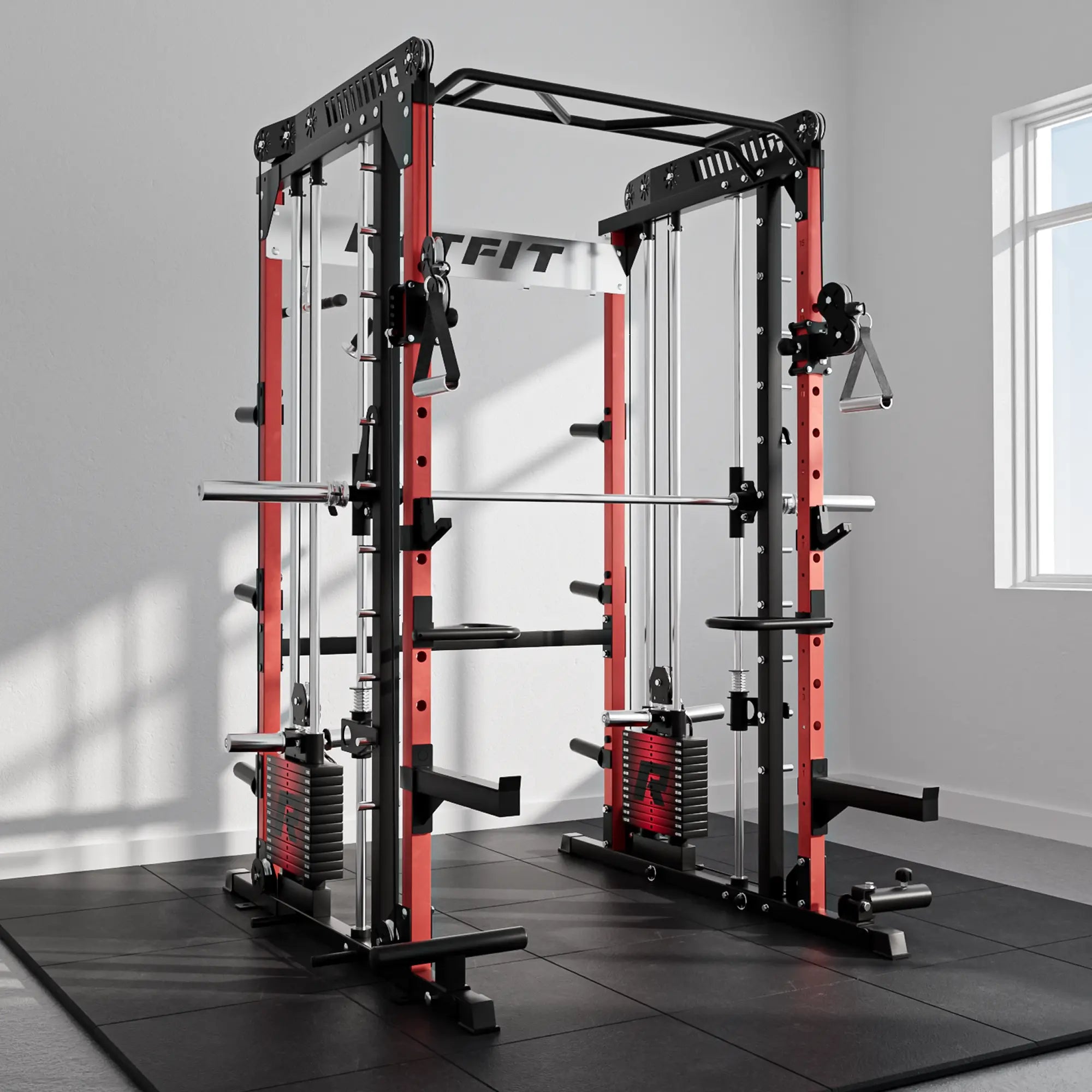
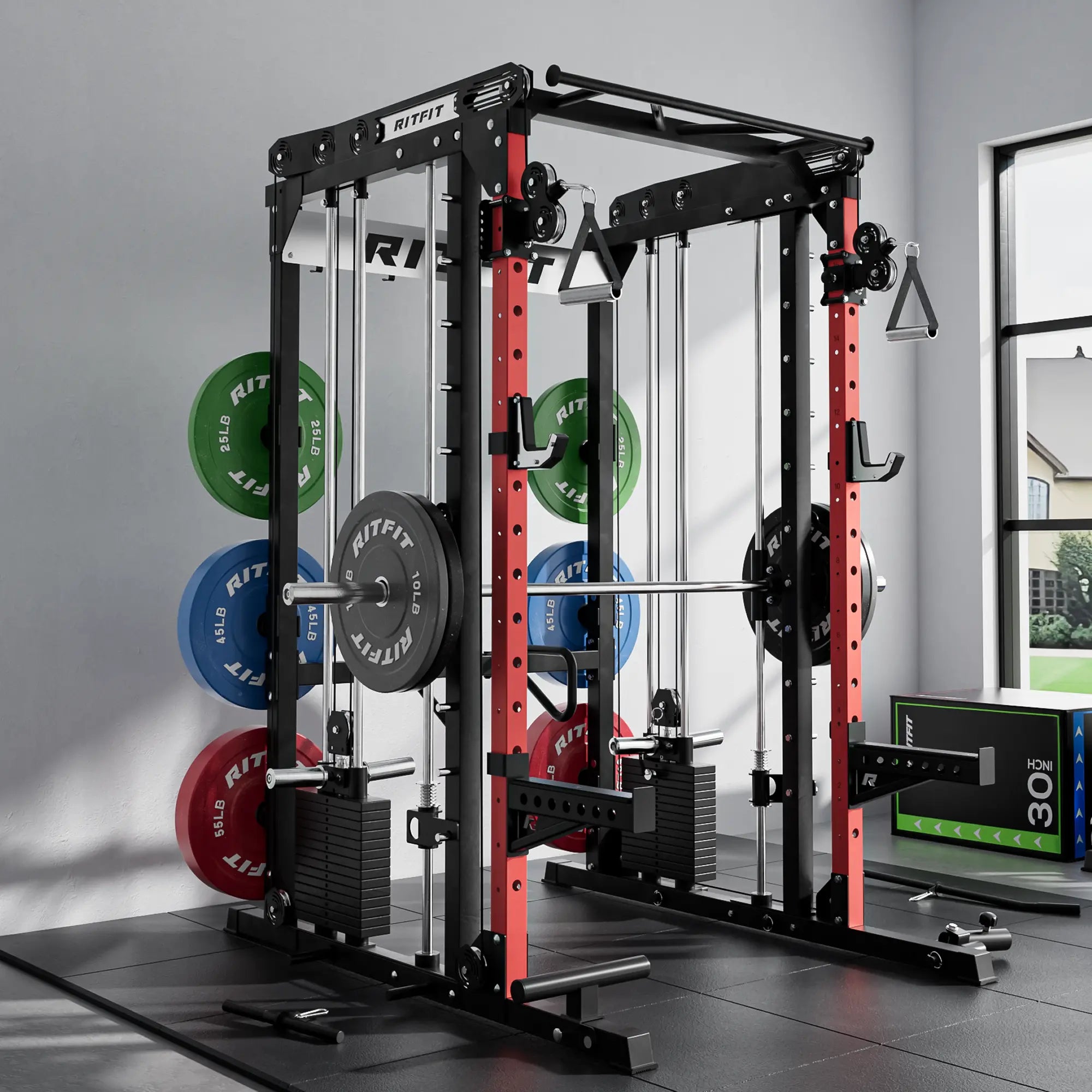
The RitFit M3 PRO suits pin presses because its frame rating sits far above any press load and the guided bar lands on the same catch spot every repetition. For a lift that ends on the safety catches rather than in a spotter's hands, that headroom and a rigid frame are the parts that matter.
RitFit lists the M3 PRO frame at a 2,500 lb rating on 3 by 3 inch 11-gauge steel uprights, standing 84 inches tall on an 86.5 by 60.4 inch footprint.
- Durability: A 2,500 lb frame rating on 3x3 inch 11-gauge steel uprights means the catches are not the limiting factor in a pin press.
- Versatility: One station covers pin presses, full-range pressing, and cable work, so a pin press block does not need extra equipment.
- Fit: At 84 inches tall on an 86.5 by 60.4 inch footprint, the frame needs a single bay plus bench clearance.
- Verified feedback: Buyers describe the frame as solid and the cables as smooth on the M3 line, which matches what a heavy pressing block demands.
The RitFit M3 PRO Smith machine is the model this setup is written around, and the full RitFit Smith machine lineup shows the shorter frames if ceiling height is the tighter constraint.
"Very Solid 3x3 setup. Cables are smooth. Love that it came in pink. Great all in one piece. Hope you add more accessories and attachments for the m3 ! I use it daily!!!!"
Katharine B. Verified Buyer, M3 Power Rack Cable Crossover Smith Machine
FAQs About Smith Machine Pin Presses
Can you do pin presses on a Smith machine?
Yes. A Smith machine does not need a separate rack with pins because the adjustable safety catches that ride up the uprights become the pins themselves. You set both catches at the same height, lower the bar until it settles on them, hold for a full second, and press from that dead stop. The guided bar path drops the bar onto the same spot every repetition.
What height should the safety catches be set for a pin press?
Most lifters set the catches so the bar rests one to two inches above the chest at the bottom position. That places the start of the press right inside the sticking region without letting the shoulders drop into a painful stretch. Lower pins add range of motion and difficulty, while higher pins turn the movement into a lockout or mid-range press.
How much less weight can you use for a Smith machine pin press?
Start ten to twenty percent lighter than your touch-and-go bench press working weight, because a dead stop removes the countermovement that normally helps you off the chest. Many lifters find their pin press one rep max sits ten to fifteen percent under their regular bench press. Add five to ten pounds at a time only after every repetition still starts cleanly from the catches.
How long should the bar pause on the pins?
One to two seconds is enough. The pause removes any bounce and any stretch reflex, so the bar has to be lifted from a genuine standstill. A shorter pause turns the repetition into a touch-and-go press with extra steps, and a much longer pause mostly adds fatigue without changing the training effect. Count the pause until it becomes automatic.
Are Smith machine pin presses good for building strength?
Yes. Sports medicine literature describes the sticking point as the position where a lift most often fails, and a study of maximal bench presses found that region still appears in pure concentric repetitions that begin from a dead stop. Training that exact position against a controlled overload is a direct way to attack a weak bottom range.
Should beginners use pin presses?
Beginners are better off building a base with full range bench pressing first, then adding pin presses once they can control the bar consistently. The dead stop is less forgiving than a touch-and-go repetition, and the heavier loads that make pin presses useful assume you already know how to brace and set your shoulders. Start light at chest height and treat it as a technique drill.
Do pin presses replace the bench press?
No. A pin press is a supplemental movement, not a replacement. It shortens the range of motion and emphasizes the start of the press, so keep full range bench pressing as the main lift and add pin presses for three to five sets of three to six repetitions after it. Rotating them in for four to eight weeks is usually enough.
Conclusion
A Smith machine pin press is simply a dead-stop press that uses the machine's safety catches as the pins, and it trains the exact bottom position where most presses fail. Set the catches one to two inches above the chest, pause one to two seconds, load ten to twenty percent lighter, and add weight only when every rep leaves the pins cleanly.
Run it for four to eight weeks alongside full-range pressing, then rotate it out. Lifters comparing machines can check the current RitFit discount guide before ordering a frame built for solo heavy pressing.
Disclaimer
This article provides general fitness and equipment information, not medical advice or individualized training or rehabilitation guidance. Consult a qualified professional before starting a new pressing program if you have a shoulder, chest, or back condition.
References
1. van den Tillaar R, Ettema G. A comparison of muscle activity in concentric and counter movement maximum bench press. J Hum Kinet. 2013;38:63-71. doi:10.2478/hukin-2013-0046. PMCID: PMC3827767
2. Kompf J, Arandjelović O. Understanding and Overcoming the Sticking Point in Resistance Exercise. Sports Med. 2016;46(6):751-62. doi:10.1007/s40279-015-0460-2. PMCID: PMC4887540
3. Tsoukos A, Wilk M, Krzysztofik M, Zajac A, Bogdanis GC. The Impact of Range of Motion on Applied Force Characteristics and Electromyographic Activity during Repeated Sets of Bench Press Exercise. J Hum Kinet. 2024;91(Spec Issue):189-204. doi:10.5114/jhk/186341. PMCID: PMC11057621
4. Martínez-Cava A, Morán-Navarro R, Hernández-Belmonte A, et al. Range of Motion and Sticking Region Effects on the Bench Press Load-Velocity Relationship. J Sports Sci Med. 2019;18(4):645-652. PMCID: PMC6873133