








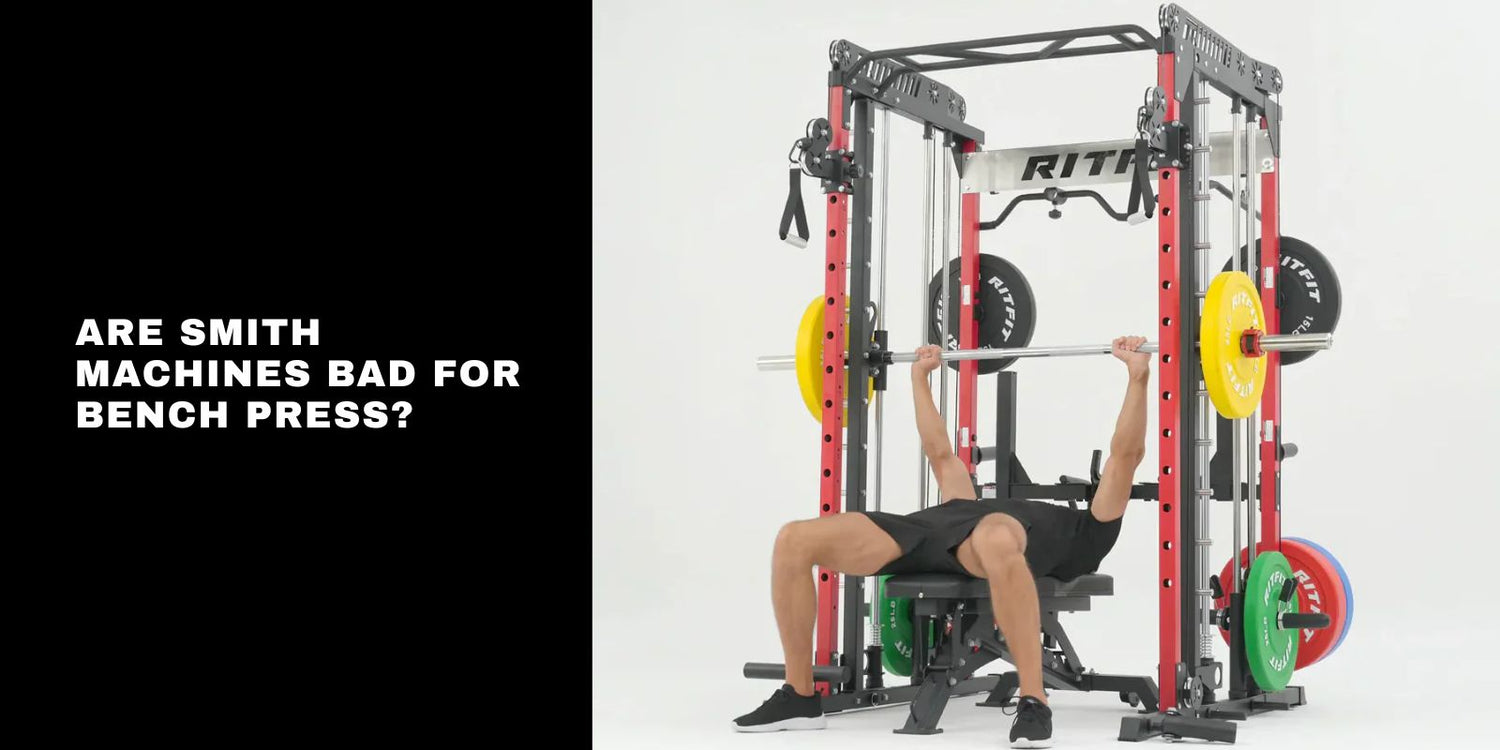
No, Smith machines are not bad for bench press when they are set up correctly and used for the right goal. They can make solo chest training safer and more controlled, but they do not replace the stabilizer demand and skill of a free barbell bench press.
This guide explains how the Smith machine bench press differs from barbell bench press, when it helps, when it limits progress, and how to use it safely in a home gym or commercial gym.
Quick Answer: Smith machines are not bad for bench press when the setup is right, and the Smith machine bench press is good for controlled solo chest training and muscle growth. The fixed bar path makes it easier than a barbell press by removing stabilization demand, but that also makes it less specific for free weight strength skill.
Key Takeaways
- Smith machines are not bad for benching: They are a useful tool for controlled chest pressing, especially when safety stops are set correctly.
- They reduce stabilization demands: The fixed bar path helps you focus on pressing force, but it does not train balance like a free barbell.
- They can build chest muscle: Muscle growth still depends on progressive overload, good range of motion, sufficient volume, and consistent effort.
- They are strong for solo home gym training: A Smith machine can reduce risk during heavy or high rep sets when you train without a spotter.
- The best approach uses both tools: Combine Smith machine pressing with dumbbells, push ups, or free barbell work for a more complete program.
What Is a Smith Machine?
A Smith machine is a strength training machine with a barbell fixed to guide rails. The bar moves in a controlled path and can usually be locked into hooks at multiple heights.
This design makes it useful for lifters who want a stable pressing station, especially in a home gym where a spotter may not be available. If you are comparing options, start with the RitFit Smith Machine collection to see different layouts for compact and full home gym setups.
Our deeper guide to what a Smith machine is covers the parts, the bar path, and the safety features in more detail.
Smith Machine Bench Press vs Barbell Bench Press
The Smith machine bench press and barbell bench press train similar prime movers, but they are not the same movement. The key difference is that the Smith machine controls the bar path while a free barbell requires you to control the bar in multiple directions.
| Factor | Smith Machine Bench Press | Barbell Bench Press |
|---|---|---|
| Bar path | Fixed path on rails | Natural path controlled by the lifter |
| Stabilizer demand | Lower | Higher |
| Solo training safety | Higher when safety stops are set correctly | Lower without safeties or a spotter |
| Skill carryover | Limited for powerlifting | Strong for free weight strength |
| Best use | Hypertrophy, controlled reps, high volume work | Strength, coordination, sport specific bench skill |
Is the Smith Machine Bench Press Easier Than a Barbell Bench Press?
Yes, the Smith machine bench press usually feels easier than a barbell bench press because the guided rails take away most of the balance and bar control work. How much easier it feels depends on the machine angle, counterbalance design, and your experience with free weights.
- Why it feels easier: The fixed path keeps the bar on track, so less effort goes into stabilizing and more effort goes into pressing.
- When easier is an advantage: Safer solo sets, chest focused volume, and high rep finishers all benefit from a guided bar path, and those use cases are what a Smith machine is good for.
- When easier is a drawback: The free barbell bench press is harder to control, and that extra control work builds the stabilizer strength and pressing skill that machine numbers do not carry over.
"You only need a power rack, barbell, bench and (ideally) some dumbbells to run this program. You could replace the bench work in this program with dips, dumbbell press, smith-machine press or machine chest press."
, Jeff Nippard, Science-Based Natural Bodybuilder and Powerlifter at JeffNippard.com
What Research Says About Smith Machine Benching
Research on bench press stability suggests that more unstable pressing conditions generally require greater coordination and muscle interaction than more guided conditions. In a study of untrained men, bench press variations with different instability levels changed muscle activation and antagonist muscle coupling, which supports the idea that a Smith machine reduces some stabilization demands compared with less stable pressing conditions.[1]
A systematic review comparing free weight and machine based strength training found that both methods can improve strength and hypertrophy, but transfer tends to be more specific to the training mode used. This means Smith machine benching can support muscle building, while free weight benching remains more specific for free weight strength skill.[2]
Benefits of the Smith Machine Bench Press
The Smith machine bench press is good for lifters who want safer solo pressing, controlled chest volume, and simple setup. It is an effective chest builder because the guided bar path makes heavy or high rep sets easier to control without a spotter.
1. Safer Solo Pressing
A Smith machine can reduce the risk of getting pinned when the safety stops are set just below your chest level. It is still not risk free, so lifters should learn how to lock the bar before training heavy.
2. Better Control for Chest Focused Sets
The guided bar path helps you focus on pressing through the chest, shoulders, and triceps without spending as much energy balancing the bar. This can be useful for controlled reps, tempo work, and high volume hypertrophy sets.
3. Beginner Friendly Setup
Beginners often find the Smith machine easier to learn because the bar cannot drift forward or backward. This lets new lifters practice grip width, elbow angle, and chest contact point before progressing to more complex free weight pressing.
4. Efficient Drop Sets and Finishers
The Smith machine is practical for drop sets because the bar can be locked quickly between weight changes. Advanced hypertrophy methods such as drop sets may increase training density, but they should be programmed carefully to manage fatigue.[3]
5. Useful for Home Gym Training
For home gym users, a Smith machine can combine pressing, squatting, rowing, cable work, and pull up options in one station. The RitFit M1 PRO Smith Machine Home Gym Package is a strong option to review if you want an all in one Smith machine setup for pressing and full body training.
Drawbacks of the Smith Machine Bench Press
The main drawbacks of the Smith machine bench press are reduced stabilizer demand, a fixed bar path that may not fit every shoulder, and strength numbers that stay machine specific.
1. Less Stabilizer Development
The main limitation is that the fixed bar path reduces the need to stabilize the weight. If you only use Smith machine pressing, your free weight control may lag behind your chest and triceps strength.
2. Fixed Path May Not Fit Every Shoulder
Some lifters feel shoulder discomfort if the machine path does not match their natural pressing groove. Adjust bench position, grip width, and elbow angle before adding more weight.
3. Strength Numbers Do Not Transfer Perfectly
A Smith machine bench press 1RM should not be treated as equal to a free barbell bench press 1RM. Bar angle, machine friction, counterbalance design, and reduced stabilization demand change how heavy the lift feels, and strength transfer to the barbell stays limited even when your machine numbers climb.[1][2]
4. Not Ideal as a Powerlifting Replacement
Powerlifters need to train the free barbell bench press because competition requires free weight control. The Smith machine can still work as an accessory for extra chest volume.
5. Repetition Stress Can Build Up
The same fixed path every session can irritate some lifters if setup is poor or volume is too high. Rotate in dumbbell presses, push ups, cable flyes, or barbell work to vary joint stress.
Who Should Use the Smith Machine Bench Press?
The Smith machine bench press is best for lifters who want controlled pressing, safer solo training, or chest focused volume. It works especially well when it is part of a balanced program rather than the only pressing movement.
- Solo home gym users: It gives you a more secure way to train pressing strength without relying on a spotter.
- Beginners: It helps you practice pressing mechanics while reducing balance demands.
- Hypertrophy focused lifters: It supports controlled reps, high volume work, and training close to fatigue, which fits Smith machine bodybuilding style programming.
- Lifters using cable accessories: A Smith machine with cables can pair bench press work with cable flyes, triceps pressdowns, rows, and lat pulldowns.
Who Should Not Rely on It Alone?
The Smith machine bench press is not the best stand alone choice for every lifter. If your goal requires free weight skill, shoulder freedom, or athletic transfer, you should keep other pressing options in your program.
- Competitive powerlifters: Use it as an accessory, not your main bench press replacement.
- Athletes needing coordination: Add free weights, push ups, and dumbbells to train control in more directions.
- Lifters with pain during the fixed path: Stop and adjust setup before forcing the movement.
- Users who ignore safety stops: The machine is only safer when it is set up correctly.
How to Bench Press on a Smith Machine
Proper setup is the difference between a useful Smith machine bench press and an uncomfortable one. Use the steps below before adding challenging loads.
- Set the bench position: Place the bench so the bar lowers to your mid chest, not your neck or upper stomach.
- Set the safety stops: Place them just below your lowest comfortable range of motion so the bar cannot trap you.
- Choose your grip: Start slightly wider than shoulder width and keep your wrists stacked over your forearms.
- Brace your body: Pull your shoulder blades back, keep your feet flat, and maintain a slight natural arch.
- Lower with control: Bring the bar down slowly to your mid chest while keeping your elbows about 45 degrees from your torso.
- Press and lock safely: Press upward without bouncing, then rotate the bar into the hooks when the set is complete.
For a full rep by rep walkthrough, see our guide to how to do the Smith machine bench press.
Common Smith Machine Bench Press Mistakes
The most common Smith machine bench press mistakes are poor bench position, missing safety stops, flared elbows, and bouncing the bar off the chest. These errors shift stress away from the chest and make the fixed path feel worse than it should. Review our bench press form guide before you add load.
- Setting the bench too far forward: The bar should meet your mid chest at the bottom of the rep, and the right incline for your bench press changes where that contact point sits. Move the bench before changing your body position.
- Skipping safety stops: The hooks are not a full safety system by themselves. Set the stops before every heavy set.
- Flaring elbows too wide: A 90 degree elbow flare can increase shoulder stress for many lifters. Keep your elbows closer to 45 degrees unless a qualified coach has given you a specific reason, and see our chest press vs shoulder press comparison for how grip and angle shift muscle emphasis.
- Bouncing off the chest: Control the bottom position and press smoothly. Bouncing shifts stress away from the target muscles and can irritate the shoulder or sternum.
- Using ego loads: Smith machine numbers do not always match barbell bench numbers. Track progress within the same machine instead of comparing it directly to a free barbell.
Best Smith Machine Bench Press Variations
The best Smith machine bench press variations are the flat, incline, close grip, paused, and tempo presses. Each version changes the angle, grip, or rep speed to shift emphasis between the chest and triceps, and the incline bench press upper chest guide covers the angle choice in depth.
- Flat Smith machine bench press: Use this as the standard chest builder for controlled pressing volume.
- Incline Smith machine bench press: Set the bench at a moderate incline to emphasize the upper chest and front delts. Our incline Smith machine press walkthrough covers bench angle and grip setup.
- Close grip Smith machine bench press: Use a narrower grip to shift more work toward the triceps, while keeping wrists and elbows comfortable. Triceps focused options such as the JM press on a Smith machine use the same close grip idea.
- Paused Smith machine bench press: Pause briefly at the bottom to reduce bouncing and improve control.
- Tempo Smith machine bench press: Lower the bar slowly to increase time under tension without needing maximal load.
Grip width can influence load, comfort, and muscle activity during bench press, so choose a grip that lets you press strongly without shoulder pain.[4]
How to Add Smith Machine Bench Press to Your Program
The Smith machine bench press can serve as a main hypertrophy press or as extra volume after barbell work. The right role depends on your goal, your training experience, and the Smith machine chest workouts for muscle growth you pair it with.
For Strength Focused Lifters
Use the free barbell bench press as your main strength lift, then add Smith machine bench press for 3 sets of 8 to 12 reps. This gives you extra chest volume without making every set highly skill demanding.
For Muscle Growth Focused Lifters
Use the Smith machine bench press for 3 to 5 sets of 6 to 15 reps, then add dumbbell presses, cable flyes, or push ups. Hypertrophy can be achieved across a range of loads when sets are challenging and volume is managed well.[5]
For Home Gym Solo Lifters
Use Smith machine bench press as your heavy pressing movement and add dumbbell or bodyweight pressing for stabilizer work. Pairing it with a stable adjustable bench such as the RitFit GATOR Adjustable Weight Bench can improve setup consistency across flat and incline pressing.
In its hands-on testing of the RitFit GATOR Adjustable Weight Bench, the independent team at Garage Gym Reviews scored it 4.4 out of 5 overall and praised its stability and 21 adjustment combinations.[6]
Choosing a Smith Machine for Home Bench Pressing
The best Smith machine for bench pressing should feel smooth, stable, and easy to set up with your bench. Look for reliable safety stops, enough interior space, compatible attachments, and a frame layout that fits your training area.
- For an all in one home gym: Review the RitFit M1 PRO Smith Machine Home Gym Package if you want Smith machine pressing, cable work, pull ups, and rack style training in one setup.
- For a heavier multi station setup: Compare the RitFit BUFFALO Smith Machine Home Gym Package if you want a more complete strength station with lat pulldown and cable crossover options. In its hands-on test of the RitFit BUFFALO Smith Machine Home Gym Package, the YouTube channel Luke's Garage Gym highlights that it covers Smith machine, power rack, cable crossover, and lat pulldown work in a single frame, with a dual pulley system that lets two people train at the same time.[7]
- For compact training spaces: Consider the RitFit PSR05 Smith Machine Home Gym Package if you need a smaller Smith machine setup for basic pressing and home workouts.
- For accessory work: Add RitFit cable machine attachments to support triceps pressdowns, cable rows, flyes, and lat work after benching.
"Super fast shipping! Awesome quality machine! Definitely requires two people to put together it's very well built and heavy! Didn't take long to put together but labeling each piece would be helpful for newbies. Loving this machine so far!!"
Betsy W. Verified Buyer, RitFit BUFFALO Smith Machine Home Gym Package with Lat Pull Down and Cable Crossover
FAQs
Is the Smith machine bench press bad for your shoulders?
No. The Smith machine bench press is not automatically bad for your shoulders. Shoulder discomfort usually comes from poor bench position, excessive elbow flare, a grip that is too wide, or a fixed bar path that does not match your body.
Can you build chest muscle with Smith machine bench press?
Yes. You can build chest muscle with the Smith machine bench press when you train with enough effort, volume, and progressive overload. It works best when paired with dumbbell presses, push ups, or cable flyes for a fuller chest program.
Is Smith machine bench press easier than barbell bench press?
Yes. Smith machine bench press often feels easier because the rails guide the bar and reduce balance demands. The exact difference depends on the machine angle, bar weight, counterbalance design, friction, and your experience with each exercise.
Should beginners use the Smith machine for bench press?
Yes. Beginners can use the Smith machine to learn pressing mechanics with less balance demand. They should still learn dumbbell or barbell pressing over time, because free weights train stabilizer control and movement skill more completely.
How should I position the bench in a Smith machine?
Position the bench so the bar lowers to your mid chest at the bottom of each rep. If the bar touches your neck, upper chest, or stomach, move the bench before adding weight or starting the set.
How much does a Smith machine bar weigh?
Smith machine bar weight varies by model and should be checked on the specific machine. Some bars feel much lighter than a 45 pound Olympic bar because the machine may use counterbalance, angled rails, or different hardware.
Can Smith machine bench press replace barbell bench press?
No. Smith machine bench press should not fully replace barbell bench press if your goal is free weight strength or powerlifting. It can replace it temporarily for solo training, controlled hypertrophy work, or when barbell setup is not available.
Is Smith machine bench press good for home gyms?
Yes. Smith machine bench press is a strong option for home gyms because it supports safer solo pressing and consistent setup. It becomes even more useful when the machine also supports cable work, pull ups, rows, and lower body training.
Can you bench press on a Smith machine?
Yes. You can bench press on a Smith machine whenever the machine has an adjustable bench and safety stops that fit your range of motion. Set the bench so the bar meets your mid chest, lock the stops just below your lowest rep, and press with the same control you would use on a barbell.
Is Smith machine bench press safer than a barbell bench press?
Yes. Smith machine bench press is often safer than a barbell bench press for solo lifters because the safety stops can catch the bar and the fixed path reduces the chance of losing balance. It is still not risk free, so set the stops correctly and learn how to lock the bar before heavy sets.
Conclusion
The Smith machine is not bad for bench press. It is a controlled pressing tool that can build chest muscle, improve solo training safety, and add useful volume when programmed correctly.
It should not be your only pressing option if you care about free weight strength, stabilizer control, or powerlifting carryover. Use it with dumbbells, push ups, cables, or barbell bench press for the best long term results.
Disclaimer
This article is for general educational purposes only and is not medical advice. If you have shoulder, wrist, elbow, chest, neck, or back pain during pressing exercises, stop training and consult a qualified medical or fitness professional before continuing.
References
1. Wang L, Qiao M, Tao H, Song X, Shao Q, Wang C, Yang H, Niu W, Chen Y. A comparison of muscle activation and concomitant intermuscular coupling of antagonist muscles among bench presses with different instability degrees in untrained men. Front Physiol. 2022;13:940719. doi:10.3389/fphys.2022.940719
2. Haugen ME, Vårvik FT, Larsen S, Haugen AS, van den Tillaar R, Bjørnsen T. Effect of free weight vs machine based strength training on maximal strength, hypertrophy and jump performance: a systematic review and meta analysis. BMC Sports Sci Med Rehabil. 2023;15(1):103. doi:10.1186/s13102-023-00713-4
3. Krzysztofik M, Wilk M, Wojdała G, Gołaś A. Maximizing muscle hypertrophy: a systematic review of advanced resistance training techniques and methods. Int J Environ Res Public Health. 2019;16(24):4897. doi:10.3390/ijerph16244897
4. Saeterbakken AH, Stien N, Pedersen H, Solstad TEJ, Cumming KT, Andersen V. The effect of grip width on muscle strength and electromyographic activity in bench press among novice and resistance trained men. Int J Environ Res Public Health. 2021;18(12):6444. doi:10.3390/ijerph18126444
5. Schoenfeld BJ, Grgic J, Van Every DW, Plotkin DL. Loading recommendations for muscle strength, hypertrophy, and local endurance: a re examination of the repetition continuum. Sports. 2021;9(2):32. doi:10.3390/sports9020032
6. Garage Gym Reviews. RitFit Gator Adjustable Weight Bench Review. 2026.
7. Luke's Garage Gym. RitFit Buffalo Smith Machine Review [video]. YouTube. 2025.





