
A close-grip bench press on a Smith machine shifts the work of the bench press from your chest to your triceps by combining a narrower hand position with a bar that moves in only one line. Set your hands about shoulder width apart and center the bench so the bar drops over your lower chest.
This guide covers the setup, the grip width that counts as close, the triceps mechanics behind the variation, and how to train it safely at home without a spotter.
Quick Answer: A close-grip bench press on a Smith machine is performed by lying on a flat bench with your hands about shoulder width apart, unracking the bar, and pressing it along the fixed rail path until your elbows lock over your lower chest. The narrow grip keeps the bar stacked over your triceps, and the adjustable safety catches let you train close to failure without a spotter.
Key Takeaways
- Grip width: Hands at or slightly inside shoulder width is the working definition of a close grip on a Smith machine bench press.
- Triceps bias: Triceps medialis activity is greater with medium and narrow grips than with a wide grip.
- Load tradeoff: Narrow-grip pressing costs you load compared with a wide grip, so program it for volume rather than for max singles.
- Catch height: Set the safety catches 1 to 2 inches below your bottom position so a failed rep lands on the rails.
- Bar path: Keep the bar tracking over your forearms instead of letting it drift toward your sternum.
How Do You Set Up for a Close-Grip Bench Press on a Smith Machine?
A close-grip bench press on a Smith machine starts with the bench centered so the rail path drops the bar over your lower chest rather than your neck. Lie flat with your eyes roughly under the bar, your feet planted, and your shoulder blades pulled back and down into the bench.
- Bench position: Slide the bench until the bar, at the bottom of the rep, sits over your lower chest and the frame clears the rails.
- Starting height: Set the bar where you can reach it with a slight elbow bend while lying flat, so you do not have to press it off the catches to unrack.
- Safety catches: Place the catches 1 to 2 inches below your bottom position so the bar settles on them instead of your chest if you fail.
- Body position: Plant both feet, keep a small natural arch, and hold your shoulder blades retracted for the whole set.
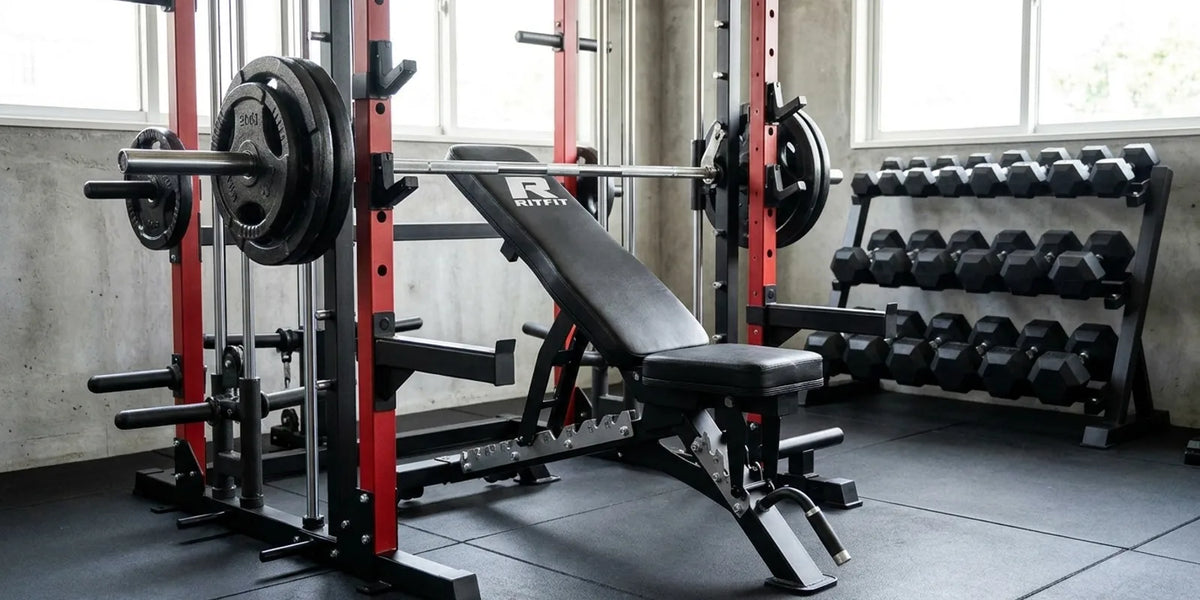
Lock the bench in place before you load anything, because a bench that slides between sets changes where the bar lands. A dedicated adjustable bench with a flat setting, such as the RitFit 1300LB Adjustable Weight Bench, gives you the flat position plus adjustable incline when you want to press at an angle.
What Counts as a Close Grip on a Smith Machine Bench Press?
A close grip on a Smith machine bench press means your hands sit roughly shoulder width apart, measured from the outside edges of your shoulders. Going narrower than that point bends the wrists inward and leaks force rather than adding usable triceps work.
- Measured definition: Hands at shoulder width, or about one hand width inside it, with both hands at the same distance from the center knurl.
- Wrist check: The bar should stack over your forearms. If your wrists bend outward at the bottom, your grip is too narrow.
- Elbow angle: A close grip tucks your elbows closer to your ribs than a competition bench press.
Grip width changes which muscle does the work, and the evidence points in one direction. A study of 28 novice and resistance-trained men found that wide-grip benching produced lower triceps brachii activation than medium and narrow grips, while biceps brachii activity rose as the grip widened.[2]
The same lifters hit their lowest six-rep-max loads with the narrow grip.
A biomechanical analysis of 14 bench-press-trained men reported a one-rep-max of 109.8 kg with a wide grip, 108.9 kg with a medium grip and 103.7 kg with a narrow grip.[1] That study also found triceps medialis activity was greater with the medium and narrow grips than with the wide grip, which is the trade you are making: less weight, more triceps.
If you already train the barbell version, the free-weight close-grip bench press for bigger triceps uses the same grip logic, but you have to control the bar path yourself.
How Does the Fixed Bar Path Change Triceps Recruitment?
The fixed rail path on a Smith machine removes the lateral balance demand, so you can hold a narrow grip and push the triceps closer to failure. With the bar locked into a single line, you can spend your effort on elbow extension instead of on keeping the bar level.
That trade shows up in the data. A study of 29 untrained men pressing at 60 percent of their one-rep max compared a Smith machine, a free-weight bench press and a band-suspended version, and the Smith machine condition was the most stable of the three.[4]
The researchers found that adding instability raised integrated muscle activity in the prime movers, including the triceps brachii, which means the stable setup is a choice about specificity rather than a free upgrade.
What stability buys you is precision. You can chase a longer range of motion, pause at the bottom, and finish with a full elbow extension on every rep without worrying about the bar drifting over your face.
Competitive lifters showed that a narrow grip cut biceps brachii activity by 25.9 to 30.5 percent against medium and wide grips, and cost them 5.8 to 11.1 percent on six-rep-max loads.[3]
The way to turn that into triceps size is volume and full range, and Smith machine pressing is a practical way to add both once you know what muscles the bench press works.
What Are the Most Common Mistakes in a Close-Grip Smith Machine Bench Press?
The most common close-grip bench press mistakes are all variations of letting the lift drift back into a chest press. Fix the grip, the elbow path and the depth, and the triceps do the work the variation is supposed to give them.
- Gripping too narrow: Hands jammed together force the wrists into an awkward angle and do not increase triceps work.
- Flaring the elbows: Elbows out turns the movement into a wide-grip press and hands the load back to the chest.
- Half reps: Stopping a few inches above the chest deletes the stretched part of the rep where the triceps contribute most.
- Bar drifting to the sternum: A low touch point pushes the bar over your chest instead of your forearms.
- Losing scapular retraction: Letting the shoulders roll forward at the bottom puts the load on the front of the shoulder joint.
Elbow and shoulder mechanics drive the sticking region in pressing, which is why a small change in elbow path changes who fails first.[5] If the bar stalls a few inches off your chest every time, the fix is usually depth and elbow tuck, not more weight.
Compare your setup against the standard Smith machine bench press and note the two differences that matter: hand spacing and elbow path. Everything else stays the same.
How Do You Stay Safe Without a Spotter on a Smith Machine Bench Press?
The Smith machine makes a bench press without a spotter practical because the safety catches stop the bar at a height you choose before the set starts. Set the catches 1 to 2 inches below your bottom position, test them with an empty bar, and you can press close to failure on your own.
- Catch check: Lower an empty bar onto the catches to confirm the height before your first working set.
- Failure plan: If a rep stalls, keep your elbows under the bar and let it settle onto the catches instead of fighting it.
- Fatigue drift: Rep tempo slows as you tire, so end the set when bar speed drops noticeably rather than grinding out sloppy reps.
- Pain rules: Stop the set for sharp wrist, elbow or shoulder pain. A dull working burn is different from joint pain.
Elbow loading does change as you fatigue. In a study of 18 healthy men pressing to fatigue, cycle time rose from 2.1 seconds to 2.58 seconds, and both the force and the moment acting on the elbow joint increased.[6]
Ending a set when form slows is a training decision, and the catches are what make that decision safe when you train alone.
"The Smith machine is a great tool for hypertrophy training because it allows you to safely push to failure without a spotter. At medium intensities typically employed in hypertrophy training, the counterweighted Smith machine design offers the best choice in terms of high-force development and total external work performed."
Dr. Mike Israetel, PhD, PhD in Sport Physiology, Co-founder, Renaissance Periodization, Smith Machine Research / RP Strength
Does the RitFit M2 Smith Machine Work for Close-Grip Bench Press?
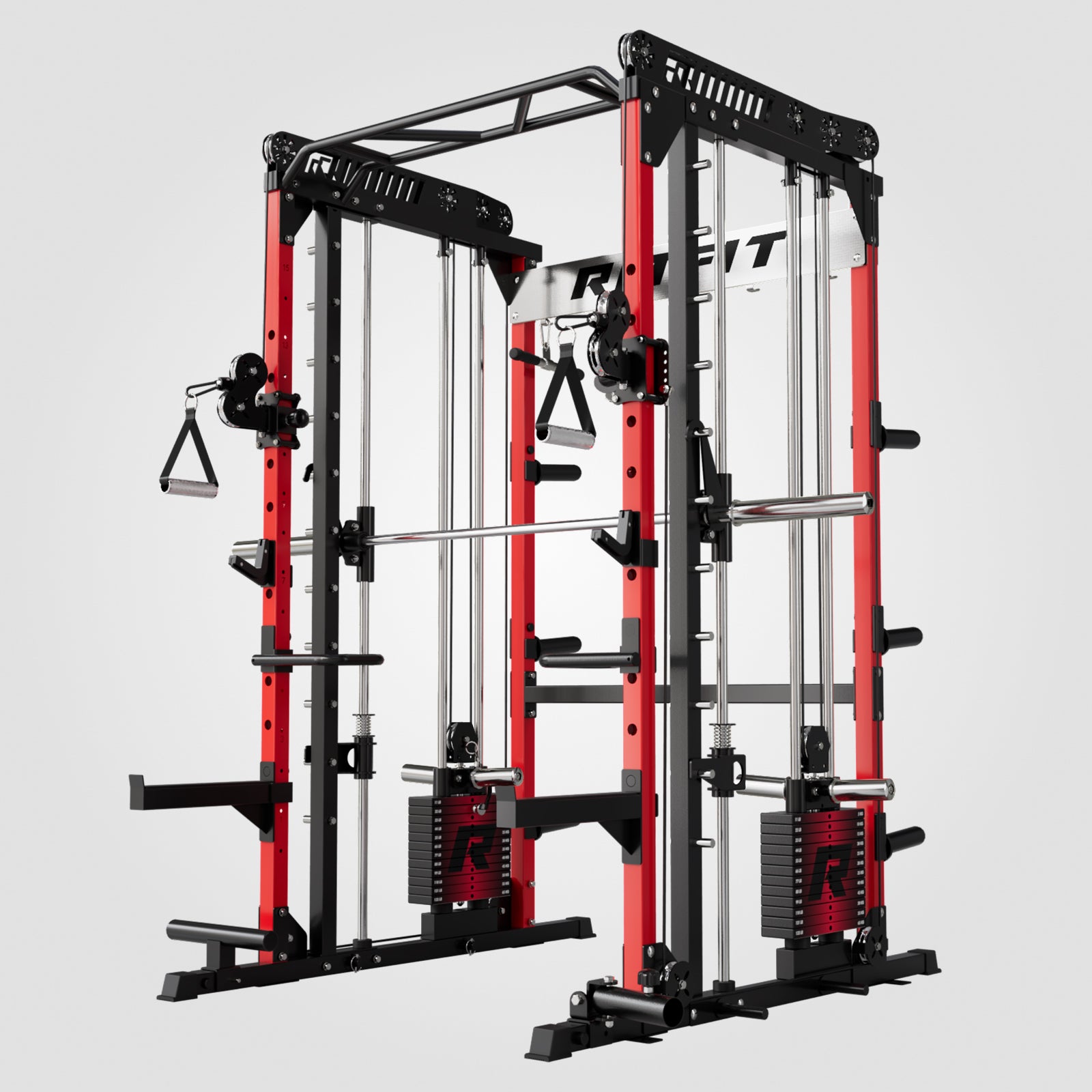
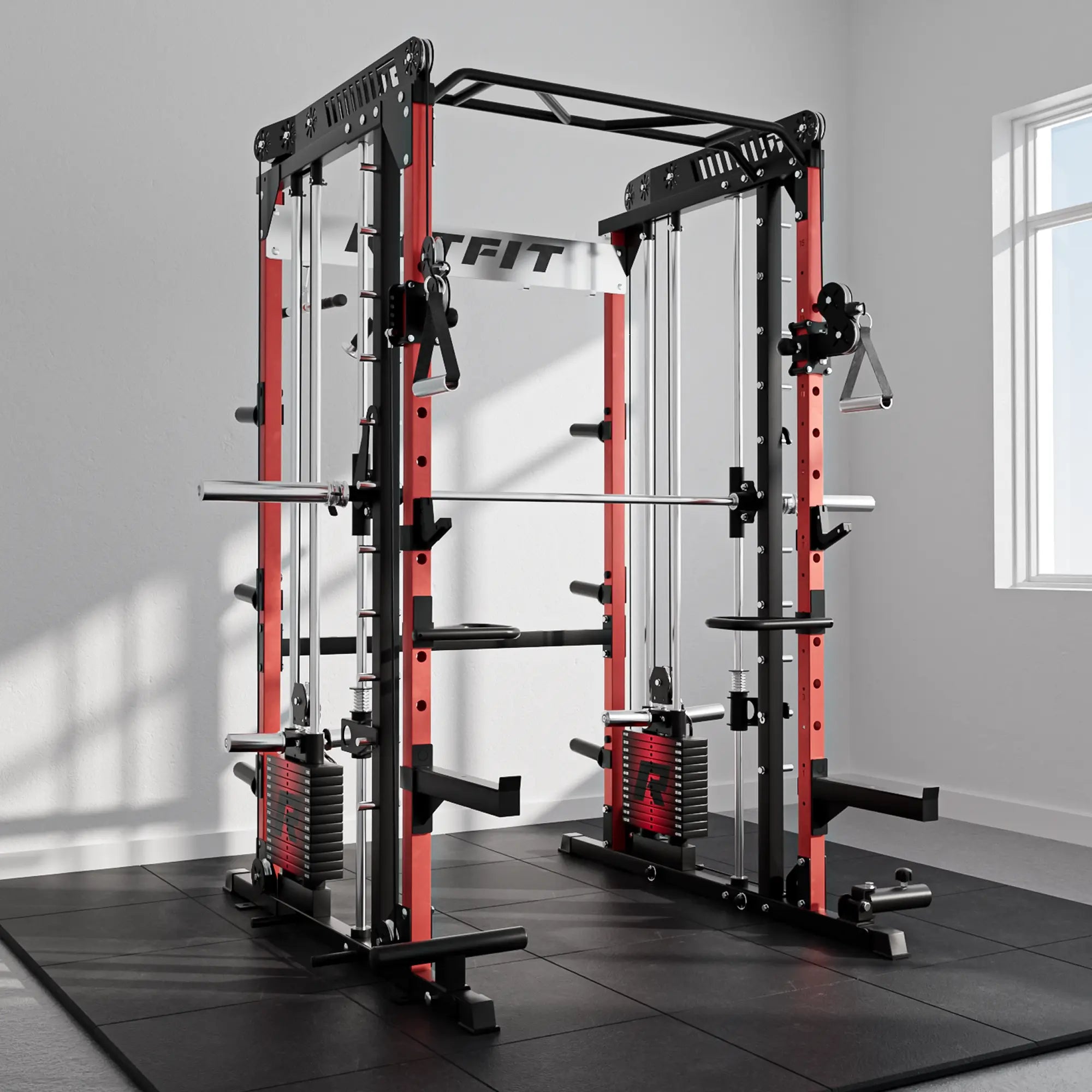
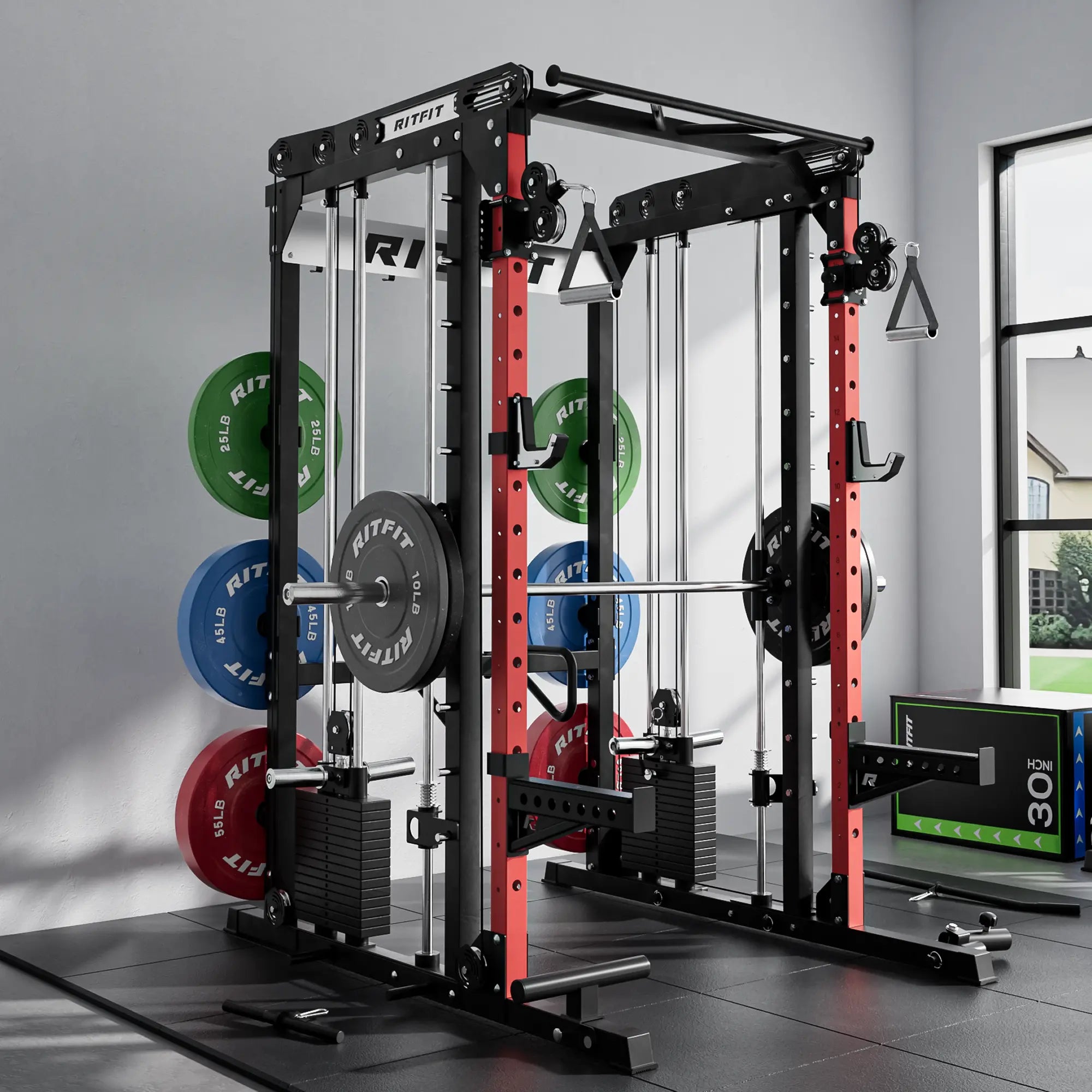
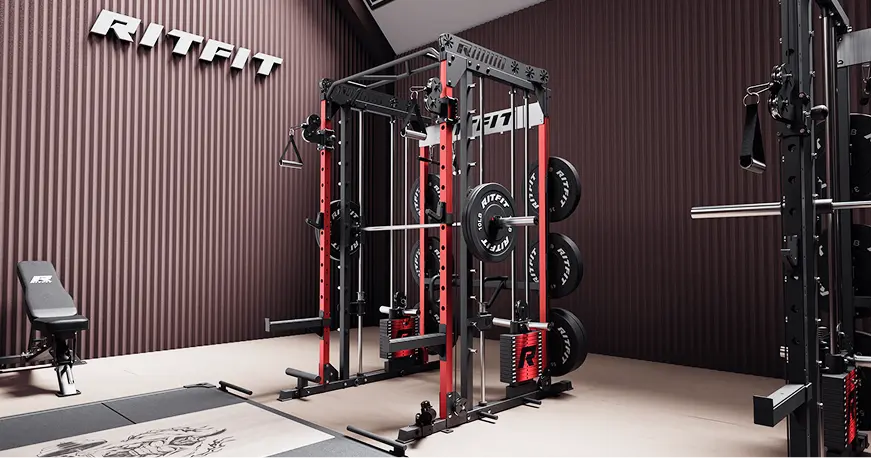
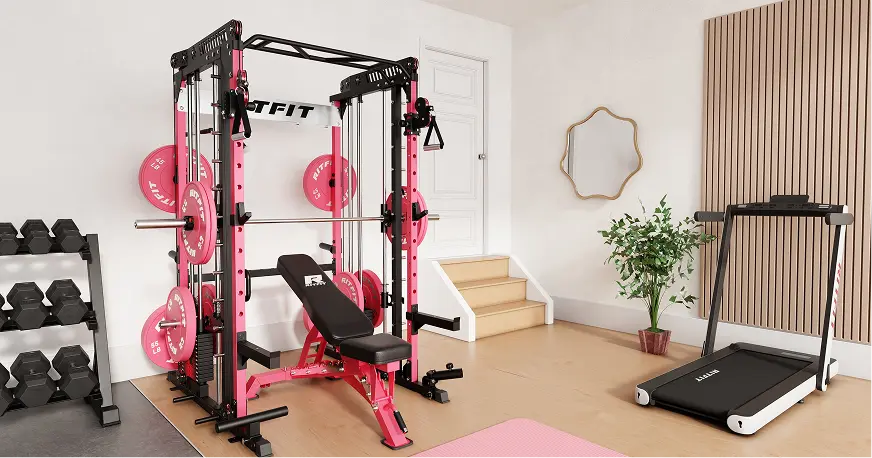
The RitFit M2 Smith machine works for a close-grip bench press because its guided rail holds the bar on one line and its catches drop to a close-grip depth. The bench sits inside the rack with the rails clearing the frame, so your hands can stay near shoulder width without the bar catching on anything.
- Rail path: The 3D Smith system carries the bar in a fixed track, which is exactly what a narrow grip needs to keep the bar stacked over the forearms.
- Catch height: Adjustable catches let you match the stopping point to a close-grip bottom position instead of the deeper position a wide-grip press uses.
- Bench fit: A flat bench inside the rack leaves the shoulders free to stay retracted, and an adjustable bench adds an incline option for the same grip.
- Modular attachments: The M2 accepts add-on stations, so triceps volume can move to cables without leaving the rack.
Two adjustments matter most for a narrow grip: where you lock the catches and how close the bench sits to the rails. Compare the Smith machines in the current lineup if you are choosing between rail systems, and note the RitFit M1 PRO Smith machine as the wider-frame alternative for lifters who want more room at the rack.
"Easy to assemble and works like a charm! Love the variety of exercises i can do with this machine!"
Dena, Verified Buyer, RitFit M2 Multi-Functional Modular Home Gym Smith Machine Tailored to All Fitness Levels
How Much Weight and How Many Reps Should You Use?
A close-grip press on a Smith machine starts lighter than your standard bench press working weight, at a load you can control for 8 to 12 controlled repetitions. Keep the bar over your forearms and add weight only once you clear the top of the rep range on every set.
- Starting load: Begin below your usual bench press weight and convert plates against the bar's own weight, since a counterbalanced Smith bar is not the same as a 45 lb Olympic bar. This guide to how much a Smith machine bar weighs explains the starting-weight math.
- Rep range: Use 8 to 12 reps for triceps growth, or 5 to 8 reps when you are training the press for strength.
- Sets and frequency: Run 3 to 4 working sets, once or twice per week, and keep at least one rep in reserve on the first set.
- Progression: Add 5 lb per side when you hit the top of the range on all sets, and drop back if your wrists start bending inward.
- Why machines count: A meta-analysis pooled 13 studies of at least 6 weeks comparing free-weight and machine-based training for strength, hypertrophy and jump performance.[7]
Narrow-grip pressing costs you load, so treat it as a volume lift rather than a max-out lift. Keep your heavy singles on a medium or wide grip and let the close-grip work accumulate reps.
Which Accessory Exercises Add Triceps Volume?
Cable pushdowns, overhead triceps extensions and dips add the triceps volume a close-grip bench press leaves on the table. The long head of the triceps works hardest with the shoulder flexed, so pair two of them with your press and you cover all three heads.
- Cable pushdowns: Set the cable high, keep your elbows pinned to your ribs, and finish each rep with a full elbow extension.
- Overhead extensions: Use a cable or an EZ bar behind the head to put the long head under stretch, which the flat press does not do.
- Dips: Add weight once bodyweight sets get easy, and lean slightly forward to keep the load on the triceps and chest.
- Close-grip dumbbell press: Pressing two dumbbells together keeps the narrow-grip pattern without a fixed bar path.
Rotate these in when progress stalls instead of adding more pressing sets. More Smith machine exercises can fill the rest of a full-body split once the press is locked in.
FAQs About Close-Grip Bench Press on a Smith Machine
How wide should your grip be for a close-grip bench press on a Smith machine?
Set both hands roughly shoulder width apart, measured from the outside edges of your shoulders, and no narrower than the point where your wrists start to bend inward. A 2021 study of 28 men found a wide grip produced lower triceps brachii activation than medium or narrow grips, so keeping the hands near shoulder width preserves the triceps bias without straining the wrists.
Does the close-grip bench press build triceps more than a regular bench press?
Yes. Narrowing the grip reduces the lever arm the chest can produce and shifts more of the extension work to the triceps brachii, and a biomechanical analysis found triceps medialis activity was greater with medium and narrow grips than with a wide grip. The tradeoff is load, because narrow-grip six-rep-max loads were 5.8 to 11.1 percent lower in competitive lifters.
Can you do a close-grip bench press on a Smith machine without a spotter?
Yes, and this is where the Smith machine earns its place in a home gym. Set the safety catches 1 to 2 inches below your bottom position so the bar settles onto them if you fail, then press without a spotter. A trained lifter can push close to failure safely, though you should still stop when your elbows or wrists hurt rather than grind through pain.
Is the close-grip bench press bad for your wrists?
No, as long as the grip stays close to shoulder width and the bar sits over your forearms rather than behind them. Gripping much narrower than shoulder width forces the wrists into an awkward angle, which leaks force and irritates the joint. If your wrists bend inward at the bottom, widen the grip by one hand width and keep the bar stacked over your elbows.
How much weight should a beginner use for a close-grip press on a Smith machine?
Start with a load you can press for 8 to 12 controlled reps while keeping the bar over your forearms, which is often a plate or two per side on a counterbalanced Smith bar. Add weight only when you clear the top of the rep range on every set with the same bar path and no wrist collapse.
Does the RitFit M2 Smith machine work for a close-grip bench press?
Yes. The RitFit M2 uses a guided rail path with adjustable safety catches and a flat or inclined bench inside the rack, so a close-grip press tracks in a straight line and stops on the catches if you fail. Lifters can also swap the bench for a modular attachment when they want a different pressing angle.
Conclusion
A close-grip bench press on a Smith machine is a triceps lift with a built-in spotter. Set your hands at shoulder width, keep the bar over your forearms, set the catches 1 to 2 inches below your bottom position, and let the fixed rail path do the balancing.
Start lighter than your regular bench press, train it for 8 to 12 reps, and add triceps accessories when progress slows. If you are building the setup out, start with the RitFit discount guide before you buy.
Disclaimer
This article is general fitness information, not medical advice, and it does not diagnose or treat any injury. Consult a qualified physician or physical therapist before starting a new training program, especially if you have existing wrist, elbow or shoulder problems.
References
1. Larsen S, Gomo O, van den Tillaar R. A Biomechanical Analysis of Wide, Medium, and Narrow Grip Width Effects on Kinematics, Horizontal Kinetics, and Muscle Activity on the Sticking Region in Recreationally Trained Males During 1-RM Bench Pressing. Front Sports Act Living. 2020;2:637066. doi:10.3389/fspor.2020.637066. PMCID: PMC7862765
2. Saeterbakken AH, Stien N, Pedersen H, Solstad TEJ, Cumming KT, Andersen V. The Effect of Grip Width on Muscle Strength and Electromyographic Activity in Bench Press among Novice- and Resistance-Trained Men. Int J Environ Res Public Health. 2021;18(12). doi:10.3390/ijerph18126444. PMCID: PMC8296276
3. Saeterbakken AH, Mo DA, Scott S, Andersen V. The Effects of Bench Press Variations in Competitive Athletes on Muscle Activity and Performance. J Hum Kinet. 2017;57:61-71. doi:10.1515/hukin-2017-0047. PMCID: PMC5504579
4. Wang L, Qiao M, Tao H, et al. A comparison of muscle activation and concomitant intermuscular coupling of antagonist muscles among bench presses with different instability degrees in untrained men. Front Physiol. 2022;13:940719. doi:10.3389/fphys.2022.940719. PMCID: PMC9486837
5. Evangelista P, Rum L, Picerno P, Biscarini A. Decoding the Contribution of Shoulder and Elbow Mechanics to Barbell Kinematics and the Sticking Region in Bench and Overhead Press Exercises: A Link-Chain Model with Single- and Two-Joint Muscles. J Funct Morphol Kinesiol. 2025;10(3). doi:10.3390/jfmk10030322. PMCID: PMC12372072
6. Huang YP, Chou YL, Chen FC, Wang RT, Huang MJ, Chou PP. Elbow joint fatigue and bench-press training. J Athl Train. 2014;49(3):317-21. doi:10.4085/1062-6050-49.1.05. PMCID: PMC4080597
7. Haugen ME, Vårvik FT, Larsen S, Haugen AS, van den Tillaar R, Bjørnsen T. Effect of free-weight vs. machine-based strength training on maximal strength, hypertrophy and jump performance - a systematic review and meta-analysis. BMC Sports Sci Med Rehabil. 2023;15(1):103. doi:10.1186/s13102-023-00713-4. PMCID: PMC10426227