If you searched for a specific adjustable workout bench by brand name, what you really want is a bench that presses safely, holds heavy loads, and fits your space. This guide breaks down the specs that actually decide a good adjustable bench.
You will learn how to size capacity, read incline angles, spot a weak frame, and fit a bench into a small room, then match the right RitFit bench to your budget and goals.
Quick Answer: An adjustable workout bench is a weight bench whose backrest pivots through multiple angles, from flat to roughly 85 degrees upright, so one frame handles flat presses, incline presses, seated shoulder work, and rows. The best choice for you depends on capacity headroom, incline range, build quality, and footprint.
Key Takeaways
- Capacity first: Size your bench to bodyweight plus heaviest load with a safety buffer, not the lowest sticker price.
- Angles matter: Multiple incline stops let you train the upper and lower chest and shoulders on one frame.
- Build quality: Heavier-gauge steel, a thick pad, and a ladder adjustment system signal a durable, stable bench.
- Space is solvable: Measure footprint and clearance first, then pick a bench that folds or stores vertically.
- Match to goals: Choose a RitFit bench by your budget, room size, and how heavy you plan to press.
What People Really Mean by an Adjustable Workout Bench
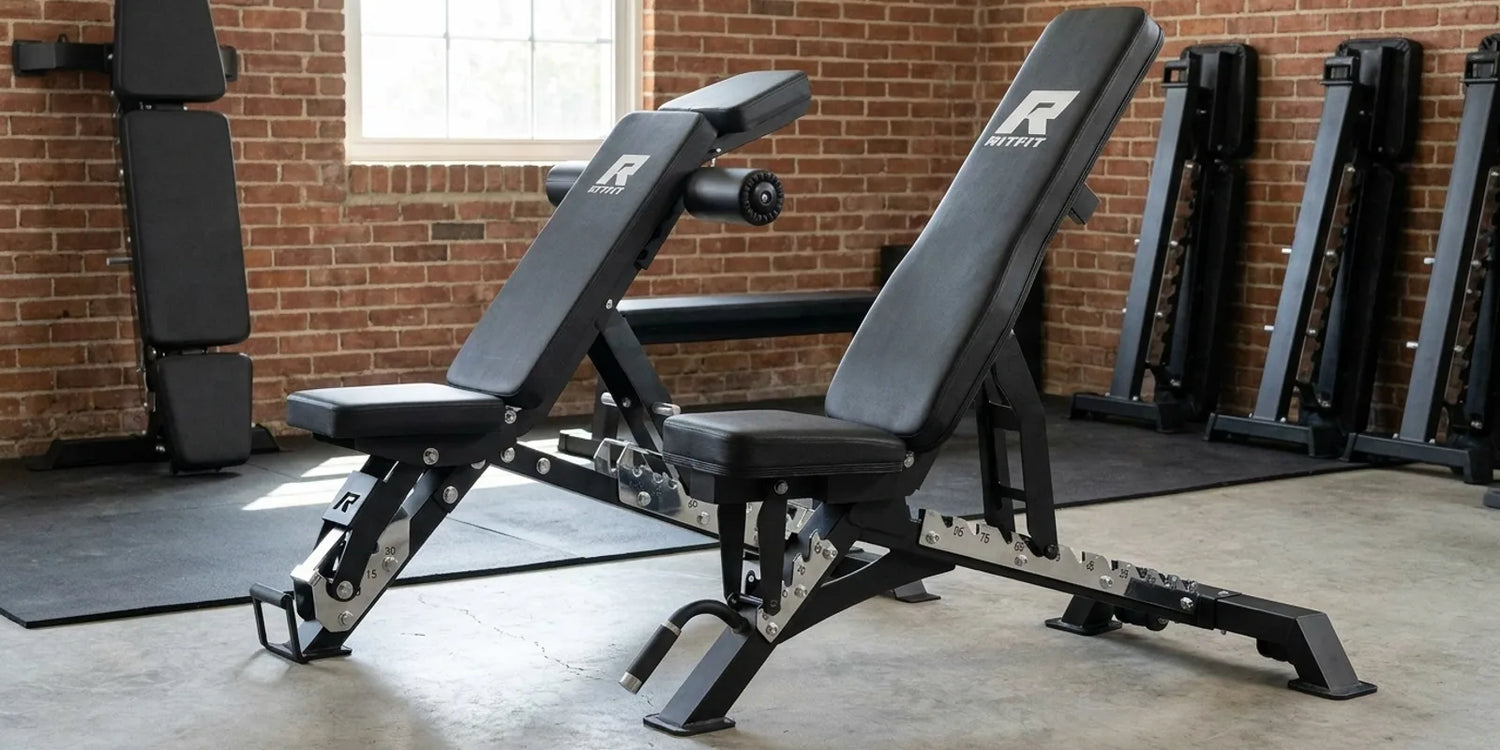
An adjustable workout bench is a single bench whose backrest pivots through several angles, so one piece of equipment replaces a flat bench plus a seated press station. Most models move from flat up to roughly 85 degrees upright.
When buyers type a specific brand name into search, they are usually comparing build quality and value rather than chasing one product. The smarter move is to learn the specs that make any adjustable bench safe and durable.
- Versatility: Flat presses, incline presses, seated shoulder work, rows, and supported single-leg work all happen on one frame.
- Footprint efficiency: One adjustable bench does the job of several fixed benches in less floor space.
If you are still deciding which workouts you want to run, browse the bench workout ideas guide to see how versatile a single bench can be.
Flat vs Adjustable vs FID: Which One Fits You
An adjustable bench beats a flat bench for most home lifters because it covers far more exercises for a small stability trade-off. A flat bench fixes at horizontal, an adjustable bench moves through flat and incline positions, and an FID bench adds a decline angle on top.
- Flat bench: Simplest and most stable, best if you only barbell bench press and want competition-friendly height.
- Adjustable bench: Multiple incline angles for incline pressing and shoulder work, the best all-rounder for home gyms.
- FID bench: Adds a decline position, useful if you truly train decline movements, but not essential for everyone.
For a sub-audience deep dive, see the companion guides on the best adjustable weight bench for men and the best adjustable weight bench for women.
How Much Weight Capacity Do You Really Need
You need a rated capacity that comfortably exceeds your bodyweight plus the heaviest load you will ever lift on the bench. A common rule of thumb adds those two numbers and multiplies by about 1.2 for a safety buffer.[1]
- Worked example: A 200 lb lifter pressing 220 lb wants a bench rated well above the resulting 500 lb figure, not one rated right at the limit.
- Minimum target: One buying guide suggests a minimum rated capacity near 600 lb for adult lifters who plan to add weight over time.
Higher capacity ratings usually reflect heavier-gauge steel and sturdier construction across the whole frame. That makes the number a useful proxy for the bench's overall quality, as the bench ab workout guide shows in practice.
Which Specs Decide a Good Adjustable Bench
The specs that decide a good adjustable bench are steel gauge, pad quality and gap, the adjustment system, and base stability. These four together explain why two benches at the same price can feel completely different under load.
- Steel and stability: Wide base feet, non-slip pads, and heavier-gauge tubing keep the bench from wobbling under heavy pressing.
- Pad quality: Look for at least 2 to 2.5 inches of high-density foam, which holds its shape for years instead of compressing within months.
- Adjustment system: Ladder-style pads that slot into notches are fast and reliable, while plastic mechanisms are best avoided entirely.
- Pad gap: A large gap between the seat and back pad is annoying for flat work, so check the seam at the angle you train most.
The video below ranks adjustable benches and shows how these build features play out in practice.
What Do Incline Angles Actually Change
Changing the bench angle shifts which part of your chest and shoulders does the most work, which is the main reason adjustability is worth the extra cost. There is no single best angle, so a bench with several stops gives you the most training range.
EMG studies report that flat pressing produces the highest signal in the lower, sternocostal head of the pectoralis major, while inclining the bench to around 44 degrees tends to produce the greatest activity in the upper, clavicular portion.[2] In one 8-week trial of 47 untrained young men, training the incline press alone produced the greatest increase in upper-chest muscle thickness, although isometric strength gains were similar across flat, incline, and combined groups.[1]
- Practical takeaway: A setting near 30 to 45 degrees lets you bias the upper chest, while flat work keeps loading the lower chest.
- Why range helps: Bench-angle research continues to examine how activation shifts across positions, supporting the case for multiple stops.[3]
A Trainer's Take on the Incline Angle
Strength coaches often anchor incline work to a defined angle so the movement stays honest and consistent rep to rep.
"I went with the incline press over the standard bench press or the military press as it keeps folks much more honest, the angle of the bench must be at around 45 degrees."
Bret Contreras, PhD, Sports Scientist and Strength Coach, Bret Contreras Training Systems
Put the research into action with the structured plans in the bench workout routines guide.
How Do You Fit a Bench Into a Small Space
You fit an adjustable bench into a small or shared space by measuring before you buy, not after. Map the bench footprint plus the working clearance you need around it, then choose a model that folds flat or stores vertically.
- Measure the footprint: Record the bench length and width, then add at least 2 feet on each side for dumbbells and your elbows.
- Check overhead clearance: Confirm floor-to-ceiling height for seated overhead pressing at the upright position before you commit.
- Plan the storage path: Many quality benches fold or stand upright, cutting their floor footprint substantially so they tuck into a closet or corner.
See how a single bench supports lower-body training too in the home workout bench exercises guide.
What Mistakes Should You Avoid When Buying
The most common buying mistake is choosing capacity that barely matches your current lifts, leaving no headroom as you get stronger. Avoid that and a few related traps and you will keep the bench for years.
- Buying capacity to the limit: Pick a rating well above your bodyweight plus load, since a bench that wobbles under heavy weight is unsafe.
- Ignoring the pad gap: A wide seat-to-back gap can pinch on flat work, so check the seam at your most-used angle.
- Skipping the measurement step: Order a bench that does not fit your room or storage path and you will resent it quickly.
- Trusting plastic adjusters: Plastic mechanisms wear and fail, so favor a metal ladder or a solid pop-pin design.
If you want product-specific answers before purchase, the RitFit adjustable bench Q&A covers common setup questions.
Which RitFit Adjustable Bench Should You Choose
Choose your RitFit adjustable bench by matching its rated capacity and footprint to your budget, room size, and how heavy you plan to press. Both benches below are multi-position adjustable frames, so the decision comes down to capacity headroom and space.
| Bench | Rated capacity | Best for | Space and budget |
|---|---|---|---|
| RitFit 1300lb Adjustable Weight Bench | 1300 lb rated | General home-gym lifters adding moderate weight over time | Compact footprint, mid-range price |
| RitFit Gator Adjustable Weight Bench | Heavier-duty frame | Stronger lifters and heavy pressing who want maximum headroom | Larger footprint, higher price |
Decision matrix across two RitFit adjustable benches by buyer profile.
- Worth the price: A higher capacity rating buys peace of mind and usually heavier steel, which pays off as your lifts climb.
- Long-term cost: Picking enough headroom now avoids replacing the bench later when you outgrow a borderline rating.
FAQs About Adjustable Workout Benches
What is an adjustable workout bench?
An adjustable workout bench is a weight bench whose backrest moves through multiple angles, typically from flat up to around 85 degrees upright, letting you train flat presses, incline presses, seated shoulder work and rows on one frame. FID models add a decline position, giving the widest exercise range for a home gym in a single footprint.
How much weight capacity do I need in an adjustable bench?
A common rule of thumb is your bodyweight plus the heaviest load you will lift, multiplied by about 1.2 for a safety buffer. Many buying guides suggest a minimum rated capacity near 600 pounds for adult lifters who plan to add weight over time, and higher ratings usually reflect heavier-gauge steel and sturdier construction.
What incline angle is best on an adjustable bench?
There is no single best angle, since each position shifts the stimulus, with EMG research reporting that flat pressing emphasizes the lower chest while inclining to around 44 degrees tends to maximize activity in the upper chest. Having several incline stops, including a setting near 30 to 45 degrees, lets you train the chest and shoulders thoroughly.
Will an adjustable bench fit in a small apartment?
Yes, if you measure first. Check the bench footprint, leave clearance on each side for dumbbells and your elbows, and confirm ceiling height for seated overhead work, then favor a bench that folds flat or stands vertically for storage so it cuts its floor footprint and tucks into a closet or corner between sessions.
Is a ladder or pop-pin adjustment system better?
Ladder-style systems, where you lift the pad and slot it into notches, are generally the fastest and most reliable because there is no single pin bearing all the load. Pop-pin systems are still functional but slower and rely on the pin being fully seated, so whichever you choose, avoid benches with plastic adjustment mechanisms.
Conclusion
Choosing an adjustable workout bench comes down to capacity headroom, a usable incline range, solid build quality, and a footprint that fits your space. Get those right and one bench covers years of pressing, shoulder work, and rows.
Start by measuring your room and your heaviest planned lift, then compare ratings across the RitFit benches collection and pick the model with room to grow.
Disclaimer
This article is for general informational purposes only and does not replace professional fitness or medical guidance. Consult a qualified trainer or healthcare provider before beginning a new strength training program.
References
1. Chaves SFN, Rocha-Junior VA, Encarnacao IGA, Martins-Costa HC, Freitas EDS, Coelho DB, et al. Effects of Horizontal and Incline Bench Press on Neuromuscular Adaptations in Untrained Young Men. Int J Exerc Sci. 2020;13(6):859-872.
2. Effect of Five Bench Inclinations on the Electromyographic Activity of the Pectoralis Major, Anterior Deltoid, and Triceps Brachii. Int J Environ Res Public Health. 2020.
3. Comparison of muscle activities during bench press at different bench angles. PMC. 2025.