








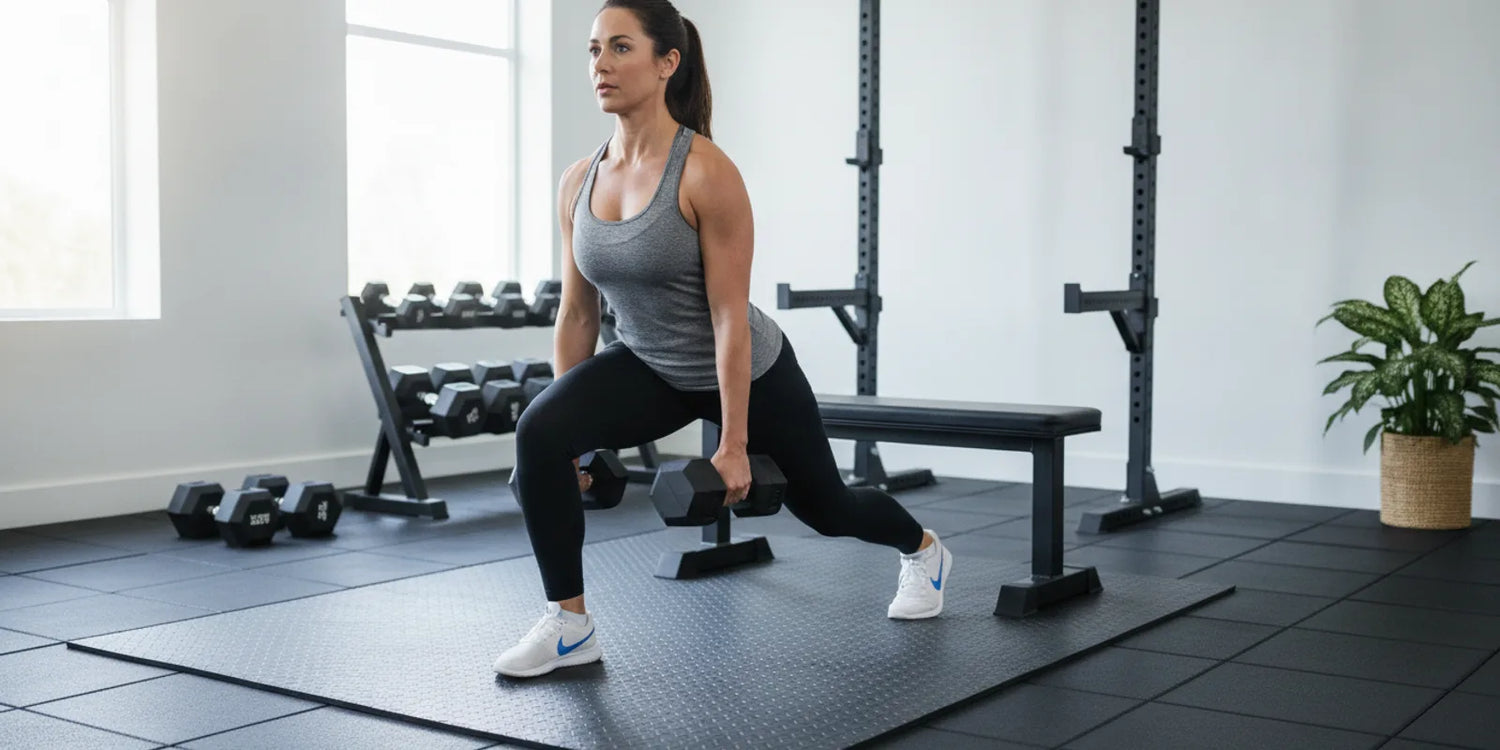
Choosing the right dumbbells for Bulgarian split squats can make the difference between a productive leg day and a frustrating balancing act. The Bulgarian split squat, or rear-foot elevated split squat, demands more from each leg individually than almost any bilateral exercise, so getting your weight selection and grip style right from the start matters.
This guide is written for intermediate home gym lifters, especially women who want to build glute and quad strength without a barbell rack. You'll find a practical weight progression roadmap, grip comparisons, setup cues, and a programming plan to keep you moving forward every session.
Quick Answer: For the dumbbell Bulgarian split squat, beginners should start with 10-15 lb per hand once bodyweight balance is solid. Intermediate lifters typically work in the 20-40 lb per hand range for sets of 8-12 reps. Use a goblet hold first to learn form, then switch to dual dumbbells at your sides for heavier progressive loading.
Key Takeaways
- Start light: Begin with bodyweight or a 10-15 lb goblet hold to master balance before adding bilateral dumbbell load.
- Bench height matters: A bench or box between 12 and 18 inches keeps rear-knee stress low and front-leg tension high.
- Hip-dominant movement: The Bulgarian split squat places greater hip extension demand than the bilateral back squat, making it especially effective for glute development.
- Progression signal: Add 5 lb when you can complete all sets with two reps in reserve, controlled descent, and heel staying planted throughout.
- Home gym friendly: A pair of adjustable dumbbells covers every loading stage of the BSS from beginner to advanced without requiring a barbell rack.
What Is the Dumbbell Bulgarian Split Squat and Why It Works
The dumbbell Bulgarian split squat is a rear-foot elevated unilateral squat where one foot rests on a bench and the front leg performs all the work, making it one of the most effective lower-body exercises available for home gym training. Unlike bilateral squats, each leg operates independently, which forces your stabilizers to engage fully and quickly exposes any strength imbalance between sides.
For home gym lifters working without a power cage or barbell, dumbbells remove the need for any rack. You can load heavy enough to drive real muscle and strength gains using nothing more than a pair of dumbbells and a weight bench, a chair, or even a plyo box.
- No rack required: Dumbbells let you load the movement progressively at home without a squat rack or barbell setup.
- Unilateral strength: Training each leg separately corrects side-to-side imbalances that bilateral squats mask.
- Scalable for all levels: The exercise scales from pure bodyweight for new movers up to heavy dual-dumbbell loads for advanced lifters.
- Core and hip stability demand: The split stance activates your core and hip stabilizers to a greater degree than bilateral pressing or squatting patterns.
- Glute and quad emphasis: Adjusting trunk angle lets you shift emphasis between the gluteus maximus and the quadriceps without changing the exercise itself.
Pair this foundation with a solid set of RitFit hex rubber dumbbells and a stable bench to get started immediately in your home gym.
Which Muscles Does the Dumbbell Bulgarian Split Squat Target?
The dumbbell Bulgarian split squat primarily trains the gluteus maximus and quadriceps of the front leg, with secondary activation of the hamstrings, adductors, calves, and core stabilizers. A 2021 study published in the International Journal of Exercise Science found that the BSS is a hip-dominant exercise that places significantly less compressive demand on the knee than a bilateral back squat, while hip extension demand remains comparable between the two movements.[1]
This makes the dumbbell BSS particularly well suited for lifters who want to emphasize glute development or who find high knee stress uncomfortable with heavy bilateral squatting.
- Gluteus maximus: The primary mover during the push-up phase, especially when a slight forward trunk lean is used.
- Quadriceps: Heavily loaded during the descent and drive phase, with more quad activation when the front foot is positioned closer to the bench.
- Hamstrings: Contribute to hip extension at the top of the movement and act as stabilizers through the range of motion.
- Adductors: Help stabilize the pelvis and prevent the front knee from collapsing inward.
- Core and erector spinae: Activated throughout to keep the torso stable and upright under dumbbell load.
- Medial glute and hip abductors: Engaged in the frontal plane, particularly when using contralateral dumbbell loading.
According to Bret Contreras, PhD, single-leg training is essential for addressing strength imbalances and improving hip stability, and the Bulgarian split squat in particular places a high demand on the glutes and hip stabilizers of the front leg, making it one of the most effective unilateral lower-body exercises available.
Bret Contreras, PhD in Sports Science, The Glute Guy, Contreras Strength Institute
How Do You Set Up for the Dumbbell Bulgarian Split Squat?
The dumbbell Bulgarian split squat setup requires three things to be right before you pick up any weight: bench height, front foot distance, and dumbbell grip style. Getting all three correct before adding load prevents the most common form breakdowns.
What Bench Height Works Best?
A bench or box between 12 and 18 inches high works best for most people. A height around 12 inches keeps the rear-knee angle comfortable and maintains tension on the front quad and glute.
Higher surfaces increase hip flexor stretch on the rear leg, which can compromise form when you are holding heavy dumbbells.
How Far Should Your Front Foot Be?
Position your front foot 2-3 feet in front of the bench so you can drop straight down with your front heel staying planted. A quick test: sit on the bench, extend your legs, press your heels into the floor, and stand up, and that foot position is your starting point.
Which Dumbbell Grip Option Should You Choose?
Three grip options exist for the dumbbell BSS, each suited to different loading stages and goals.
- Goblet hold (one dumbbell at chest): Best for beginners and technique work. Keeping the weight at the chest self-corrects torso posture and reduces balance demands, letting you focus on depth and heel drive.
- Dual dumbbells at sides: The most common loaded variation for intermediate and advanced lifters. This grip allows heavier total loading while keeping the spine neutral, and it scales well as strength increases.
- Contralateral single dumbbell: Holding one dumbbell on the opposite side of the working leg increases frontal-plane stability demand, engaging the medial glute and obliques more than bilateral loading. Coaches note this variation is ideal if you want extra core challenge without going heavier.
Browse the full range of dumbbells at RitFit to find the right weight for your current training stage.
How Do You Perform the Dumbbell Bulgarian Split Squat Step by Step?
The dumbbell Bulgarian split squat is performed by setting your rear foot on the bench laces-down, gripping your dumbbells at your sides, and descending in a straight line until your front thigh is near-parallel to the floor, then driving up through the front heel. Each phase has a specific cue that keeps the front leg doing the work.
A 2021 study in BMC Sports Science and Medicine and Rehabilitation found that a slight trunk flexion during the BSS significantly increased gluteus maximus and biceps femoris activation, while maintaining a more upright trunk shifted emphasis to the quadriceps.[2] Use this cue intentionally based on your training goal for the session.
- Step 1: Position: Stand 2-3 feet in front of the bench. Place the top of your rear foot on the bench with laces facing down. Hold dumbbells at your sides or in goblet position.
- Step 2: Brace: Take a breath, brace your core, and drive 80-90% of your weight into your front heel. Keep hips square to the front.
- Step 3: Descend: Lower straight down at a controlled 2-3 second pace. Front knee tracks over toes without collapsing inward. Hover 1-2 inches above the floor at the bottom.
- Step 4: Drive up: Push through the front heel and squeeze the glute to return to the start. Do not push off the rear foot.
- Step 5: Complete the set: Finish all reps on one leg before switching. Reset your front foot position if balance shifted between reps.
Watch this tutorial from Lift With Michelle for a clear visual walkthrough of the dumbbell BSS with both bench and box variations:
If your lower back aches during the movement, it is often a sign that the weight is too heavy and pulling your chest forward, or that you are not bracing your core before each rep. Reduce the load, reset your stance, and focus on pelvic tilt before adding weight again.
How Heavy Should Your Dumbbells Be for Bulgarian Split Squats?
Dumbbell weight for the Bulgarian split squat depends on your training experience, balance proficiency, and current goal, with beginners starting at bodyweight and working up to 10-15 lb per hand, intermediates using 20-40 lb per hand, and advanced lifters progressing to 40-60 lb or more. The right weight is the heaviest load that lets you complete all programmed reps with two reps in reserve and no form breakdown.
A study in Sports found measurable between-leg mechanical asymmetries during the Bulgarian split squat, which means that if you rush the load before your balance and coordination are solid, your dominant leg will compensate and the weaker side gets less training stimulus.[3]
Beginner: Bodyweight to Light Goblet (0-15 lb per hand)
Beginners should train BSS with bodyweight until they can complete 3 sets of 10 reps per leg with consistent balance before adding any load. Once balance is stable, move to a 10-15 lb goblet hold at the chest and spend 1-2 weeks grooving the movement pattern.
Intermediate: Dual Dumbbells at Sides (20-40 lb per hand)
Intermediate lifters who have mastered the goblet progression typically work in the 20-40 lb per hand range for sets of 8-12 reps. Progress by 5 lb increments when all sets can be completed with clean form and two reps in reserve.
Advanced: Progressive Overload (40-60 lb or More per hand)
Advanced lifters can push into the 40-60 lb range per hand and beyond once bilateral dumbbell balance is consistent. Grip becomes a limiting factor at these weights, so lifting straps are often useful to keep grip from capping leg stimulus.
A set of dumbbells with a rack package makes organizing multiple weight pairs for progressive loading far more convenient in a home gym.
| Training Level | Dumbbell Range (per hand) | Sets x Reps | Rest |
|---|---|---|---|
| Beginner | Bodyweight, then 10-15 lb | 2-3 x 8-12 | 60-90 sec |
| Intermediate | 20-40 lb | 3 x 8-12 | 90-120 sec |
| Advanced | 40-60 lb+ | 3-4 x 6-10 | 120-180 sec |
Weight ranges are illustrative benchmarks. Individual variation in limb length, balance, and training history affects appropriate starting loads.
Goblet Hold or Dumbbells at Both Sides: Which Is Better?
The goblet hold is better for learning the movement, while dual dumbbells at your sides are better for long-term progressive loading once balance is consistent. The two grips serve different phases of the same learning curve rather than competing with each other.
Coaches typically recommend progressing to dual dumbbells once you can complete 12 reps cleanly with a moderate goblet weight, as the bilateral hand position allows heavier total load without the chest-load limitation of the goblet style. A 30-50 lb goblet hold is the typical bridge point where most intermediate lifters transition.
- Goblet hold advantages: Self-corrects posture, keeps the torso upright, reduces balance demand on the first loaded sessions, and helps you find depth without forward lean.
- Goblet hold limitations: A single heavy dumbbell at the chest becomes awkward and grip-limiting quickly, capping how much you can progressively overload the exercise long-term.
- Dual dumbbells at sides advantages: Allows heavier bilateral loading, keeps the spine neutral throughout, distributes weight symmetrically, and scales well over months of training.
- Contralateral single dumbbell (bonus option): Holding one dumbbell on the opposite side of the working leg increases lateral hip stability demand and engages the medial glute and obliques more. This is a useful technique variation for lifters who want extra core challenge at moderate loads.
If grip starts limiting your heaviest sets before your legs fatigue, consider a hex dumbbell set with a knurled handle for better control under load, or move to a front-rack variation.
Sets, Reps, Frequency, and When to Add Weight
For intermediate lifters focused on hypertrophy and glute development, 3 sets of 8-12 reps per leg at 2 sessions per week is the standard starting point. Allow at least 48 hours of recovery between sessions to allow the significant unilateral muscle damage to resolve.
Beginners can start with 2 sessions per week at lighter loads and build to 3 sessions as conditioning improves.
When Should You Increase Dumbbell Weight?
Add 5 lb per dumbbell when you can complete all programmed sets and reps with two reps in reserve and no form breakdown on any set. Signs that you are ready to progress include a controlled 2-3 second descent every rep, front heel staying planted throughout, hips remaining square, and no rear-leg push-off to complete the concentric drive.
When Should You Stop Adding Weight or Stop the Exercise?
Stop the set and reduce load if your front heel lifts during the ascent, your knee caves significantly inward, or your torso pitches forward uncontrollably.
Stop the exercise entirely and rest if you feel sharp knee pain, hip flexor pinching, or lower back pain that does not resolve when you reset your stance and reduce load. These are signals to reassess setup and weight selection, not push through.
How Should Women Program the Dumbbell BSS?
Women respond well to the same rep ranges as mixed-sex populations for hypertrophy, but research on female athletes suggests that attention to hip stabilizer activation is particularly important. Running the BSS twice per week as a primary unilateral leg movement, paired with a hip thrust variation on the same or alternate sessions, addresses both glute and stability needs efficiently.
- Weeks 1-4: 2-3 x 8-12 reps per leg, goblet or light dual dumbbells, focus on balance and depth.
- Weeks 5-8: 3 x 8-12 reps per leg with dual dumbbells, add 5 lb when all sets hit the top of the rep range.
- Weeks 9 onward: 3-4 x 6-10 reps per leg at heavier loads, introduce tempo work (3-second descent) for additional stimulus without always needing more weight.
A set of rubber hex dumbbells provides the floor stability and grip quality you need to manage heavy BSS loads safely in a home gym setting. Pair them with a RitFit 3-tier dumbbell rack to keep multiple weight pairs organized and accessible for warm-up and working sets.
Common Mistakes and How to Fix Them
The most common dumbbell Bulgarian split squat mistakes involve setup errors that shift load away from the front leg, turning the exercise from a quad and glute builder into a balance test. Fixing these before adding more weight saves months of stalled progress.
- Front foot too close to the bench: Causes the front knee to track too far forward, shifting stress from the glute to the knee. Fix: step the front foot further out until you can drop straight down with your heel planted.
- Front foot too far from the bench: Creates excessive forward lean and hip flexor stretch that destabilizes the movement. Fix: bring the foot closer until the torso angle and front-shin angle match at the bottom of the squat.
- Pushing off the rear foot: Reduces tension on the front quad and glute by letting the rear leg assist the ascent. Fix: think of the rear foot as a kickstand, not a driver, and initiate every rep by driving the front heel into the floor.
- Rear foot on toes instead of laces-down: Creates an unstable base and can cause the rear ankle to roll. Fix: rest the top of the rear foot flat on the bench with laces facing down and toes relaxed.
- Dumbbells too heavy too soon: Causes the torso to pitch forward under load, shifting stress to the lower back. Fix: reduce weight until the descent is controlled for the full range before progressing.
- Front knee caving inward: Indicates weak hip abductors or load that exceeds stability capacity. Fix: consciously push the front knee out over the second toe, and consider reducing weight or adding lateral band work to strengthen the medial glute.
Once your form is clean and your loads are progressing steadily, explore the PVC coated dumbbells for lighter warm-up sets, and keep a heavier pair of hex dumbbells ready for working sets. If you eventually want a guided movement path for the BSS, the Smith machine Bulgarian split squat is a useful variation to explore. For an advanced unilateral challenge after mastering the BSS, the pistol squat is a natural next step.
FAQs About Dumbbells for Bulgarian Split Squat
What dumbbell weight should I start with for Bulgarian split squats?
Beginners should start with bodyweight until balance is consistent, then add 10-15 lb per hand. Once you complete 3 sets of 10 reps with two reps in reserve, increase by 5 lb increments. Most intermediate lifters settle into the 20-40 lb per hand range for hypertrophy.
A goblet hold is better for beginners and those learning the movement because it keeps the torso upright and self-corrects posture. Once you can complete 12 clean reps with a moderate goblet weight, switching to dual dumbbells at your sides allows heavier total loading and better scalability for long-term strength progression.
How do I know when to increase dumbbell weight on the Bulgarian split squat?
Add weight when you can complete all programmed sets and reps, typically 3-4 sets of 10-12 per leg, with two reps in reserve and no form breakdown. Signs include controlled descent, heel staying planted, hips square throughout, and no compensating with the rear leg. Increase by 5 lb at a time and retest form on the first set.
What bench height is best for the dumbbell Bulgarian split squat?
A bench or box between 12 and 18 inches high works best for most people. A surface around 12 inches keeps the rear knee angle comfortable and maintains tension on the front quad and glute. Higher surfaces place more stress on the hip flexors of the rear leg and can compromise form, especially when holding heavy dumbbells.
How often should women do Bulgarian split squats with dumbbells?
Two sessions per week is the standard recommendation for intermediate lifters. Allow at least 48 hours of recovery between sessions as the BSS is a demanding unilateral exercise that generates significant muscle damage. Beginners may do one session per week initially, progressing to two once balance and technique are consistent across all sets.
Can I build glutes with only dumbbells doing Bulgarian split squats?
Yes. The dumbbell Bulgarian split squat is highly effective for glute development because it places the front leg in a hip-dominant position with significant hip extension demand. A slight forward trunk lean of 20-40 degrees further increases gluteus maximus activation. Paired with progressive overload, increasing weight every 1-2 weeks, dumbbell BSS can drive meaningful glute gains without any barbell equipment.
Conclusion
Choosing the right dumbbells for Bulgarian split squats comes down to one principle: start lighter than you think you need, master balance and hip hinge, then add load in 5 lb increments as each weight becomes controllable. Begin with a goblet hold, progress to dual dumbbells, and use the weight table in this guide as your roadmap.
Start with bodyweight to dial in bench height and foot distance. Then check out our full guide on how to do a Bulgarian split squat, and pair it with a front squat for balanced bilateral and unilateral programming.
Disclaimer
The information in this article is intended for general educational purposes only and does not constitute medical or professional fitness advice. Consult a qualified healthcare or fitness professional before starting any new exercise program, particularly if you have a pre-existing injury or health condition.
Save on your next RitFit order
Tap the button to copy your code, then paste it at checkout.
References
1. Mackey ER, Riemann BL. Biomechanical Differences Between the Bulgarian Split-Squat and Back Squat. Int J Exerc Sci. 2021;14(1):533-543. doi:10.70252/CIYT8956
2. Aygun-Polat E, Guzel NA, Guruhan S, Polat Y, Karatas N. Targeted muscle activation in Bulgarian split squat variations: effects of trunk position and suspension-based execution. BMC Sports Sci Med Rehabil. 2025;17(1):251. doi:10.1186/s13102-025-01306-z
3. Lockie RG, Risso FG, Lazar A, et al. Between-Leg Mechanical Differences as Measured by the Bulgarian Split-Squat: Exploring Asymmetries and Relationships with Sprint Acceleration. Sports (Basel). 2017;5(3). doi:10.3390/sports5030065





