








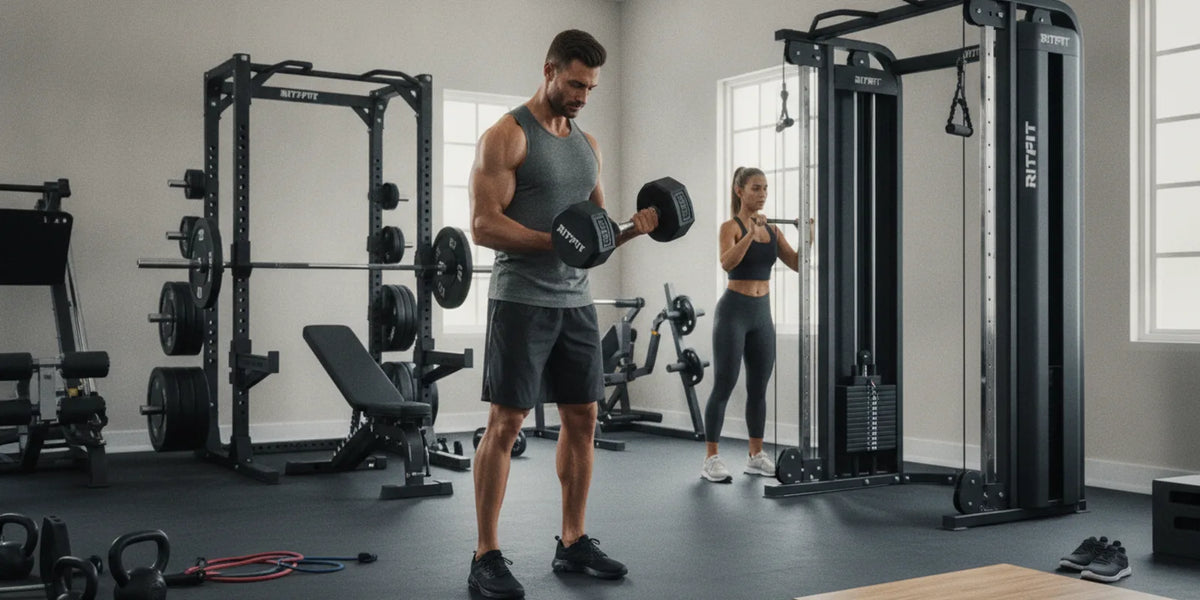
Dumbbells and cables are the two most common tools for building muscle in a home gym, and choosing between them often comes down to how each one applies resistance to your muscles.
This guide breaks down the real biomechanical differences, points to peer reviewed research on muscle activation and growth, and helps you decide which tool, or combination, fits your goals and space.
Quick Answer: Research comparing dumbbell and cable exercises for muscle growth finds the two are roughly equally effective, so the better choice for most home gyms depends on space, budget, and whether you want the constant tension cables provide or the natural range of motion dumbbells allow.
Key Takeaways
- Muscle growth: Dumbbell and cable lateral raises produced nearly identical deltoid growth over eight weeks of training.
- Tension curve: Dumbbells peak resistance mid range, cables keep tension more constant through the full range of motion.
- Space and cost: Dumbbells take less space and cost less upfront than a cable crossover machine.
- Best use case: Dumbbells suit compound, stability demanding lifts, cables suit constant tension isolation work.
- Verdict: Choose based on your goals and space, or combine both for the most complete home gym.
What's the Real Difference Between Dumbbells and Cables?
Dumbbells are independent free weights that rely entirely on gravity for resistance, while cables use a pulley and weight stack to pull the load in a fixed, adjustable direction. That single difference in how force is applied changes muscle activation, range of motion, and stability demands for nearly every exercise.
- Dumbbells: Independent handheld weights that require you to balance and stabilize the load through the entire movement.
- Cable machines: Weight stacks connected through pulleys and adjustable handles, letting you change the angle and direction of resistance.
- Resistance source: Dumbbells depend on gravity, cables depend on the pulley and cable path, which is why the two feel different even in the same exercise.
- Stability demand: Dumbbells recruit more stabilizer muscles because nothing guides the weight's path.
Both tools show up in the RitFit dumbbell collection and cable machine collection, and many home gyms end up using a mix of both rather than picking only one.
What Does the Research Say About Muscle Activation?
A 2025 experimental study found dumbbell and cable lateral raises produced nearly identical lateral deltoid muscle growth after eight weeks of training, with thickness increasing 3.3 to 4.6 percent in both groups.[1] The takeaway is that neither tool has a meaningful hypertrophy advantage when training variables like sets and reps are matched.
A separate 2025 study noted that no prior research had directly compared biceps brachii activation between a dumbbell curl and a Bayesian cable curl, so researchers used surface EMG to examine the difference in a small group of lifters.[2] Their exploratory design highlights how recent this specific comparison still is in exercise science.
- Stabilizer engagement: Dumbbells force your shoulder, wrist, and core stabilizers to work harder since nothing controls the weight's path.
- Constant tension: Cables keep the target muscle under load even at the top and bottom of a rep, where dumbbells often lose tension.
- Individual variation: Activation differences between the two tools are often small and can vary by exercise, grip, and individual anatomy.
Which Offers a Better Range of Motion?
Dumbbells generally allow a more natural, unrestricted range of motion because your joints, not a fixed cable path, determine how far you can move. Cables, on the other hand, let you adjust pulley height and angle to work a muscle from multiple directions that free weights cannot easily reach.
A ten-week training study comparing cable and barbell preacher curls found biceps hypertrophy was nearly identical between the two, 7 percent versus 8 percent muscle thickness increase, though the barbell produced slightly greater strength gains when the muscle was in a lengthened position.[3] That pattern lines up with the general resistance profile difference between free weights and cables.
One comparison of the two tools notes that cables keep tension on the target muscle fairly constant throughout the range of motion, including the stretched position, while dumbbells rely on gravity, producing the most resistance when the limb is parallel to the floor and the least in the stretched position.
- Ascending resistance, dumbbells: Resistance increases as your arm moves away from your body and decreases again as it returns.
- Descending or constant resistance, cables: Tension can stay high even in the stretched position, which many lifters find useful for hypertrophy focused work.
- Multi-angle training: Cable pulleys can be raised, lowered, or angled to hit a muscle from several directions in the same session.
Which Should You Choose for Your Goals?
The right choice depends on your primary goal, available space, and budget rather than one tool being universally better. RitFit's own dumbbell and cable crossover lines cover most home gym goals without needing to compare outside brands.
| Goal | Pick | Why |
|---|---|---|
| Compact home setup | RitFit Hex Rubber Dumbbells | Small footprint, no wall mounting needed |
| Constant tension isolation work | RitFit M3 Power Rack Cable Crossover Smith Machine | Pulley keeps tension even through the full range of motion |
| Budget full body home gym | RitFit PVC Coated Dumbbells | Lower upfront cost, versatile across many lifts |
| Guided path pressing for stability limited lifters | RitFit M1 Multi-Functional Smith Machine | Fixed rail path reduces the need for stabilizer control |
Recommendations are based on RitFit's own dumbbell and cable crossover product lines, not a ranking against outside brands.
If you train alone at home, weigh how much you value guided stability against the natural feel and lower cost of free weights before you commit to a frame.
Is a Cable Machine Worth the Investment?
A cable machine costs more upfront and needs more space than a set of dumbbells, but it can replace several single purpose attachments and add exercise variety as your training evolves. Dumbbells stay cheaper to start with and scale easily since you can simply add more pairs or an adjustable set over time.
- Upfront cost: Dumbbells are the lower cost entry point for most beginners.
- Long term versatility: A cable crossover system can cover presses, pulls, curls, and core work in one footprint, reducing the need to buy separate machines later.
- Upgrade path: You can start with dumbbells and add a cable crossover system later without replacing your existing equipment.
- Space planning: Measure your available wall and ceiling clearance before committing to a cable crossover frame, since most units need several feet of depth for full range of motion.
For most beginners, dumbbells remain the more practical first purchase, while a cable crossover system becomes worth the investment once you outgrow basic free weight exercises.

What Mistakes Should You Avoid When Switching?
The most common mistake is copying the exact same tempo and range of motion between dumbbells and cables without adjusting for their different resistance curves, which can quietly reduce muscle engagement. A second mistake is ignoring stabilizer training entirely once you switch to cables, since the guided pulley path does some of the stabilizing work dumbbells normally require.
- Skipping a warm up set: Test the resistance curve of a new cable exercise with a light warm up set before loading up.
- Ignoring pulley height: A poorly set pulley height changes which part of the muscle gets the most tension.
- Only using one tool: Relying exclusively on dumbbells or cables can leave gaps in stabilizer strength or peak tension work.
- Rushing form to load more weight: Cables can make it tempting to use momentum, which reduces muscle tension and raises injury risk.
If you are new to combining both tools, our guide on how to do a dumbbell fly shows proper form cues that also translate well to the cable version of the movement.
Which Exercises Work Best With Each?
Dumbbells work best for compound, stability demanding lifts like presses, rows, and lunges, where free movement recruits more supporting muscle. Cables shine in isolation work such as curls, flys, and pull-downs, where constant tension through the full range of motion helps target a specific muscle without needing a spotter.
- Dumbbell exercises to prioritize: Bench press, single arm row, goblet squat, and walking lunge.
- Cable exercises to prioritize: Cable curl, cable fly, lat pulldown, and cable lateral raise.
- Best of both: Pairing a dumbbell compound lift with a cable isolation finisher covers stability and constant tension in the same session.
For more exercise ideas, see our best back exercises with dumbbells guide, and pair your cable sessions with RitFit lat pulldown attachments for more pulling variety.
This side by side demonstration shows a cable curl and an incline dumbbell curl performed back to back, illustrating the technique differences discussed above.
"They're very similar in muscle activation and joint moments, but the machine is a bit more stable than the free-weight version."
Bret Contreras, PhD, PhD in Sports Science known as The Glute Guy, Contreras Strength Institute
FAQs About Dumbbells vs Cables
Are dumbbells or cables better for building muscle?
Research comparing dumbbell and cable lateral raises found nearly identical increases in muscle thickness after eight weeks of training, suggesting both tools can build muscle equally well. The bigger factor is consistency and proper form rather than which equipment you choose, so pick whichever one you will use regularly and with good technique.
What is the main difference in muscle activation between dumbbells and cables?
Dumbbells rely on gravity, so resistance is greatest when your arm is parallel to the floor and lowest when the muscle is stretched. Cables use a pulley system that keeps tension roughly constant throughout the entire movement, including the stretched position, which some lifters find helpful for isolating a muscle.
Do cables give a better range of motion than dumbbells?
Cables often allow smoother, multi-directional movement and can be adjusted to different heights and angles, which is useful for isolating a muscle from multiple directions. Dumbbells typically allow a very natural, unrestricted range of motion since nothing but your own joints limits the path, though stability can become the limiting factor at heavier loads.
Is a cable machine worth the investment compared to buying dumbbells?
A cable machine costs more upfront and needs more space, but it replaces many single purpose attachments and lets you train dozens of exercises with adjustable, constant tension. Dumbbells are cheaper to start with and take up less room, making them the more practical first purchase for most home gyms.
What mistakes do people make when switching between dumbbells and cables?
A common mistake is copying the exact same tempo and range of motion between tools without adjusting for the different resistance curve, which can reduce muscle engagement. Another is neglecting stabilizer muscles when moving to cables, since the guided pulley path does some of the stabilizing work dumbbells normally require.
Which exercises work best with dumbbells versus cables?
Dumbbells excel at compound, stability demanding lifts like presses, rows, and lunges where free movement recruits more supporting muscles. Cables shine in isolation work such as curls, flys, and pull-downs, where constant tension through the full range of motion helps target a specific muscle without needing a spotter.
Conclusion
Dumbbells and cables both build muscle effectively, and the biggest difference between them is how they apply tension rather than which one is definitively better. Choose dumbbells for natural movement and lower upfront cost, cables for constant tension and exercise variety, or combine both for the most complete home gym.
Start by matching the tool to your goal and space. Browse the RitFit adjustable dumbbells collection if you need a compact, budget friendly entry point before adding a cable crossover system later.
Disclaimer
This article is for general informational purposes only and is not a substitute for personalized fitness or medical advice. Consult a qualified trainer or healthcare provider before starting a new strength training program, especially if you have an existing injury or health condition.
Save on your next RitFit order
Tap the button to copy your code, then paste it at checkout.
References
1. Larsen S, Wolf M, Schoenfeld BJ, et al. Dumbbell versus cable lateral raises for lateral deltoid hypertrophy: an experimental study. Front Physiol. 2025;16. PMC12277279.
2. Vasiliou A, Michaelides M, et al. An exploratory study of biceps brachii electromyographic activity during traditional dumbbell versus Bayesian cable curls. Muscles. 2025;4(4):45. PMC12550948.
3. Nunes JP, Jacinto JL, Ribeiro AS, et al. Placing greater torque at shorter or longer muscle lengths. Effects of cable vs barbell preacher curl training on muscular strength and hypertrophy in young adults. Int J Environ Res Public Health. 2020;17(16):5859. PMC7460162.





