








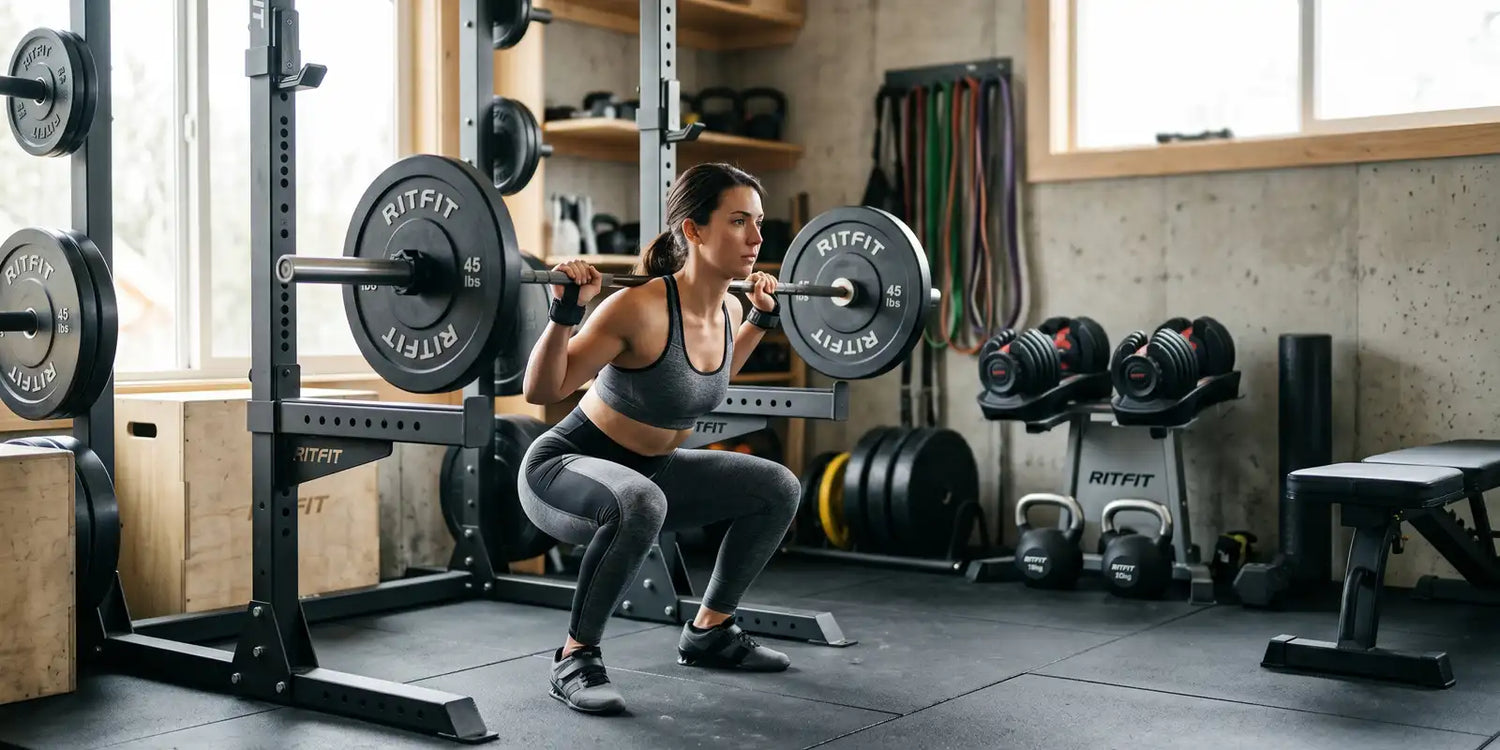
A good leg workout trains all four lower body muscle groups, the quads, hamstrings, glutes, and calves, using a mix of compound and isolation moves. This guide shows you the best leg exercises and gives four ready-to-run sessions for any setup.
You will learn how to pick your weight, swap exercises, set weekly volume, and know when to add load or stop for pain. It suits beginners through intermediate lifters training at home or in a gym.
Table of Contents
Key Takeaways
- Train all four muscle groups: A complete leg workout covers quads, hamstrings, glutes, and calves with both compound and isolation moves.
- Build around three patterns: Squats, hip hinges, and lunges form the backbone of any good leg day.
- Match the session to your setup: Heavy gym, quad and glute, at-home, and machine-only days all work when programmed well.
- Control the lowering phase: A slower eccentric on squats can drive more strength and quad growth.
- Progress gradually and respect pain: Add weight when the last set feels easy, and stop any set that causes sharp joint pain.
What Makes a Leg Workout Good?
A good leg workout trains the four main lower body muscle groups across the key movement patterns, rather than piling on random exercises. It balances knee-dominant work, hip-dominant work, and direct calf training so no area gets neglected.
- Quadriceps: The muscles on the front of the thigh extend the knee and do most of the work in squats, leg presses, and lunges.
- Hamstrings: The muscles on the back of the thigh flex the knee and extend the hip, so they respond to hinges and leg curls.
- Glutes: The gluteus maximus drives hip extension and is loaded heavily by hip thrusts, squats, and lunges.
- Calves: The gastrocnemius and soleus control the ankle and need direct, full-range work to grow.
For a deeper exercise list, see our roundup of the best leg exercises for leg day. The structure below routes you to the right moves for each muscle.
What Are the Best Leg Exercises by Muscle Group?
The best leg exercises are the ones that load each muscle group through its main job, with a compound lift as the anchor and isolation work to fill gaps. Below are the most effective options organized by the muscles they target.
Which Exercises Build the Quads?
Quad-dominant moves load knee extension under heavy weight, with the squat as the foundation.
- Back and front squats: Back squats let you move the most weight, while front squats increase quad demand and keep the torso upright.
- Leg press and hack squat: These add quad volume with less spinal loading, useful when squats are fatiguing your back.
- Leg extension: A pure quad isolation move, best done through a full range with a brief hold at the top.
Which Exercises Build the Hamstrings?
Hamstring growth is exercise-specific, so the position you train in matters as much as the movement. Lengthened-state eccentric leg-curl style training increased hamstring volume more than Nordic curls in one trial, +18% versus +11%, favoring work that loads the muscle in a stretched, hip-flexed position.[2]
- Romanian deadlift: A long, loaded stretch on the hamstrings and glutes, and one of the most effective posterior chain builders.
- Seated leg curl: Trains knee flexion with the hip flexed, loading the hamstrings at a longer length.
- Nordic curl: Brutally effective for eccentric hamstring strength when you progress it patiently.
Which Exercises Build the Glutes?
Glute exercises load hip extension, and both vertical and horizontal patterns belong in a good plan. In a 9-week trial of untrained adults, back squat and hip thrust training produced similar gluteus maximus growth, but the squat produced greater quadriceps and adductor growth, which supports using both rather than picking one.[1]
- Hip thrust: Loads hip extension heavily near the top, where the glutes produce force well.
- Glute bridge: A shorter-range option that works for beginners, warm ups, or home training.
- Walking and reverse lunges: Unilateral moves that build the glutes and quads while improving balance.
Which Exercises Build the Calves?
Calves need both a straight-knee and a bent-knee movement to train their two heads fully. The standing calf raise emphasizes the gastrocnemius, while the seated calf raise targets the soleus.
- Standing calf raise: Heavy load with a full stretch at the bottom of each rep.
- Seated calf raise: Moderate weight and full range, often the neglected key to fuller calves.
To train these patterns with dedicated equipment, browse our leg machines collection.
Which 4 Leg Workouts Can You Run This Week?
Four leg workouts cover almost every situation, a heavy gym day, a quad and glute day, an at-home day, and a machine-only day. Pick the one that matches your equipment, recovery, and weakest muscle group, then run it once or twice per week.
Heavy Gym Leg Day
This barbell-focused session builds total lower body size and strength.
- Main lifts: Front squat 4x6, Romanian deadlift 3x8, leg press 3x12.
- Finishers: Walking lunges 3x10 per leg and standing calf raises 4x12.
Quad and Glute Day
This day shifts emphasis toward physique balance and lower body shape.
- Build: Hip thrust 4x10, Bulgarian split squat 3x10 per leg, leg extension 3x15, seated leg curl 3x12.
At-Home Leg Day
This minimal-equipment session uses bodyweight progressions and any dumbbells you own.
- Circuit: Goblet or bodyweight squats, split squats, single-leg glute bridges, and calf raises for 3 rounds of 12 to 15 reps.
For loaded variations, see our dumbbell leg workout at home or these leg workouts at home with a bench.
Machine-Only Leg Day
This joint-friendly day manages lower-back fatigue while still training hard.
- Run: Leg press 4x12, hack squat 3x10, seated leg curl 3x12, leg extension 3x15, seated calf raise 4x15.
See our lower body machine workout guide and Smith machine leg workouts for more setups.
The video below walks through a science-based leg day that mirrors the structure above.
How Do You Choose the Right Weight?
You choose the right weight by using a load that lets you stop each set with one to three reps in reserve, meaning you could do a few more before failure. This keeps effort high enough to grow while protecting your form on big lifts.
How you lift the weight matters too. In a 7-week squat study in novices, a slower eccentric tempo produced greater 1RM strength gains and greater vastus lateralis growth than a fast tempo, so controlling the lowering phase pays off.[3]
- Compound lifts: Work in the 6 to 10 rep range and keep two or three reps in reserve.
- Isolation moves: Use 12 to 15 reps and push closer to failure since the joint risk is lower.
- Tempo: Lower under control for two to three seconds rather than dropping the weight.
A loadable machine like the RitFit 3-in-1 leg press, hack squat and calf raise set makes adding small increments simple.
What Can You Swap an Exercise For?
You can swap any exercise for one that trains the same pattern using equipment you have or a joint position that feels better. The goal is to keep the movement pattern, not the exact lift.
- No barbell: Replace back squats with goblet squats or a heavy dumbbell split squat.
- Knee discomfort: Swap deep squats for leg presses or box squats with a controlled depth.
- No hip thrust bench: Use floor glute bridges or single-leg bridges instead.
- No leg curl machine: Use Nordic curls, slider leg curls, or stability-ball curls.
Browse our leg press machines if you want a lower-back-friendly squat alternative at home.
How Much Volume and Frequency Do Legs Need?
Most lifters grow well on roughly 6 to 16 hard sets per muscle group each week, split across one or two leg days. Quads and glutes handle the higher end, hamstrings often need slightly less, and calves respond to frequent training.
How you split that volume across exercise types also matters for glute development.
"A third of your volume for glutes should be vertical hip extension exercises, those involve squats, lunges, split squats, step ups, deadlift variations, good mornings. Another third should be horizontal. That includes your hip thrust, glute bridge, kickback, back extension. And then the remaining third should be abduction."
Bret Contreras, PhD, Contreras Strength Institute, Muscle for Life Podcast
- Frequency: Training legs once or twice per week works for most people.
- Recovery: Leave at least one day between leg sessions.
- Progression: Add a set or a little weight only when recovery and performance allow.
When Should You Add Weight or Stop for Pain?
You should add weight when your last set feels controlled and you finish with reps to spare, and you should stop a set the moment you feel sharp joint pain. Normal muscle burn and a deep stretch are expected, but stabbing pain is not.
- Add load when: The top of your rep range feels easy with good form for two sessions in a row.
- Hold steady when: Form breaks down or you are still very sore from the last session.
- Stop and reassess when: You feel sharp pain in the knee, hip, or lower back.
If pain persists across sessions, rest the area and consult a qualified professional rather than training through it.
What Are Common Leg Workout Mistakes to Avoid?
Most leg day problems come from skipping muscles or rushing the work rather than the exercises themselves.
- Skipping hamstrings and calves: Quad-heavy days leave the posterior chain and lower legs underbuilt.
- Bouncing out of the bottom: Losing tension wastes the stretch and raises injury risk, so control every rep.
- Adding weight too fast: Jumping load before form is solid stalls progress and strains joints.
FAQs About Good Leg Workouts
What are some good leg workouts for beginners?
A good beginner leg workout uses three or four basic moves built around the main patterns. Try goblet squats, dumbbell Romanian deadlifts, walking lunges, and calf raises. Do three sets of eight to twelve reps each, twice per week. Keep one or two reps in reserve and rest at least a day between sessions.
What muscles should a leg workout train?
A complete leg workout trains four groups. The quadriceps extend the knee, the hamstrings flex the knee and extend the hip, the glutes drive hip extension, and the calves control the ankle. Squats and leg presses hit the quads, hinges and curls hit the hamstrings, hip thrusts and lunges hit the glutes, and calf raises finish the lower leg.
How many sets per week do legs need to grow?
Most lifters do well with roughly six to sixteen hard sets per muscle group each week, split across one or two leg days. Quads and glutes handle the higher end, hamstrings often need slightly less, and calves respond to frequent training. Start near the lower number and add sets only when recovery and performance allow.
Can I build good legs at home without a gym?
Yes. One six-week study in sedentary young women found progressive bodyweight squats increased lower-limb muscle thickness and strength much like barbell squats. At home, progress from two-leg squats to split squats and single-leg work, add tempo and pauses, and use dumbbells or bands. The barbell group lost more body fat, so add some loading once bodyweight moves feel easy.
How often should I train legs each week?
Training legs once or twice per week works for most people. One harder full leg day suits busier schedules, while two lighter days let you spread volume and recover between sessions. Leave at least one day between leg workouts, and adjust based on soreness, sleep, and whether your strength is still climbing week to week.
When should I stop a leg exercise for pain?
Stop a set immediately if you feel sharp, stabbing, or joint pain rather than normal muscle burn. Mild fatigue and a deep stretch are expected, but pain in the knee, hip, or lower back is a signal to reduce load, fix your form, or swap the movement. If pain persists, rest the area and consult a qualified professional.
Conclusion
A good leg workout is simple at its core, train the quads, hamstrings, glutes, and calves through squats, hinges, lunges, and calf work. Choose the session that fits your equipment, control your tempo, and progress gradually.
If you are new, start with the at-home or quad and glute day twice a week, then add load as moves feel easy. Listen to your joints and build from there.
Disclaimer
This article is for general educational purposes only and does not replace personalized medical or fitness advice. Consult a qualified healthcare or training professional before starting a new program, especially if you have an injury or health condition.
References
1. Plotkin DL, Rodas MA, Vigotsky AD, et al. Hip thrust and back squat training elicit similar gluteus muscle hypertrophy and transfer similarly to the deadlift. Frontiers in Physiology. 2023;14:1279170. https://pmc.ncbi.nlm.nih.gov/articles/PMC10593473/
2. Maeo S, Balshaw TG, Nin DZ, et al. Hamstrings Hypertrophy Is Specific to the Training Exercise: Nordic Hamstring versus Lengthened State Eccentric Training. Medicine and Science in Sports and Exercise. 2024;56(10):1893-1905. https://pmc.ncbi.nlm.nih.gov/articles/PMC11419281/
3. Kojic F, Mandic D, Duric S. The effects of eccentric phase tempo in squats on hypertrophy, strength, and contractile properties of the quadriceps femoris muscle. Frontiers in Physiology. 2024;15:1531926. https://pmc.ncbi.nlm.nih.gov/articles/PMC11754408/





