








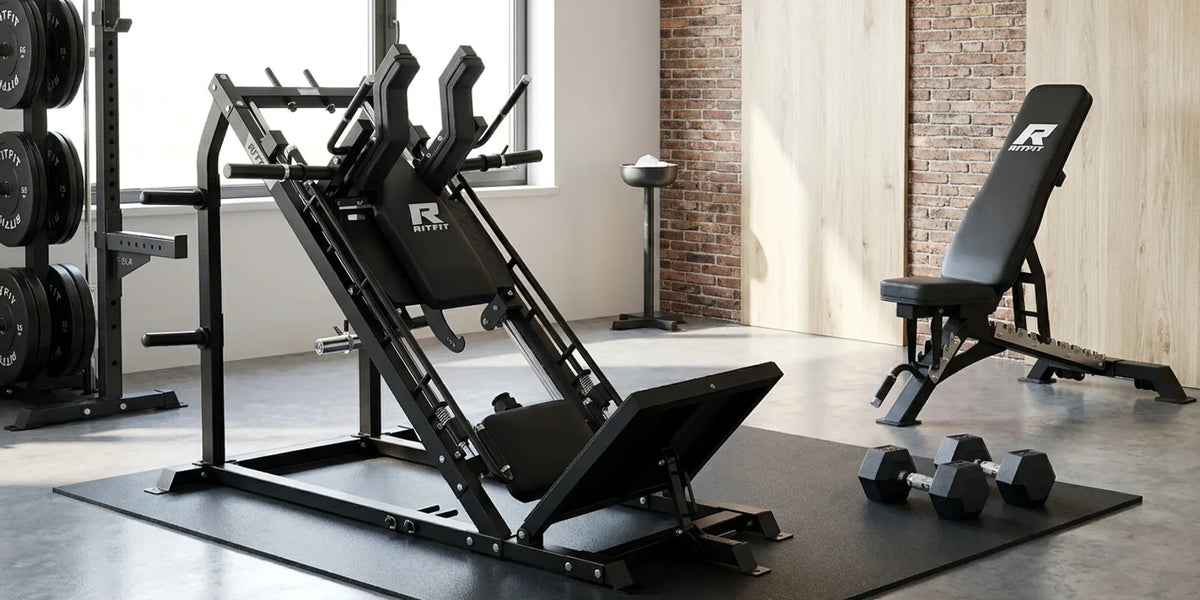
The pause hack squat is a machine squat variation with a complete 2-3 second dead stop at the bottom of every rep. On a combo leg press & hack squat machine like the RitFit GAZELLE PRO 3-in-1, the guided rails make that stop easy to control.
This guide covers machine setup, paused rep form, the muscles worked, and simple programming. If the machine is new to you, start with our how to use a leg press hack squat machine walkthrough, and if the pattern is new, our what is a hack squat guide covers the basics.
Quick Answer: To do a pause hack squat on a leg press & hack squat machine, lock the machine into its hack squat mode, set the shoulder pads and footplate as you would for a normal hack squat, lower the sled to about parallel, hold a complete 2-3 second dead stop with no bounce, then drive back up.
Key Takeaways
- Setup first: The pause hack squat is a hack squat exercise, so the machine must be locked into its hack squat configuration before the first plate goes on.
- Dead stop, not a dip: Every rep holds a genuine 2-3 second stop at the bottom, with the sled motionless and no rebound.
- Less weight than regular reps: The pause removes the stretch reflex, so expect to use noticeably less load than on continuous hack squats.
- Safety stops protect the pause: Set the stops just below your deepest pause position so they can catch a failed rep while you are deliberately weakest.
- Run it in blocks: Keep the variation for roughly 6-10 weeks as a first or second lower-body exercise, then rotate back to regular hack squats.
Set Up the Machine for the Pause Hack Squat
The pause hack squat is performed in the machine's hack squat mode, not the leg press mode. Lock the combo unit into its hack squat configuration before you load anything, because the paused rep builds directly on the standard hack squat pattern.
Choosing the Right Station on the RitFit GAZELLE PRO 3-in-1
Combo units such as the RitFit BLP01 and the home-gym RitFit GAZELLE 3-in-1 dedicate one configuration to the hack squat pattern and another to the leg press. Switch to the hack squat side and settle the sled there before the first plate goes on.
- Shoulder pad height: Climb in and set the pads on your shoulders and upper traps, not on your neck or the tips of your shoulders. With the sled unracked at the top, your knees should hold a slight bend instead of a hard lockout.
- Footplate position: Place your feet roughly shoulder-width apart with the whole foot flat on the platform and the toes turned out slightly. A higher foot position shifts more work toward the hips and a lower one emphasizes the quads, so paused reps want the spot where your heels stay down, whether you press on a welded plate or an add-on like the RitFit foot plate for leg press AT04.
- Safety stops: This is the key setting for paused reps. Adjust the stops so they sit just below your deepest comfortable pause position, so they can catch the sled if a rep goes wrong while you are deliberately weakest.
"Very well built. Smooth gliding trolley, safety stop at the bottom is appreciated. It takes a little while to assemble but nothing to bad considering the product being built. I think two additional features would be appreciated by the public, some type of retractable wheel system for movement, it wieghs over 300lbs assembled, about 700lb loaded with wieght plates. The four plastic 2" inch storage pegs would be so much nicer in chromed metal like the trolley carraige has. The seat is very comfortable. It stores and handles weight really well. This is an exceptional piece of equipment. The shoulder padding for hack squats is thick and the brackets are very sturdy. The seat pad and back pad are both thick, well made, and comfortable. The safety locks are well placed and function perfectly. The adjustable stand plate is well thought out. I havent used the band pegs. but use both top and bottom loading pins on the carriage to balance the wieght loading. The hack squat positioning works well for me. Actually I fit this machine perfectly at 5'7. There seems to be alot more room available. I have to say this is one of my favorite additions to my gym. Its robust design is evident both during assembly and use. Very solid machine. Loaded with a full set of weights, this machine feels fused to the floor. I may consider their Buffalo Smith now that I see the engineering and build quality in this piece. If you're undecided, all I can say is the Gazelle will not disappoint. I noticed some comments stating the alignment gave them hell. This seems to be caused by tightening bolts as you go. Welding steel can sometimes cause the metal to twist or turn in unexpected ways, even when welded within a jig. My best advice as a homebuilder and an automotive restoration mechanic, assemble all of the frame without tightening bolts on a flat level surface. once everything is in place slowly tighted all bolts to the point where they still have some give if you need to manipulate the frame, then tighten once its square and true. That leads you to the carraige which although the directions tell you you need two people, I assmebled the entire machine alone. One more word of advice, assemble it where you intend it to be. Its very heavy! Thanks Ritfit! Nice job"
Phil M. Verified Buyer, RitFit GAZELLE PRO 3-In-1 Leg Press and Hack Squat Machine
Perform the Paused Rep Step by Step
A paused rep follows a strict sequence, and the whole point is that the bottom of the rep is a dead stop. Each phase is deliberate, and every rep gets its own full pause.
- Step 1: Set up and brace. Step under the shoulder pads, set your feet as described above, breathe into your belly, and brace hard before you unrack. Your back stays flat against the pad for the entire set.
- Step 2: Unrack. Straighten your legs to lift the sled off the hooks and rotate the handles to clear them. Check that your feet feel even and your brace is still tight.
- Step 3: Lower under control. Bend the knees and hips and let the sled descend over roughly two to three seconds, keeping the knees tracking in line with the toes. The rails hold the path fixed, so your job is control, not balance.
- Step 4: Pause at the bottom. Descend until your thighs are at least roughly parallel to the footplate, or to the depth your mobility allows without your lower back peeling off the pad. Then stop completely and hold for 2-3 seconds while staying tight, with the sled genuinely motionless and not drifting into the stops.
- Step 5: Drive up and re-rack. Push the whole foot through the platform and return the sled to the top on one smooth effort, exhaling near the end of the lift. Each rep repeats its own full pause, and when the set is finished, guide the sled up and rotate the handles back into the hooks.
One cue keeps pauses honest: count out loud, one-one-thousand, two-one-thousand, so the pause has an objective length.
Muscles Worked in the Pause Hack Squat
The pause hack squat is a quad-dominant machine exercise, and the quads do the bulk of the work, especially out of the bottom where the pause leaves no elastic energy to borrow. The glutes and adductors assist powerfully from the hips, particularly out of deeper positions, while the calves and the core contribute as stabilizers rather than prime movers.
Compared with the continuous version of the movement, the paused variation typically makes the quads' contribution more visible, because the bounce that usually helps launch the ascent is gone. If quad development is your priority, our hack squats for quads guide explains why this pattern is such a reliable quadriceps builder.
Why the Pause Changes the Rep
On a normal hack squat, the bottom of the rep flows straight into the ascent. That quick turnaround taps the stretch-shortening cycle, the phenomenon where a rapidly stretched muscle can produce more force immediately afterward.
The National Strength and Conditioning Association's Basics of Strength and Conditioning describes the mechanism in three phases: an eccentric stretch in which "elastic energy is stored in the series elastic component," an amortization phase defined simply as a "pause between phases I and III," and a concentric phase in which "elastic energy is released from the series elastic component." Stop during that amortization window long enough and the stored energy dissipates, so the upward phase has to be produced almost entirely by active muscle force.[1]
- Harder start: Without a rebound, the first few inches out of the bottom are genuinely grindy.
- Honest feedback: A paused rep tells the truth about your positioning, because a weak spot or a drifting knee is obvious while you are frozen at the bottom.
- More time under tension: The sled is held motionless under load for two to three extra seconds per rep.
- Lighter working load: The pause removes the assistance the stretch reflex usually provides, so the load on the sled drops, which lets you overload the weakest range with less total stress on the joints.
This is also where the machine earns its keep. A barbell squat can be paused too, but the balance demands of a free squat spike exactly when you are most vulnerable, and the rails remove that problem while the safety stops hold your chosen depth even if a rep fails.
The leg press side of the same machine loads the body differently, and our hack squat vs leg press comparison covers that trade-off.
"A common mistake is to confuse plyometrics (the exercise the athlete performs) with the stretch-shortening cycle (the mechanism underlying the tissue response)."
National Strength and Conditioning Association (NSCA), Basics of Strength and Conditioning, 4th ed. Basics of Strength and Conditioning manual, NSCA
Common Mistakes and Safety
Most pause hack squat errors come from cheating the pause or losing position under it. The mistakes below account for nearly every bad paused rep you will see on the machine.
- Cutting the pause short: A half-second dip is not a pause. If the sled never fully stops, you are back to using the stretch reflex and the variation loses its purpose.
- Relaxing at the bottom: The pause is not a rest, and going soft shifts the load to passive structures that are not meant to hold it. Keep the brace, keep the chest up, and breathe between reps if needed.
- Knees caving inward: Fatigue shows up first at the bottom of the pause, so cue the knees out over the toes for the entire hold and drive. If they collapse rep after rep, the weight is too heavy or the set is over.
- Bouncing off the safety stops: The stops catch failed reps, and they are not a launch pad. Touching them every rep means your depth setting is wrong or your control is gone.
- Going deeper than your position allows: Depth is valuable only when you can own it with a flat lower back and full-foot contact. A slightly higher pause held with perfect control beats a deeper one where the pelvis tucks under.
- Ego loading: The pause removes free rebound force, so you will need less weight than on regular hack squats. Add weight only while the stop stays clean and silent.
How to Program the Pause Hack Squat
The pause hack squat works best as a focused accessory or primary leg movement for a training block, not as an exercise you run on every set of every session.
- Sets and reps: A common starting point is 3-4 sets of 5-8 reps with a 2-3 second pause, resting about two to three minutes between sets. If your goal is hypertrophy, 2-4 sets in the 8-12 range works too, though high-rep paused sets are brutally fatiguing.
- Load: Use less weight than on your regular hack squat, and treat your first session as a calibration. Pick a load where the last rep's pause is still a true dead stop, and leave 1-2 reps in reserve during the first few weeks.
- Frequency: Once or twice per week fits most programs. Once weekly is enough for most lifters, and twice weekly makes sense during a block where the pause hack squat is your main quad movement.
- Progression: Hold the pause length constant and add load or reps gradually, because the most common self-sabotage is letting the pause shrink as the weight climbs. Run the variation for roughly 6-10 weeks, then rotate back to regular hack squats and keep the strength you built at the bottom.
- Placement: Program it where quality is highest, usually the first or second lower-body exercise of the session. Paused reps at the end of a long leg day degrade into sloppy half-stops, so save the quad finisher for a leg extension machine like the Mustang Pro leg extension curl machine.
FAQs About the Pause Hack Squat
Can you do a pause hack squat on a leg press and hack squat machine?
Yes. You run the pause on the combo machine's hack squat side, and the guided rails keep the sled on a fixed path while you hold the stop. The leg press configuration of the same machine is a different exercise, so browse our leg press machine collection if you are still choosing a unit for your home gym.
How long should the pause be?
Most lifters use a 2-3 second pause at the bottom of each rep. That is long enough for the sled to be genuinely motionless and the stretch reflex to fade, and short enough that form does not decay. Counting out loud keeps the pause consistent across reps and sets.
How much weight should I use compared with regular hack squats?
Less, because removing the rebound takes away some of the force you normally get for free. A load that feels manageable on continuous reps will feel significantly harder with a pause, so start conservatively and verify that every pause is a clean dead stop. Progress from there rather than guessing at a fixed percentage.
Is the pause hack squat better than the regular hack squat?
No, it is different rather than better. Regular hack squats let you move more total load and are the better bread-and-butter builder, while paused hack squats sharpen positioning, build strength out of the bottom, and make honest technique mandatory. Most well-structured programs use both, rotating the paused version in for a block.
Should the sled touch the safety stops during the pause?
No. Set the stops just below your pause depth so they only catch the sled if a rep fails. If you are resting on the stops every rep, raise the stop position or end the set, because the pause should be held by muscular tension rather than by the machine's hardware.
Conclusion
The pause hack squat turns a standard machine exercise into a precision tool, with the same hack squat setup but a hard 2-3 second stop at the bottom of every rep that strips out the stretch reflex and forces your quads to own the hardest range.
Set the pads and footplate carefully and keep every pause a true dead stop. When you are ready to run it at home, check the RitFit discount guide before you order, and look at the RitFit GAZELLE PRO 3-in-1 set if your home gym still needs the combo machine.
Disclaimer
This article covers general training information and is not medical advice. If you have a specific knee, hip, or back condition, get individual guidance from a qualified professional before loading a paused variation.
References
1. National Strength and Conditioning Association. Basics of Strength and Conditioning. 4th ed.





