








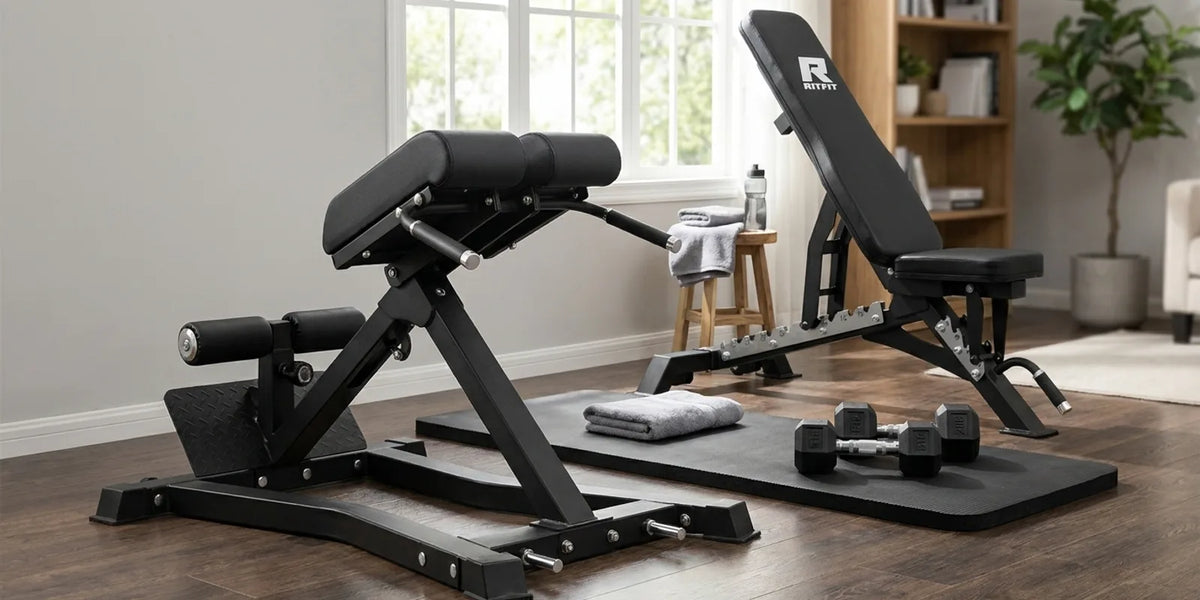
How to do back extensions at home is straightforward. Set up on the floor, on a 45-degree or Roman chair bench, or on a back extension machine, and lift your torso until your shoulders, spine, and hips line up.
This guide covers exact steps and breathing for every setup, plus sets and reps, progression to weighted back extensions, common mistakes, and clear safety stop rules for training alone at home.
Quick Answer: How to do back extensions at home covers three setups, the floor with bodyweight, a 45-degree or Roman chair bench, and an adjustable back extension machine. Keep your spine neutral and move slowly, and finish each rep when your shoulders, spine, and hips line up.
Key Takeaways
- Three Setups: floor, 45-degree or Roman chair, and machine versions all train the same posterior chain, only the range and loading options change.
- Form First: move slowly, keep a neutral spine, and stop each rep when your shoulders, spine, and hips line up.
- Simple Programming: 2 to 4 sets of 8 to 15 controlled reps, two or three sessions per week.
- Progress Carefully: add a dumbbell or plate at your chest only after bodyweight reps stay clean for two or three weeks.
- Clear Stop Rules: momentum, form breakdown, or sharp pain always ends the set, and returning discomfort calls for professional guidance first.
What Muscles Do Back Extensions Work?
Back extension exercises train the erector spinae that runs along your spine, plus the glutes and hamstrings that extend the hips. EMG work has compared trunk-training exercises for muscle demand, and back extension variations involve both the hip extensors and the spinal erectors.[1] One peer-reviewed EMG comparison found that prone hip extension exercises produced significantly greater abdominal, oblique, and lumbar paraspinal muscle activity than the crunch or bent-knee sit-up.[2]
- Erector spinae: the muscles along your spine extend it, and they work hardest as your torso rises from the folded position.
- Glutes and hamstrings: the gluteus maximus and the hamstrings open the hips as you lift toward the top position.
- Core: the abs and obliques brace your torso through the full range of motion, including the eccentric control on the way down.
The balance shifts with setup and range of motion, since floor work limits hip travel while bench and machine versions let the hips contribute more range. Prone floor variations still load the lumbar paraspinals heavily, which is why they work with no equipment at all.
How to Do a Floor Back Extension Without Equipment
A floor back extension needs only a mat and a small clear space, making it the easiest way to do back extensions without a machine. You lie face down and lift your torso against gravity with your hips pressed into the mat. Start with the basic hold, then move to the superman variations below once it feels easy.
Step 1: Lie face down on a mat with your legs straight behind you, elbows on the floor, and shoulders pulled down away from your ears.
Step 2: Exhale and lift your upper back while pressing your hips into the mat, keeping your head and neck neutral as you rise.
Step 3: Pause briefly at the top, then lower under control and repeat for the target reps.
Breathe out as you lift and in as you lower, and keep every rep slow and controlled. Jerking upward trades safety for height, because momentum does the work your muscles should be doing.
- Basic floor back extension: this floor progression starts with a 30-second top hold for 3 sets, with elbows down and hips pressed into the mat.
- Superman: float your hands and feet 1 to 2 inches off the floor with core and glutes engaged, pausing 5 seconds per rep.
- Alternating superman: lift opposite arm and leg together, alternating sides with the same slow control and neutral neck.
These variations also make a solid warm-up before bigger lifts, and they pair well with our back workouts at home for a full session. Move up only when the current variation feels controlled on every rep.
Instead, you'll keep your legs and hips pressed gently into the mat and only lift your upper body, either extending both arms in front of you or placing them behind your head in the prisoner position.
Sam Hopes, Fitness Editor and Coach, Tom's Guide, Forget deadlifts, this back extension strengthens your back, glutes and hamstrings without weights
How to Do Back Extensions on a 45-Degree or Roman Chair Bench
The 45-degree back extension and the Roman chair back extension share one hip hinge pattern, and only the torso angle changes between them. These bench versions are the hyperextensions seen in most gyms, and the pad should sit just below your hip bone so the hips can move freely. The steeper the angle, the more control you need to finish each rep without arching.
Step 1: Adjust the pad to sit just below your hip bone, then lock your feet on the footplate in line with slightly bent knees.
Step 2: Hinge at the hips and lower your torso toward the floor, then exhale as you lift until your shoulders, spine, and hips line up.
Step 3: Inhale on the way down under control, keeping your head neutral and stopping the rep before the lower back arches backward.
- Crossed arms: fold your arms across your chest for a middle step between hands down and the harder positions.
- Prisoner position: place your hands behind your head with elbows out to shorten the lever and raise the challenge.
- Loaded: hold a light dumbbell or plate at your chest once bodyweight reps stay clean.
Setup angle also shifts the job split between hips and back, and researchers have compared isolated contraction ratios of the hip extensors, lumbar erector spinae, and thoracic muscles during different back extension exercises.[3] If you are still shopping for a bench, our guide to adjustable back extension machines for home gyms covers the category.
How to Set Up a Back Extension Machine at Home
A back extension machine gives you the full stretch and loading options that floor work cannot match, and home models fit in the corner of a garage or spare room. Check the machine footprint against your floor plan before you order, and keep clear room to mount and dismount. Adjust the pad below your hip bone before the first set, exactly like on a gym bench.
Choosing the RitFit BE01 Adjustable Back Extension Machine
The RitFit BE01 Adjustable Back Extension Machine covers the whole home machine job in one frame, with a listed price of $439.99 and 2 x 3 inch steel tubing for rigid support during heavy or high-volume work. Its 12 position combinations across pad height, angle, and slider fit users from 4 feet 7 inches to 6 feet 3 inches.
- Durability: the reinforced wide-set base and rigid tubing keep the frame steady when you run heavy or high-volume sets, so long sessions stay smooth instead of shaking.
- Versatility: beyond back extensions you can run GHD-style holds, side bends, core work, and band-resisted sets through the built-in band pegs, which covers most posterior chain days on one station.
- Space fit: the 32.3 x 44.8 inches footprint fits most garage gyms and spare rooms, and transport wheels let you roll it aside when the floor is needed for other training.
- Performance: verified buyers describe the thick curved split pad as comfortable and the frame as solid during daily use at home.
- Value: at $439.99 the BE01 suits lifters who want machine-grade range at home without a gym commute, and the RitFit BE01 Pink Adjustable Back Extension Machine serves anyone matching a designed training space.
- Warranty: check the current warranty terms on the BE01 product page before ordering, since coverage periods change over time.
Placement matters more than perfection. Leave clearance around the base, keep the unit level on gym flooring, and browse the strength machines collection if you are still comparing stations, or plan the whole room with our home gym guide.
"Machine works great. It feels very stable even for my husband who weighs 250. Easy to transition for different heights and workouts. Build was fairly easy the only con is the tool they send you doesn't always fit in the spaces bolts are and a normal wrench has to be used."
Kiersten R. Verified Buyer, RitFit BE01 Adjustable Back Extension Machine for Home and Gym
How Many Sets and Reps of Back Extensions Should You Do?
Most home trainees do well with 2 to 4 sets of 8 to 15 controlled reps, performed two or three times per week. Keep one or two reps in reserve while your lower back adapts, and build over several weeks instead of chasing one heavy session.
- Weight selection: start with bodyweight only, then hold a light dumbbell or plate at your chest and raise the load in small steps.
- When to add load: after two or three weeks of consistent bodyweight reps that stay clean through the last rep of each set.
- Frequency: two or three sessions per week with at least a rest day between hard efforts.
- Progression order: extend range of motion first, then add reps, then add load, in that order.
Progress is real but gradual, and a training study examined the effects of back extension training on back muscle strength and spinal range of motion in young women.[4] Weighted back extensions belong to bench and machine versions, because the floor limits how far you can lean forward and how much you can load at the chest.
For a bigger plan around this movement, see our guide to strengthening your back at home with RitFit equipment.
How to Fix the Most Common Back Extension Mistakes
Most back extension mistakes come from chasing height instead of control, and every one of them has a simple fix for the next set. Move slowly, keep a neutral spine, and stop each rep at the stacked position instead of arching backward.
- Overarching at the top: finish when your shoulders, spine, and hips line up, and do not swing into a backbend for extra height.
- Using momentum: lift on a slow count and pause briefly at the top instead of jerking upward.
- Pad in the wrong spot: set it just below your hip bone so the hips can hinge instead of pinching.
- Head pulled up: keep the neck neutral by aiming your gaze at the floor as you lift.
- Pushing through fatigue: end the set when reps slow down or form degrades, and remember that researchers have studied how repeated standing back extensions relate to low back muscle fatigue.[5]
When Should You Stop Doing Back Extensions?
A set ends the moment your form breaks, when you start swinging with momentum, or when you feel sharp pain instead of normal muscle effort. Rest before continuing, and speak with a qualified professional if discomfort keeps returning during the same movement.
- Skip the movement entirely: if the same spot stays uncomfortable after a session, wait until normal training feels fine again before returning to back extensions.
- Set personal stop rules: form breakdown, momentum, and sharp pain are always stop signals, whatever the program on paper says.
Safety rules like these matter most when you train alone at home, since nobody is there to spot a breakdown in form. Keep the movement controlled and the stop rules strict, and the exercise stays productive for years.
FAQs About How to Do Back Extensions at Home
Can you do back extensions at home without a machine?
Yes. You can do back extensions without a machine on a mat, using bodyweight variations like the basic floor hold, the superman, and the alternating superman. These floor versions train the same posterior chain muscles, and they work well in a small space with no equipment beyond a mat.
What is the difference between a 45-degree back extension and a Roman chair?
A 45-degree back extension bench sets your torso at an angle at the top of each rep, while a Roman chair holds your body closer to horizontal. Both styles train the same muscles, and on either one the pad should sit just below your hip bone.
How many sets and reps of back extensions should you do at home?
Most home trainees do well with 2 to 4 sets of 8 to 15 controlled reps, two or three sessions per week. Start at the low end with bodyweight floor variations, and keep one or two reps in reserve while your lower back adapts to the work.
When should you add weight to back extensions?
Add load once bodyweight reps feel controlled and consistent for two or three weeks, using a dumbbell or plate held at your chest. Increase the weight in small steps, keep the same range of motion, and end the set as soon as your form breaks down.
What are the best back extension alternatives for home training?
Good back extension alternatives at home include superman holds, alternating supermans, bird dogs, glute bridges, and light hip hinge work with dumbbells or a kettlebell. Match the variation to your current strength, and move through the floor progressions before you add any external load.
How much space does a back extension machine need at home?
The RitFit BE01 back extension machine occupies 32.3 x 44.8 inches of floor space, which fits most garage gyms and spare rooms. Leave extra clearance around the base for mounting and dismounting, and use the transport wheels to roll it aside when the floor is needed for other training.
When should you stop doing back extensions?
A set ends when your form breaks, when you start swinging with momentum, or when you feel sharp pain instead of normal muscle effort. Rest first, and speak with a qualified professional before continuing if discomfort keeps returning during the same movement.
Conclusion
Back extensions at home give you a simple, scalable way to train the posterior chain on the floor, on a bench, or on a machine. Master the bodyweight form first, then progress to weighted reps with clear stop rules in place.
New to training at home? Build the habit with two short sessions a week, and check the RitFit discount guide before you order any equipment.
Disclaimer
This article covers general fitness training only and does not provide medical, rehabilitation, or pain treatment advice. Consult a qualified healthcare professional before starting any new exercise program if you have an existing injury or condition.
References
1. Konrad P, Schmitz K, Denner A. Neuromuscular Evaluation of Trunk-Training Exercises. J Athl Train. 2001;36(2):109-118. PMCID: PMC155519
2. Escamilla RF, Lewis C, Pecson A, Imamura R, Andrews JR. Muscle Activation Among Supine, Prone, and Side Position Exercises With and Without a Swiss Ball. Sports Health. 2016;8(4):372-9. PMCID: PMC4922527
3. Yoo WG. Comparison of the isolated contraction ratios of the hip extensors and erector spinae muscles of the lumbar region and thoracic muscles during different back extension exercises. J Phys Ther Sci. 2015;27(2):315-6. doi:10.1589/jpts.27.315. PMCID: PMC4339128
4. Yaprak Y. The effects of back extension training on back muscle strength and spinal range of motion in young females. Biol Sport. 2013;30(3):201-6. doi:10.5604/20831862.1047500. PMCID: PMC3944566
5. Kumamoto T, Seko T, Matsuda R, Miura S. Repeated standing back extension exercise: Influence on muscle shear modulus change after lumbodorsal muscle fatigue. Work. 2021;68(4):1229-1237. doi:10.3233/WOR-213452. PMCID: PMC8293651





