








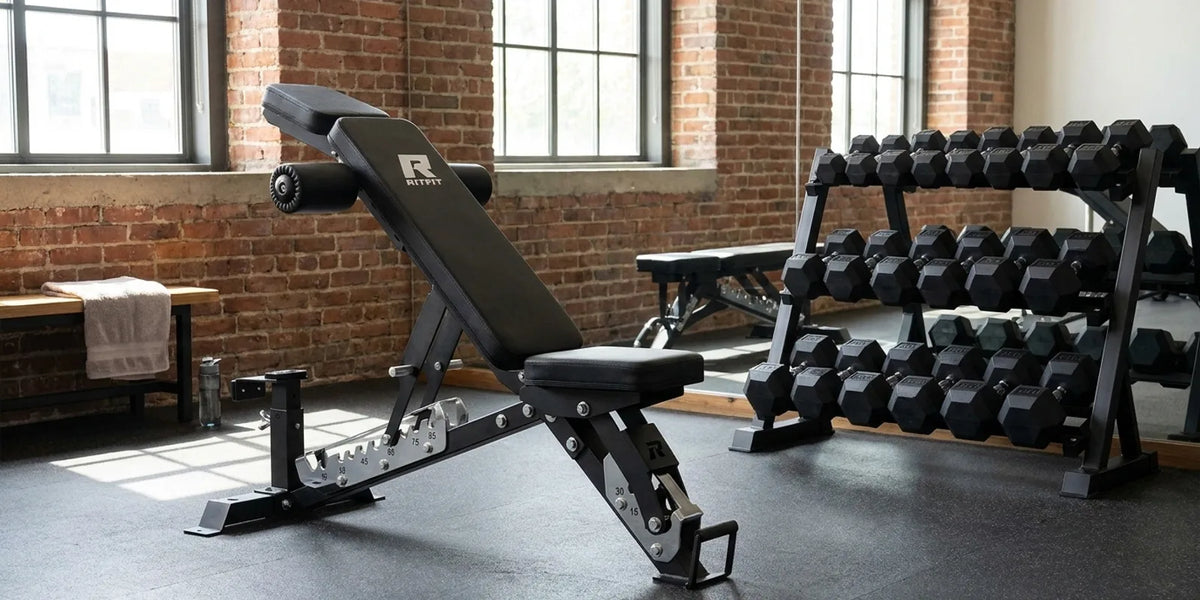
Decline sit-ups on a weight bench are one of the most demanding bodyweight ab exercises you can run in a home gym. Done right, they train the abs through spinal flexion against gravity with a longer range of motion than floor sit-ups.
This guide covers the bench and foot anchoring you need, step-by-step form, how steep to set the decline, the muscles worked, and when to add weight. Form comes first and load comes second, so stop the set whenever your back or neck protests.
Quick Answer: Decline sit-ups on a weight bench are performed on an adjustable bench set to a 30 to 45 degree decline with your feet locked under the leg rollers. Curl your torso up under control, keep your chin tucked, and lower slowly before the next rep.
Key Takeaways
- Equipment First: Decline sit-ups need an adjustable bench with real decline settings plus a way to anchor the feet, such as leg rollers or foot pads.
- Angle Controls Difficulty: Most lifters train this movement on a decline between 30 to 45 degrees, and steeper settings make each rep harder.
- Abs Lead and Hip Flexors Assist: The movement trains the rectus abdominis and obliques through spinal flexion while the hip flexors help lift the torso.
- Form Before Load: Add a weight plate only after bodyweight sets look controlled for every planned rep.
- Stop Signals Matter: Sharp back or neck pain ends the set immediately, and lingering discomfort deserves a conversation with a qualified professional.
What You Need Before You Try Decline Sit-Ups
Decline sit-ups need an adjustable bench with a true decline setting and a solid way to anchor your feet. Master the floor sit-up first, because the decline version loads the movement harder than the flat version.
- Bench with a real decline: Flat-only benches cannot run this movement, so choose an adjustable bench whose seat and back pad settings include a decline.
- Foot anchoring: Leg rollers or foot pads pin the lower legs while the torso moves. A review published in the British Journal of Sports Medicine cautions that sit-ups with foot fixation can compound hip muscle imbalance and stress the lumbar spine, so hook the feet lightly and keep muscular control of pelvic tilt.[1]
- Prerequisite strength: Own the conventional sit-up for sets of 15 or more clean reps before adding a decline angle.
- Clear floor space: A decline bench swings the torso below the pad, so leave room around the bench in your garage gym or home gym.
Bench options run from the RitFit 1300lb Adjustable Weight Bench to heavier frames in the adjustable weight benches collection, and the weight bench guide covers setup basics.
How to Do Decline Sit-Ups on a Weight Bench
Decline sit-ups are performed as a slow, controlled sit-up on a decline bench with the legs locked under rollers. Set the angle, anchor the feet, and curl the spine up one segment at a time.
- Step 1: Set the decline. Lock the bench at a shallow to moderate decline and make sure the ladder or pin is fully seated before loading it.
- Step 2: Anchor your feet. Slide the ankles under the leg rollers or foot pads so the calves press against them, and hook lightly rather than yanking the rollers.
- Step 3: Set your torso and hands. Sit tall with hands crossed on the chest or fingertips at the temples, and keep the chin tucked toward the chest to protect the neck.
- Step 4: Curl up under control. Exhale as the spine peels off the pad and lead with the chest instead of pulling with the elbows.
- Step 5: Lower with control. Inhale on the way down and stop just short of the pad before starting the next rep.
"I'm pleased with the bench. It's good quality and built solidly. It doesn't offer a decline position but that's my bad, I didn't notice before ordering."
Steven C. Verified Buyer, RitFit Adjustable Bench 2
What Decline Angle Should You Use for Decline Sit-Ups?
Decline sit-ups are typically performed on a decline between 30 to 45 degrees, and the steeper the decline the harder the exercise becomes. One gym training guide suggests a more upright setting when the range already feels steep, then progressing slowly to greater decline.
| Decline setting | Who it suits | What changes |
|---|---|---|
| Shallow decline, around 30 degrees | Lifters moving up from floor sit-ups | Smallest added demand per rep |
| Mid decline, 30 to 45 degrees | Most lifters training the abs | Full range of motion against gravity |
| Steepest setting on the bench | Experienced lifters adding load | Highest demand and the first place form breaks |
Angle guidance adapted from general gym training guidance, and the exact settings depend on the decline options your bench publishes.
What Muscles Do Decline Sit-Ups Work?
Decline sit-ups train the core through spinal flexion and mainly work the rectus abdominis and the obliques, with the hip flexors helping lift the torso. Working against gravity on the decline makes the muscles work harder than the floor version.
- Rectus abdominis: Curls the ribcage toward the pelvis and controls the descent on every rep.
- Obliques: Help control the curl and keep the torso from twisting.
- Hip flexors: Assist the lift, which is why the movement feels harder than a crunch.
One small electromyography study of four male subjects reported no significant difference in mean rectus abdominis activity between four popular abdominal exercises or between the muscle's four quadrants.[2] A 2011 biomechanical analysis reported that lumbar spinal stability increased by an average factor of 1.8 with doubling of intra-abdominal pressure, while forced activation of the rectus abdominis did not increase stability.[3]
For a deeper look at the anatomy behind the sit-up family, see our guide to what sit-ups work.
Does the RitFit GATOR Adjustable Weight Bench Go Decline Enough for Sit-Ups?
The RitFit GATOR Adjustable Weight Bench goes decline enough for sit-ups, with 3 decline settings and foam rollers rated to 176 lb holding the legs in place. RitFit's published specs list 21 total adjustment combinations and a 1,600 lb total load capacity.
- Decline settings: The bench lists 3 decline settings among 10 backrest angles, 5 headrest positions, and 3 seat angles.
- Leg anchoring: Foam rollers rated to 176 lb keep the calves pinned while the torso curls below the seat.
- Load headroom: A 1,600 lb total load capacity covers body weight plus a held plate when you progress to weighted decline sit-ups.
- Versatility: The same bench runs presses, flyes, rows, and curls, so it earns its floor space in a garage gym beyond ab work.
RitFit does not publish the exact degree of each decline setting, so start at the shallowest decline and judge the difficulty by feel. A pink configuration, the RitFit GATOR Pink 1600lb Adjustable Weight Bench, is listed with the same 1,600 lb total load capacity.
Built with 14-gauge steel, the RitFit Gator Adjustable Weight Bench offers a robust weight capacity of 1,600 pounds. With 10 back pad angles, three seat pad positions, three decline settings, and a five-way adjustable head rest, you have ample options to support your strength and muscle building goals.
Stephen Sheehan, CPT, CNC, Certified Personal Trainer and Nutritionist, Garage Gym Reviews, RitFit Gator Adjustable Weight Bench Review (2026)
"Wow! This is not my first weight bench, but I am confident it will be my last. The ease of use and ability to move around the cable machine from one exercise to the next is awesome. Regardless of the exercise I am performing I feel secure and stable. It is an awesome product."
Richard R. Verified Buyer, RitFit GATOR 1600LB Adjustable Weight Bench
Common Mistakes and Simple Fixes for Decline Sit-Ups
Most decline sit-up mistakes come from pulling with the arms, rushing the descent, and choosing a decline that is too steep. Each mistake has a simple fix that keeps the work on the abs.
- Pulling on the neck: Keep the chin tucked and lead with the chest. Fingertips at the temples beat interlocked hands behind the head.
- Using momentum: Pause briefly at the top and lower slowly. If the torso bounces off the pad, the reps have stopped being useful.
- Yanking the rollers: Hook the ankles lightly and press the toes down instead of hauling on the leg rollers to finish a rep.
- Going too steep too soon: Drop the decline one setting and rebuild the reps before climbing again.
- Holding the breath: Exhale on the way up and inhale on the way down to keep the trunk braced.
How to Progress to Weighted Decline Sit-Ups
External load comes only after bodyweight sets look controlled and crisp for every planned repetition. Holding a weight increases the resistance, and small jumps in load keep the lower back out of the movement.
- When to add load: After two or three weeks of clean bodyweight sets, add weight in the smallest jumps available.
- How to hold it: Keep a light weight plate or dumbbell at the chest with both hands, close to the center of mass.
- How much to add: Start with 5 to 10 lb and earn the next jump with clean reps instead of grinding form.
- Progression order: Add reps first, then steepen the decline, and only then add load, which keeps progressive overload steady.
- Eccentric control: The lowering phase builds most of the strength, so take two or three seconds to descend.
Light weight plates and exercise weights cover the load options that fit this movement.
Sets, Reps, and Training Frequency for Decline Sit-Ups
A simple default is 3 sets of 10 to 15 controlled reps, 2 to 3 sessions per week with at least a day between hard ab workouts. Treat decline sit-ups as one movement inside a bigger core plan rather than the whole plan.
- Rest: Take 60 to 90 seconds between sets so the abs recover enough to keep every rep strict.
- Placement: Run the movement at the end of a session or in a dedicated ab workout when the trunk is fresh.
- Frequency: Two or three sessions per week is enough for most lifters once the movement is familiar.
- Deload: If reps slow down or form softens, return to bodyweight and a shallower decline for a week.
Weight lifting accessories such as mats and collars round out a home gym setup for core work.
Easier Variations and Alternatives
Floor sit-ups, decline crunches, and stability ball work let you scale the demand down or change the angle of attack. Pick the variation that matches the reps you can control today.
- Floor sit-up: The prerequisite for the decline version and the right regression whenever form slips.
- Decline crunch: Keep the range short with only the shoulders leaving the pad to reduce the pull on the hips.
- Stability ball: One fitness guide notes that a stability ball can replace a decline bench when your gym lacks one.
- Weighted decline sit-up: The progression once bodyweight reps are locked in.
When to Stop and Talk to a Professional
Sharp back or neck pain during decline sit-ups is a clear signal to stop the set immediately. Training through pain is not part of this movement, and lingering discomfort deserves professional guidance rather than guesswork.
- Stop the set: Any sharp or shooting pain in the back, neck, or hips ends the set right away.
- Skip the movement: If sit-ups of any kind bother an existing back or hip issue, leave decline work off the program.
- Ask for help: A qualified coach, physical therapist, or other professional can check form and clear the movement for your situation.
FAQs About Decline Sit-Ups on a Weight Bench
What angle should a weight bench be for decline sit-ups?
Most lifters run decline sit-ups at a bench angle between 30 and 45 degrees, and the steeper the decline the harder the rep becomes. If 30 degrees already feels steep, set the bench to a shallower decline, own the form for a few weeks, then increase the angle one setting at a time.
Are decline sit-ups harder than floor sit-ups?
Yes. On a decline bench your torso starts lower and works against gravity through a larger range of motion, so your abs and hip flexors handle more resistance than on the floor. That extra demand is why you should first master the floor sit-up and only then move to the decline version.
What muscles do decline sit-ups work?
Decline sit-ups train the core through spinal flexion and mainly work the rectus abdominis and the obliques, with the hip flexors lifting the torso as you curl up. One small electromyography study also reported no significant difference in rectus abdominis activity between four popular abdominal exercises.
How do you set up the bench and keep your feet anchored for decline sit-ups?
Hook your ankles under the bench leg rollers or foot pads and press your toes down lightly so your lower legs stay pinned as your torso rises. If your feet keep slipping, drop the decline angle, check that the rollers are snug against your calves, and avoid yanking on the rollers to pull yourself up.
When should I add weight to decline sit-ups?
Add load once bodyweight sets feel controlled and crisp for all planned reps, usually after two or three weeks of consistent training. Hold a light weight plate or dumbbell at your chest, keep the same tempo and range of motion, and progress in small jumps so your lower back never takes over the movement.
Can beginners do decline sit-ups?
Beginners can do decline sit-ups, but only after the floor sit-up feels easy and pain free for sets of fifteen or more reps. Start at the shallowest decline setting your bench offers, keep your hands by your temples or crossed on your chest, and treat any sharp back or neck pain as a clear stop signal.
Conclusion
Decline sit-ups on a weight bench reward patience. Lock the angle, own the form at bodyweight, and let progressive overload do the rest.
Start with 3 sets of 10 to 15 controlled reps this week, and check the RitFit discount guide when you are ready to add a bench or plates to your home gym.
Disclaimer
This article provides general fitness information and is not medical advice, diagnosis, or treatment. Train within a pain-free range of motion, and consult a qualified professional before starting decline sit-ups if you have a back, neck, or hip condition.
References
1. Norris CM. Abdominal muscle training in sport. Br J Sports Med. 1993;27(1):19-27. doi:10.1136/bjsm.27.1.19. PMCID: PMC1332101
2. Piering AW, Janowski AP, Wehrenberg WB, Moore MT, Snyder AC. Electromyographic analysis of four popular abdominal exercises. J Athl Train. 1993;28(2):120-6. PMCID: PMC1317695
3. Stokes IA, Gardner-Morse MG, Henry SM. Abdominal muscle activation increases lumbar spinal stability: analysis of contributions of different muscle groups. Clin Biomech (Bristol). 2011;26(8):797-803. doi:10.1016/j.clinbiomech.2011.04.006. PMCID: PMC3157598





