The incline dumbbell fly puts a focused stretch and squeeze on the upper chest using nothing more than a weight bench and a pair of dumbbells. This guide covers the bench angle, body position, elbow angle, load selection, and progressions that make the movement work.
You will also see how the incline fly differs from the flat fly and the incline bench press, which mistakes to fix first, and when to stop for shoulder discomfort. Train within your current strength level and use the step by step checkpoints below.
Quick Answer: To do an incline dumbbell fly on a weight bench, set the backrest to 30 to 45 degrees, lie back with your shoulder blades pulled down and back, and open your arms in a wide arc with a fixed soft elbow bend. Lower to a comfortable stretch, then squeeze your upper chest to return the dumbbells over your chest.
Key Takeaways
- Bench Angle: A 30 to 45 degree incline keeps the line of pull on the upper chest, and going steeper than 45 degrees shifts the work toward the front delts.
- Elbow Angle: A fixed soft bend in the elbows is what separates the fly from a press, and that angle stays constant through the whole arc.
- Load: Flys use lighter dumbbells than pressing because the long lever arm keeps tension on the chest while the biceps brachii stabilizes the extended arm.
- Differences: The incline fly emphasizes the clavicular pectoralis major, the flat fly spreads work across the whole chest, and the incline press is the heavier compound builder.
- Progression: Add weight in small jumps only when every rep stays controlled for 8 to 12 reps across 2 to 4 sets.
What Is an Incline Dumbbell Fly?
The incline dumbbell fly is a single-joint chest exercise performed on a weight bench set to a moderate incline. The arms open in a wide arc with a fixed soft elbow bend while the incline shifts the line of pull toward the clavicular pectoralis major, with the anterior deltoid assisting and the biceps brachii stabilizing the extended arm.
- Upper chest focus: Electromyography work on dumbbell pressing shows the incline position raises activation of the clavicular pectoralis major, especially during the eccentric phase.[1]
- Supporting muscles: The anterior deltoid and biceps brachii share the load as stabilizers, which is why the movement works best as a lighter accessory.
- Range of motion: The wide arc loads the chest in a stretched position that pressing alone does not fully replicate.
Because the movement hinges at the shoulder rather than the elbow, bench angle and arm path decide which chest fibers do most of the work.
"Dumbbells. Good quality and weight was accurate within a .3 lb margin"
Matt W. Verified Buyer, RitFit Rubber Hex Dumbbells Pairs and Sets
Why Do Incline Dumbbell Flys on a Weight Bench?
The incline dumbbell fly needs a bench because the padded back support lets your shoulders work from a stable, fixed base while the incline directs effort toward the upper chest. Running the same arc on the floor forces a flat torso position and cuts the range of motion short.
- Stable base: A firm pad holds the torso in place so the chest, not the lower back, controls the arc through every rep.
- Angle control: Only an adjustable bench sets the 30 to 45 degree torso angle that defines the incline fly.
- Shared home gyms: One adjustable bench covers this movement plus chest presses, rows, and arm work for every lifter in the house.
"They're good for everything from chest presses, dumbbell bench presses, incline bench supersets, skull crushers, glute bridges, incline rows to hit your back, ab moves, quad and leg moves like split squats, and more biceps moves than you can imagine."
Ebenezer Samuel, C.S.C.S. Fitness Director, Men's Health, The Best Weight Benches of 2026 (Men's Health)
"Wow! This is not my first weight bench, but I am confident it will be my last. The ease of use and ability to move around the cable machine from one exercise to the next is awesome. Regardless of the exercise I am performing I feel secure and stable. It is an awesome product."
Richard R. Verified Buyer, RitFit GATOR 1600LB Adjustable Weight Bench
Set the Bench Angle and Body Position
A 30 to 45 degree bench angle gives the incline dumbbell fly its upper chest emphasis without letting the front delts take over the set. In one EMG study of 30 trained adults, the upper portion of the pectoralis major reached its highest activity at a 30 degree bench inclination, and inclinations above 45 degrees significantly shifted activation toward the anterior deltoid.[2]
- Bench angle: Start at 30 degrees and move toward 45 degrees only while you still feel the upper chest leading every rep.
- Shoulder blades: Pull them down and back against the pad, a position known as scapular retraction, and keep a light natural arch in the upper back.
- Feet and head: Keep both feet flat on the floor and your head resting on the pad for the entire set.
Once the bench and body are set, the torso stays fixed and only the arms move through the arc.
Should You Get the RitFit Gator Weight Bench for Incline Dumbbell Flys?
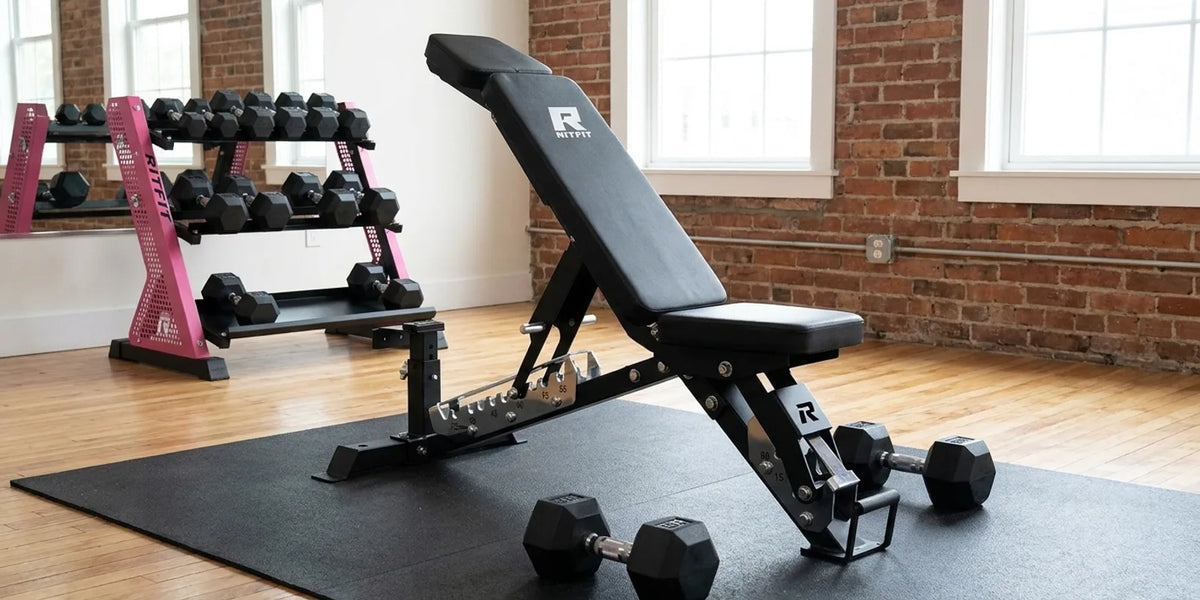
Yes, the RitFit Gator adjustable weight bench fits incline dumbbell flys well because its backrest locks at 30, 37.5, and 45 degree positions that cover the full working range. Any bench you choose should offer numbered incline settings, a back pad that supports your head, and a load rating above your bodyweight plus the dumbbells you lift.
- Backrest angles: The RitFit Gator adjustable weight bench offers 10 backrest levels from 0 to 85 degrees, including 30, 37.5, and 45 degree positions, so you can dial in the exact incline instead of guessing between a flat pad and a shoulder-dominant steep angle.
- Stability and capacity: Its 50 x 70 mm reinforced steel frame is officially rated for 1600 lb total load, which keeps the bench planted when you brace heavy dumbbells on your knees before lying back.
- Room to grow: 21 adjustment combinations across backrest, seat, and headrest let the same bench serve incline flys, flat presses, and rows for a shared garage gym, and a 3-year frame warranty backs the structure.
- Lighter setups: For newer lifters or tighter spaces, the RitFit 1300LB adjustable weight bench covers the same incline range at a lower capacity, and the full range of weight benches shows every option in one place.
"Super easy to put together, very sturdy when lifting, and fits me perfectly! I look forward to hitting my fitness goals using this bench!"
Jeff F. Verified Buyer, RitFit GATOR 1600LB Adjustable Weight Bench
How to Do an Incline Dumbbell Fly Step by Step
The incline dumbbell fly follows five steps that keep tension on the chest from the first rep to the last. Run this exact sequence on every set so the form becomes automatic.
- Step 1: Set the bench: Adjust the backrest to 30 to 45 degrees and sit down with one dumbbell resting on each thigh.
- Step 2: Lie back and press up: Rock the dumbbells back as you lie down and press them over your upper chest with the palms facing each other.
- Step 3: Fix the elbow angle: Bend your elbows slightly and keep that same soft bend for the entire arc so the movement stays a fly instead of becoming a press.
- Step 4: Open the arc: Lower the dumbbells in a wide path until you feel a comfortable stretch across the chest, controlling the eccentric phase instead of dropping.
- Step 5: Squeeze and reset: Squeeze the upper chest to bring the dumbbells back together over your chest and exhale at the top.
Any pair of dumbbells works for the movement, from fixed hex pairs in the dumbbells collection to lighter studio styles, as long as both sides match.
"I ordered dumbbells ranging in weight 35-50 lbs. I was very pleased how quickly they came and how much care was taken in their packaging. The weights are perfect for my use and No damage. Definite plus!"
Minde F. Verified Buyer, RitFit Rubber Hex Dumbbells Pairs and Sets
How Much Weight Should You Use?
Use noticeably lighter dumbbells than you press with, because the long lever arm of the fly keeps tension on the chest at its weakest stretched position. In one comparison of 17 resistance-trained men, the barbell bench press produced 8-81% higher activation of the pectoralis major, anterior deltoid, and triceps brachii than dumbbell flyes, while the flyes produced 57-86% higher biceps brachii activation and moved lower external loads.[3]
- Starting load: Pick dumbbells you can move for 8 to 12 controlled reps while holding the elbow angle perfectly fixed.
- Form first: If the elbows bend deeper mid-set or the stretch turns sharp, the weight is too heavy for this movement.
- Progression: Add load in the smallest jumps available, and adjustable dumbbells make those micro increases easy in a home gym.
Because the biceps brachii stabilizes a long extended arm, heavy flys shift strain toward the elbow and shoulder instead of the chest.
Incline Flys vs Flat Flys and Incline Bench Press
The incline fly, flat fly, and incline bench press all train the chest, but each one changes the bench angle, the elbow action, and the load you can safely handle. One training study in 47 untrained men found incline and horizontal pressing produced similar isometric strength gains of about 10 to 11 kg over 8 weeks, while upper chest muscle thickness at the second intercostal site favored the incline group by a mean difference of 0.62 cm.[4]
| Movement | Bench Angle | Chest Emphasis | Typical Load | Best Used As |
|---|---|---|---|---|
| Incline dumbbell fly | 30 to 45 degrees | Upper, clavicular chest | Lighter than pressing | Isolation accessory |
| Flat dumbbell fly | Flat, 0 degrees | Whole chest, sternal focus | Lighter than pressing | Chest finisher |
| Incline bench press | 30 to 45 degrees | Upper chest with triceps | Heavier compound load | Main strength builder |
Emphasis and load patterns reflect the cited EMG findings for bench inclines and flyes; your setup may differ slightly with limb length and experience.
For the flat version and a full form walkthrough, read our guide to the flat dumbbell fly before stacking both variations in one program.
Common Mistakes to Avoid
Most incline dumbbell fly problems come from turning the fly into a press, using momentum, or setting the bench too steep. Fix these errors in order, because each one changes which muscles do the work.
- Elbows bending too much: Deepening the bend mid-set converts the fly into a partial press and shortens the chest tension.
- Weight too heavy: Swinging the dumbbells up with momentum loads the shoulders and biceps instead of the chest.
- Stretch too deep: Dropping the dumbbells far below the torso line stresses the shoulder joint without adding chest benefit.
- Shoulders shrugging: Letting the shoulders rise toward the ears undoes scapular retraction and steals work from the chest.
- Bench too steep: Angles above 45 degrees shift the set toward the front delts, which defeats the purpose of the incline fly.
Correct one issue at a time, starting with elbow control, before adding any load to the movement.
When to Stop for Pain and Stay Safe
Stop the exercise immediately if you feel sharp pain in the front of the shoulder, the chest, or the elbow during the set. Muscle fatigue in the chest is expected, but joint pain, pinching, or numbness means the movement is doing harm rather than good.
- Warm up first: Run light pressing or push-up sets before the fly so the chest and shoulders are ready for the stretched position.
- Conservative depth: End the descent at a comfortable stretch rather than chasing the deepest possible range.
- Recurring pain: If the same discomfort returns across several sessions, swap the fly for a pain-free chest movement and seek qualified guidance.
This guide describes when to stop, not how to diagnose or treat an injury, so persistent pain deserves professional attention.
Incline Dumbbell Fly Variations and Alternatives
Incline dumbbell fly variations change the angle, the tool, or the resistance curve while keeping the same wide-arc chest focus. Use them to work around shoulder discomfort, equipment limits, or simple training boredom.
- Incline cable fly: Cables keep tension on the chest at the top of the arc where dumbbells go light.
- Low-to-high cable fly: A standing angle that mimics the incline line of pull without a bench.
- Flat dumbbell fly: The flat version shifts emphasis toward the whole chest and pairs well after incline work.
- Incline dumbbell press: The heavier pressing cousin that loads the same muscles through a bent-arm pattern.
- Machine fly: A fixed path that removes balance demands for high-rep finishers.
Rotate variations every few weeks to keep progress moving while preserving the upper chest emphasis that makes the incline fly worth programming.
"Loved the dumbbell definitely a great design and durable"
Julio A. Verified Buyer, RitFit PVC-Coated Round Dumbbells in Pairs
How to Program Incline Dumbbell Flys
Two to four sets of 8 to 12 reps, once or twice a week, fits most chest routines as a finishing accessory movement. Place the fly after your main pressing so fresh strength goes to the compound lifts first.
- Frequency: Train the movement once or twice a week with at least a full rest day between sessions.
- When to add weight: Move up in load only when every rep stays controlled with the elbow angle fixed and one or two clean reps left in the tank.
- Equipment at hand: A dumbbell weight rack keeps matched pairs beside the bench so set transitions stay quick and safe.
- Pairing: Follow the fly with a pulling movement or finish a bench day by reading our incline dumbbell curls on a weight bench guide for the matching arm session.
Track the reps and load you use, because small consistent jumps beat occasional heavy sets on a long lever movement like this one.
"RitFit has Excellent Workout Equipment! I am a repeat RitFit customer! I purchased a bench and dumbbells that arrived in great shape . Great equipment to get me through my workouts in my home gym! Thank you , RitFit!"
Karen B. Verified Buyer, RitFit Rubber Hex Dumbbells Pairs and Sets
FAQs About Incline Dumbbell Flys
What angle should the bench be for incline dumbbell flys?
Set the bench to a moderate incline between 30 and 45 degrees. This range tilts your torso toward the upper chest line of pull while keeping the shoulders comfortable. On benches with numbered backrest settings, use the 30 degree or 37.5 degree position first and adjust from there.
What muscles do incline dumbbell flys work?
Incline dumbbell flys train the pectoralis major with extra emphasis on the clavicular or upper portion, supported by the anterior deltoid and the biceps brachii, which stabilizes the extended arm. The flatter the bench, the more the sternal and lower chest fibers do the work.
How heavy should incline dumbbell flys be?
Flys are a long lever isolation move, so use far less weight than you press. Pick dumbbells you can lower for a slow two second count and raise for eight to twelve controlled reps without your elbows bending into a press. If your form breaks down, the weight is too heavy.
Are incline dumbbell flys better than flat dumbbell flys?
Neither version is universally better. The incline fly shifts emphasis toward the upper chest, while the flat fly spreads work across the whole pectoralis major. Most lifters use the incline fly as an accessory after pressing and the flat fly as a general chest finisher.
How often should I do incline dumbbell flys?
Two to four sets once or twice a week fits most chest routines. Place the movement after your main pressing so fresh strength goes to the compound lift, leave at least forty eight hours between sessions, and add small dumbbell jumps only when every rep stays controlled.
Why do my shoulders hurt during incline dumbbell flys?
Shoulder discomfort usually means the bench is too steep, the dumbbells are too heavy, or you are dropping too deep behind your torso. Slow the load down, limit the stretch to a comfortable depth, and stop the exercise if you feel sharp front shoulder pain.
Can I do incline dumbbell flys on a flat bench?
No. A flat bench keeps your torso horizontal, which turns the movement into a flat dumbbell fly with different chest emphasis. You need an adjustable bench with incline settings around 30 to 45 degrees to train the incline fly the way this guide describes.
Conclusion
The incline dumbbell fly earns its place when bench angle, elbow control, and load are all dialed in. Set the bench to 30 to 45 degrees, keep the arc wide and slow, and let the upper chest do the work.
Start with light dumbbells for 2 to 4 sets of 8 to 12 reps, progress patiently, and pair the movement with a solid pressing plan. If you are new to building a home gym, visit the RitFit discount guide for current offers before you shop.
Disclaimer
This article provides general fitness information and is not medical advice or a treatment plan. Consult a qualified healthcare or fitness professional before starting a new exercise program, especially if you have a shoulder, chest, or joint condition.
References
1. Luczak J, Bosak A, Riemann BL. Shoulder Muscle Activation of Novice and Resistance Trained Women during Variations of Dumbbell Press Exercises. J Sports Med (Hindawi Publ Corp). 2013;2013:612650. doi:10.1155/2013/612650. PMCID: PMC4590897
2. Rodríguez-Ridao D, Antequera-Vique JA, Martín-Fuentes I, Muyor JM. Effect of Five Bench Inclinations on the Electromyographic Activity of the Pectoralis Major, Anterior Deltoid, and Triceps Brachii during the Bench Press Exercise. Int J Environ Res Public Health. 2020;17(19). doi:10.3390/ijerph17197339. PMCID: PMC7579505
3. Solstad TE, Andersen V, Shaw M, Hoel EM, Vonheim A, Saeterbakken AH. A Comparison of Muscle Activation between Barbell Bench Press and Dumbbell Flyes in Resistance-Trained Males. J Sports Sci Med. 2020;19(4):645-651. PMCID: PMC7675616
4. Chaves SFN, Rocha-JÚnior VA, EncarnaÇÃo IGA, et al. Effects of Horizontal and Incline Bench Press on Neuromuscular Adaptations in Untrained Young Men. Int J Exerc Sci. 2020;13(6):859-872. doi:10.70252/FDNB1158. PMCID: PMC7449336