








Incline dumbbell curls are a biceps curl performed while seated on a weight bench set to a 45-60 degree incline, with the arms hanging behind the torso so every repetition starts from a stretched position.
This guide covers the bench angle, step by step form, load selection, common mistakes, and programming for incline dumbbell curls on a weight bench, and it focuses only on what the incline angle changes about the curl.
Quick Answer: To do incline dumbbell curls on a weight bench, set the backrest to a 45-60 degree incline, sit back with your shoulder blades tight, and curl from a full stretch with your elbows behind your torso. The angle trains the biceps long head in its stretched position, and 3 sets of 10 to 12 controlled reps fit most arm days.
Key Takeaways
- Bench Angle: A 45-60 degree incline lets the arms hang behind the torso so the biceps long head works from a stretched position at the bottom of every rep.
- Strict Form: Keep the shoulder blades tight, the elbows behind the torso, and a supinated grip, then lower the dumbbells slowly through the eccentric phase.
- Smart Loading: 3 sets of 10 to 12 strict reps with a lighter load than standing curls beats heavy swinging, and weight goes up only when every rep stays controlled.
- Training Evidence: A 10-week training study and electromyography data confirm that shoulder-extended curls build biceps muscle and keep activation high across the full elbow range of motion.
- Bench Choice: The bench must lock firmly anywhere in the incline range with a stable seat, or the strict elbow position breaks down under load.
Set the Bench to a 45-60 Degree Incline
The incline dumbbell curl starts with the bench set to a 45-60 degree incline so the arms hang behind the torso at the bottom.
Coaching guides split the range by goal, since a 45 degree angle creates the deepest biceps stretch while a 60 degree angle eases shoulder stress for newer lifters.
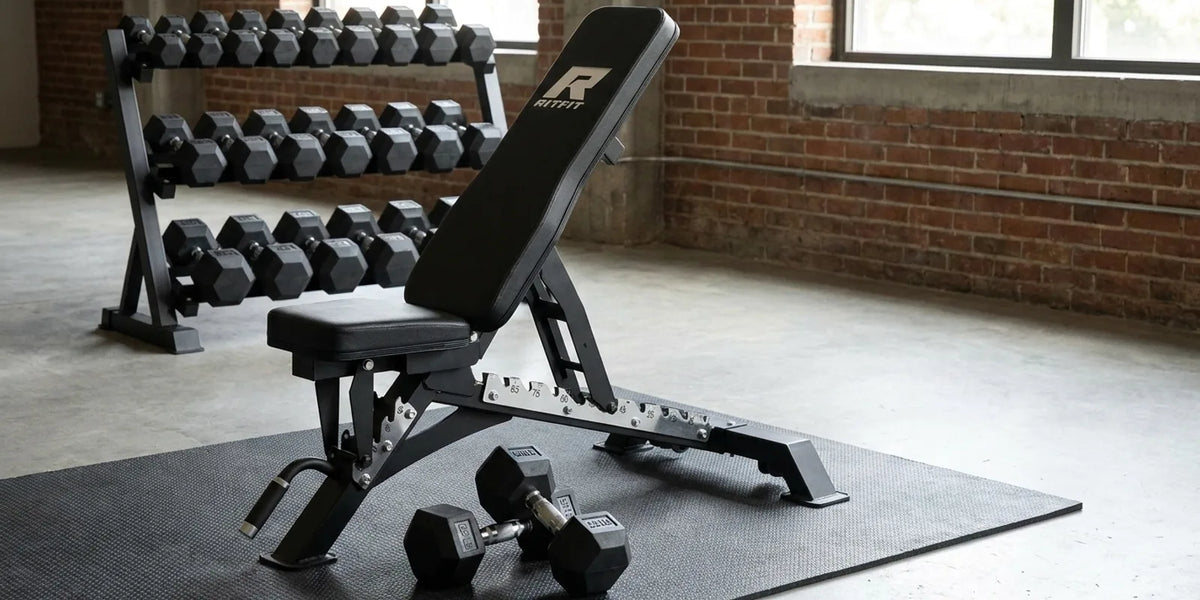
Set the backrest, then sit back so your shoulder blades stay pinned down and back with your feet flat on the floor. The bench must hold the angle without wobble, and a sturdy option like the RitFit 1300LB Adjustable Weight Bench, shown in the video below, locks each incline setting solidly.
- Angle check: When you sit down with a dumbbell in each hand, your arms should hang perpendicular to the floor with the elbows just behind your torso.
- Head position: Keep your head up rather than pressed into the pad, which coaching guidance finds more comfortable for your thoracic spine.
- Seat: Set the seat angle if your bench has one so you do not slide forward as the set gets hard.
If your current bench will not lock anywhere near this range, it is worth comparing adjustable weight benches built for multiple incline settings.
"If you do feel it in your shoulders, it's more than likely you still have the bench too far back and your shoulders are under too much stress."
Ebenezer Samuel, C.S.C.S. Fitness Director, Men's Health, from Build Bigger Biceps with the Dumbbell Incline Curl
Curl From a Full Stretch to a Full Squeeze
The incline dumbbell curl is performed with a supinated grip, arms hanging fully extended, and a controlled curl up to a hard squeeze at the top of every rep.
Step 1: Hang from the stretch. Hold a pair of dumbbells at arm's length with the palms facing up, keeping the elbows in line with the shoulders and behind the torso.
Step 2: Curl without drift. Curl the weights up under control while the upper arms stay still, and only let the elbows move forward slightly at the very top.
Step 3: Squeeze and lower slowly. Pause and squeeze the biceps at the top, then lower the dumbbells through the eccentric phase over a few seconds until the arms are fully extended again.
- Full range of motion: Reach the full stretch at the bottom and a full contraction at the top on every rep.
- Time under tension: The slow lowering phase keeps tension on the biceps instead of the shoulders.
Train the Biceps Long Head in a Stretched Position
The incline angle moves the shoulder into extension, so the biceps brachii long head works from a lengthened position at the bottom, not the shortened position of standing curls.
A 10-week training study of 15 young men found that elbow curls with the shoulder extended increased biceps muscle thickness by 9 percent at the proximal, mid, and distal regions, with no significant difference from shoulder-flexed preacher curls that reached 6 to 7 percent.[1] Both positions built muscle, so the incline stretch is an effective training angle rather than a magic shortcut.
Electromyography data from 22 subjects showed that incline dumbbell curls and standard dumbbell bicep curls produce similar biceps brachii long head activation across the whole elbow range of motion, reaching at least 50 percent of maximum RMS.[2] Preacher curls by contrast concentrated their activation in a short joint angle range.
The practical difference from a standing curl is the starting position. In a standard standing curl the arms hang in front of the hips, while the incline setup parks them behind the torso.
- Long head: The biceps brachii long head runs over the shoulder joint, so shoulder extension lengthens it more than the arms in front position of a standing curl.
- Short head and helpers: The biceps brachii short head still works on the way up, with the brachialis and brachioradialis assisting elbow flexion.
For the base movement without the angle, see our guide to standard dumbbell bicep curls, and for the anatomy of both heads see our long head and short head biceps guide.
Choose the Right Dumbbell Weight and Rep Range
Incline dumbbell curls work best for 3 sets of 10 to 12 reps with a load lighter than your standing curl weight, since the stretched bottom position removes momentum.
- Starting load: Pick dumbbells you can curl for all 12 reps with strict elbows, then stop 1 to 2 reps short of failure on your first session.
- Tempo: Lower the dumbbells over 3 to 4 seconds so the eccentric phase does the work, then curl up at a steady pace.
- Progressive overload: Add reps first until you reach 12 clean reps on every set, then add the smallest load jump available.
- When to add weight: Move up only when the elbows stay behind the torso and the full range of motion holds for every rep.
Free weights make the small jumps easy, and a set of adjustable dumbbells lets you micro load the curl as the weeks pass. For a deeper guide to curl loads by training level, read how much weight to curl.
"This is one of the best purchases I've ever made. This is so convenient on days I can't make it to the gym. The weights feel so heavy I love it. Don't hesitate, trust me this is the best."
Wene-fraide J. Verified Buyer, RitFit Adjustable Dumbbells 40-100 lbs
Fix These Common Mistakes on the Incline Bench
The most common incline curl mistakes are setting the bench too far back or too shallow, letting the elbows drift forward, swinging the load, and cutting reps short.
- Bench angle off: If the shoulders complain, the backrest is probably too far back or too shallow, so reset it near 45-60 degrees before the next set.
- Elbows drifting forward: Fatigue pulls the elbows in front of the torso and shifts work off the biceps, so keep the shoulder blades tight and end the set when the position breaks.
- Too much weight: Swinging the dumbbells and rolling the shoulders forward turns the strict curl into a standing swing, so drop the load until every rep stays clean.
- Rushing the lowering: Bouncing out of the bottom wastes the stretch, so keep a slow eccentric phase of 3 to 4 seconds.
- Partial reps: Stopping short at the bottom or the top cuts the range of motion, so reach the full stretch and the full squeeze on every rep.
When to stop: End the set at the first sharp pain in the shoulder, elbow, or biceps tendon, and if discomfort repeats across sessions, have a qualified professional check the setup before loading the movement again.
Pick a Bench That Locks the Incline Angle You Need
A good curl bench locks its backrest firmly at any angle in the 45-60 degree range and keeps you stable while your arms hang behind the torso.
- Locking incline positions: The backrest should offer several angles across the 45-60 degree range so you can tune the stretch to your shoulders.
- Load capacity: A high tested capacity keeps the bench solid when you sit back with heavy dumbbells at the top of a hard set.
- Seat and pad: A seat angle adjustment and a grippy pad stop you sliding forward as the set gets hard.
Does the RitFit GATOR Adjustable Weight Bench Hold the Right Incline Angle for Curls?
Yes. The RitFit GATOR Adjustable Weight Bench covers the incline curl range with 10 backrest angles spanning 0-85 degrees among 21 total adjustment combinations, and its 1600 lbs tested total load capacity on a 50 by 70 mm reinforced steel frame keeps every set stable.
- Seat and pad: Three seat angles stop you sliding forward, and the 2.7 in thick pad stays firm through full sets of presses, rows, and curls.
- Value: At $399.99 the GATOR fits lifters who want one bench for the whole arm session, and you can check current pricing and stock before you buy on the product page.
"This bench is great and sturdy and does everything I need out of it for me and my son. I really like the arm rest especially for my son while he is learning and starting out in working out I think it's great that this product has something that can help with his form. It moves and adjust easily and very simple any one can do it. I use this in a limited space so I am moving it around to store it so bigger wheels would have been nice but It's also not a make or break. It still moves around great I just need to adjust the angle a bit. Over all great product and it's definitely worth the money to add to my home gym."
Rey O. Verified Buyer, RitFit GATOR 1600LB Adjustable Weight Bench
Swap In These Movements When You Need a Substitute
Substitute movements for incline dumbbell curls are preacher curls, spider curls, concentration curls, and hammer curls, each shifting the stretch or the muscles worked.
- Preacher curls: This opposite shoulder position trains the arm in front of the body from a shortened biceps position, and our preacher curls guide covers the full setup.
- Spider curls: Another bench angle variation that keeps the arms in front of the body for a hard peak contraction, with the details in our spider curls guide.
- Concentration curls: A strict single arm option for lifters who cannot hold the incline position comfortably, covered in our concentration curls guide.
- Hammer curls: The neutral grip shifts work toward the brachialis and brachioradialis when the biceps need a break, and our dumbbell hammer curls guide breaks it down.
Changing the variation changes the muscle demand. In an electromyography study of 12 participants performing one set of ten reps at 65 percent of 1-RM, biceps brachii and brachioradialis activation differed across dumbbell, straight bar, and EZ bar curls.[3]
Program Incline Curls Into Your Arm Workouts
Incline dumbbell curls fit best as a finisher at the end of arm day, once or twice a week, after your heavier curl work.
- Frequency: Run the movement once or twice a week with at least one rest day between biceps sessions.
- Placement: Slot it in as the final move of arm day so the strict stretch position finishes off the biceps.
- Progression: Add reps up to 12 per set first, then add load in the smallest jumps while form holds, which keeps progressive overload moving week to week.
- When to back off: If the elbows keep drifting or the shoulders complain, drop the load or flatten the angle toward 60 degrees and rebuild the strict reps.
Track the load and clean reps each week so the progression stays visible across the training block.
FAQs About Incline Dumbbell Curls on a Weight Bench
What angle should the bench be for incline dumbbell curls?
Set the bench to a 45-60 degree incline so your arms hang with the elbows slightly behind your torso at the bottom. Coaching guidance from ATHLEAN-X and Men's Health lands in this range, since a shallower angle adds shoulder stress while a steeper angle cuts the biceps stretch.
What muscles do incline dumbbell curls work?
Incline dumbbell curls train the biceps brachii, with the long head emphasized in the stretched bottom position, plus the brachialis and brachioradialis assisting elbow flexion. In one electromyography study of 22 subjects, incline and standard dumbbell curls kept biceps brachii activation high across the whole elbow range of motion.
Why do incline dumbbell curls feel harder than standing curls?
The bench angle lets your arms hang behind your torso, so the biceps start every rep in a stretched position with less room to swing. That lengthened position changes the leverage at the bottom, and controlled reps keep the tension on the biceps instead of the shoulders.
How much weight should you use for incline dumbbell curls?
Start with dumbbells you can curl for 3 sets of 10 to 12 strict reps without swinging your elbows forward. The stretched bottom position is demanding, so go lighter than your standing curl weight and lower the dumbbells slowly before adding load.
How often should you do incline dumbbell curls?
Run incline dumbbell curls once or twice a week as an accessory at the end of arm day, for 3 sets of 10 to 12 reps. Leave at least one rest day between biceps sessions, and add weight only when every rep stays controlled through the full range of motion.
Can you do incline dumbbell curls on any adjustable bench?
You need a bench whose backrest locks firmly at roughly a 45-60 degree incline with a seat that stops you sliding forward. The RitFit GATOR Adjustable Weight Bench covers the range with 10 backrest angles spanning 0-85 degrees and a 1600 lbs tested load capacity.
Why do my shoulders hurt during incline dumbbell curls?
Shoulder discomfort usually traces back to a bench set too far back or too shallow, which pushes the shoulder joint out of its natural position. Reset the incline near 60 degrees, keep your shoulder blades pulled down and back, and stop the set if discomfort continues.
When should you stop a set of incline dumbbell curls for shoulder pain or form loss?
Stop the set at the first sharp pain in the shoulder, elbow, or biceps tendon, and end the workout if discomfort lingers. Form loss is another stop sign, so finish the set when the elbows drift forward or the shoulders roll, even if reps remain.
Conclusion
Incline dumbbell curls turn a simple weight bench into a precise biceps builder by stretching the long head on every repetition. Set the bench to a 45-60 degree incline, curl from a full stretch with strict elbows, and progress the load only when the form holds.
Start with 3 sets of 10 to 12 reps at the end of arm day, and check the RitFit discount guide before you shop for a bench or dumbbells.
Disclaimer
This article is general fitness information and is not medical advice or a diagnosis. Consult a qualified healthcare professional before starting a new exercise program, especially if you have a history of shoulder, elbow, or biceps injuries.
References
1. Attarieh P, Nunes JP, Khani S, et al. Comparison Between Shoulder Flexed and Extended Positions in Elbow Flexion Resistance Training on Regional Hypertrophy and Maximum Strength: Preacher versus Bayesian Cable Curls. Eur J Sport Sci. 2025;25(4):e12279. doi:10.1002/ejsc.12279. PMCID: PMC11906226
2. Oliveira LF, Matta TT, Alves DS, Garcia MA, Vieira TM. Effect of the shoulder position on the biceps brachii emg in different dumbbell curls. J Sports Sci Med. 2009;8(1):24-9. PMCID: PMC3737788
3. Marcolin G, Panizzolo FA, Petrone N, et al. Differences in electromyographic activity of biceps brachii and brachioradialis while performing three variants of curl. PeerJ. 2018;6:e5165. doi:10.7717/peerj.5165. PMCID: PMC6047503





