








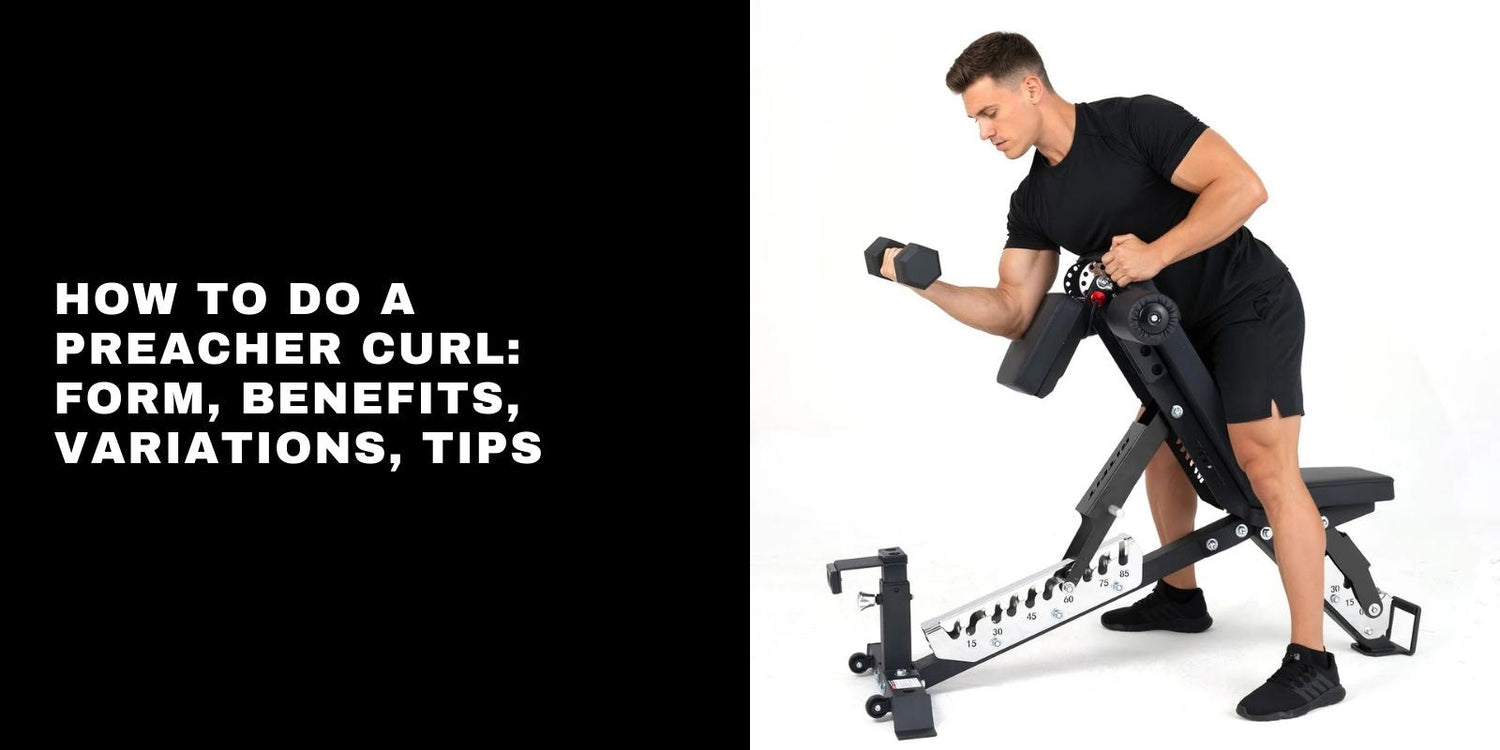
The preacher curl is a strict biceps isolation exercise that braces your upper arms against a slanted pad, so the biceps move the weight without help from your shoulders or lower back. That setup makes it one of the most effective movements for building bigger, stronger biceps.
This guide explains how to do a preacher curl step by step, which muscles it works, its benefits, the mistakes that stall progress, how to train it at home, and how to program it for steady arm growth.
Quick Answer: A preacher curl is a pulling, strict biceps isolation exercise performed with your upper arms braced against a slanted pad, which removes momentum and keeps tension on the biceps. Most lifters see results with 3-4 sets of 8-12 controlled reps once or twice per week, using a lighter load than a standing curl.
Key Takeaways
- Strict isolation: Locking your upper arms on the pad removes momentum and keeps tension on the biceps.
- Lighter loads: Preacher curls feel heavier than standing curls, so start light and prioritize a slow lowering phase.
- Elbow care: Stop just short of full lockout and keep your wrists stacked to reduce stress on the joints and tendons.
- Pull day movement: Preacher curls are a pull exercise, so place them on pull days or arm days after heavier back work.
- Variety wins: Rotate EZ-bar, dumbbell, cable, and machine versions to train slightly different grips and keep progress steady.
- Smart pairing: Combine preacher curls with incline curls and hammer curls to cover the biceps, brachialis, and forearms.
What Is a Preacher Curl?
A preacher curl is an isolation exercise performed on a preacher bench, a station built around a slanted pad that supports your upper arms and elbows. The pad removes your ability to swing the weight, so the biceps have to complete the lift without help from the shoulders or back.
- Bench: A seated or standing preacher curl bench with a slanted arm pad.
- Resistance: Typically an EZ-curl bar, though barbells, dumbbells, and cable machines all work.
- Position: Your armpits rest over the top edge of the pad so your upper arms stay anchored through the set.
If you train at home, a dedicated preacher curl pad like the RitFit Preacher Curl Pad adds ergonomic biceps and arm support to the bench you already own, and the full range of RitFit gym accessories covers the rest of a home setup.
Which Muscles Does the Preacher Curl Work?
The preacher curl trains the biceps brachii, with more emphasis on the short inner head because your upper arms sit in front of your torso. The brachialis, the brachioradialis, and the forearm flexors all assist the movement.
- Primary: Biceps brachii, especially the short inner head.
- Secondary: Brachialis, the muscle underneath the biceps that pushes it up.
- Support: Brachioradialis and the forearm flexors.
Because the pad holds your upper arms still, the shoulders cannot help drive the weight, which is why the same load feels harder here than in a standing curl.
Are Preacher Curls Push or Pull?
Preacher curls are a pull exercise. The biceps shorten to bend the elbow, which pulls your forearm toward your upper arm, the same movement pattern used in chin-ups, rows, and other back and biceps work.
That pattern is why preacher curls belong on pull days or arm days and not on push days. Placing them after your heavier pulling movements keeps the biceps working without cutting into your pressing strength the next day.
"Exercises such as preacher curls and concentration curls (where the upper arm is positioned in front of the torso) work more in the short head, as do exercises such as cross cable curls on a high pulley apparatus."
Brad Schoenfeld, PhD, Exercise Science Researcher specializing in Muscle Hypertrophy, CUNY Lehman College, The Science of Biceps Training
Benefits of Preacher Curls
Preacher curl benefits come from strict isolation: bracing your upper arms on the pad removes momentum and holds tension on the biceps from the first rep to the last. That combination makes the exercise useful for beginners learning clean reps and for experienced lifters chasing more precise arm work.
- Strict isolation: Anchoring the upper arms reduces help from the shoulders and back.
- Reduced momentum: The setup makes cheating much harder.
- Mind muscle connection: Stable support helps you focus on the contraction and the tempo.
- Consistent tension and cleaner reps: A stable arm position makes it easier to track form and progress.
- Balanced arm development: Preacher curls complement other curl angles to support fuller biceps growth.
Do Preacher Curls Build a Bigger Biceps Peak?
Preacher curls can build overall biceps size and improve how hard you can squeeze at the top, but they cannot reshape the peak itself. Peak shape is influenced by genetics and tendon attachment, so treat this exercise as a growth tool rather than a guarantee of a specific look.
How Do You Set Up for Preacher Curls?
Setup decides whether the preacher curl loads your biceps or your joints, so dial in the seat, the load, and the bar before the first rep. A pad that sits in the wrong place shifts work into the shoulders and wrists.
- Adjust the seat height: Sit down and check that your armpits rest comfortably over the top edge of the pad. A seat that is too low raises your arms awkwardly, and one that is too high leaves you hunched over.
- Choose your weight: Select a lighter load than you would use for a standing barbell curl. Without momentum to help, the same plates feel heavier.
- Select the bar: An EZ-curl bar is generally preferred over a straight barbell because the angled grip reduces stress on the wrists.
Preacher Curl Setup Checklist
Run through five checks before your first rep: chest anchored, feet flat, upper arms fully supported, wrists stacked, and a controlled range with no bouncing off the bottom.
How to Do a Preacher Curl With Proper Form
The preacher curl is performed in four steps: set your position on the bench, lower the bar under control, curl without letting your elbows lift off the pad, and repeat at a steady rhythm. Control matters more than the number on the plates.
- Starting position: Sit with your chest firmly against the pad and your feet flat on the floor. Place your upper arms parallel to each other on the pad, then grip the bar underhand at about shoulder width.
- Lowering phase: Inhale and lower the bar slowly, controlling the weight until your elbows are almost fully extended. Do not lock the elbows out completely, because that places unnecessary stress on the joint.
- Lifting phase: Exhale and curl the bar upward by flexing your elbows. Keep your upper arms and elbows glued to the pad and squeeze the biceps hard at the top of the contraction.
- Repetition range: Perform the movement in a smooth, controlled rhythm. A common recommendation for muscle growth is 3-4 sets of 8-12 repetitions.
Beginners learning how to do preacher curls should treat the lowering phase as the main lift and add load only when the final rep of a set still looks clean.
Common Mistakes and How to Fix Them
The pad provides stability, but it cannot stop errors once the weight gets heavy. These five problems show up most often, and each one has a fix you can apply on the next set.
- Using too much weight: When the load is too heavy you instinctively lift your hips or lean back to get the bar moving. Fix: lower the weight and focus on strict execution.
- Lifting elbows off the pad: Raising your elbows turns the movement into a partial front raise and brings the shoulders into the lift. Fix: keep your triceps pressed firmly against the pad at all times.
- Rounding the back: Slumping forward can strain your neck and back. Fix: keep your chest up and pressed against the support pad.
- Bouncing at the bottom: Dropping the weight quickly and bouncing it back up puts the biceps tendons and elbows at risk. Fix: pause briefly at the bottom before curling back up.
- Incomplete range of motion: Stopping halfway down denies the muscle the full benefit of the stretch. Fix: lower the weight until your arms are nearly straight.
What Are the Best Preacher Curl Variations?
Preacher curl variations change the grip, the resistance curve, or the demand on each arm, which keeps training fresh and works around limited equipment. Rotate two or three of them across a training block instead of chasing a single perfect version.
- EZ-bar preacher curl: The standard version, and the kindest to your wrists.
- Dumbbell preacher curl: Performed with one arm or two, it allows a neutral grip option and helps you identify strength imbalances between the left and right arms.
- Single-arm preacher curl: Focuses intensely on one side at a time for maximum concentration.
- Cable preacher curl: A low pulley keeps constant tension on the biceps through the entire range of motion, unlike free weights where tension varies. Our comparison of cable bicep curls and dumbbell curls covers which one suits which goal.
- Machine preacher curl: A fixed path of motion makes this version safe and easy to learn, which suits beginners.
In a home gym, a cage attachment can stand in for a cable station, and the RitFit 2-in-1 hip thrust and bicep curl attachment is one way to add curl work to a power rack.
How to Do Preacher Curls at Home Without a Bench
You can do preacher curls at home without a dedicated station by fixing your upper arms at a similar angle: an incline bench set steeply, a preacher pad that clips onto the bench you already own, a low cable pulley, or a resistance band anchored near knee height.
Whichever option you pick, keep the same cues you would use in a commercial gym. Lock your upper arms in place, avoid swinging the weight with your back, and control the lowering phase on every rep.
How Should You Program Preacher Curls?
Preacher curls fit best into pull workouts or dedicated arm days, usually after heavier compound exercises like chin-ups or barbell rows. Isolation work like this fills in the arm volume that big pulling movements leave behind.
- For muscle growth: 3-4 sets of 8-12 reps with moderate weight.
- For muscle endurance: 2-3 sets of 15-20 reps with a lighter weight.
- Frequency: 1 to 2 times per week is generally sufficient for most lifters.
Want a reference point before you set targets? Our breakdown of the average bicep curl for men puts typical curl strength in context by bodyweight and training experience.
Safety Tips and Modifications
The preacher curl places significant torque on the elbow joint, particularly at the bottom of the movement where the arm is most extended. A few habits keep the exercise productive instead of irritating.
- Warm up first: Never start your arm workout with heavy preacher curls, and prepare the elbows with lighter movements first.
- Avoid full lockout: Stopping just short of full extension protects the elbow from hyperextension.
- Listen to your wrists: If a straight bar hurts your wrists, switch immediately to an EZ-bar or dumbbells.
- Stop if it hurts: Sharp pain in the forearm or elbow, which is often a sign of tendonitis, is a reason to switch to an exercise such as hammer curls.
Can You Do Preacher Curls With Elbow Pain?
You can keep preacher curls in your program with mild elbow discomfort by using a lighter load and stopping short of full extension, but sharp pain is a reason to take the movement out. Pain that persists between sessions usually points to tendon irritation, so swap in hammer curls or another curl variation until the elbow settles.
Preacher Curls vs. Other Biceps Exercises
The preacher curl trades total load for strict tension, which is exactly why it pairs well with heavier free weight curls instead of replacing them. Compare it with the classics before you plan your next arm session.
- Vs. standing barbell curl: The standing curl allows more total weight and recruits stabilizer muscles, but it invites cheating. The preacher curl is lighter and stricter.
- Vs. incline dumbbell curl: The incline curl places the arms behind the torso and stretches the long head of the biceps, while the preacher curl places the arms in front and targets the short head. Using both covers more of the muscle.
- Vs. hammer curl: Hammer curls target the brachialis and forearms more than the biceps peak, which makes them a strong complement to preacher curls.
For single-arm work with a similar front-of-torso arm position, the concentration curl is a natural rotation, and spider curls shift the challenge to a stricter, more stretched position. If your home setup centers on a Smith machine, our guide to cable bicep curls on a Smith machine shows how to load that variation.
FAQs About the Preacher Curl
How can you prevent elbow pain during preacher curls?
You must stop just short of full arm extension at the bottom of the movement. Fully locking out your elbows puts dangerous stress on the joint and tendons. Keeping a slight bend ensures continuous muscle tension while protecting your arms from severe hyperextension injuries during the heavy lowering phase.
Why is an angled bar better than a straight barbell?
An angled bar significantly reduces uncomfortable stress on your wrists during the lifting motion. The natural grip placement prevents severe joint strain and allows you to focus entirely on the muscle contraction. This safer wrist position ultimately helps you lift more consistently without developing chronic tendon irritation over time.
What specific muscle groups does this isolation exercise target primarily?
This movement primarily targets the short inner head of your biceps brachii muscle. The secondary muscles engaged include the brachialis underneath the biceps and the brachioradialis in your forearm. Anchoring your arms firmly on the pad removes shoulder involvement and isolates these specific arm muscles for optimal growth.
How frequently should you perform this exercise for muscle growth?
You should perform this movement one or two times every week for the best results. Treating it as a strict isolation exercise means it fits perfectly at the end of your pull days. Three or four sets with moderate weights provide enough dedicated volume to build substantial arm size.
Why does this exercise feel heavier than regular standing barbell curls?
The slanted bench totally eliminates your ability to cheat using back momentum. Standing curls allow other body parts to help swing the load upward through the air. You must use a lighter weight because your biceps are forced to complete the entire mechanical lifting process completely unassisted.
Can you do preacher curls at home with a bench and a pad?
Yes. A preacher curl pad placed on your existing bench gives your upper arms the support the movement needs, and a low pulley or cage attachment works as an alternative. Keep the same cues you would use in a commercial gym and control the lowering phase on every rep.
Are preacher curls a push or pull exercise?
A preacher curl is a pull exercise because the biceps bend the elbow and pull your forearm toward your upper arm. That pattern matches chin-ups, rows, and other back and biceps work, so the movement belongs on pull days or arm days rather than push days. Placing it after your heavier pulling exercises keeps the biceps working without interfering with your pressing.
How can you do preacher curls at home without a preacher bench?
Yes. You can brace your upper arms on an incline bench set steeply, clip a preacher pad onto the bench you already own, or use a low pulley or an anchored resistance band instead. Because the pad only has to lock your upper arms at a fixed angle, any setup that does that lets you train the same movement at home.
Conclusion
The preacher curl remains one of the best exercises for isolating the biceps and building a defined, muscular upper arm. Removing momentum forces the biceps to work through every repetition, so keep your form strict, control the lowering phase, and choose a weight your elbows can handle.
Add it to the end of an arm or pull session and track your reps from week to week. If you are also building a home setup, our RitFit discount guide explains how to save on your first order.
Disclaimer
This article is for general fitness education and is not a substitute for personalized coaching or medical advice. Consult a qualified professional before starting a new training program, especially if you have a history of elbow, wrist, or shoulder issues.





