Seated leg extensions are the simplest way to load the quadriceps: you sit down, hook your shins behind a pad, and straighten your knees against a weight stack. This guide walks through fitting a leg extension curl machine to your body, then through a full rep.
It is written for first-time owners of a PLC01-style combo machine, so each adjustment is described by where it puts your knee, hip, and shin rather than by a number stamped on the frame. You will finish with a starting load, a weekly set count, and a four-week plan.
Quick Answer: Seated leg extensions work best when the seat puts your knee joint in line with the machine pivot, the ankle pad sits just above your foot, and each rep travels from about 90 degrees of knee bend to a full but unforced lockout. Lift in two seconds, lower in three, and start with a load you can control for 12 to 15 reps.
Key Takeaways
- Fit comes first: a seat height that puts the machine pivot on your knee joint matters more than the load on the stack.
- Full range wins: take every rep from about 90 degrees of knee bend to a straight knee without slamming into lockout.
- Tempo controls the rep: a two second lift and a three second lower keeps tension on the quad instead of the joints.
- Dose stays small: two to three sets twice a week is enough for a first training block.
- Pain is a stop sign: a deep burn is fine, a sharp pinch under the kneecap is a reason to change the setup.
Why Seated Leg Extensions Are the Base Quad Exercise
Seated leg extensions isolate the quadriceps because the only joint moving is the knee, which makes them the easiest quad exercise to set up and progress at home. The machine removes balance and technique from the equation, so a beginner can train all four quad muscles, the rectus femoris, vastus lateralis, vastus medialis, and vastus intermedius, without a spotter or a rack.
What seated leg extensions do for your quads covers the strength and size side in depth, and the leg extension benefits beyond size roundup explains why the movement stays useful once you are past the beginner stage.
One clarification before you load it: this is a quad exercise, not a hamstring exercise. The curl side of a combo machine handles the back of the thigh, and mixing the two up is the most common reason a beginner trains one side of the leg twice and the other side never.
Adjust the Machine to Your Body in Four Steps
Four adjustments decide whether a seated leg extension feels smooth: seat height, back pad depth, ankle pad height, and the gap between your knee and the machine pivot. Work through them in that order, because moving the back pad changes where your knee sits.
- Step 1: Seat height. Raise or lower the seat until the pivot bolt on the side of the machine lines up with the center of your knee joint, the bony point on the outside of the knee.
- Step 2: Back pad. Slide the back pad so your back is supported and the front edge of the seat stops just behind your knee, which leaves room to bend without the seat pushing your thigh forward.
- Step 3: Ankle pad. Set the pad just above your ankle joint against the lower shin, not across the top of your foot.
- Step 4: Pivot check. Sit down, hook your shins behind the pad, and look at the side of the machine. The arm should rotate around the same point your knee bends around, with no arc that pulls your shin up or pushes it down.
If the seat bottoms out before your knee reaches the pivot, you need more adjustment range rather than a workaround. Fitting a leg extension machine to a taller frame lists the measurements to check before you buy.
On a new machine, assemble the frame and seat before you chase a perfect fit, because a half-built unit will not hold an adjustment. The video below shows the assembly order for the PLC01, which is the same sequence most combo machines follow.
Set the Start Angle and Use the Full Range
Each rep starts with your knees bent to about 90 degrees and ends with the knee straight, so the quad works through its full arc. The start-angle pin sets the bottom of that arc, and the top is your own knee, not a number on the frame.
Range of motion is the part most beginners cut. A 2020 systematic review of range of motion in resistance training reported that two of the four quadriceps studies showed greater hypertrophy with full range than with partial range, and no study favored the short range, though about 94 percent of the pooled sample were young men.[1]
In practice, that means lowering the pad until your knees reach roughly a right angle and extending until the knee is straight but not jammed. Bouncing out of the bottom and stopping two inches short of lockout both shrink the range where the quad has to do the most work.
Control the Tempo and Breathe on Every Rep
Lift the pad in about two seconds, pause for one second at the top, and lower it over three seconds so the eccentric phase carries real time under tension. The lowering phase is where most of the control is lost, and it is the first place a load that is too heavy shows up.
Breathe out as you extend and in as you lower, and brace your trunk before the first inch of movement. If the stack clanks on every rep or the pad free-falls at the top, the weight is too heavy for this tempo rather than too light for your legs.
Pick a Starting Weight and a Weekly Set Count
Start with a load you can move for 12 to 15 controlled reps with your hips pinned to the seat, then run two to three sets twice a week. That dose is small on purpose, because the first two sessions are about learning positions rather than chasing fatigue.
Add weight only when every set reaches the top of the rep range at the same tempo. How leg extension weight increments work explains the small jumps that keep progress steady instead of turning every session into a grind.
Progressive overload here is mostly a matter of adding reps first and the smallest plate or pin setting second. If you cannot control the lowering phase after a jump, the jump was too big, so drop back one increment and earn it again.
Seated vs Standing vs Single-Leg vs Paused Leg Extensions
Seated leg extensions are the default for building quad size and strength, while standing, single-leg, and paused versions each solve a problem the seated version cannot. Use the comparison below to pick the version that matches what your program is missing.
- Seated, two legs: the most stable position and the heaviest load, which makes it the main lift for mechanical tension and weekly volume.
- Single-leg: use it when one side lags, when the combined load bothers your knee, or when you want more stabilizer work from the same seat.
- Standing or cable: the hip stays extended, which puts the rectus femoris under stretch, but the load is limited and the setup is harder to repeat exactly.
- Paused: hold for two or three seconds at mid-range or at lockout to remove momentum and expose a weight you have been swinging.
Pick seated work for your main sets, add single-leg work if one thigh is visibly smaller, and use paused reps when the stack moves faster than your tempo allows. Standing versions are a warm-up or travel option rather than a replacement for loaded seated work.
Seat Too Low, Pad Too High: Five Common Mistakes
The five mistakes that ruin a seated leg extension are a seat set too low or too high, a pad on the instep, hips lifting, swinging, and half reps.
Each one has a physical fix rather than a cue to try harder.
- Seat too low: your knee sits above the pivot, so the pad pulls your shin upward through the rep. Raise the seat until the pivot meets the knee.
- Seat too high: your knee drops below the pivot and the top of the rep becomes a lever arm against the joint. Lower the seat one notch and recheck the alignment.
- Pad on the instep: pressure lands on the foot instead of the shin, which invites a toe push. Move the pad up to just above the ankle.
- Hips lifting: the load is too heavy or the back pad sits too far forward. Reset the pad and take weight off until your hips stay down for every rep.
- Swinging and half reps: a fast bounce and a short arc both skip the hardest part of the range. Slow the lift to two seconds and touch the same start angle each rep.
Film one set from the side if you are unsure which mistake you are making. The camera shows hip lift and pad drift that you will not feel from the seat.
Your First Four Weeks on the Machine
Four weeks is enough to learn the setup and build a repeatable dose, so keep the load light and the reps clean. Run the plan twice a week on non-consecutive days and leave at least one full day between sessions.
| Week | Sets and reps | Load rule | Focus |
|---|---|---|---|
| Week 1 | 2 sets of 12 to 15 | Light, stop two reps before failure | Learn the seat and pad positions |
| Week 2 | 3 sets of 12 to 15 | Same load, add one clean rep per set | Hold the two second lift and three second lower |
| Week 3 | 3 sets of 10 to 12 | Small increment once all sets hit 15 | Full range with no hip lift |
| Week 4 | 3 sets of 10 to 12 plus 1 single-leg set per leg | Half the two-leg load on single-leg work | Check side to side strength |
Rep ranges assume a two second lift and a three second lower with a one second pause at the top.
After week four, keep two sessions per week and add a set only when the current work feels repeatable. The single-leg set in week four is a check rather than a new program, so note which side fatigues first and lead with that side in later sessions.
When to Stop: Knee Discomfort vs Normal Effort
Normal effort feels like a deep quad burn, while sharp pain under the kneecap, swelling, or pain that outlasts the session is a signal to stop and change something. The difference matters because the last part of the range loads the knee joint differently than the middle.
Clinicians writing about open kinetic chain knee extension note that from 40 to 0 degrees of knee flexion the quadriceps must produce three to four times more force, and that patellofemoral reaction forces are significantly higher from 50 to 0 degrees than in closed chain work.[2]
A 2022 biomechanics review adds that a fixed moment arm machine keeps patellofemoral joint stress high across the full 90 to 0 degree arc, while variable resistance shifts more of the load toward the last 45 degrees.[3]
That does not make leg extensions unsafe for healthy knees, and it is no reason to skip the final degrees. It does explain why a sharp pinch near lockout usually responds to less load, a slightly shorter range for a week, or a switch to leg press while the knee settles.
Stop the set if you feel a catch, a giving-way sensation, or pain that changes how you walk. See a clinician for swelling that lasts more than a day, pain at rest, or a knee that locks.
"Leg extensions create hypertrophy in the quads and can be overloaded. However, there are some potential safety issues for people with tendonitis or knee issues, as it places a lot of force and tension on the patella. It's a good exercise for some, definitely not all."
Jeff Cavaliere, MSPT, CSCS, Physical Therapist and Strength Coach at Athlean-X, Quad Exercises Ranked
Fit a Leg Extension Machine Into a Small Home Gym
A leg extension curl machine earns its floor space when it covers both quad and hamstring work, which is why a compact combo unit suits a garage or basement gym. The machine also replaces the seat, pad, and cable setup you would otherwise build around a bench.
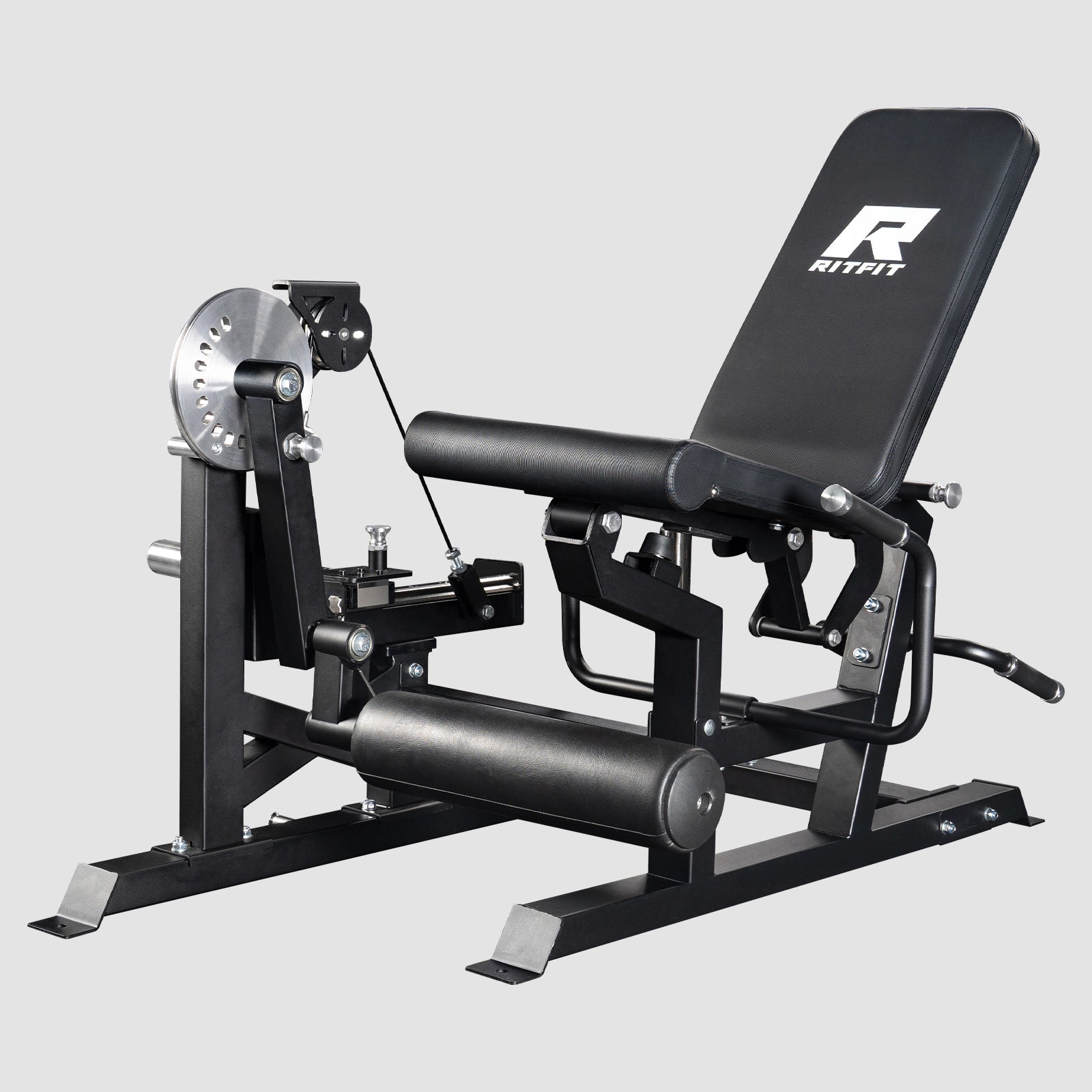
The RitFit PLC01 leg extension curl machine is built around that idea, with one seat, a leg extension arm on one side, and a leg curl station on the other. Check that the seat, back pad, and ankle pad all adjust before you buy, because a fixed seat is the fastest way to end up with a machine that fits nobody in the house.
Browse the full leg machines line to compare formats, and read leg extension curl machines for beginners before you commit to a footprint. Leg extension machines for home gyms covers the space question in more detail.
Measure the wall space with the seat fully back and the arm at the bottom of its arc, not at the compact position you see in photos. A second opinion on a machine like this one helps, and the review below walks through the same setup points from a home gym owner's perspective.
If the curl side matters as much as the extension side, prone leg curls on the same machine shows how to set up the other station without moving the seat.
"Love my RitFit equipment and all its uses. I started with the squat rack and slowly have been putting my home gym together little by little. The newest piece being the leg extension machine with different functions for up to 5 different exercises. Thank you Ritfit for the fast delivery and beautiful equipment."
Hector R. Verified Buyer, RitFit PLC01 Leg Extension Curl Machine
FAQs About Seated Leg Extensions
Where should my knee sit relative to the machine pivot?
Line the center of your knee joint up with the pivot bolt on the side of the machine, the point the arm rotates around. If your knee sits above or below that bolt, the pad pulls your shin off its natural path. Adjust the seat first, then check the alignment from the side.
How much weight should a beginner use for seated leg extensions?
Start with a load you can move for 12 to 15 clean reps while your hips stay glued to the seat. If the pad slows down on the last two reps but still travels the full arc, that load is right. Most beginners land on a light setting for the first two sessions and add a small increment once all sets finish clean.
How many sets of seated leg extensions should I do each week?
Two to three sets taken close to fatigue, twice a week, is enough for most beginners. That gives you four to six hard sets of quad work per week on this machine, which pairs well with squats, leg press, or split squats. Add sets only after the current number feels repeatable for two weeks.
Where should the ankle pad sit on my lower leg?
Place the pad just above your ankle joint, on the front of the shin, so it rests against the lower shin rather than the top of your foot. The pad should feel flat and stable when you push. If it rides onto your instep or your toes, drop the pad height one notch.
Should I lock my knees at the top of a leg extension?
Straighten the knee fully without jamming or snapping it, then hold for a beat. A full lockout is where the quad finishes its work, but slamming into it with momentum shifts the load to the joint. Keep the last few degrees smooth and stop the rep if the knee feels pinched.
Can I do seated leg extensions if my knees ache?
Mild discomfort that settles as you warm up is common, but sharp pain, swelling, or pain that lingers after the session is a reason to stop. Reduce the range, lower the load, or switch to a leg press for a week. See a clinician if pain persists or your knee catches or gives way.
Do seated leg extensions work the hamstrings too?
No. Seated leg extensions train the quadriceps only, because the movement is knee extension against resistance. The hamstrings work on the opposite side of the same machine when you switch to the leg curl station. Program both if you want balanced thigh development.
Conclusion
Seated leg extensions are the easiest quad exercise to load at home, provided the seat puts your knee on the pivot and every rep travels the full range. Set the four adjustments once, write down the seat and pad positions, and use a two second lift with a three second lower.
Two to three sets twice a week is enough to start, and small weight jumps beat big ones. Once the setup is automatic, log your seat height and pad setting, then build the rest of leg day around a movement you can repeat exactly.
Disclaimer
This article is general training information, not medical advice. Stop and consult a physician or physical therapist if you have knee pain, a recent injury, or a condition that affects how you load the joint.
References
1. Schoenfeld BJ, Grgic J. Effects of range of motion on muscle development during resistance training interventions: A systematic review. SAGE Open Med. 2020;8:2050312120901559. doi:10.1177/2050312120901559. PMCID: PMC6977096
2. Wilk KE, Arrigo CA, Bagwell MS, Finck AN. Considerations with Open Kinetic Chain Knee Extension Exercise Following ACL Reconstruction. Int J Sports Phys Ther. 2021;16(1):282-284. doi:10.26603/001c.18983. PMCID: PMC8341750
3. Theisen BJ, Larson PD, Chambers CC. Optimizing Rehabilitation and Return to Sport in Athletes With Anterior Knee Pain Using a Biomechanical Perspective. Arthrosc Sports Med Rehabil. 2022;4(1):e199-e207. doi:10.1016/j.asmr.2021.10.028. PMCID: PMC8811520