You do a single-leg press on a leg press & hack squat machine in leg press mode, with one foot in the middle of the platform, the other completely off it, and the safety stops set below your deepest position.
This guide covers the machine setup, step-by-step form, muscles worked, programming, and the mistakes that make the set feel harder than it should. It suits anyone closing a strength gap between the legs or adding unilateral leg work in a home gym.
Quick Answer: Yes, you can do a single-leg press on a leg press & hack squat combo machine. Put the machine in leg press mode, set the safety stops, place one foot in the middle of the platform with the other completely off it, and press through the working leg, starting much lighter than your two-legged load and matching reps on both sides.
Key Takeaways
- Setup First: Set the safety stops and seat height before a single plate goes on the sled.
- Foot Discipline: One foot sits in the middle of the platform and the other stays completely off it for the whole set.
- Load Reality: The working leg takes the entire load, so start well below your two-legged working weight and match reps on both sides.
- Muscles Worked: The quadriceps and glutes drive the press while the hip stabilizers keep the knee tracking over the toes.
- Programming: Three to four sets of six to twelve reps per leg, once or twice a week, covers both strength and hypertrophy goals.
How the Machine Setup Works
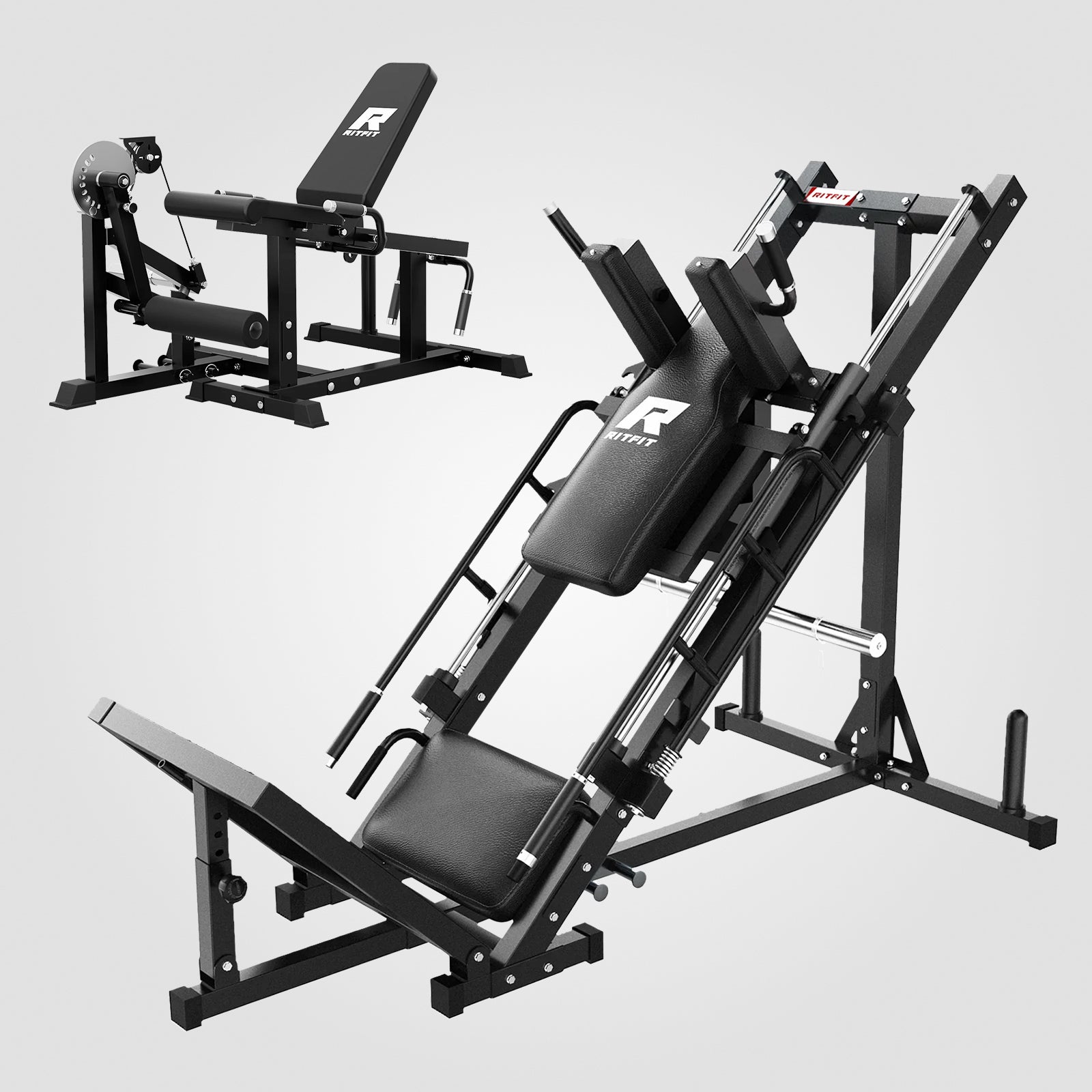
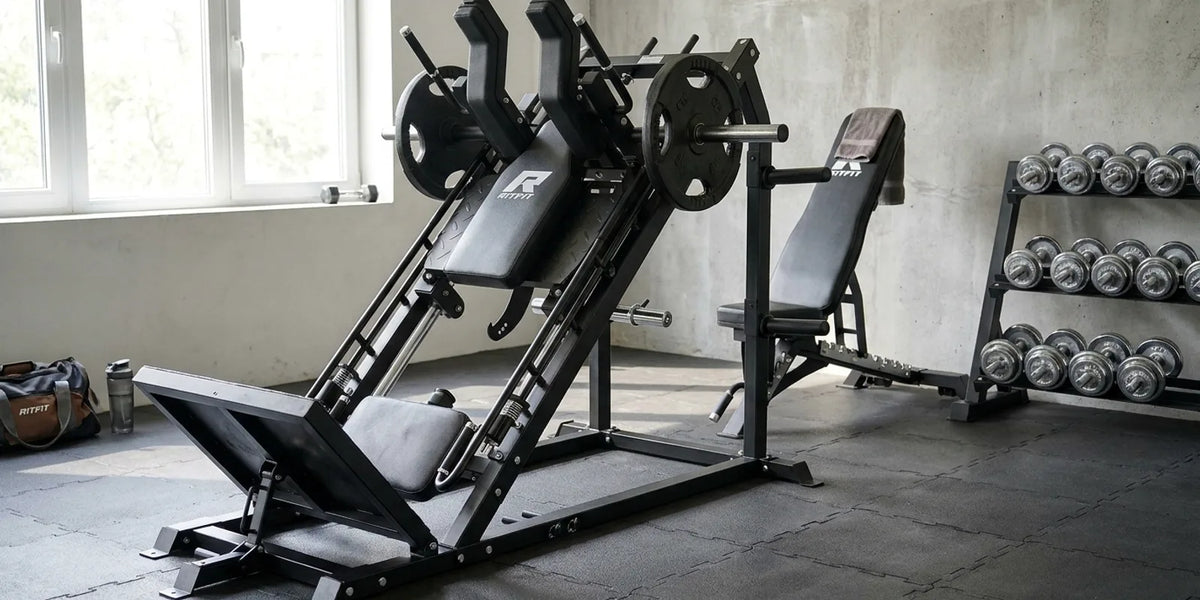
A leg press & hack squat machine runs one heavy sled on guide rails, with a shoulder pad assembly and a foot platform at opposite ends. In leg press mode you sit in the seat and push the platform away from you, and the single-leg press happens entirely in this mode.
A 3-in-1 version, such as the RitFit GAZELLE PRO 3-in-1, adds a calf block so the same sled covers leg press, hack squat, and calf raise. Combo units like the RitFit BLP01 follow the same basic logic: one guided carriage, multiple training modes.
- The guide rails replace the balance demand. On a free single-leg squat most of your attention goes to not falling over. Here the sled travels on a fixed path, so the working leg simply produces force while the rails handle stability.
- The safety stops give you a hard floor. Every combo machine has adjustable safety catches or lockout handles that stop the sled before it reaches your body. With one leg fatigued, that mechanical limit matters more than usual, so set it before you load a single plate.
- The back pad supports your spine. Because your torso is braced against the seat, the single-leg press loads the legs heavily without asking your lower back to balance a barbell.
Two setup details decide whether the rep feels clean or awkward. First, adjust the seat so your working knee travels comfortably, and most people end up somewhere around a right angle at the bottom without the hips lifting off the pad.
Second, decide where the non-working foot goes: on the floor beside the machine, on the frame, or just off the platform edge. It must never touch the platform mid-set, or the set turns back into a two-legged press without you noticing.
If the machine itself is still new to you, walk through the standard setup in our guide to how to use a leg press and hack squat machine before adding the single-leg variation.
Step-by-Step Form
The single-leg press follows eight steps, from setting the safety stops before the first plate to matching reps on the second leg. Set up in leg press mode, keep one foot on the platform and the other completely clear, and control the sled through a slow descent.
- Step 1, set the safeties first. Move the safety stops to a height that catches the sled a little above your deepest comfortable position. Test the catch by lowering the empty sled onto it once.
- Step 2, load conservatively. The working leg handles the entire load, so start with well under what you press with two legs. You can always add weight after the first clean set.
- Step 3, take your seat and foot position. Sit back fully, brace your lower back against the pad, and place one foot in the middle of the platform, roughly hip-width apart, with the whole foot flat. Point the knee in line with the toes, not drifting inward.
- Step 4, park the other leg. Move the non-working foot completely off the platform: on the floor, on the frame, or resting near the platform edge without touching it. This leg stays quiet for the whole set.
- Step 5, unlock the sled. Grasp the side handles, disengage the lockout handles, and let the sled settle onto your working leg. Keep your grip on the handles for the entire set.
- Step 6, lower under control. Inhale and bend the working knee in the direction of the toes, descending slowly over roughly three seconds until you reach your comfortable depth. Stop before the hips curl off the pad or the lower back rounds.
- Step 7, drive back up. Exhale and push through the middle to heel area of the foot until the leg is nearly straight. Stop just short of a hard knee lockout, since the sled, not your joint, should hold the load at the top.
- Step 8, re-rack, then switch. Engage the lockout handles before you relax after the last rep. Set up the opposite leg with the same foot height and depth, and keep the reps matched: if the second leg can only do six after the first did ten, six becomes the target for both sides next session.
Depth, foot height, and tempo should look almost identical left to right, and filming one set per side is the easiest way to confirm they do. If the two-legged press still feels shaky, build the standard movement first in our full leg press guide before adding the single-leg variation.
Muscles Worked
The single-leg press is a knee-dominant push, and the quadriceps and gluteus maximus do most of the work on every rep. A lower foot placement shifts the effort toward the quads, while a higher placement or a deeper descent brings the glutes in harder.
- Quadriceps: straighten the knee on the way up, and a lower foot position on the platform shifts more of the work here.
- Gluteus maximus: extends the hip and contributes more when you use a slightly higher foot placement or a deeper descent.
- Hamstrings and adductors: assist through the hip and help control the descent.
- Calves: contribute when you press through the full foot, and get their own share of work in calf raise mode on a 3-in-1 unit.
- Hip stabilizers: the gluteus medius and its partners work to keep the thigh tracking over the toes instead of collapsing inward.
Compared with a free single-leg squat, the sled reduces the balance component so the prime movers take the load directly. Compared with the two-legged press, each leg does all of the work alone, and the hip stabilizers keep the leg aligned without help from the other side.
Benefits of the Single-Leg Press
The single-leg press exposes and fixes left-to-right strength imbalances that a two-legged press quietly hides. Working one leg at a time makes the gap obvious, trains it directly, and keeps the spine out of the heavy-loading equation.
- It exposes and fixes left-to-right imbalances. In a two-legged press, the stronger leg quietly covers for the weaker one. One leg at a time removes that cover and trains the gap head-on.
- Unilateral strength is its own skill. Strength adapts to how you train it, so one-leg work builds what two-legged pressing cannot.
- It trains the lateral hip. Keeping the knee aligned over the toes on every rep challenges the hip abductors and external rotators more than a two-legged press does.
- It keeps the spine out of the equation. Because the back is supported by the pad, you can push one leg hard without loading the lower back the way a barbell lunge or split squat would. That matters in a home gym where a combo machine is often the only lower-body station.
- It may help the other leg too. Research on cross-education suggests unilateral training can produce some strength transfer to the untrained side, a nice bonus while the weaker leg catches up.
- It is time-efficient. One leg rests while the other works, so you can alternate sides with little downtime.
"Single-leg training will promote greater muscle growth and greater muscle strength because it works more muscles. Single-leg strength is specific and cannot be developed through double-leg exercises."
Mike Boyle, Strength Coach, quoted in ACE Certified, The Benefits of Unilateral Training, May 2020, from Advances in Functional Training (2010)
Common Mistakes and Safety
Most single-leg press mistakes come from loading the movement like a two-legged press or letting the free leg help. Keep the load lighter than expected, keep the non-working foot clear of the sled, and the set stays controlled.
- Loading it like a two-legged press. The single-leg press needs less weight than you think. If the sled stalls halfway up or the knee collapses, the set is too heavy, so strip weight and rebuild.
- Letting the free leg help. The non-working foot pushes off the floor or hooks the platform edge, quietly turning the set back into a standard press. Keep it entirely clear of the sled.
- Knee caving inward. Track the knee in line with the toes through the whole range. If it drops inward at the bottom, reduce the load or shorten the depth.
- Bouncing at the bottom. The lowest position is where the joint is most compressed. Pause briefly and drive out of the bottom under control instead of rebounding off the stops.
- Locking the knee hard at the top. Finish with the leg nearly straight instead of snapping into a forceful lockout while the sled still loads the joint.
- Ignoring the safety stops. The stops are the reason a solo home-gym lifter can train this movement confidently. Set them every session, and use the lockout handles whenever you rack or unrack.
- Different depth per side. Match the range of motion left to right. If the weaker side cannot reach the same depth, lighten the load instead of cutting the rep short on one side only.
- Holding your breath through the whole set. Inhale on the way down and exhale as you push. Keep a light brace through the midsection while your back stays glued to the pad.
Programming (Sets, Reps, Frequency)
The single-leg press works as a main strength movement or as an accessory after two-legged work, and three to four sets per leg covers both goals. Train each leg once or twice per week, and start every set with the weaker side.
- Strength focus: 3-4 sets of 6-8 reps per leg, with a load that leaves 1-2 reps in reserve.
- Hypertrophy focus: 3-4 sets of 8-12 reps per leg, controlled on the descent.
- Frequency: once or twice per week per leg, with at least a couple of days between hard sessions.
- Order: always start each set with the weaker leg, and cap the stronger side at the same rep count.
- Progression: add a small amount of weight once you hit the top of the rep range on both legs with matched depth and clean form.
If you are unsure what light enough means on this machine, start from our guide to what counts as a good leg press weight. Then account for the sled itself with our breakdown of how much weight is already on a leg press machine before you add plates.
Does the RitFit Gazelle Pro 3-in-1 Work for Single-Leg Press?
The RitFit GAZELLE PRO 3-in-1 works well for the single-leg press because its guided sled, adjustable safety stops, and padded seat cover every requirement the variation has. One unit handles leg press, hack squat, and calf raise, so single-leg work slots into a full lower-body session on the same machine.
If you are still deciding which unit fits your space, our buying guide to the best 3-in-1 leg press and hack squat machine for a home gym walks through the format in detail, and the leg press machine collection shows the full lineup.
"Whether it is leg presses, hack squats, or calf raises, this machine handles them all perfectly. It is truly a versatile piece of equipment for building a professional grade home gym!"
Michael Johnson, Verified Buyer, RitFit GAZELLE PRO 3-In-1 Leg Press and Hack Squat Machine
FAQs About the Single-Leg Press
Can you really do a single-leg press on a leg press & hack squat machine?
Yes. Switch the machine to leg press mode, set the safety stops, and run the sled with one foot on the platform and the other foot completely off it. The guided rails make the path more stable than a free single-leg squat, which is exactly why the combo format suits this variation. If the machine itself is still new to you, master the two-legged setup first and add the single-leg version once the seat, sled, and safeties feel routine.
How much weight should I use for a single-leg press?
Start well below your two-legged working weight, since the working leg takes the entire load on its own. Pick a weight you can press for 8-10 controlled reps with the knee tracking over the toes and the hips staying on the pad, then build from there. Remember the sled itself already carries some load, and the two resources linked in the programming section explain how to account for it.
Is the single-leg press harder than the regular leg press?
Per leg, yes. Each leg does all of the work instead of splitting it, and most lifters find they use noticeably less total weight with the weaker side failing first. That gap between sides is the main reason people include the movement.
Should I do both legs in the same session?
Generally, yes. Train the weaker leg first, match the rep count on the stronger leg, and keep the setup identical on both sides so the comparison stays meaningful. Foot height, depth, and tempo should match left to right before load goes up on either side.
Single-leg press in leg press mode or hack squat mode?
Leg press mode is the practical choice, since the seated position lets you place one foot on the platform while the other stays clear and the safety stops protect the bottom of the rep. Single-leg work in hack squat mode is possible for experienced lifters but demands far more balance, so it is not the usual starting point for this variation.
Is the single-leg press safe for beginners?
The single-leg press is one of the more beginner-friendly single-leg movements, because the sled path and safety stops remove the balance and spinal-load problems of free single-leg exercises. Start light, set the stops conservatively, and treat clean reps rather than heavy plates as the goal.
Conclusion
The leg press & hack squat combo machine is a natural home for the single-leg press, giving you a guided sled, hard safety stops, and a padded seat that keeps the load on the legs. Park one foot in the middle of the platform and the other completely off it, lower under control, and drive up just short of a hard lockout.
Start lighter than your two-legged numbers, match reps and depth on both sides, and this becomes a simple weekly tool for closing strength gaps. Check the RitFit discount guide before you add equipment to the home gym.
Disclaimer
This article provides general training guidance and is not medical advice. If a movement causes sharp or unusual pain, stop and consult a qualified professional before continuing.