








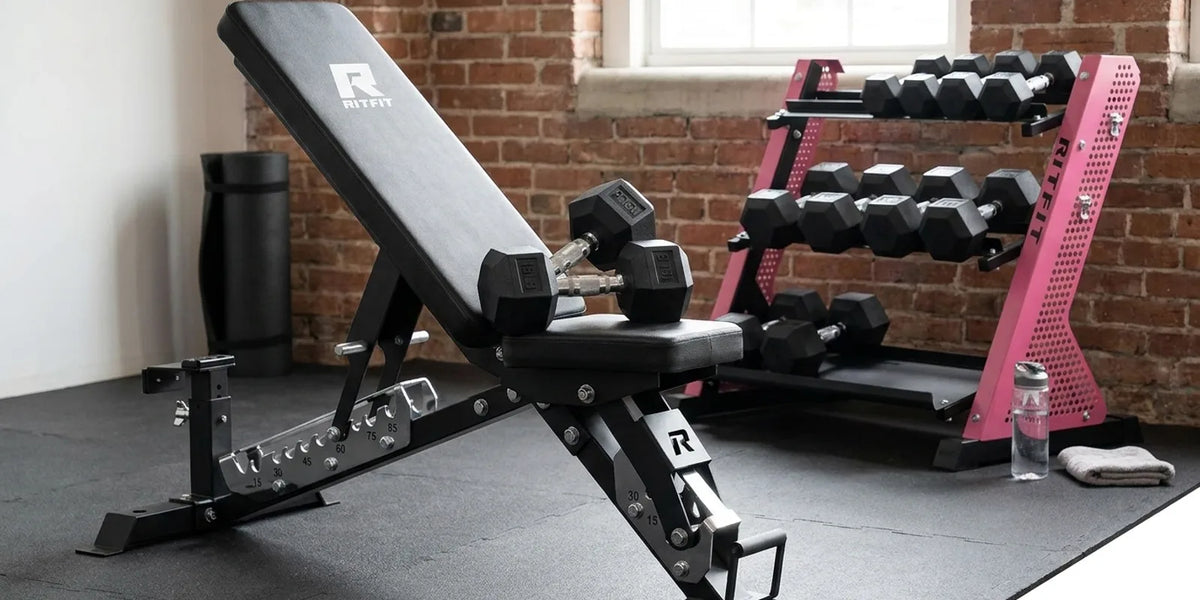
The Tate press on a weight bench is done by lying flat, pressing two dumbbells together over your chest, and lowering them to your sternum with the elbows flared out. Extend your elbows back to lockout under control.
This guide covers bench setup, the elbow path, load selection, skull crusher differences, and common mistakes. Stop any set that causes sharp elbow or shoulder pain.
Quick Answer: The Tate press on a weight bench is a triceps isolation exercise that lowers two pressed-together dumbbells to your sternum with the elbows flared out. Lie flat with your feet planted and keep the load light, because a strict elbow path matters more than heavy dumbbells.
Key Takeaways
- Elbow Path: The Tate press lowers two pressed-together dumbbells to the chest with the elbows flared out, and only the elbow joint moves.
- Triceps Focus: The flared-elbow lying position keeps the load on the triceps and treats the elbows more gently than skull crushers.
- Load Selection: Start with dumbbells you would curl rather than press, then add 2 to 5 pounds per hand only when every rep stays clean.
- Bench Setup: A flat locked bench with both feet planted gives the strict platform this short-range movement needs.
- Programming: Run the movement after your main press for 3 sets of 8 to 12 reps, once or twice a week.
Understand How the Tate Press Trains Your Triceps
The Tate press is a triceps isolation exercise that trains elbow extension while the upper arms stay vertical and the elbows point out to the sides. Elite powerlifter Dave Tate designed the movement to build bench press lockout strength, and one exercise guide notes it puts less strain on the elbows than most triceps isolation moves.
- Primary target: The triceps brachii does the work through elbow extension, with the lateral and medial heads taking most of the load in the flared position.
- Shoulder angle matters: A 2018 study using musculoskeletal modeling found that at 90 degrees of shoulder elevation the medial head generates significantly more muscle force than the long and lateral heads, while at 0 degrees elevation the long head leads.[1]
- Stabilizers: The front delts, chest, and core brace the torso while the two dumbbells travel as one unit.
- Who it fits: Home gym lifters who want triceps volume without cranky elbows, and lifters chasing a stronger lockout on the bench press.
The short range of motion is normal for this movement, and the strict elbow path is what makes the short range work.
Set Up Your Flat Bench and Starting Position
The Tate press starts on a flat locked bench with both feet planted and two dumbbells pressed together over your chest. Set your shoulder blades back and down, keep your wrists straight, and point your elbows out to the sides instead of tucking them.
Can You Do the Tate Press on an Adjustable Bench Like the RitFit GATOR?
Yes, as long as the bench locks flat and holds your body weight plus the dumbbells. The RitFit GATOR adjustable weight bench lists 10 backrest angles from 0 to 85 degrees including flat, a 1600 lb total load capacity covering body weight and added weights, and 70 mm recycled foam padding for a firm base.
- Lock everything: Set the back pad flat, confirm the pin is seated, and test the bench with body weight before you load dumbbells.
- Foot position: Plant both feet flat on the floor so the torso stays put while the arms move.
- Starting load: Pick a pair of dumbbells you would curl rather than press, and keep them pressed together from the first rep.
If your bench wobbles or the pad feels soft under load, fix that before adding reps. A lower-cost flat-capable option is the RitFit 1300LB Adjustable Weight Bench, and more frame choices live in the full weight bench collection.
"Built with 14-gauge steel, the RitFit Gator Adjustable Weight Bench offers a robust weight capacity of 1,600 pounds. With 10 back pad angles, three seat pad positions, three decline settings, and a five-way adjustable head rest, you have ample options to support your strength and muscle building goals."
Stephen Sheehan, CPT, CNC, Certified Personal Trainer and Nutritionist at Garage Gym Reviews, RitFit Gator Adjustable Weight Bench Review
"This bench is great and sturdy and does everything I need out of it for me and my son. I really like the arm rest especially for my son while he is learning and starting out in working out I think it's great that this product has something that can help with his form. It moves and adjust easily and very simple any one can do it. I use this in a limited space so I am moving it around to store it so bigger wheels would have been nice but It's also not a make or break. It still moves around great I just need to adjust the angle a bit. Over all great product and it's definitely worth the money to add to my home gym."
Rey O. Verified Buyer, RitFit GATOR 1600LB Adjustable Weight Bench
Perform the Tate Press Step by Step
Each Tate press rep lowers the pressed-together dumbbells to your sternum with the elbows flared out, then extends the elbows back to lockout. Move only at the elbow and keep the upper arms vertical for the whole set.
- Step 1: Lie back on the flat bench and press the dumbbells over your chest with your palms facing forward and the inner ends of the dumbbells touching.
- Step 2: Point the elbows out to the sides, keeping the upper arms vertical and the wrists straight.
- Step 3: Bend the elbows and lower the dumbbells in a straight line toward the middle of your chest while keeping them pressed together.
- Step 4: Stop when the dumbbells touch your chest with the forearms flat and the elbows wide, then pause for a second.
- Step 5: Extend the elbows and press the dumbbells back along the same path, then squeeze the triceps at the top before the next rep.
Any pair of dumbbells you can press together comfortably works, so match the load to your elbows rather than to your bench press numbers.
What Is the Correct Elbow Trajectory and Range of Motion?
Keep squeezing the inner ends together, because inward pressure is what holds the path steady, and lower the dumbbells slowly since they drift apart the moment control slips. If the full range feels cranky on the elbows, stop an inch short of the chest and build control over a few sessions.
Compare the Tate Press With Skull Crushers and Close-Grip Bench Press
The Tate press, the skull crusher, and the close-grip bench press all train the triceps with different elbow paths and different loads. The elbow position decides how a movement feels and which variation fits your joints.
| Movement | Elbow path | What it emphasizes |
|---|---|---|
| Tate press | Elbows flared out, dumbbells lower to the chest | Triceps isolation with light loads and less elbow strain |
| Skull crusher | Elbows point up, weight lowers toward the forehead | Triceps isolation with a longer stretch and more elbow stress |
| Close-grip bench press | Elbows tucked, bar or dumbbells press from the chest | Compound triceps, chest, and shoulder strength with heavier loads |
Movement descriptions follow standard coaching guides, including the Tate press guide from Generation Iron.
Choose the Tate press when your elbows complain about skull crushers, and treat it as the stricter, lighter option in a triceps rotation. Our guides to skull crushers for bigger arms and the close-grip bench press for big triceps break down both alternatives in detail.
- Swap option: If two dumbbells will not cooperate, a band pushdown keeps the same one-joint idea with an easier joint angle.
- Regression: The single-arm Tate press exposes the weaker side and cuts the working load in half.
- Heavier cousin: The hex press on a weight bench is the pressing variation when you want to load the pattern more aggressively.
Choose the Right Weight and Progress Carefully
The Tate press needs lighter dumbbells than pressing exercises because the long moment arm makes even modest loads feel heavy. One training guide suggests starting with a pair you would curl rather than press.
Load selection follows the leverage of the movement. The dumbbells sit far from the elbow joint, so the triceps must produce a large torque to extend the elbows through the bottom inches of each rep.
- Starting point: Choose dumbbells you would curl for a set of 10, then own the elbow path before adding anything.
- Rep range: Work 8 to 12 reps per set with about a minute of rest, since the range of motion is short and the tension stays on the triceps.
- When to add weight: Go up by 2 to 5 pounds per hand only when every rep keeps the dumbbells touching through the full path.
- When to add a set instead: If the elbows ache, hold the weight steady and add volume gradually before chasing load.
- Pause progression: Add a one-second pause on the chest before pressing up to make each rep harder without heavier dumbbells.
Partial range of motion work can still produce measurable training results. In one randomized controlled trial, 30 recreational basketball players significantly improved three-point shooting accuracy after 4 weeks of partial-range and full-range triceps training.[2]
The partial-range group also showed the most promising group-by-time effect in that trial.
That step-by-step pattern is the progressive overload route for this movement, and heavier pairs are ready in the weights collection when the jump is due.
"The size of the external flexor moment you have to overcome to lift a weight depends on two things: the load itself and the length of the moment arm. This is why lifting heavier weights is harder than lifting lighter weights."
Greg Nuckols, MA, Strength Researcher and Coach at Stronger By Science, How to Bench
Avoid These Common Tate Press Mistakes
Most Tate press mistakes come from loading the movement like a press or letting the dumbbells drift apart. Both errors move the work away from the triceps and toward the shoulders.
- Loading it like a press: The leverage is poor, so a bench press weight makes the movement impossible to control. Start light and earn the load.
- Letting the dumbbells separate: Once they drift apart the shoulders take over and the path collapses. Squeeze the inner ends together from start to finish.
- Turning it into a skull crusher: Dropping the elbows back behind you changes the exercise and the muscles it loads. Keep the elbows flared and pointing out.
- Bouncing off the chest: A rebound skips the hardest inches of the press and jars the elbows. Touch softly and pause for a second.
- Rushing the descent: Control is the whole point of a short-range movement. Lower slowly and end the set when the path breaks down.
If form keeps breaking past the last clean rep, end the set there, because sloppy extra reps teach the wrong pattern.
Program the Tate Press Into Your Week and Know When to Stop
The Tate press fits best after your main pressing work for 3 sets of 8 to 12 reps, once or twice a week. Rest about a minute between sets, and pair it with an overhead extension when you want long head work in the same session.
- Frequency: One or two sessions a week is enough for most home gym lifters, especially inside a bench press block where lockout strength is the goal.
- What progress feels like: In one lab study, 19 young nonathletes completed 10 weeks of triceps training, and endurance strength increased by 57% while the fatigue rate fell by 68%.[3] Fatigability gains plateaued after about 4 weeks.
- When to stop: End the set at sharp elbow or shoulder pain, and switch to a pain-free variation like a band pushdown instead of pushing through joint pain.
- When to get help: If pain lingers after a session or wakes you at night, pause the movement and talk with a qualified healthcare professional before returning to it.
For a stronger bench foundation under the accessory work, review the best bench press form guide before your next heavy day.
For readers building out the rest of a home gym, here is a third-party review of another RitFit machine.
FAQs About the Tate Press on a Weight Bench
What muscles does the Tate press work?
The Tate press is a triceps isolation exercise that trains elbow extension with the upper arms held vertical and the elbows flared out. A 2018 modeling study found the medial head of the triceps produces more muscle force when the shoulder sits around 90 degrees of elevation, which is the arm position used on a flat bench.
How much weight should you use for a Tate press?
Start far lighter than your pressing numbers because the leverage is poor and the load travels a long way from the elbow joint. One training guide recommends beginning with dumbbells you would curl rather than press, then adding 2 to 5 pounds per hand only when every rep keeps the dumbbells pressed together.
What is the difference between a Tate press and a skull crusher?
Both are lying triceps isolation moves, but the elbow path changes the stress. In a skull crusher the elbows point at the ceiling and the weight lowers toward your forehead, while in a Tate press the elbows flare out and the dumbbells lower to your chest. One exercise guide notes the Tate press places less stress on the elbows.
Can you do a Tate press on an adjustable weight bench?
Yes. Set the bench flat and lock every adjustment before you lie down. The RitFit GATOR for example locks 10 backrest angles from 0 to 85 degrees including flat, and its 1600 pound total load capacity covers body weight plus dumbbells, so it handles the movement comfortably.
How often should you do the Tate press?
Once or twice a week is enough for most home gym lifters, programmed after your main pressing work for around 3 sets of 8 to 12 reps with about a minute of rest between sets. Add a second weekly session only when your elbows feel fresh session after session.
Why is the Tate press so hard with light dumbbells?
The dumbbells sit far from the elbow joint, so the moment arm is long and the triceps must produce a large torque to extend the elbows. As one strength coach explains, how hard a lift feels depends on the load and the length of the moment arm, which is why light dumbbells feel heavy.
What are the most common Tate press mistakes?
The usual errors are loading it like a press, letting the dumbbells drift apart, turning it into a skull crusher by dropping the elbows back, bouncing the dumbbells off the chest, and rushing the descent. Keep the dumbbells pressed together, move only at the elbows, and lower slowly under control.
Conclusion
The Tate press on a weight bench is a simple triceps finisher that pays off when you keep the load light, the dumbbells together, and the elbows flared. Run it after your main press for 8 to 12 clean reps and add weight only when every rep stays strict.
If you are new to the movement, start with the lightest pair you own and master the elbow path before chasing load. When you are ready to upgrade your bench or dumbbells, check the current offers in the RitFit discount guide.
Disclaimer
This article provides general training information and is not medical advice, diagnosis, or treatment for pain or injury. Consult a qualified healthcare professional or certified coach before starting a new exercise program, especially with a history of elbow or shoulder problems.
References
1. Kholinne E, Zulkarnain RF, Sun YC, et al. The different role of each head of the triceps brachii muscle in elbow extension. Acta Orthop Traumatol Turc. 2018;52(3):201-205. doi:10.1016/j.aott.2018.02.005. PMCID: PMC6136322.
2. Mir IA, Mohd Jamali MNZ, Humayra S, et al. Partial versus full range of motion triceps strength training on shooting accuracy among recreational basketball players: a randomized controlled trial. BMC Sports Sci Med Rehabil. 2025;17(1):41. doi:10.1186/s13102-025-01060-2. PMCID: PMC11884187.
3. Gacesa JZ, Klasnja AV, Grujic NG. Changes in strength, endurance, and fatigue during a resistance-training program for the triceps brachii muscle. J Athl Train. 2013;48(6):804-809. doi:10.4085/1062-6050-48.4.16. PMCID: PMC3867092.





