








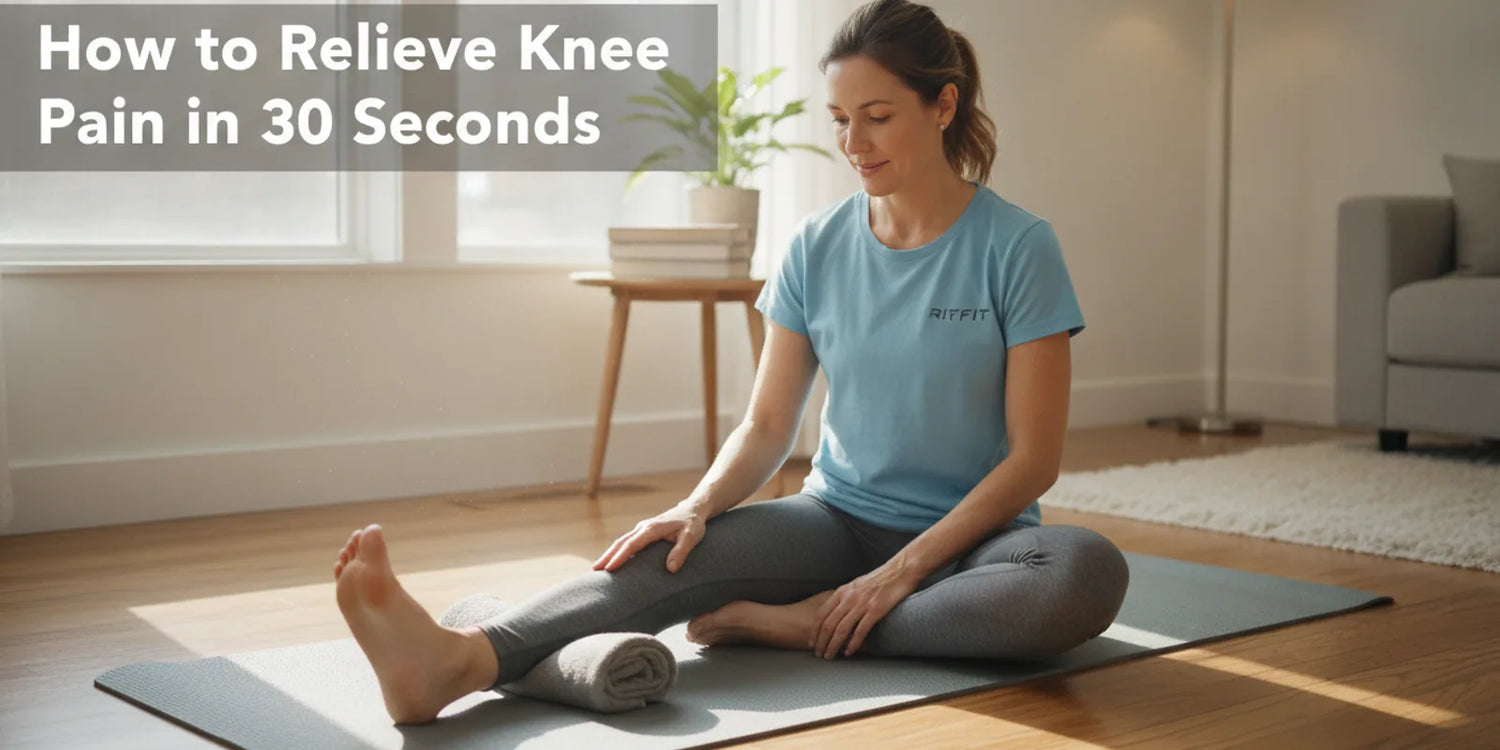
If your knee is aching right now from sitting too long, mild overuse, or tight leg muscles, a single 30-second move really can take the edge off. This guide gives you five specific moves and shows exactly how to do each one.
These are general activity tips for minor everyday knee aches, not a fix for injuries. We also flag clear signs that mean you should stop and see a doctor instead.
Table of Contents
- Can You Really Relieve Knee Pain in 30 Seconds?
- The Fastest 30-Second Move: The Isometric Quad Set
- 4 More 30-Second Moves to Calm an Achy Knee
- Why Do Tight Quads and Hamstrings Make Your Knees Hurt?
- How Long Should You Hold a Stretch or Contraction?
- What Builds Lasting Knee Comfort Beyond 30 Seconds?
- What Common Mistakes Make Knee Pain Worse?
- How Do the Experts Approach Knee Pain?
- When Should You Stop and See a Doctor?
Key Takeaways
- 30 seconds soothes, it does not cure: A quick isometric hold or stretch can calm everyday knee aches in the moment, but lasting relief comes from consistency.
- The quad set is the fastest move: Tighten your thigh to gently press the back of your knee down, hold 30 seconds, and you activate the muscle that stabilizes the kneecap without bending the joint.
- Tight muscles are a hidden cause: Tight quads and hamstrings pull on the kneecap and shift stress onto the joint, so stretching often eases pain at its source.
- Hold each stretch at least 30 seconds: Harvard Health and NHS guidance suggest 20 to 60 second holds, repeated a few times daily, never pushing into sharp pain.
- Know when to stop: Pain after an injury, lasting more than a few days, or with swelling, locking, or instability needs a doctor, not a stretch.
Can You Really Relieve Knee Pain in 30 Seconds?
Yes, for everyday aches from stiffness, tight muscles, or mild overuse, a 30-second isometric hold or gentle stretch can noticeably reduce discomfort in the moment by easing muscle tension and improving blood flow. It is genuine short-term relief, not a permanent cure.
- What 30 seconds can do: Loosen a tight muscle, calm a minor flare-up, and let you move more comfortably for a while.
- What it cannot do: Heal a torn ligament, reverse arthritis, or fix an injury that needs medical attention.
A 5-week randomized controlled study of 42 people with knee osteoarthritis found that isometric quadriceps exercise significantly reduced pain and improved function, and the authors noted isometric work causes the least joint inflammation and is safe to do at home with no equipment.[1]
The Fastest 30-Second Move: The Isometric Quad Set
The isometric quad set is the single fastest reliable move for an aching knee because it activates the quadriceps that stabilize your kneecap without bending or loading the joint. That makes it comfortable even when bending the knee hurts.
It needs no equipment and can be done seated or lying down, which is why it is a staple of at-home knee care.
- Step 1: Sit or lie with your sore leg straight out in front of you.
- Step 2: Tighten your thigh muscle to gently press the back of your knee down toward the floor.
- Step 3: Hold the contraction at a comfortable effort for 30 seconds, breathing normally, then relax.
Keep the effort gentle, around half of your maximum, so you feel the thigh working without any sharp pain.
4 More 30-Second Moves to Calm an Achy Knee
Four more 30-second moves can calm an achy knee: a seated knee extension hold, a standing quad stretch, a standing hamstring stretch, and a calf stretch against a wall. Each targets a muscle group that influences how your kneecap tracks and how much stress lands on the joint.
Pick the variations that feel comfortable for your mobility level and stop any move that creates sharp pain.
Seated Knee Extension Hold
Sit tall in a chair, slowly straighten one leg until it is level, hold for 30 seconds while tightening the thigh, then lower with control.
Standing Quad Stretch
Hold a wall or chair, bend one knee, and gently draw your heel toward your buttock until you feel a stretch in the front of the thigh, holding 30 seconds.
Standing Hamstring Stretch
Place one heel on a low step with the leg straight, hinge forward from the hips with a flat back until you feel a stretch behind the thigh, and hold 30 seconds.
Calf Stretch Against a Wall
Face a wall, step one foot back with the heel down and knee straight, lean in until you feel a calf stretch, and hold for 30 seconds per side.
Why Do Tight Quads and Hamstrings Make Your Knees Hurt?
Tight quads and hamstrings make knees hurt because they change how force travels through the joint. According to Harvard Health, tight quadriceps pull too hard on the tendon at the kneecap, which can cause inflammation and a sore knee.
- Quad tension: Overly tight thigh muscles increase pressure on the kneecap and its tendon.
- Poor tracking: Weak or tight hip and leg muscles can stop the kneecap from gliding smoothly on its groove.
- Shared load: Because the muscles around the knee work as a team, imbalance shifts extra stress onto the joint.
This is why loosening and later strengthening these muscles often relieves pain closer to its real source rather than just masking it.
How Long Should You Hold a Stretch or Contraction?
You should hold each static stretch for at least 30 seconds, according to Harvard Health, and repeat it two to three times. The hold time, not heavy effort, is the dose that matters for easing tension around the knee.
- Stretch holds: NHS guidance suggests 20 to 30 seconds, while HSS physical therapists often use 30 to 60 second holds, repeated 2 to 3 times.
- Effort level: For an isometric quad set, work at a gentle to moderate contraction, never a maximal strain.
- Frequency: Do small amounts daily or several times a day rather than one long session.
You should feel a gentle stretch, never sharp pain, and consistency over a few weeks is what improves flexibility.
What Builds Lasting Knee Comfort Beyond 30 Seconds?
Lasting knee comfort comes from consistently strengthening the muscles that support the joint, especially the quadriceps. Quick moves calm symptoms in the moment, but steady strengthening is what reduces how often your knee aches in the first place.
An 8-week controlled study of knee osteoarthritis patients found that isometric quadriceps exercise significantly increased quadriceps strength and significantly reduced pain compared with no exercise.[2]
- Start with isometrics: Daily quad sets and seated holds build strength with minimal joint stress.
- Progress gradually: Once you are pain free, add gentle leg strengthening such as supported squats or work on a RitFit PLC01 Leg Extension Curl Machine to load the quads and hamstrings.
- Stay consistent: Aim for strengthening 2 to 3 times per week, not just during a flare-up.
A randomized controlled trial of knee osteoarthritis patients similarly confirmed that isometric quadriceps strengthening improves both pain and function over time.[3] For a fuller routine, see our guide to the 5 Best Home Exercises For Knee Pain Relief And Stronger Joints.
What Common Mistakes Make Knee Pain Worse?
The most common mistakes that make knee pain worse are pushing a stretch into sharp pain, bouncing instead of holding, and ignoring warning signs. Gentle, controlled movement helps, while forcing a painful range can aggravate the joint.
- Stretching into pain: You should feel a gentle pull, not a sharp or pinching sensation, so ease off if it hurts.
- Bouncing the stretch: Hold each position still rather than bobbing, which can strain the muscle.
- Sitting too long: Sitting beyond about 60 minutes can stiffen the hips and knees, so take regular movement breaks.
- Skipping support: For activity that aggravates the joint, options like a knee sleeve can add comfort, as covered in our look at The Advantages Of Knee Sleeves And When To Wear Them and Patellar Straps For Knee Issues.
If a move consistently increases your pain, stop it and consider whether the cause needs professional assessment, similar to managing other joints as in our piece on Weight Lifting For Lower Back Pain.
How Do the Experts Approach Knee Pain?
Experts emphasize not abandoning movement but choosing smarter exercises that load the knee without aggravating it. Physical therapists routinely use isometric holds, supported squats, and targeted stretching to keep people active while their knees settle.
This balanced approach is echoed by physical therapist and strength coach Jeff Cavaliere, who stresses training around pain rather than stopping entirely.
"The key is to NOT ABANDON strengthening the knees through exercise, but making sure to do so SMARTLY by choosing the right exercises."
Jeff Cavaliere, MSPT, CSCS, Physical Therapist and Strength Coach, Athlean-X
The short tutorial below walks through simple knee-friendly exercises you can try at home.
For active readers, related support gear is covered in Weightlifting Knee Wraps How When And Why and our broader look at Knee Braces Help Prevent And Treat Injuries.
When Should You Stop and See a Doctor?
You should stop and see a doctor if your knee pain follows an injury, lasts more than a few days, or comes with swelling, locking, or your knee giving way. According to an orthopedic surgeon at Houston Methodist, while most knee pain can be self-managed at home, some pain results from serious injury needing professional evaluation.
- See a provider if: Pain follows a fall or twist, persists beyond a few days, or you cannot bear weight.
- Warning signs: Significant swelling, the knee locking or buckling, or sharp pain that worsens with movement.
- Set up your space: A comfortable surface like a RitFit Non-Slip Yoga Mat makes floor-based quad sets and stretches easier on the joints.
For more recovery and support options, browse RitFit Fitness Accessories or Shop All RitFit Equipment, and explore related work in our roundup of Exercises For Strength Stability And Pain Relief.
FAQs About Relieving Knee Pain in 30 Seconds
Can you really relieve knee pain in 30 seconds?
For everyday aches from stiffness, tight muscles, or mild overuse, a 30-second isometric quad set or gentle stretch can noticeably calm discomfort in the moment by improving blood flow and easing muscle tension. It is real short-term relief, not a cure. Sharp, swelling, locking, or injury-related pain will not resolve in 30 seconds and needs proper evaluation.
What is the fastest single move to ease an aching knee?
The isometric quad set is the quickest reliable option. Sit or lie with your leg straight, tighten your thigh muscle to press the back of your knee down, hold for 30 seconds at a gentle effort, then relax. It activates the quadriceps that stabilize the kneecap without bending or loading the joint, so it is comfortable even when bending hurts.
How long should I hold a stretch for knee pain relief?
Hold each static stretch for at least 30 seconds, according to Harvard Health, and repeat two to three times. NHS guidance suggests 20 to 30 seconds per hold. You should feel a gentle stretch, never sharp pain. Do these stretches daily in small amounts to gradually improve flexibility around the knee over a few weeks.
Why do my knees hurt when my quads and hamstrings are tight?
Tight quadriceps pull harder on the tendon at your kneecap, which can inflame it and cause soreness, while tight hamstrings and weak hip muscles let the kneecap track poorly. Because the muscles around the knee work together, tightness shifts stress onto the joint, so loosening and strengthening them often relieves the pain at its source.
When should I see a doctor instead of stretching?
See a healthcare provider if your knee pain follows an injury, lasts more than a few days, or comes with significant swelling, locking, giving way, or an inability to bear weight. Stop any stretch that causes sharp pain. These quick moves are general guidance for minor everyday aches, not a substitute for medical diagnosis or treatment.
Conclusion
For minor everyday knee aches, a 30-second isometric quad set or gentle stretch is a genuine way to take the edge off in the moment. Start with the quad set, then add the stretches that feel comfortable.
Build real, lasting relief by strengthening the supporting muscles a few times a week, and always stop and see a doctor if pain follows an injury, lingers, or comes with swelling or instability.
Disclaimer
This article offers general activity and wellness information for minor everyday knee discomfort and is not medical advice, diagnosis, or treatment. Consult a qualified healthcare professional before starting any new exercise, especially for pain that follows an injury, persists, or worsens.
References
1. Anwer S, Alghadir A. Effect of isometric quadriceps exercise on muscle strength, pain, and function in patients with knee osteoarthritis: a randomized controlled study. Journal of Physical Therapy Science. 2014;26(5):745-748. https://pmc.ncbi.nlm.nih.gov/articles/PMC4047243/
2. Choi YL, Kim BK, Hwang YP, Moon OK, Choi WS. Effects of isometric exercise using biofeedback on maximum voluntary isometric contraction, pain, and muscle thickness in patients with knee osteoarthritis. Journal of Physical Therapy Science. 2015;27(1):149-153. https://pmc.ncbi.nlm.nih.gov/articles/PMC4305548/
3. Sengul A, Yavuzer MG, Keles O, Tunali AN, Tuncer D. Isometric Quadriceps Exercises for Patients with Knee Osteoarthritis: A Randomized Controlled Trial Comparing Knee Joint Position Flexion versus Extension. Rehabilitation Research and Practice. 2022;2022:2690871. https://pmc.ncbi.nlm.nih.gov/articles/PMC9427309/





