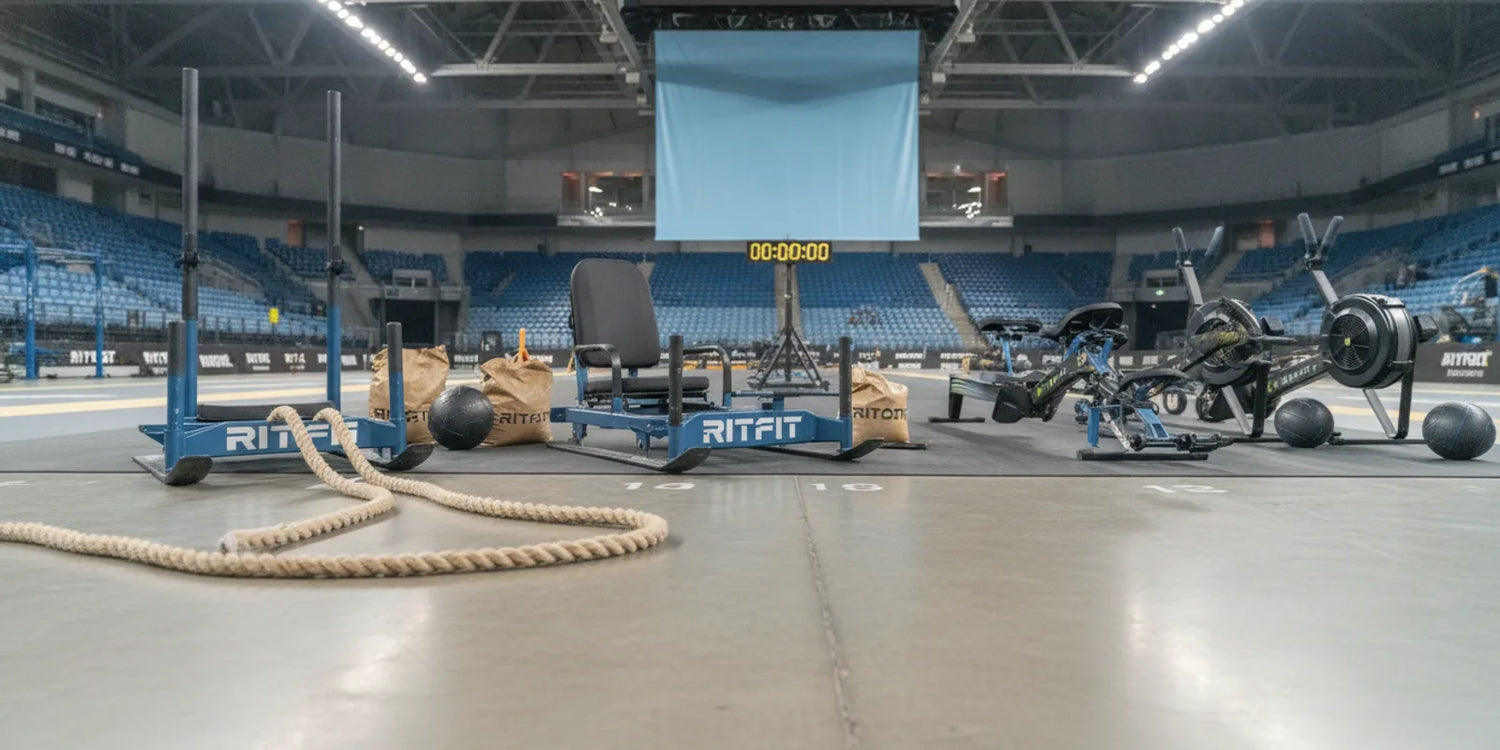
HYROX is the global fitness race that pairs eight functional workout stations with eight kilometers of running. Most athletes race the standard Open category, but HYROX also runs a dedicated Adaptive category for athletes with permanent physical, neurological, or sensory impairments.
This guide explains how HYROX Adaptive and Open categories work, from the official divisions and classification process to race-day rule changes. You will learn which category fits, what stays the same, and how to register.
Quick Answer: HYROX Adaptive is an inclusive race category for athletes with permanent physical, neurological, or sensory impairments. The race keeps the same eight-station format and the 8 km running course, adapting weights, repetitions, distances and movement standards to each athlete's official division.
Key Takeaways
- Inclusive format: HYROX Adaptive lets athletes with permanent physical, neurological, or sensory impairments race the same eight-station, eight-kilometer format as everyone else.
- Six main divisions: The rulebook groups adaptive athletes into lower limb, upper limb, short stature, visual or hearing, neurological, and seated divisions.
- Classification first: Athletes must complete official classification before racing, and adaptive divisions are only for permanent impairments.
- Adjusted standards: Weights, repetitions, and distances change by division, while some athletes run a shorter lap between stations.
- Solo or guided: Adaptive athletes can race alone or with a guide runner, and visual or hearing-impaired athletes use guides for navigation.
What Are the HYROX Adaptive Categories?
HYROX Adaptive is the inclusive race category designed for athletes with permanent physical, neurological, or sensory impairments. The race structure stays close to the standard format so every athlete gets the same challenge with fair adjustments.
- Solo or assisted: Athletes may race individually or with a guide or assistant, depending on their division and needs.
- Official standards: Weights, repetitions, distances, and movement standards follow the official HYROX Adaptive Rulebook for each division.
- Separate from Open: The Adaptive category is distinct from the standard Open division, which uses fixed standards for every athlete.
If you are new to the series, our guide to What Is HYROX Fitness Race covers the race format and the eight workout stations in detail.
What Is the HYROX Open Category and How Is It Different?
The Open category is HYROX's standard race, with fixed weights, repetitions, and distances that every athlete follows. Adaptive categories use the same stations and running format, but the rulebook adjusts standards to each athlete's classification.
- Fixed distances: Open athletes run or push a full kilometer between each of the eight stations for a total of 8 km.
- Adaptive adjustments: Some adaptive divisions use shorter laps, and station loads and repetitions vary by division.
- Shared structure: Both categories run men's and women's divisions plus standard age groups, and athletes start in gender-based waves.
The practical difference on race day comes down to the numbers printed next to each station, not the layout of the course itself.
What Are the Official HYROX Adaptive Divisions?
The HYROX Adaptive rulebook lists six main divisions: lower limb, upper limb, short stature, visual or hearing, neurological, and seated impairment. Neurological and seated divisions split into further sub-divisions, which gives up to 13 in total.
Lower Limb, Upper Limb, and Short Stature Impairments
- Lower Limb Impairment: Impairments primarily affecting the lower extremities, including partial or complete loss of function in one or both legs.
- Upper Limb Impairment: Impairments in one or both arms, hands, or shoulders that may reduce strength, dexterity, or range of motion.
- Short Stature Impairment: A significantly shorter height resulting from conditions such as skeletal dysplasia or other growth-related conditions.
Visual and Hearing Impairment
- Visual Impairment: Partial or complete loss of vision, with adaptations such as guide runners for navigation.
- Hearing Impairment: Partial or complete hearing loss, with similar navigation support available on course.
Neurological Impairment (Major and Minor)
- Neurological Minor: Milder limitation that typically affects a single extremity while the athlete retains significant mobility and strength.
- Neurological Major: More severe impairment affecting two or more extremities, such as paraplegia, hemiplegia, or a severe stroke.
Seated Impairment (SWHF, SWOHF, SWOC)
- SWHF: Seated athletes who retain full or partial hip function but cannot stand or walk.
- SWOHF: Seated athletes without functional hip movement who may still use their core and upper body.
- SWOC: Seated athletes without hip or core function who retain upper-body function for stations.
To see these divisions in action, watch the official Adaptive category highlights from the HYROX World Championships.
How Does Adaptive Classification Work?
Classification is the process HYROX uses to place each adaptive athlete into the division that matches their functional ability. Athletes must be officially classified into one of the approved divisions to ensure eligibility, and the system applies only to permanent impairments.
- Official process: Athletes are classified before racing, and the assigned division determines weights, repetitions, distances, and movement standards.
- Permanent only: Divisions are reserved for permanent impairments, and temporary injuries such as recovery from knee surgery do not qualify for adaptive categories.
- Continuous improvement: HYROX notes the classification system is an ongoing project and encourages athletes to share feedback for a more accurate and inclusive process.
If your impairment does not fit a listed division, HYROX asks you to contact them directly rather than self-selecting a category.
What Stays the Same and What Changes in an Adaptive Race?
Every HYROX race uses the same eight stations, ski erg, sled push, sled pull, rower, burpee broad jump, farmers carry, sandbag lunges, and wall balls, with running between each one. The rulebook adjusts distances, weights, repetitions, and movement standards according to each adaptive division.
- Running distance: In the standard race, all athletes run or push 1 km between each workout for a total of 8 km, per the official rulebook.
- Shorter laps: Athletes with neurological impairments or short stature complete a shorter lap of about 350 m between workouts instead.
- Station changes: Heights, loads, and repetition counts are adapted so each division can complete the movements safely and fairly.
The first scientific study of HYROX tracked 11 recreational athletes through a simulated race and found the format is predominantly aerobic, with effort sitting at hard to very hard intensities for most of the event.[1]
A scoping review of high-intensity functional training in hybrid competitions reported that HYROX keeps athletes in very high heart-rate zones for roughly 80% of the race.[2]
Integrated physiological monitoring strategies can help athletes track internal load across functional fitness formats such as HYROX.[3]
For grip and conditioning that carries into the sled and farmers carry stations, a kettlebell collection and battle rope workouts for beginners build the endurance you need.
Brush up on wall ball vs slam ball differences for the ball-based station, and browse the functional and strength training collection for race-specific gear.
How Do You Register for the HYROX Adaptive Category?
To race in the HYROX Adaptive category, you complete the standard race entry, then finish official classification into an approved division before race day. You can race solo or with a guide runner depending on your division and needs.
- Entry: Register through the event page for your chosen HYROX race and select the Adaptive category.
- Classification: Complete the official classification process to confirm your division and its standards.
- Guides: Visual or hearing-impaired athletes may use guide runners for safe navigation and orientation on course.
For strength work at home, a pair of RitFit Hex Rubber Dumbbells supports the progressive load you need for race prep, while adjustable dumbbells let you scale weight as you build. Beginners can follow the best functional trainer guide to build a complete home setup for station practice.
These options are not adaptive race equipment, but they support the strength and conditioning base that helps you arrive ready on race day.
FAQs About HYROX Adaptive and Open Categories
What is the HYROX Adaptive category?
HYROX Adaptive is an inclusive race category for athletes with physical, neurological or sensory impairments. It keeps the eight-station format and running, but adapts distances, weights and repetitions to each athlete's classification. Athletes may compete solo or with a guide, making the World Series accessible across a wide range of abilities.
Who can enter the HYROX Adaptive category?
Any athlete with a permanent physical, neurological or sensory impairment can apply, provided they complete official classification into one of the approved divisions before racing. Men's and women's divisions and standard age groups apply across all adaptive divisions, and participants start in waves based on gender.
What are the HYROX Adaptive divisions?
The rulebook groups adaptive athletes into six main divisions: lower limb, upper limb, short stature, visual or hearing, neurological, and seated impairment. Neurological and seated divisions split further into sub-divisions such as neurological major and minor, and seated with or without hip or core function, to keep competition fair.
Can I race Adaptive HYROX with a temporary injury?
No. HYROX Adaptive divisions are reserved for athletes with permanent impairments, so temporary injuries such as recovery from knee or hip surgery do not qualify for adaptive categories. If you are injured but race-eligible, you can enter the standard Open category instead, provided you can safely meet its standards.
How are Open and Adaptive HYROX categories different?
The Open category is the standard race with fixed weights, repetitions and distances, while Adaptive categories use the same eight stations but modify weights, repetitions, distances and movement standards per classification. Open athletes also run a full kilometer between stations, while some adaptive athletes complete shorter laps.
What equipment do adaptive athletes use in HYROX?
Adaptive athletes use the same core stations, including the ski erg, sled push, sled pull, rower, farmers carry, sandbag lunges and wall balls, with heights, loads and movement standards adapted per division. Visual and hearing impaired athletes may use guide runners, and seated athletes compete from wheelchairs in their seated divisions.
Conclusion
HYROX Adaptive and Open categories share the same core race, but Adaptive lets athletes with permanent physical, neurological, or sensory impairments compete on fair terms through official classification. The six main divisions adjust distances, weights, repetitions, and movement standards so every athlete gets the full HYROX experience.
If you want to race, confirm your division through official classification, then build a training plan that matches your goals. Check the current offers at RitFit sales to stock the gear for your preparation.
Disclaimer
The information in this article is for general education and does not constitute medical or legal advice. Consult a qualified healthcare professional before starting a new training program or entering a race, especially if you have a medical condition or a permanent impairment.
References
1. Brandt T, Ebel A, Lebahn V, Schmidt A. Acute physiological responses and performance determinants in Hyrox©, a new running-focused high intensity functional fitness trend. Front Physiol. 2025;16:1519240. doi:10.3389/fphys.2025.1519240. PMCID: PMC11994925
2. Villarroel P, Juárez Santos-García D. High Intensity Functional Training in Hybrid Competitions: A Scoping Review of Performance Models and Physiological Adaptations. J Funct Morphol Kinesiol. 2025;10(4):365. doi:10.3390/jfmk10040365. PMCID: PMC12550923
3. Rios M, Pyne DB. Integrative Physiological Strategies for Monitoring Demands in Functional Fitness. Sports (Basel). 2025;13(11):381. doi:10.3390/sports13110381. PMCID: PMC12656209