New to HYROX and not sure what gear to buy? This HYROX equipment and gear buying guide breaks down the essential kit for first-time racers, from hybrid running shoes to blister-proof socks, so you spend on what matters and skip the rest.
You do not need a race vest, carbon plates or a drawer of gadgets to finish. The smart approach is to nail the essentials first, train in them, and add training equipment as your goals grow.
Quick Answer: The essential HYROX equipment and gear for a first race is a stable hybrid running shoe, sweat-wicking training clothes, blister-resistant socks and basic grip protection. Everything else, including gloves, belts, watches and recovery tools, is optional, so spend on the essentials first and test them in training before adding home training equipment.
Key Takeaways
- Essentials only: A first HYROX race needs stable hybrid shoes, sweat-wicking clothes, blister-resistant socks and basic grip protection.
- Shoes matter most: Pick a hybrid trainer with a 4-8 mm drop, a firm midsole and a grippy outsole rather than a max-cushion runner.
- Gloves are optional: Grip protection helps if your hands tear easily, but only if you train with it before race day.
- Train at home: A wall ball, kettlebells and a sled or weighted substitute cover the stations you can practice at home.
- Skip the gadgets: Race vests, carbon shoes and untested extras add cost without solving untrained pacing or untested kit.
What Gear Does a HYROX Race Demand?
HYROX demands gear that handles both running and heavy functional stations, because the race pairs eight 1 km runs with eight strength-based workouts. You will sled push, sled pull, do burpee broad jumps, row, carry kettlebells, lunge with a sandbag and throw wall balls on indoor turf.
- Running: eight 1 km segments on a flat indoor course, which add up to the bulk of your race time.
- Stations: SkiErg, sled push, sled pull, burpee broad jumps, rower, farmer's carry, sandbag lunges and wall balls.
- Open weights: men push a 102 kg (225 lb) sled and carry 24 kg (53 lb) per hand, while women push 78 kg (172 lb) and carry 16 kg (35 lb) per hand.
- Floor: everything happens on carpet or rubberized turf, so outsole grip matters more than aggressive lugs.
The equipment demands explain why your buying list looks different from a normal gym kit. If you are new to the format, read our primer on what a HYROX fitness race involves before you spend.
What HYROX Gear Do You Actually Need?
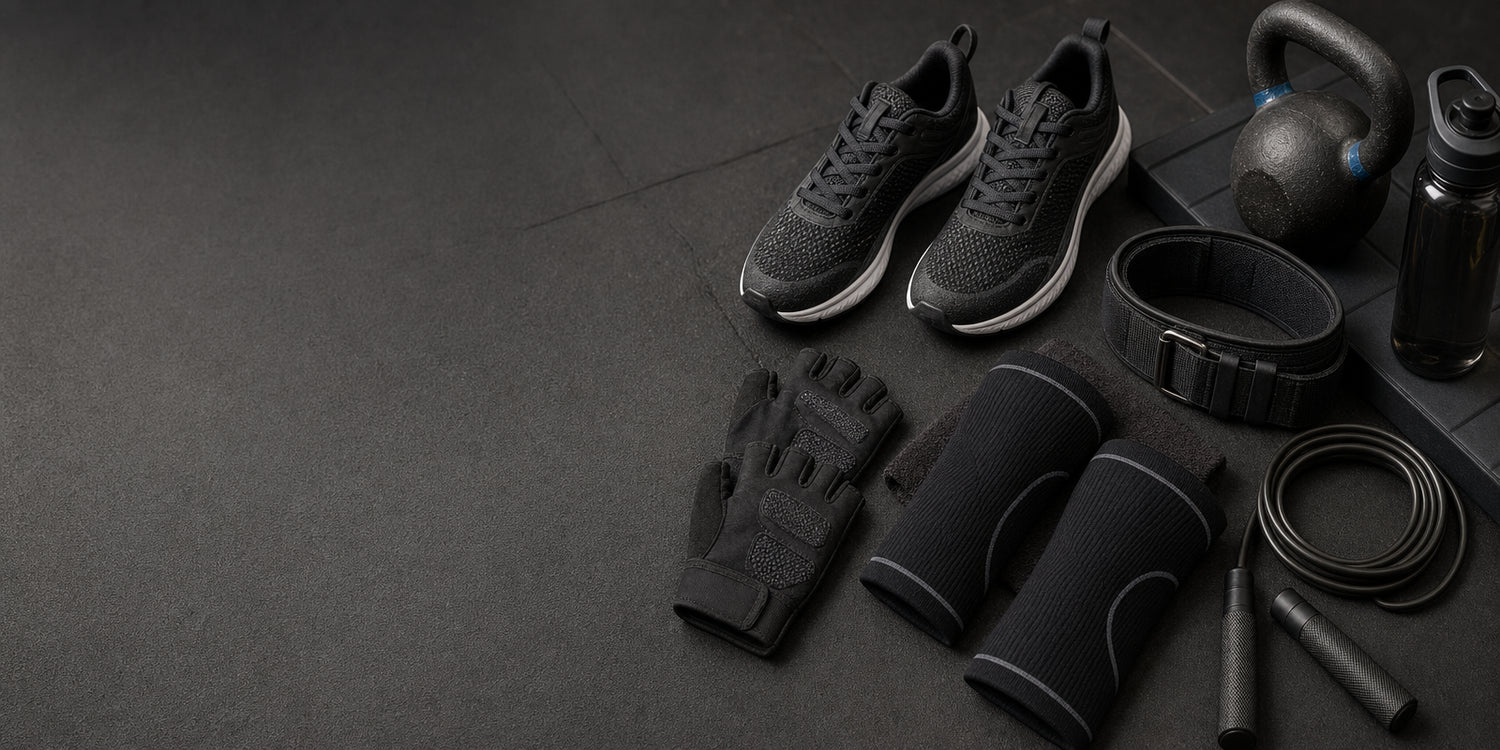
Your first HYROX race needs four essentials: a stable hybrid running shoe, sweat-wicking training clothes, blister-resistant socks and basic grip protection. Everything else, from gloves to race belts to recovery tools, is optional until you train with it.
- Essential: hybrid running shoes, breathable top, stretchy shorts or leggings, non-cotton socks and basic fuel.
- Optional: gloves, grips, a pacing watch, a small belt for fuel, warm-up bands and recovery tools.
- Skip for now: weight vests, carbon race shoes, hydration belts and any gadget you have not tested.
Owning expensive gear will not replace a consistent training routine, and research shows that habit-formation interventions improve physical-activity behavior, so a repeatable training schedule matters more than your gear budget.[1] If you are still weighing how much to spend, our guide on whether budget home gym equipment is worth it helps you decide.
Why Are Shoes the Most Important HYROX Purchase?
Shoes are the most decisive piece of HYROX gear because they carry you through eight 1 km runs and every heavy station. A shoe that feels great on a treadmill can feel unstable on a sled push or wall ball squat.
How to choose a HYROX shoe
Trainers often recommend a hybrid trainer with a 4-8 mm heel-to-toe drop, a firm midsole and a grippy outsole, and most good HYROX shoes sit in the 22-28 mm stack range.
- Drop: keep it between 4-8 mm for a stable platform across running and sled work.
- Midsole firmness: a firm sole resists compressing under a loaded sled push.
- Outsole grip: a tacky rubber compound grips wet, sweat-soaked turf.
- Toe box: leave room for your toes to splay in a wall ball squat.
Shoes to avoid for HYROX
Skip pure lifting shoes, max-cushion running shoes and minimal racing flats for race day. Each solves one demand well but fails the rest of the course.
- Lifting shoes: too rigid and high-heeled for eight 1 km runs.
- Max-stack runners: too soft for sled pushes and lateral lunges.
- Minimal flats: under-cushioned for the running volume.
What Clothing Avoids Chafing During HYROX?
The right HYROX clothing is breathable, sweat-wicking kit you have already tested through burpees, lunges and wall balls. Fitted tops, stretchy shorts or leggings and high-impact support beat any new outfit bought just for race day.
Tops, bottoms and sports bras
Choose fabric that dries fast and fits close, with no loose fabric that can catch on sled handles or a wall ball target.
- Top: a fitted singlet or t-shirt in a sweat-wicking fabric, never cotton.
- Bottoms: shorts or leggings with a secure waistband and no flapping pockets.
- Support: a high-impact sports bra without underwire for women.
Socks are cheap insurance against blisters
Good socks are the cheapest upgrade in your kit, because blisters can end a race faster than fatigue. Choose a synthetic blend with a snug fit and no bunching.
- Fabric: synthetic blends wick sweat, while cotton holds moisture and rubs.
- Length: mid-length socks protect your heel and Achilles better than no-show styles.
Do You Need Gloves, Grips or Tape for HYROX?
Gloves, grips and tape are optional for HYROX because the race has no rig gymnastics and grip demand comes mainly from sled pulls, farmer's carries and wall balls. They help if your hands tear easily or you also train CrossFit, but only if you practice with them first.
- When gloves help: sweaty hands or frequent hand tears during heavy carries.
- When to skip them: if you have not trained in them, because new grips feel clumsy and slow transitions.
- Cheap alternative: athletic tape or chalk can protect key contact points without the bulk.
Test whatever grip protection you choose in a compromised running session before race day.
What Training Equipment Prepares You for the Stations?
The most useful home training equipment for HYROX is a wall ball or soft medicine ball, a pair of kettlebells and a sled or weighted substitute. These let you practice the exact station demands at home, starting with a small setup and adding pieces as your budget grows.
Wall ball and medicine ball
A soft, dead ball that does not bounce is the safest choice for wall ball practice at home. Open men throw a 6 kg (13 lb) ball to a 10 ft target, while open women throw a 4 kg (9 lb) ball to a 9 ft target.
- Weight: match your division weight once you can squat and throw smoothly.
- Practice: rehearse the full squat-to-throw rhythm against a sturdy wall.
Kettlebells for the farmer's carry
Open men carry 24 kg (53 lb) per hand and open women carry 16 kg (35 lb), so practice with race-weight pairs when you can. A quality RitFit 550-Lb Rubber-Coated Dumbbell Set doubles as a carry tool and a general strength base.
- Start lighter: build grip and posture before loading up to race weight.
- Carry practice: walk smooth, even laps while bracing your core.
Sled and budget substitutes
A sled is the most specific station tool, but a weighted substitute works if you have space and a budget. You can push a weighted bag or even a car on smooth pavement as a low-cost stand-in.
- Push and pull: alternate both directions to match the sled push and sled pull.
- Check the floor: use surfaces that will not tear the soles of your training shoes.
Low-cost warm-up tools
A mini resistance band is a low-cost warm-up tool that primes the hips before a session. A study found that adding a band loop above the knees increases gluteus medius activation during squats without changing depth or knee kinematics.[2]
- Mini band: a few banded walks wake up the glutes before running and squatting.
- Skipping rope: useful only if you regularly warm up with one.
For station-friendly ideas, see our best place to buy dumbbells guide and browse the CrossFit equipment and functional training equipment collections.
What Gear Can You Skip for Your First HYROX?
For your first HYROX you can skip weight vests, carbon-plated race shoes, tactical gloves, hydration belts and any gadget you have not tested in training. Untested and new-on-race-day items cause more problems than they solve.
- Weight vests: the course already loads your legs and back through the stations.
- Carbon race shoes: too unstable for most beginners on sleds and lunges.
- Hydration belts: water is available on the course, so a small belt only carries extras.
- Massage guns and gels: nice after the race, but sleep, food and walking matter more.
If you plan to build a home training area anyway, start with the where to buy gym equipment for home guide to avoid buying pieces you will not use.
How Much Should You Budget for HYROX Gear?
A sensible HYROX gear budget starts with shoes, clothing and socks because you need those for training anyway, then adds a wall ball, kettlebells or a sled as you can afford them. Most beginners do fine keeping the extra spend under $300 before race day.
| Spend tier | What to buy | Why it works |
|---|---|---|
| Budget (under $100 extra) | Stable hybrid shoes, tested training clothes, blister-resistant socks, basic grip tape | Covers the race essentials without untested extras |
| Value ($100-$300) | Add a wall ball or soft medicine ball and a pair of kettlebells | Practices the wall ball and farmer's carry at home |
| Premium ($300+) | Add a sled or weighted substitute, a rower or SkiErg alternative, tested mid-race fuel | Prepares every station before race day |
Tiers assume you already own basic training shoes and gym clothing; spend on tested kit before premium additions.
Training consistency also shapes how much gear is worth buying. A study found that self-efficacy is a key determinant of whether people form and maintain an exercise habit, so confidence built through training justifies the gear you own.[3]
For budget shopping tips, see our best place to buy budget gym equipment online guide and compare best garage gym equipment packages if you plan a fuller setup.
What Is Your Final HYROX Race-Day Checklist?
Your final HYROX race-day checklist is simple: broken-in shoes, tested clothing, blister-resistant socks, a basic fuel plan and calm pacing. Practice that exact setup in training so nothing is new on race day.
- Shoes: a broken-in hybrid trainer you have already run and sled-pushed in.
- Clothing: the sweat-wicking outfit you wore through your last compromised session.
- Fuel: one gel before the start and possibly one mid-race if you expect over 90 minutes.
- Warm-up: a mini band and light jog to open the hips and lungs.
- Pacing: start conservative and stay calm through the early stations.
"The most important gear will be your running shoes. Make sure that your feet are accustomed to your shoes and the shoe gives you good stability for lunges, wall balls and running on the curved track. Grip is essential on the sled push and pull."
Bentler, HYROX coach, Red Bull
If space is tight at home, our basement gym equipment essentials guide shows a compact station setup.
FAQs About HYROX Equipment and Gear
What gear do I actually need for my first HYROX race?
For your first HYROX you need stable hybrid running shoes, sweat-wicking training clothes, blister-resistant socks and a basic fueling plan, and that is all that is essential. Gloves, belts, watches and recovery tools are optional, so buy them only if you already train with them.
Do I need special HYROX shoes?
No official HYROX shoe exists, so choose a hybrid trainer stable enough for sled pushes, lunges and wall balls yet comfortable for eight one-kilometer runs. Look for a four-to-eight millimeter drop, a firm midsole, a grippy outsole and a stack height under 30 millimeters.
Are gloves or grips mandatory for HYROX?
No, grips and gloves are optional and mostly useful if your hands tear easily or you also do CrossFit. Because HYROX has no rig gymnastics, grip demand comes mainly from sled pulls, farmer's carries and wall balls, so train with any gloves before race day.
What clothing avoids chafing through wall balls, lunges and burpees?
Wear breathable, sweat-wicking kit you have already tested through burpees, lunges and wall balls, with a fitted top and no loose fabric. Choose shorts or leggings with a secure waistband and no flapping pockets, add high-impact support where needed and avoid cotton entirely.
What home gym equipment helps me train for HYROX stations?
The most useful pieces are a wall ball or soft medicine ball, kettlebells for the farmer's carry, and a sled or a budget substitute such as a weighted bag. A rower or ski erg builds the engine, so start small with a wall ball and a pair of kettlebells.
How much should I budget for HYROX gear?
A sensible starter budget covers shoes, clothing and socks first since you need them anyway, then adds a wall ball, kettlebells or a sled as you can. Avoid premium items you have not tested in training, because value gear that gets used beats expensive gear that sits.
Conclusion
The right HYROX gear is simple: stable shoes, tested clothing, good socks and basic grip protection, bought before any extras. Start with the essentials, train in them, and add home training equipment like a wall ball or kettlebells as your goals grow.
For a budget-friendly home setup, browse the RitFit training collections and check current deals on the RitFit sales page. Buy what you will actually use, and let consistency do the rest.
Disclaimer
HYROX gear recommendations are for general training information only and are not a substitute for professional advice. Consult a qualified coach or health care professional before starting a new training program or buying equipment for a specific race goal.
References
1. Ma H, Wang A, Pei R, Piao M. Effects of habit formation interventions on physical activity habit strength: meta-analysis and meta-regression. Int J Behav Nutr Phys Act. 2023;20(1):109. PMCID: PMC10498635
2. Foley RCA, Bulbrook BD, Button DC, Holmes MWR. Effects of a band loop on lower extremity muscle activity and kinematics during the barbell squat. Int J Sports Phys Ther. 2017;12(4):550-559. PMCID: PMC5534145
3. Stojanovic M, Fries S, Grund A. Self-efficacy in habit building: how general and habit-specific self-efficacy influence behavioral automatization and motivational interference. Front Psychol. 2021;12:643753. PMCID: PMC8137900