The HYROX wall ball is the 100-rep final test of race day, and it punishes anyone who loses their squat standard in the last minutes of the event. This guide covers the official rules, the correct ball weight for your division, the exact technique, and the pacing that gets you through all 100 reps.
You will also learn how to train under fatigue, what to do when you have no wall ball, and when a set should stop for safety. Follow the steps below to race through Station 8 instead of grinding against it.
Quick Answer: The HYROX wall ball is the 100-rep Station 8 finisher where you squat, throw a medicine ball, and catch it without breaking form. Open Men throw 6 kg, Open Women 4 kg, Pro Men 9 kg, and Pro Women 6 kg at a 3 m or 2.7 m target. Train at race weight to avoid no-reps.
Key Takeaways
- Rep count: the HYROX wall ball is 100 reps at Station 8, the final station of the race.
- Division weights: Open Men throw 6 kg, Open Women 4 kg, Pro Men 9 kg, and Pro Women 6 kg.
- Target height: men aim at 3 m and women at 2.7 m, and each throw must hit the center.
- Squat standard: every rep must drop below parallel or the judge does not count it.
- Pacing: break the 100 reps into small planned sets and keep rest under 10 seconds.
What Is the HYROX Wall Ball Station?
The HYROX wall ball is Station 8, the final test of race day, where you must complete 100 medicine-ball throws before the clock stops. It sits last by design, so your technique must hold on legs that are already tired.
It is the climactic station of the HYROX fitness race, and it rewards athletes who practice the exact pattern under fatigue. Most first-timers underestimate how much squat strength this station demands.
- Rep count: exactly 100 throws, with no cap on time.
- Position: the last of the eight stations, straight into the finish.
- Failure mode: no-reps, not exhaustion, end most wall ball meltdowns.
What Are the HYROX Wall Ball Rules and Standards?
Every HYROX division performs 100 wall ball reps at Station 8, and only reps with full squat depth, a two-hand throw, and a clean target hit are counted. The standards are identical for every athlete, with only the ball weight and target height changing between divisions.
| Division | Ball Weight | Target Height |
|---|---|---|
| Open Men | 6 kg | 3 m |
| Open Women | 4 kg | 2.7 m |
| Pro Men | 9 kg | 3 m |
| Pro Women | 6 kg | 2.7 m |
Official HYROX standards. Men use the higher target and women the lower one in every division.
- Start position: the ball must begin at chest height with both hands on it.
- Squat depth: the hip crease must drop below the top of the knee.
- Throw: both hands must release the ball into the center of your target.
How Do You Do the HYROX Wall Ball with Correct Technique?
A correct HYROX wall ball is a full front squat, an explosive two-hand throw, and a soft catch that flows straight into the next rep. Legs do the work, while the arms simply guide the ball.
The Squat: Depth Is Non-Negotiable
Drive your hips below parallel on every rep, because a short squat is a no-rep. Keep your heels down and your chest tall as you lower.
- Stance: feet shoulder-width apart with toes slightly turned out.
- Depth: hip crease below the top of your knee.
- Common fix: widen your stance if your heels start to lift.
The Drive and Throw: Legs Lead, Shoulders Finish
Explode upward from the bottom, then extend your arms only after your legs are almost straight. Your shoulders finish the throw, but your legs start it.
- Timing: push with the legs first, then flick the ball with the arms.
- Line: send the ball straight up your eyeline to the center of your target.
The Catch and Reload: One Fluid Motion
Let the ball land in your hands and sink you straight back into the next squat. Absorb the weight as you descend, which saves energy and keeps the rhythm.
- Hands: keep them spread wide so the catch stays soft.
- Flow: one rep runs straight into the next with no reset.
How Do You Choose Your Wall Ball Weight and Stand Distance?
Use the official weight for your division, and stand close enough that your arms stay slightly bent when you release the throw. Stand about an arm's length from the wall so the ball travels vertically rather than in a long arc.
Train at race weight for at least the last few weeks before the event. A lighter ball in practice teaches a rhythm that your race day cannot match.
- Stand distance: roughly 60 to 80 cm from the wall for most athletes.
- Rule of thumb: your elbows should stay bent at full extension of the throw.
How Do You Breathe and Pace 100 Wall Ball Reps?
Break the 100 reps into small planned sets of 10 to 15, breathe in during the descent, and keep any rest under 10 seconds. A steady 1.2 to 1.8 second rhythm per rep keeps your heart rate from spiking out of control.
Exhale hard on the drive so your core stays braced through the throw. If you find yourself gasping, shorten the sets rather than slowing the reps.
- Set scheme: 10 to 15 reps, then a short standing reset.
- Rest cap: under 10 seconds so your legs do not lock up.
- Signal to adjust: breathless throws mean your sets are too big.
Pair this pacing work with exercise ball exercises to build the same endurance in a home setup.
How Do You Simulate Race Day Fatigue in Wall Ball Workouts?
Train the wall ball at the end of a run or conditioning session so you practice holding technique when you are already fatigued. This mimics the exact scenario Station 8 presents on race day.
Start with three rounds of 15 wall balls after a five minute run, then build from there. Add goblet squats and front squats to raise the strength your squat depth depends on.
- Finisher A: 5 rounds of 15 wall balls plus a 200 m run.
- Finisher B: 4 rounds of 20 wall balls at race weight.
- Strength: 3 sets of 8 front squats to fortify the drive.
Build the legs behind the station with the 3-in-1 Leg Press and Hack Squat Machine, and round out your gear from the Functional Training Equipment and CrossFit Equipment collections.
What Common Mistakes Ruin Your HYROX Wall Ball Reps?
Most no-reps come from squatting too shallow, missing the center of the target, or letting the throw turn into an arm toss. Each has a simple fix once you know what to watch for.
- Shallow squats: drop the hips below parallel on every rep, even when tired.
- Arm-dominant throws: push from the legs and let the arms finish.
- Off-center target: aim at the middle of your board, not its edges.
- Stopping after misses: catch and reload instead of walking back to reset.
- Overly big sets: shrink your reps per set before your form breaks.
What Are the Best Alternatives and Support Exercises for the Wall Ball?
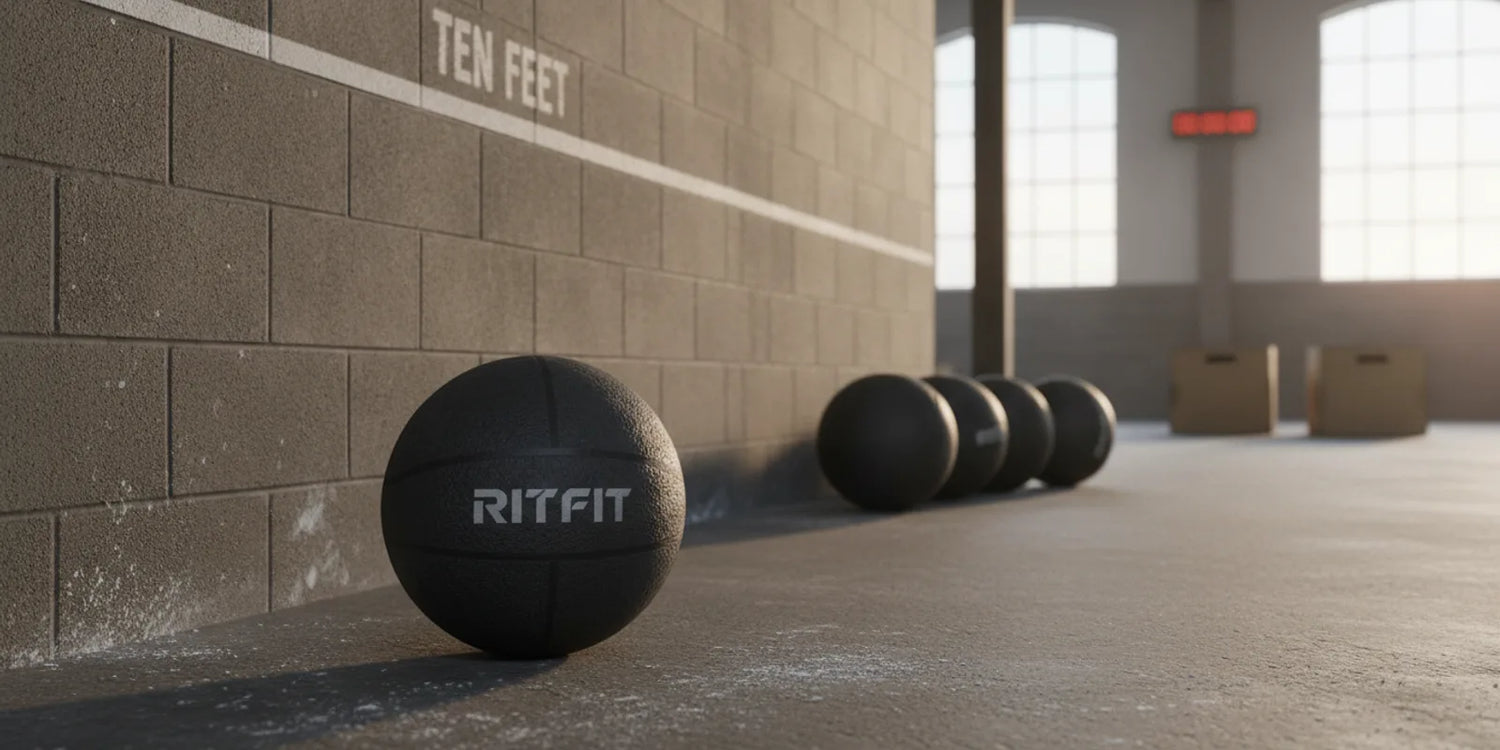
If you have no wall ball, use a slam ball or a medicine ball, or replace the pattern with a dumbbell thruster to build the same squat and press motion. A study of medicine-ball interval training found it posed a moderate-to-vigorous cardiometabolic stimulus, with heart rate climbing from about 121 to 178 bpm across the protocol.[1]
Ball-based conditioning is worth the effort. In one trial, a single conditioning session that included wall-ball throws significantly increased acute plasma BDNF, and the effect size was moderate.[2] Researchers also note that throwing-and-catching movements like the wall-ball shot are hard to quantify, since squat depth and throw trajectory vary rep to rep.[3]
- Direct swap: a slam ball throw covers the same squat and press chain.
- Pattern builder: dumbbell thrusters teach the leg-to-arm transfer.
- Lower body: Swiss ball leg curls strengthen the hamstrings that support squat depth.
Compare ball types before you buy in our guide to wall ball vs slam ball vs medicine ball, and see the guide to slam ball for a full movement library.
When Should You Stop the Wall Ball Set?
Stop the set if you feel sharp knee pain, uncontrolled shoulder fatigue, or a form breakdown that turns throws into arm tosses. Pain is your cue to reduce the weight or end the set, not to push through.
Knee pain usually signals a stance or depth problem, while shoulder pain often comes from catching with locked arms. Dial back the reps or the weight, and revisit the pattern before you return to 100.
- Sharp pain: stop and see a professional if it persists.
- Wrecked form: end the set rather than bank no-reps.
- Persistent fatigue: lower the ball weight for that session.
"We're potentially reinforcing a bad pattern, reinforcing an idea of, when you get tired, just go ahead and break posture. We don't want those things. That never is going to be a win in our book."
Andy Galpin, PhD, Professor of Kinesiology, California State University, Fullerton
FAQs About HYROX Wall Balls
How many reps are in the HYROX wall ball station?
Every HYROX division performs 100 wall ball reps at Station 8. The ball must start at chest height, the squat must reach below parallel, and each throw must hit the correct target. The station ends when the judge or digital display confirms 100 counted reps.
What weight wall ball do you use in HYROX?
Open Men throw a 6 kg ball, Open Women a 4 kg ball, Pro Men a 9 kg ball, and Pro Women a 6 kg ball. Always train at your race weight at least a few weeks before race day so the pattern and cadence feel automatic.
How high is the HYROX wall ball target?
Women aim at the lower target at 2.7 meters, while men aim at the higher target at 3 meters. The ball must hit the center of your designated target for the rep to count, so practice at the exact official height in training.
How do you avoid no reps in HYROX wall balls?
Squat until your hip crease drops below the top of your knee, hit the center of your target, and throw with both hands. Break your 100 reps into small planned sets, keep rest under 10 seconds, and stop before form collapses.
What exercises build strength for HYROX wall balls?
Front squats, thrusters, goblet squats, and wall-ball practice itself build the squat strength and throwing power the station demands. Train wall balls at the end of a run or workout so you learn to keep your technique clean under fatigue, which is exactly what Station 8 requires on race day.
Conclusion
The HYROX wall ball is a 100-rep squat and throw test, and it rewards athletes who hold their depth standard when fatigue hits hardest. Master the official rules, pick your race weight, and practice the pattern at the end of every session.
Start your Station 8 prep now with the gear on sale at RitFit, and build the legs that carry you through all 100 reps.
Disclaimer
This article is for general information and training guidance only, and it does not replace medical or professional coaching advice. Consult a qualified physician before starting any exercise program, especially if you have existing knee, shoulder, or lower-back conditions.
References
1. Faigenbaum AD, Kang J, Ratamess NA, et al. Acute Cardiometabolic Responses to Medicine Ball Interval Training in Children. Int J Exerc Sci. 2018;11(4):886-899. doi:10.70252/WFYJ1596. PMCID: PMC6033503
2. Pereira ES, Krause Neto W, Calefi AS, et al. Significant Acute Response of Brain-Derived Neurotrophic Factor Following a Session of Extreme Conditioning Program. Front Physiol. 2018;9:823. doi:10.3389/fphys.2018.00823. PMCID: PMC6038715
3. Mangine GT, Seay TR. Quantifying CrossFit: Potential solutions for monitoring multimodal workloads. Front Sports Act Living. 2022;4:949429. doi:10.3389/fspor.2022.949429. PMCID: PMC9613943