








Exercise for kids and adults works best as one shared at-home circuit, and this guide gives you that exact routine. You get a 20-minute family workout, age-scaled moves, safety rules, and compact equipment picks.
Every recommendation fits small spaces and real schedules, so parents and kids can train together starting today.
Quick Answer: The best exercise for kids and adults at home is a shared bodyweight circuit of animal walks, squats, push-up variations, and dance breaks run in short rounds. Kids need 60 minutes of activity daily, adults need 150 minutes weekly, and one 20-minute family session covers both.
Key Takeaways
- Daily targets: Kids ages 6 to 17 need 60 minutes of moderate to vigorous activity daily, while adults need 150 minutes per week plus two strength days.
- One shared session: A 20-minute bodyweight circuit with age-scaled versions of each move trains parents and kids at the same time.
- Home training works: Randomized controlled trials show home-based resistance programs achieve high adherence and measurable strength gains.
- Strength is safe for kids: Supervised, light-load strength training with good technique is safe for children, while maximal lifts are not.
- Start small: Mats, bands, light dumbbells, and an exercise ball cover about 90 percent of a family home gym.
How Much Exercise Do Kids and Adults Need?
Kids ages 6 to 17 need at least 60 minutes of moderate to vigorous physical activity every day, while adults need 150 minutes of moderate aerobic activity per week plus two days of strength training. The World Health Organization 2020 guidelines confirm the same daily 60-minute target for children and adolescents [1].
That hour for kids can be split into shorter play sessions across the day. It should include muscle and bone strengthening activity like jumping or climbing at least three days per week, per the CDC guidelines for children.
Adults can hit their weekly target with five 30-minute moderate sessions, per the CDC guidelines for adults. A daily 20-minute family circuit gets kids a third of their hour and quietly checks both adult boxes.
Why Do Family Workouts at Home Actually Work?
Family workouts at home work because they remove the two biggest barriers to exercise, which are time and travel. A randomized controlled trial found that a graded home program combining resistance and aerobic exercise reached 82.9 percent adherence over 12 weeks in community-dwelling older adults [2].
Consistency at home also produces real strength gains. A preliminary RCT during COVID-19 home confinement observed a 19.8 percent improvement in chair-stand test performance after six months of home-based resistance training [3].
Both studies involved older adults, so treat those numbers as proof that home training works rather than promised results for your family. The behavioral bonus is that kids copy what they see, and a parent training in the living room normalizes exercise better than any lecture.
What Is the Best 20-Minute Workout for Kids and Adults?
The best 20-minute workout for kids and adults is a six-station bodyweight circuit run twice, with 60 seconds of work and 30 seconds of transition per station. Everyone performs the same movement at their own level at the same time.
Start with a 3-to-5-minute dynamic warm-up of follow the leader and an animal parade of bear crawls, crab walks, and frog hops. Skip static stretching before play, and add exercise for balance drills if anyone in the family wobbles early.
- Animal walks: bear crawl or crab walk across the room, with kids racing and adults slowing down for core tension.
- Squats: kids do jump squats, adults do tempo squats or goblet squats with a light dumbbell.
- Jumping jack countdown: 30 seconds of jacks or star jumps, with step jacks as the low-impact option.
- Push-up pyramid: kids use knees or a wall, adults use full or incline push-ups, and the family counts total reps as a team score.
- Balance challenge: single-leg stands with eyes open, then closed, and the first person to wobble picks the next animal walk.
- Dance break finisher: one song of freestyle dancing that works as honest cardio for every age.
Two rounds give kids roughly 15 minutes of moderate to vigorous work and give adults a legitimate full-body session. For comparisons with other options, see our guide to what exercise burns the most calories.
Prefer a coached session some days? This follow-along kids workout from The Body Coach TV slots straight into this slot of your routine.
How Do You Scale the Same Move for Kids and Adults?
You scale the same move for kids and adults by changing reps, tempo, and load while keeping the movement pattern identical. Kids use playful variations and bodyweight, while adults add slower tempos, extra reps, or light weights.
| Movement | Kid version (ages 5 to 12) | Adult version |
|---|---|---|
| Squat | Jump squats, squat-and-clap | Tempo squats, goblet squats with light weight |
| Push-up | Wall or knee push-ups | Full, incline, or slow-eccentric push-ups |
| Lunge | Forward stepping game | Reverse lunges or walking lunges with dumbbells |
| Plank | 10 to 20 second holds, plank high-fives | 30 to 60 second holds, shoulder taps |
| Cardio burst | Freeze dance, animal races | Jump rope, step jacks, shadow boxing |
| Pulling | Towel tug-of-war | Band rows with RitFit exercise handles for cable machines |
Scaling guidance reflects general youth strength training recommendations to keep loads light and technique first.
Two rules keep scaling safe. Kids' loads stay light with bands, bodyweight, and play, and adults earn intensity through tempo and reps before adding weight.
For low-impact days, a simple step platform works for every age. Our stepping exercise guide covers progressions that kids also enjoy as a step-up game.
What Home Gym Equipment Works for Kids and Adults?
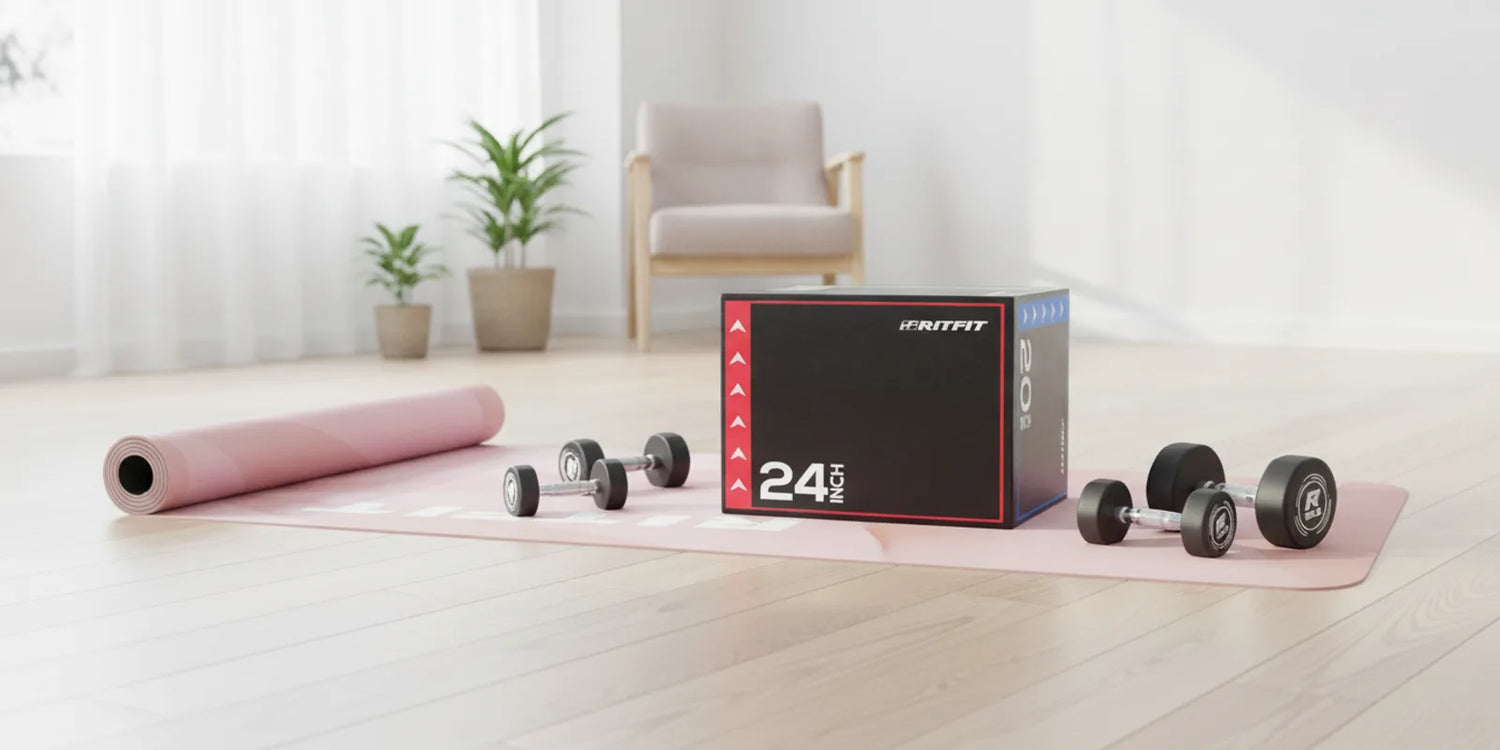
The home gym equipment that works for both kids and adults starts with five shared basics, which are mats, resistance bands, light dumbbells, an exercise ball, and a jump rope. These tools scale across ages by changing band tension or weight.
- Exercise mats: the non-negotiable surface for every floor station in the circuit above.
- Resistance bands and light dumbbells: browse compact exercise weights that adults can load meaningfully while kids use the lightest options.
- An exercise ball: a balance toy for kids and a core tool for adults, with ideas in our exercise ball exercises guide.
- Jump ropes and grip tools: kids skip for cardio, and adults add grip work with exercise hand grips while supervising.
- Cable attachments later: quality exercise handles make rows joint-friendly, and they remain adult-only equipment around young kids.
Buy in that order, because most families cover 90 percent of their training with the first three items. Core finishers like the moves in our exercise to flatten stomach guide need nothing but a mat.
What Safety Rules Should Parents Follow?
Parents should supervise every strength movement, keep loads light, and clear a mat-sized space for each person before the timer starts. Supervised, light-load strength training is safe for children, while unsupervised heavy lifting is not.
- Supervise strength work always: keep loads light enough for 8 to 15 controlled reps and coach form first.
- Clear the zone: move coffee tables, pick up toys, and give each person their own square of floor.
- No max attempts: effort is measured in reps and games, never in one-rep-max lifts.
- Hydrate on schedule: kids overheat faster than adults, so build water breaks into any session longer than 15 minutes.
- Stop on pain, not on tired: tired is the goal, and sharp pain or dizziness ends the session.
- Lock up heavy equipment: racks, benches, and plates are adult tools that go back into storage after the session.
Common Mistakes to Avoid
The most common family workout mistakes are sessions that run too long, adult loads handed to kids, and coaching from the couch instead of joining in. Keep sessions under 30 minutes, scale every load, and train alongside your kids.
Adults chasing strength inside these sessions should also train smart rather than heavy. As strength coach Jeff Cavaliere puts it when discussing hard lifts:
"What I advise in most cases is, instead of looking for a spotter to take you through those areas of a lift that are more difficult, think of other ways you can improve your ability to complete that lift, if strength is your goal."
Jeff Cavaliere, MSPT, CSCS, Athlean-X
When in doubt about readiness for structured training, ask your pediatrician. This matters most for kids under six or anyone with a medical condition.
FAQs About Exercise for Kids and Adults
How much exercise do kids need every day?
Children ages 6 to 17 should get at least 60 minutes of moderate to vigorous physical activity every day, according to CDC guidelines. That hour can be broken into shorter play sessions and should include aerobic movement plus muscle and bone strengthening activities like jumping or climbing three days weekly.
What is the best workout for kids at home?
The best at home workout for kids mixes games with simple bodyweight moves like animal walks, jumping jacks, squats, and dance breaks. Keep sessions under 30 minutes, change activities every few minutes, and let kids choose moves so the workout feels like play instead of a chore.
Can kids and adults do the same workout together?
Yes, most bodyweight movements scale easily across ages. Adults add reps, slower tempos, or light weights while kids use shorter rounds and playful variations, so a shared circuit keeps the whole family moving without anyone getting bored or overwhelmed.
Is it safe for kids to lift weights?
Supervised strength training with light weights or resistance bands is safe for children when technique comes first, according to pediatric sports medicine guidance. Avoid maximal lifts, keep loads light enough for 8 to 15 controlled reps, and focus on form, balance, and fun rather than heavy numbers.
How do I motivate kids to exercise at home?
Turn exercise into games like obstacle courses, follow the leader, dance parties, or fitness dice. Work out alongside your kids instead of coaching from the couch, keep sessions short and consistent, and celebrate effort with stickers or a family activity chart rather than screen based rewards.
What home gym equipment works for both kids and adults?
Start with shared basics like exercise mats, resistance bands, light dumbbells, an exercise ball, and a jump rope. These tools scale across ages by changing band tension or weight, and you should always supervise kids around benches, racks, or any heavy strength equipment.
Conclusion
Exercise for kids and adults does not require two separate programs, a gym membership, or a spare room. One shared 20-minute circuit with age-scaled moves gives kids their daily activity and gives parents real training, and the evidence on home workouts shows consistency pays off. Start with the six-station circuit three times this week.
Ready to build your family training corner? Grab mats, bands, and light weights from the RitFit sale collection and run your first session tonight.
Disclaimer
This guide is for general education and is not medical advice. Consult your pediatrician before starting structured exercise with children, especially kids under six or anyone with a medical condition, and stop any activity that causes pain or dizziness.
Save on your next RitFit order
Tap the button to copy your code, then paste it at checkout.
References
1. Bull FC, Al-Ansari SS, Biddle S, et al. World Health Organization 2020 guidelines on physical activity and sedentary behavior. Br J Sports Med. 2020;54(24):1451-1462. doi:10.1136/bjsports-2020-102955. PMCID: PMC7719906
2. Liu M, Li J, Xu J, et al. Graded Progressive Home-Based Resistance Combined with Aerobic Exercise in Community-Dwelling Older Adults with Sarcopenia: A Randomized Controlled Trial. Clin Interv Aging. 2024;19:1581-1595. doi:10.2147/CIA.S473081. PMCID: PMC11444075
3. Vitale JA, Bonato M, Borghi S, et al. Home-Based Resistance Training for Older Subjects during the COVID-19 Outbreak in Italy: Preliminary Results of a Six-Months RCT. Int J Environ Res Public Health. 2020;17(24). doi:10.3390/ijerph17249533. PMCID: PMC7767132





