Home gym workouts let you train on your own schedule, stay consistent, and build strength without the commute or membership fees of a commercial gym. This guide covers five beginner-friendly home gym workouts using a power rack, bench, barbell, dumbbells, and jump rope to train your whole body in about 30 minutes.
Whether you are new to training or want to make better use of equipment you own, you will learn correct form, sets and reps, and a simple weekly plan. Consult a doctor before starting if you have a medical condition or have been inactive.
Quick Answer: A home gym workout routine can train your whole body in about 30 minutes using five basic movements, squats, presses, deadlifts, glute bridges, and jump rope. Beginners should do two to three sets of 6 to 12 reps per exercise, two to three days per week, with rest days in between.
Key Takeaways
- Full-body in 30 minutes: Five compound movements can train your legs, upper body, core, and cardio in a single short home gym session.
- Compound beats isolation: Exercises like squats and deadlifts recruit more muscle mass and deliver better results in less time than isolation movements.
- Basic equipment is enough: A power rack, adjustable bench, barbell, dumbbells, and a jump rope cover nearly every beginner training need.
- Safety bars matter: Set rack safety bars just below the bottom of your squat so they catch the bar if you cannot stand back up.
- Consistency wins: Training two to three days per week beats an intense schedule you cannot keep, so progress as you get stronger.
Why Build a Home Gym Workout Routine as a Beginner?
A home gym workout routine is worth building because it removes the commute, lets you train on your own schedule, and keeps you consistent, which matters more for results than any single exercise. With just a power rack, a bench, a barbell, dumbbells, and a jump rope, you can cover legs, upper body, core, and cardio in one session and repeat it two to three times per week.
- Save time: You eliminate the travel to and from a commercial gym.
- Train on your schedule: You can work out whenever it fits your day, even in short blocks.
- More control: You choose the music, temperature, and environment, and you have more privacy.
- Safer setup: A sturdy power rack with adjustable safety bars spots you on heavy lifts.
- Easier consistency: You are far more likely to stay consistent when everything you need is a few steps away.
Before buying anything, think about the space you have and the movements you want to do. Start with the essentials that support the five exercises in this guide, then add weight plates and accessories as you progress.
For a complete shopping plan, see our Home Gym Guide, browse Home Gym Ideas for layout inspiration, and read about the 5 Unique Benefits Of Home Gym training. If budget is a concern, our guide to the Best Affordable Home Gym Equipment For Home Workouts covers the essentials you actually need.
How to Do a Barbell Back Squat in a Home Gym
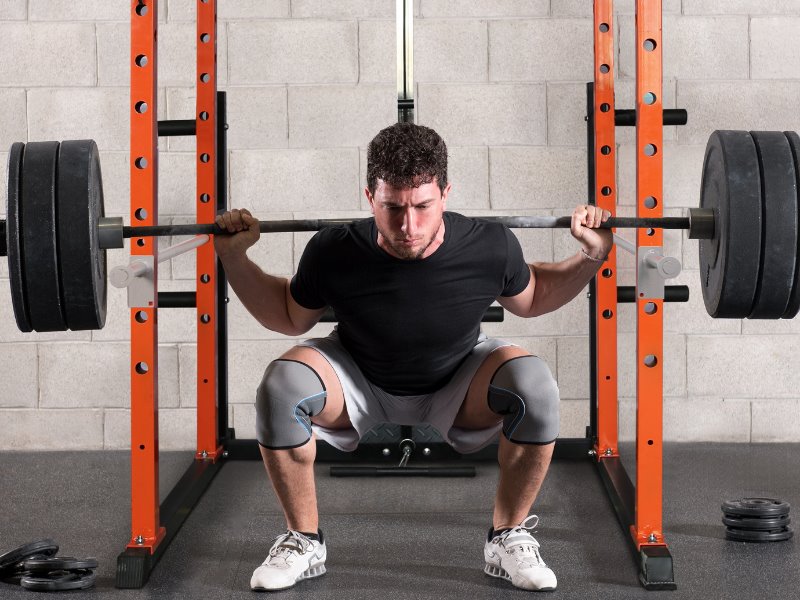
A barbell back squat trains your quadriceps, glutes, and hamstrings with strong help from your core and upper back, and it builds lower-body strength you use every day, such as climbing stairs, lifting groceries, and rising from low chairs. It is considered one of the most effective compound exercises because it recruits more muscle mass than isolation movements, and studies comparing free weight squats to machine squats found 43% higher muscle activation in the stabilizers with free weights.
Equipment needed: a barbell, weight plates, and a sturdy power rack or squat rack with adjustable safety bars, such as a compact home power cage.
- Step under the barbell and brace your core to lift it off the rack.
- Grip the bar wide enough for good shoulder mobility so your elbows sit under the bar.
- Set the bar across your upper back, unrack it, and take a few steps backward.
- Pull the bar down to create tension in your upper back.
- Keep your chest up, take a deep breath, and squat down to a comfortable depth.
- Pause briefly, then drive your feet through the floor until you reach lockout.
Beginner guideline: start with 2 to 3 sets of 6 to 10 repetitions using a weight that keeps your back flat and your knees stable, and rest 60 to 90 seconds between sets.
Home gym safety tip: set the safety bars of your rack one or two inches below the bottom of your squat so they catch the bar if you cannot stand back up, and talk to a doctor or coach before squatting heavy if you have a history of knee, hip, or lower back pain. Pick your Power Rack for Home Gym from the full rack collection to keep heavy squats safe.
How to Do a Dumbbell Shoulder Press at Home
A dumbbell shoulder press builds strong shoulders and triceps while forcing your core to stabilize your torso, which makes it one of the best upper-body exercises for a home gym. Compared with a barbell overhead press, dumbbells are more joint-friendly and let each arm work independently, which helps correct strength imbalances over time.
Equipment needed: an adjustable weight bench with good back support and a pair of dumbbells, set to an upright or slightly inclined position.
- Place your feet flat on the floor and sit on a bench that is straight or slightly slanted.
- Hold a pair of dumbbells at shoulder height with palms facing forward and elbows bent to about 90 degrees.
- Keep your ribcage down, brace your core, and press the dumbbells straight up until your arms are almost straight without locking out.
- Lower the weights under control back to shoulder height with your forearms vertical.
- Repeat for 8 to 12 smooth, controlled repetitions.
Beginner guideline: pick a weight that feels easy for the first four or five reps but challenging by rep ten, and keep your lower back from arching. Do 2 to 3 sets with 60 to 90 seconds of rest between sets.
Safety tip: if you feel sharp pain in your shoulders, stop the set, lower the weight, or switch to a friendlier variation like a landmine press or incline dumbbell press. Find the right load with our guide to Best Dumbbell Sets For Home Gym.
How to Perform a Barbell Deadlift at Home
A barbell deadlift is one of the easiest and most effective strength exercises you can do at home, and it works your hamstrings, glutes, lower back, and core while also strengthening your grip and upper back. Building this pattern makes everyday tasks like lifting boxes and carrying groceries safer and easier, which is why it belongs in any beginner home gym routine.
Equipment needed: a barbell and weight plates on a flat, non-slippery surface, with rubber bumper plates recommended if you plan to lift heavier weights because they protect your floor and your equipment.
- Stand behind the barbell with your feet at least shoulder-width apart.
- Sit your hips back, bend your knees slightly, and lean your torso forward while keeping a tight core and flat back.
- Grip the bar with hands shoulder-width apart and palms facing your body.
- Stand up tall by pushing your feet into the floor, keeping your arms straight as the bar rises.
- Bring your hips forward and squeeze your glutes and abs at the top.
- Reverse the movement slowly, bending your knees and pushing your hips back to lower the bar, keeping it close to your body.
Beginner guideline: start light and complete 2 to 3 sets of 6 to 8 repetitions without your back rounding, resting about 90 seconds between sets.
Safety tip: keep the bar close to your shins and avoid jerking it off the floor. If you feel sharp lower back pain, stop, reduce the weight, or consult a qualified professional, and check our Best Back Workouts At Home for supporting moves.
How to Do a Glute Bridge at Home
A glute bridge strengthens your glutes, hamstrings, and core using only your body weight and a mat, which makes it a safe, accessible movement for beginners and for days when you want a lighter lower-body option. Stronger glutes and a more stable core help you stand up straighter, ease strain on your lower back, and carry over to better squats, deadlifts, and daily tasks like walking and climbing stairs.
- Lie on your back with knees bent, feet flat on the floor and hip-width apart, and arms at your sides with palms down.
- Brace your core gently and keep your ribs down.
- Press through your heels and squeeze your glutes to lift your hips until your body forms a straight line from shoulders to knees.
- Pause at the top for one to two seconds without overextending your lower back.
- Lower your hips slowly and repeat for 10 to 15 repetitions.
Beginner guideline: perform 2 to 3 sets of 10 to 15 reps. If this feels too easy, hold the top position longer or progress to single-leg bridges.
Safety note: if you are recovering from an injury or have pelvic floor or lower back problems, talk to a doctor or physical therapist before using bridge variations as your main exercise.
How to Jump Rope for Cardio at Home
Jumping rope is one of the most effective cardio exercises you can do in a small home gym, and a study in the Research Quarterly for Exercise and Sport found that 10 minutes of jumping rope is equivalent to 30 minutes of jogging for cardiovascular improvement. It is a perfect finisher because it needs almost no space and fits neatly into the end of a strength session.
Equipment needed: a jump rope that rotates smoothly with comfortable handles, plus enough ceiling clearance and a flat, non-slippery surface.
- Jump for 20 to 30 seconds, then rest for 30 to 40 seconds.
- Repeat for 5 to 10 rounds, focusing on light, quick contacts with the floor instead of jumping high.
- Turn the rope with your wrists, not your shoulders, and keep your elbows close to your sides.
- If you keep tripping, slow down and practice small, controlled jumps before adding speed.
Beginner guideline: use jump rope intervals as a short cardio finisher at the end of your strength workout two to three times per week. The RitFit Speed Jump Rope with anti-skid handles is built for home cardio and agility work.
What Does a 30-Minute Home Gym Workout Plan Look Like?
A 30-minute home gym workout plan combines a 5-minute warm-up, a 20-minute strength block, and a 5-minute cardio finisher for a complete beginner-friendly session you can repeat two to three days per week with at least one rest day between sessions. Use the template below and pick weights that feel challenging but leave one or two good reps in reserve at the end of each set.
| Exercise | Sets | Reps |
|---|---|---|
| Barbell Back Squat | 2 to 3 | 6 to 10 |
| Dumbbell Shoulder Press | 2 to 3 | 8 to 12 |
| Barbell Deadlift | 2 to 3 | 6 to 8 |
| Glute Bridge | 2 to 3 | 10 to 15 |
| Jump Rope Finisher | 6 to 8 rounds | 20 sec on, 40 sec off |
Rest 60 to 90 seconds between sets and exercises. Warm up for 5 minutes with light cardio and dynamic stretches for hips, shoulders, and ankles, then finish with jump rope intervals.
Warm-up (5 minutes): light cardio such as marching in place or gentle rope skipping without the rope, plus dynamic stretches for your hips, shoulders, and ankles.
Strength block (about 20 minutes): work through the four strength movements above in order, resting 60 to 90 seconds between sets. If you are new, do one or two sets of each movement and focus on form before adding weight or volume.
Cardio finisher (about 5 minutes): complete 6 to 8 rounds of 20 seconds of jumping rope followed by a 40-second break, and slow the pace if your form starts to suffer.
"If your space is limited, a good set of adjustable dumbbells might be your better option. They will allow you to progress to heavier weight as you get stronger."
Jeff Cavaliere, MSPT, CSCS, Physical Therapist and Strength Coach, Creator of ATHLEAN-X, Athlean-X
For a bigger training plan once this routine feels easy, add weight or a few extra reps first, then expand with more weekly sessions such as the 30 Best Stack Weight Home Gym Workouts, the Best Full Body Workout Smith Machine For Home Gym, or the Ultimate 5 Day Workout Routine for Men.
FAQs About Home Gym Workouts for Beginners
What is the best 30-minute home workout for beginners?
The best 30-minute home workout for beginners combines a 5-minute warm-up, a 20-minute strength block, and a 5-minute cardio finisher.
Squats, shoulder presses, deadlifts, and glute bridges cover your whole body, and jumping rope finishes the session.
This plan needs only a rack, a bench, weights, and a jump rope.
How many days a week should I do home workouts?
Most beginners should train two to three days per week with at least one rest day between sessions.
This schedule gives your muscles time to recover while keeping you consistent.
If you have more energy, add a light cardio or mobility day, but avoid training the same muscles hard on back-to-back days.
Is a barbell necessary for home workouts?
A barbell is not necessary for every home workout, but it is very useful for squats and deadlifts because it lets you load more weight over time. Beginners can start with dumbbells and bodyweight exercises, then add a barbell, plates, and a power rack when they need heavier loads to keep progressing.
What equipment do I need to start a home gym workout?
To start a beginner home gym workout, you need a power rack or squat rack with safety bars, a barbell and plates, a pair of dumbbells, an adjustable bench, a jump rope, and a workout mat. This setup supports every exercise in this guide and can be expanded later with more plates and accessories.
How many reps should a beginner do for strength?
For strength, beginners should aim for 6 to 10 repetitions per set for lower-body lifts like squats and deadlifts, and 8 to 12 repetitions for upper-body movements like shoulder presses.
Do 2 to 3 sets per exercise and rest 60 to 90 seconds between sets.
This range builds muscle and skill safely.
Can I build muscle with a home gym workout routine?
Yes, you can build muscle with a home gym workout routine as long as you train consistently, use progressive overload, and eat enough protein.
Increase the weight or reps whenever the current load becomes easy.
Compound movements like squats, presses, and deadlifts are especially effective for muscle growth at home.
Conclusion
Home gym workouts are an easy and effective way to train when you focus on a few high-value movements and do them regularly. The five exercises in this guide form a complete 30-minute beginner plan you can run two to three times per week.
Record your workouts and add a little weight or a few extra reps when the sets feel easy. Always stop if you feel sharp pain, and explore RitFit home gym packages, racks, and benches to match your budget and training space.
Disclaimer
This article is for informational purposes only and is not a substitute for professional medical advice. If you have a medical condition, joint pain, or have not been active in a while, consult a doctor or licensed healthcare professional before starting any new exercise program.
References
1. Mangine GT, Hoffman JR, Gonzalez AM, et al. The effect of training volume and intensity on improvements in muscular strength and size in resistance-trained men. Physiol Rep. 2015;3(8):e12472. doi:10.14814/phy2.12472
2. Schwanbeck S, Chilibeck PD, Binsted G. A comparison of free weight squat to Smith machine squat using electromyography. J Strength Cond Res. 2009;23(9):2588-2591. doi:10.1519/JSC.0b013e3181b1b181
3. Fountaine CJ, Schmidt BJ. Metabolic cost of rope training. J Strength Cond Res. 2015;29(4):889-893. doi:10.1519/JSC.0b013e3182a35da8