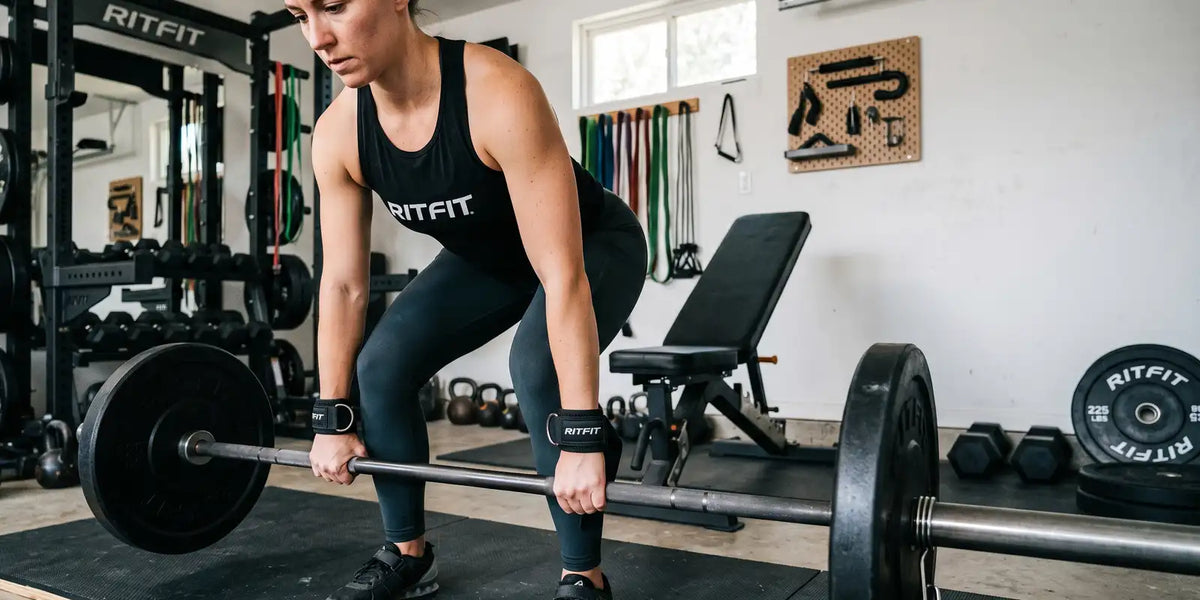
Micro adjustment lifting straps give you the grip support of traditional wrist straps with one key upgrade: a quick-release mechanism that lets you fine-tune tightness between sets without unwrapping and re-wrapping by hand. The result is less setup time and more consistent tension across every working set.
This guide explains how micro-adjustment straps work, which exercises benefit most, what current evidence says about strap-assisted lifting, and what to look for when choosing a pair.
Quick Answer: Micro adjustment lifting straps are wrist-worn lifting accessories with a sliding buckle that tightens and releases in one motion, giving deadlifts, rows, and other pulling movements the grip support of standard straps with faster setup between sets. Evidence shows they can affect how many reps you complete at a given load.
Key Takeaways
- Faster Setup: The micro-adjustment mechanism tightens and releases in one motion, removing the per-set wrap-and-unwrap routine of standard lasso straps.
- Proven Performance Support: Studies confirm that wrist straps influence deadlift kinematics and affect the relationship between velocity and reps to failure.
- Best for Pulling Movements: Deadlifts, rows, rack pulls, and shrugs are the primary beneficiaries, letting you shift focus from grip to the target muscle group.
- Grip Strength Is Safe: Using straps for heavy pulling sets does not weaken grip if you maintain dedicated grip training in your program.
- Key Buying Factors: Material, wrist padding, adjustability range, and load rating separate a reliable strap from one that fails mid-set.
What Are Micro Adjustment Lifting Straps?
Micro adjustment lifting straps are wrist-worn accessories that connect your hand to the barbell or dumbbell, allowing you to maintain a secure grip independent of hand and forearm fatigue. The micro-adjustment feature is a sliding buckle or cam-lock mechanism that lets you dial in tension precisely and release it quickly without removing the strap from your wrist.
Micro Adjustment vs. Standard Lasso Straps
Standard lasso straps require you to thread a free end around the bar and wrap it manually for each set, a process that can take 20 to 30 seconds per hand. Micro-adjustment straps use a built-in slider so you adjust tightness with a single motion, making them faster to use during time-sensitive training sessions or circuits.
How to Use Micro Adjustment Lifting Straps
Micro adjustment lifting straps take under 10 seconds to set up once you have practiced the sequence a few times. The key is firm wrist contact without cutting off circulation or allowing the strap to slip during the lift.
Step-by-Step Setup Guide
Slide the loop over your wrist so the adjustment buckle sits on the back of your hand, then position the strap across your palm. Pass the tail under and around the barbell knurling, pull snug with your free hand, and engage the micro-adjustment lock to hold tension throughout the set.
Best Exercises for Lifting Straps
Lifting straps offer the greatest advantage on pulling movements where the load exceeds what grip endurance can sustain for a full working set. The exercises below cover the core use cases and the contexts where they deliver the most training value.
- Conventional and Romanian deadlifts: The highest-load pulling movement in most programs, where grip typically fails before the posterior chain does.
- Barbell and dumbbell rows: Allows full back engagement across all sets without forearm fatigue changing the stimulus mid-session.
- Rack pulls and block pulls: Partial-range pulls at supramaximal loads where bare grip becomes the limiting factor immediately.
- Shrugs and trap work: Lets you hold peak contraction longer without the strap slipping on high-rep trap sets.
- Weighted pull-ups and lat pulldowns: Useful when grip fatigue accumulates toward the end of a high-volume back session.
Pair your straps with the how to use lifting straps guide, and browse the full range of weightlifting accessories to build out a complete support gear setup.
How Do Lifting Straps Affect Performance?
Lifting straps change how pulling movements are executed under load, and studies confirm a measurable effect on lift performance. The findings consistently support the practical experience of lifters who report better pulling output with strap assistance.
More Reps and Higher Load
A study found that wrist straps influenced deadlift kinematics and performance, suggesting a measurable biomechanical effect on how the lift is executed under load.[1] A second study found that lifting straps affect the relationship between maximum velocity and repetitions to failure, indicating that strap use changes the effective stimulus per set.[2]
Velocity and Power Output
Research on velocity-based training monitoring found that lifting straps influence barbell velocity readings during resistance training, confirming a mechanical interaction between strap use and movement output.[3] Paired with regular whether you need weightlifting straps guidance, these findings help you decide when straps add real value to a session.
Will Lifting Straps Weaken Your Grip?
Using lifting straps for heavy pulling sets will not weaken your grip as long as you include dedicated grip work elsewhere in your training week. Farmer carries, plate pinches, and strap-free barbell holds maintain grip strength while straps handle the heaviest sets.
Think of straps as a tool for hypertrophy and strength sets on pulling movements, not as a replacement for grip training. Pairing straps on heavy back days with what a weightlifting belt does gives you a clearer picture of how supportive gear fits into a complete program.
"When people start to see a drop off of 10% or so of their grip output, you really should skip the gym that day."
Jeff Cavaliere, MSPT, CSCS, Physical Therapist and Strength Coach, former Head Physical Therapist for the NY Mets, Athlean-X
What to Look for When Buying Lifting Straps
Micro adjustment lifting straps vary widely in build quality, and the micro-adjustment feature differs across manufacturers. These four factors separate reliable straps from those that fail mid-session.
- Material: Nylon offers durability and sweat resistance; cotton provides a softer feel; leather suits the heaviest deadlift-focused use. Choose based on your primary exercise and session length.
- Wrist padding: Thicker padding reduces pressure during long sets of rows or shrugs where the strap stays loaded for extended periods.
- Adjustment range: The micro-adjustment mechanism should cover a wide enough range to fit different bar diameters and still tighten firmly on your wrist size.
- Load rating and stitching: Look for reinforced stitching at the buckle attachment point, which is the primary stress concentration in any strap design.
For a broader view of training support gear, explore benefits of wearing a weightlifting belt and weightlifting knee wraps to complete your accessory stack.
FAQs About Micro Adjustment Lifting Straps
What is the difference between micro adjustment and lasso lifting straps?
Lasso straps require you to thread a free end around the bar and wrap it by hand before each set, which takes 20 to 30 seconds per hand. Micro adjustment straps use a built-in slider or buckle that tightens with one motion, making them faster to secure and release during high-volume training sessions.
Which exercises are lifting straps best for?
Lifting straps deliver the most benefit on pulling movements where grip fatigue limits performance before the target muscle does. Deadlifts, barbell and dumbbell rows, rack pulls, shrugs, and weighted pull-ups are the primary use cases. Straps are generally not needed for pressing movements where grip is not a limiting factor.
Will using lifting straps make my grip weaker?
No. Using straps on heavy pulling sets does not weaken your grip as long as you include dedicated grip training in your weekly program. Farmer carries, plate pinches, and strap-free accessory sets are common methods to maintain grip strength while still using straps for primary back and hinge movements.
Do lifting straps improve lifting performance?
Yes. Studies have found that wrist straps influence deadlift kinematics, affect the relationship between maximum velocity and reps to failure, and alter velocity readings in resistance training. These findings confirm a real mechanical effect, supporting the practical experience of lifters who report better pulling output with strap assistance.
How tight should micro adjustment lifting straps be?
The strap should be snug enough to prevent slipping under load but loose enough to allow normal blood flow to your fingers. A useful test is to check that you can slip two fingers under the wrist loop at rest. Tighten through the micro-adjustment mechanism just before gripping the bar, then release immediately after completing the set.
What materials are lifting straps made from?
Lifting straps are commonly made from nylon, cotton, or leather. Nylon is durable and resists sweat, making it well suited for high-volume sessions. Cotton offers a softer feel and conforms more easily to the bar. Leather provides maximum stiffness and durability, favored for heavy powerlifting pulls where strap longevity is a priority.
When should I start using lifting straps in my training?
Most coaches recommend introducing straps once your pulling loads consistently exceed what your grip can hold for the target rep range. This commonly occurs in intermediate training when deadlift and row weights progress faster than grip strength. Beginners are often advised to train without straps first to develop foundational grip capacity.
Conclusion
Micro adjustment lifting straps combine the grip support of traditional wrist straps with a faster, more consistent setup mechanism. Studies confirm that strap use influences deadlift performance, reps to failure, and velocity output, making them a well-supported addition to any pulling-focused training program.
Start with your heaviest deadlift or row sets and track whether grip is the first thing to fail. If it is, straps are the right tool, and you can pair them with the when and how to wear a weightlifting belt guide for a complete support gear strategy.
Disclaimer
This article is for informational and educational purposes only and does not constitute medical or professional training advice. Consult a qualified fitness professional before incorporating new equipment into your program, particularly if you have existing wrist, hand, or shoulder injuries.
References
1. Fong SSM, Chung LMY, Gao Y, et al. The influence of weightlifting belts and wrist straps on deadlift kinematics and performance. Medicine. 2022;101(7):e28918. PMCID: PMC9282110
2. Miras-Moreno S, Garcia-Ramos A, Rojas-Ruiz FJ, et al. Impact of Lifting Straps on the Relationship Between Maximum Repetitions to Failure and Maximum Velocity. Sports Health. 2025;17(2):332-341. PMCID: PMC11569576
3. Jukic I, Garcia-Ramos A, Tufano JJ. Velocity-Based Resistance Training Monitoring: Influence of Lifting Straps, Reference Load, and Prediction Equation. Sports Health. 2023;15(3):333-341. PMCID: PMC10170227