Compound lifts can be hard. These exercises, which require many of the body's muscles to work together, are the cornerstones of any serious training program, and most are best performed with a barbell and a few Olympic weight plates for resistance.
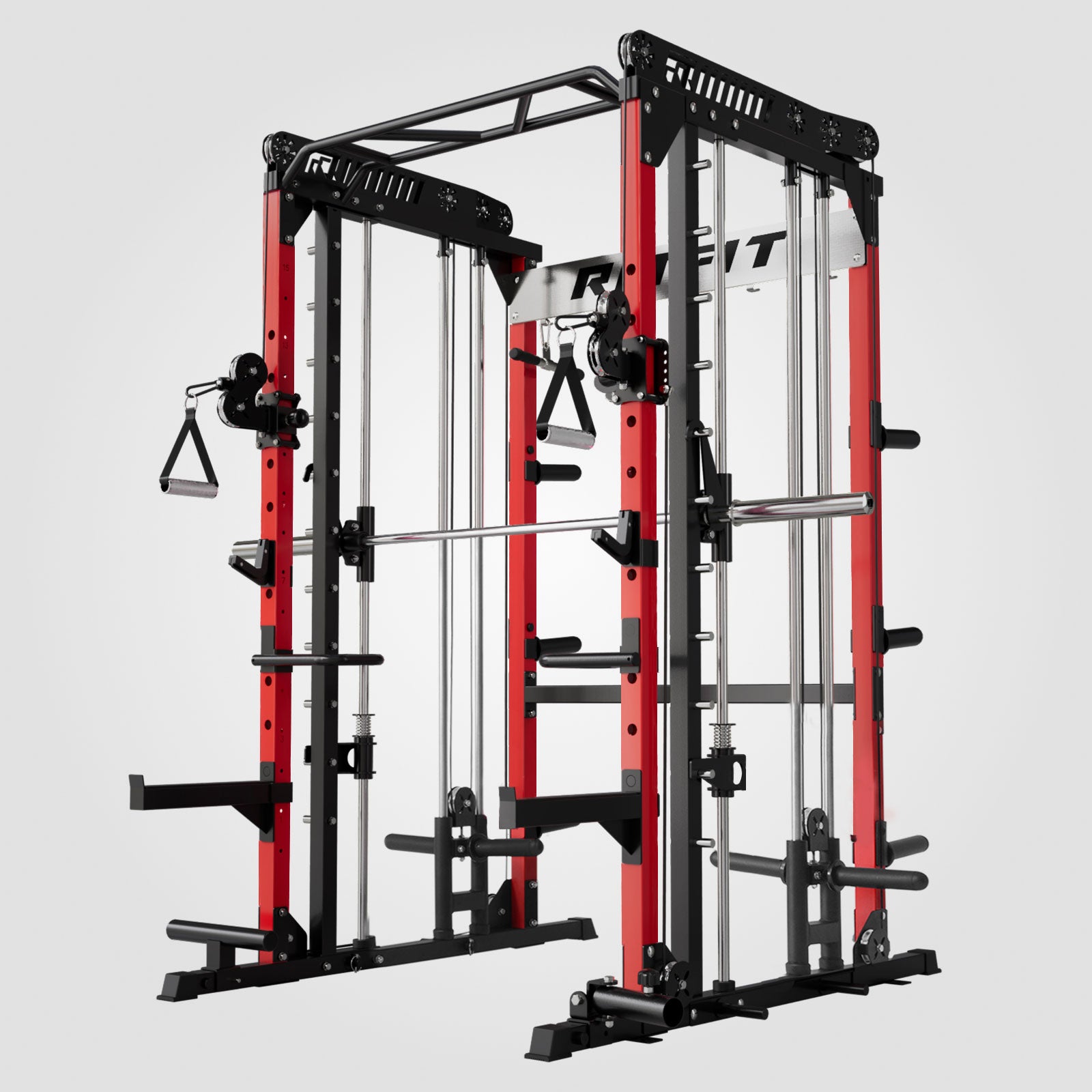
Most of them also need a power rack, whether it is a basic pair of uprights, a folding rack, a power cage, or a Smith machine and power rack combination. This guide breaks down the top power rack exercises, the muscles each one trains, and how to perform them safely in your home gym.
Quick Answer: The best power rack exercises are the barbell back squat, barbell bench press, and barbell standing press. Each compound lift trains multiple muscle groups, and the power rack's J-cups and safety bars support safe loading, unracking, and failure protection so you can train heavy at home.
Key Takeaways
- Compound first: Multi-muscle movements should anchor any serious training program.
- Squat: The barbell back squat is second to none for building total lower-body strength.
- Bench press: One of the three powerlifting competition lifts, it builds chest, triceps, and deltoids.
- Standing press: The overhead press builds shoulder strength plus balance and coordination.
- Rack safety: J-cups and safety bars let you lift heavy and fail reps without a spotter.
Why Is the Barbell Back Squat the Most Important Power Rack Exercise?
The barbell back squat is the most important power rack exercise because it develops total lower-body strength with the heaviest load your legs can move. Inside a power rack, J-cups let you unrack and re-rack the bar at shoulder height, and safety bars catch the bar if you miss a rep.
- Muscles worked: Quadriceps, gluteus maximus, gluteus minimus, hamstrings, and core.
- Heavier loading: The rack expands the weight you can use by letting you load the bar while it is racked, instead of cleaning it to your shoulders before every set.
- Failure safety: Safety bars catch a missed rep before the weight lands on you, which makes solo heavy squatting far less risky.
For lifters who train alone, a power cage with full safety bars is a smart upgrade over a bare rack, since it surrounds the lifter on every side.
"Strengthening the muscles around the knee is the way to go to get rid of some of this knee pain. A lot of us are probably using the wrong exercises and focusing on the wrong muscles."
Jeff Cavaliere, MSPT, CSCS, Athlean-X

Img source: www.liftmanual.com
How Does the Power Rack Make the Barbell Bench Press Safer?
The power rack makes the barbell bench press safer by holding the bar at a height you can unrack and re-rack without a spotter, and by catching the bar on safety bars set just under chest level if a rep fails. You bench inside the rack and can train alone with confidence.
- Muscles worked: Pectoralis major, pectoralis minor, triceps, and deltoids.
- Competition lift: Alongside the squat, the bench press is one of the three lifts contested in powerlifting meets.
- Fail safely: Set the safety bars just under chest level; if a rep fails, lean into the bench, let go of the bar, and the bars support the weight.
Without a rack or other uprights, you would need to clean the bar to your shoulders before lying down, then get the bar off after your last rep. A rack removes that risk entirely.

Img source: www.liftmanual.com
Which Power Rack Exercise Builds Shoulders and Balance Together?
The barbell standing press is the power rack exercise that builds shoulder strength while developing balance and coordination. Unracking from shoulder height inside the rack lets you start every set fresh, and the safety bars give you an escape route if you miss a lift.
- Muscles worked: Deltoids, trapezius, triceps, and core.
- Programming: The press is a staple in popular programs like 5/3/1 and Starting Strength.
- Floor protection: Safety bars catch a dropped barbell so steel plates do not damage your floor, though dropping from height should not become a habit.
As a standing compound exercise, the press also trains balance and coordination alongside the shoulders and triceps (Hedrick, 2016). To expand your home gym further, explore rack attachments or read our guide to power rack exercises beyond the big 3.

Img source: www.liftmanual.com
FAQs About Power Rack Exercises
What are the best power rack exercises?
The best power rack exercises are the barbell back squat, barbell bench press, and barbell standing press. These three compound lifts train the lower body, chest and triceps, and shoulders while engaging the core. Each one benefits from the rack's J-cups and safety bars, which support heavy loads and catch missed reps.
Do I need a power rack to do the big three lifts?
A power rack is strongly recommended for the barbell back squat, bench press, and standing press.
It holds the bar at shoulder height for easy unracking and re-racking, and its safety bars catch the weight if a rep fails.
Without a rack, you must clean the bar into position and manage a failed rep alone.
How does a power rack improve squat safety?
A power rack improves squat safety through its J-cups and safety bars. J-cups hold the loaded bar at shoulder height so you unrack and re-rack without a spotter, and safety bars catch the bar if you fail a rep. This allows heavier training with a much lower risk of injury.
Can I train alone with a power rack?
Yes.
The power rack is one of the best tools for solo training because its safety bars catch the barbell on a failed rep.
For bench presses, set the bars just under chest level, and for squats set them just below the bottom of your range of motion.
Always use safety bars when lifting near failure.
Which power rack exercise is best for shoulders?
The barbell standing press is the best power rack exercise for shoulder strength. It works the deltoids, trapezius, triceps, and core while also developing balance and coordination. Unracking from shoulder height inside the rack lets you start each set fresh, and the safety bars offer an escape route on a missed rep.
What is the difference between a power rack and a squat rack?
A power rack is a four-post steel cage with adjustable J-cups, safety bars, and optional attachments such as pull-up bars and dip handles, while a squat rack is a simpler open stand with fewer safety features. For serious home strength training, a full power rack offers more protection and versatility.
Conclusion
These three power rack exercises, the barbell back squat, bench press, and standing press, are the most efficient way to build serious strength at home, and each one benefits from the rack's J-cups and safety bars.
Start with a solid rack, a barbell, and a set of plates, then add load steadily, explore all-in-one rack machines, or check current deals to finish your setup.
Disclaimer
This article is for general informational and educational purposes only and is not a substitute for professional medical or training advice. Consult a qualified coach or healthcare provider before starting a new strength program, and always use spotters or safety bars when lifting heavy weights.