








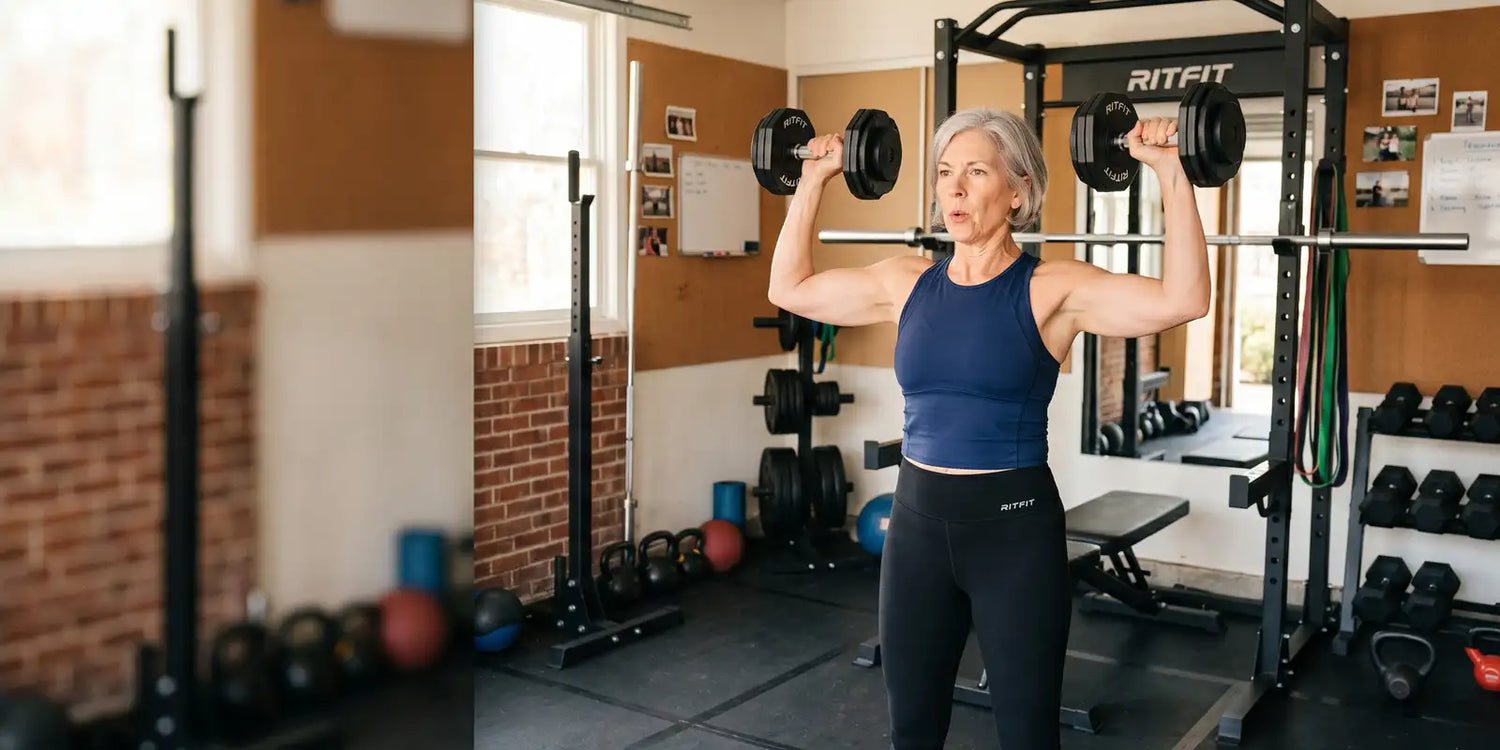
Sarcopenia, the progressive loss of muscle mass and strength with age, affects a significant share of adults over 55 and sharply raises the risk of falls, frailty, and loss of independence. Research confirms that resistance training is the most effective first-line intervention to slow, halt, or even reverse this decline.[1]
This guide explains what sarcopenia is, why it starts earlier than most people realize, and how to build a practical home resistance training program using dumbbells, resistance bands, or a cable machine.
Table of Contents
Key Takeaways
- Starts Earlier Than You Think: Muscle loss typically begins around age 40 and accelerates after 60, making early action the most effective prevention strategy.
- Resistance Training Is First-Line: A 2025 systematic review of 24 RCTs found resistance training significantly improves handgrip strength, gait speed, and functional performance in older adults with sarcopenia.
- Evidence-Based Dose Works: Pooled evidence from a 2026 systematic review reports approximately 30-60% gains in muscle strength and approximately 1.1 kg increase in lean mass with a prescription of 60-80% 1RM, 2-3 sessions per week, for 8-12 weeks.
- Home Equipment Is Sufficient: Adjustable dumbbells, resistance bands, and a cable machine all support effective sarcopenia-focused training without a gym membership.
- Safe for Adults 55+: Evidence-based guidelines endorse resistance training for older adults when intensity is introduced gradually and proper form is maintained throughout.
What Is Sarcopenia?
Sarcopenia is a progressive skeletal muscle disease defined by low muscle mass combined with reduced strength or physical performance, officially recognized by the WHO as a major driver of frailty and disability in older adults. Research notes sarcopenia prevalence has doubled in recent decades, linked to aging, sedentary lifestyles, and poor nutrition.
When Does Muscle Loss Begin?
Muscle mass begins declining around age 40, with losses accelerating significantly after 60, particularly in the lower limbs where the effects on mobility and balance are most pronounced.
Consequences of Untreated Sarcopenia
Without intervention, sarcopenia creates a downward spiral where weaker muscles reduce activity, which in turn accelerates further muscle loss and raises fall risk.
- Fall Risk: Weakened lower limbs directly increase the likelihood of falls and fractures.
- Reduced Mobility: Slower gait speed and declining balance undermine independence in daily tasks.
- Metabolic Impact: Less muscle mass lowers resting metabolic rate and impairs glucose regulation.
- Functional Decline: Everyday actions such as climbing stairs or rising from a chair become increasingly difficult, reducing quality of life across all major muscle groups.
Why Resistance Training Is the #1 Evidence-Based Strategy
Resistance training is the gold standard for combating sarcopenia because it triggers the muscle-building adaptations that aerobic exercise alone cannot provide. Only resistance work generates the mechanical tension and metabolic stress needed to activate satellite cells, drive protein synthesis, and preserve appendicular skeletal muscle mass.
How Resistance Training Reverses Sarcopenia vs. Cardio Alone
Cardio supports cardiovascular health and general mobility, but it does not produce the stimulus required to rebuild lost muscle tissue the way resistance training does.[1]
| Factor | Resistance Training | Cardio Training |
|---|---|---|
| Muscle Mass | Increases lean mass | Minimal effect on mass |
| Muscle Strength | Significant gains | Limited strength gains |
| Functional Performance | Improves gait, balance, TUG | Moderate mobility benefit |
| Bone Density | Positive loading stimulus | Weight-bearing cardio helps |
| Sarcopenia Reversal | First-line intervention | Complementary, not primary |
A 2025 systematic review of 24 RCTs covering 951 participants found resistance training significantly improved handgrip strength, gait speed, and timed up-and-go test performance in older adults with sarcopenia, with an optimal dose of 1,220 MET-min/week for handgrip and a minimal effective dose of 600 MET-min/week for gait speed improvements.
This lecture by UBC researcher Teresa Liu-Ambrose covers why resistance training is particularly powerful for older adults looking to maintain independence and function.
Evidence-Based Resistance Training Prescription for Sarcopenia
Getting the dose right is as important as showing up to train. Evidence from multiple large-scale reviews points to a consistent prescription range that balances effectiveness with safety for adults 55+, and understanding what is a rep in strength training is the first building block.
Frequency, Intensity, Volume (FITT Framework)
A 2025 clinical guideline synthesizing 42 RCTs recommends resistance training at least 3 times per week for 24 weeks at 60-80% of 1RM, 10-15 reps across 2-3 sets, with sessions lasting at least 30 minutes, supported by Level I evidence, Grade A.[3]
| FITT Component | Recommended Range | Beginner Entry Point |
|---|---|---|
| Frequency | 3 times/week | 2 times/week |
| Intensity | 60-80% 1RM | Light to moderate load |
| Sets | 2-3 sets | 1-2 sets |
| Reps | 10-15 reps | 10-15 reps |
| Session Duration | 30 min or more | 20-30 min |
| Program Length | 24 weeks minimum | 8-12 weeks to first review |
Progression and Progressive Overload
Progressive overload drives ongoing adaptation, meaning you must incrementally increase resistance, volume, or frequency over time to continue building muscle.[2]
- Load Increase: Once you complete all prescribed reps with good form across two consecutive sessions, add the smallest weight increment available.
- Volume Increase: Add a third set before increasing load if joint comfort is a concern.
- Frequency Increase: Move from 2 to 3 sessions per week after the first 4-6 weeks, following evidence-based guidelines for maximizing muscle strength in sarcopenic adults.
Pooled evidence from a 2026 systematic review reports approximately 30-60% gains in muscle strength and approximately 5-10% increases in lean mass, with a confirmed average of approximately 1.1 kg increase in lean mass among sarcopenic older adults following this evidence-based prescription.
6 Key Exercises for Sarcopenia (with Cues)
The most effective sarcopenia program targets all major muscle groups, with particular emphasis on the lower body where age-related decline typically begins fastest.
Lower Body: Goblet Squat, Romanian Deadlift, Leg Press
These three movements cover the quads, glutes, hamstrings, and calves, forming the foundation of any sarcopenia program designed to build leg muscle and reduce fall risk.
- Goblet Squat: Hold a dumbbell at chest height, squat until thighs are parallel to the floor, then drive through the heels to stand. Trains quads, glutes, and core simultaneously.
- Romanian Deadlift (RDL): Hinge at the hips with a soft knee bend, lower the weight along the shins, then drive the hips forward to return to standing. Targets the posterior chain for fall prevention.
- Leg Press: A machine-supported alternative for those with balance limitations; allows heavy lower-body loading with spinal support.
Upper Body and Core: Seated Row, Overhead Press, Dumbbell Curl
Upper body pulling and pressing strength combats postural decline, while core stability is foundational for safe movement in all daily activities.
- Seated Row: Strengthens upper back and rear deltoids; promotes upright posture and counters the forward rounding common in older adults.
- Overhead Press: Builds shoulder stability for overhead reaching, with a seated variation available for those with balance concerns.
- Dumbbell Curl: Targets the biceps and forearms to maintain grip strength, which is itself a validated clinical marker of sarcopenia progression.
Home Gym Equipment Guide for Sarcopenia Training
You do not need a commercial gym to run an effective sarcopenia program. The right home equipment covers all six exercises above and scales with your progress, starting with the best home gym equipment for seniors as a broader reference.
Dumbbells and Adjustable Weights
Adjustable dumbbells offer the most versatility across all six exercises and allow easy load progression in small increments. Explore a range of options for adjustable dumbbells for beginners to find a weight range that matches your current strength level.
Resistance Bands for Low-Impact Entry
Resistance bands provide a gentler entry point for adults with joint sensitivity or those new to strength training, and evidence suggests consistent use with progressive tension can produce meaningful strength gains. You can explore a full selection of resistance bands suited to different resistance levels and exercise types.
Cable Machine or Functional Trainer
A cable machine delivers smooth, adjustable resistance throughout the full range of motion, making it especially well suited for seated rows, pull-downs, and single-limb exercises that challenge balance safely. Browse compact home-compatible options in the functional training equipment collection to find a setup that fits your space.
Safety Tips and When to Progress
Resistance training is safe for adults 55+ when intensity is introduced gradually and technique is prioritized over load. Evidence-based guidelines endorse this training modality for older adults, including those over 70, provided a sensible ramp-up protocol is followed.[3]
- Start with Technique: Spend the first two weeks focusing on movement patterns at a light load before adding resistance.
- Warm Up Every Session: Five to ten minutes of light cardio or dynamic stretching prepares joints and reduces injury risk.
- Rest Between Sessions: Allow at least 48 hours between sessions targeting the same muscle groups to support recovery and adaptation.
- Monitor Pain vs. Fatigue: Muscle fatigue during a set is expected and productive; sharp joint pain is a signal to stop and reassess form or load.
- Progress Gradually: Follow the progressive overload principles in the prescription section; avoid large load jumps of more than one increment per session.
- Consult a Professional: If you have cardiovascular conditions, osteoporosis, or recent joint replacements, consult a qualified healthcare professional before starting a new program.
FAQs About Resistance Training for Sarcopenia
What is sarcopenia and how do I know if I have it?
Sarcopenia is a progressive loss of muscle mass, strength, and physical function that typically begins in your 40s and accelerates after 60. Clinical markers include low handgrip strength, slow gait speed, and difficulty rising from a chair, though a formal diagnosis requires assessment by a healthcare professional.
How long does it take to see results from resistance training for sarcopenia?
Strength gains often appear within the first 4 to 8 weeks as the nervous system adapts, while meaningful increases in lean mass take longer and vary by individual. Evidence-based guidelines recommend committing to at least 12 to 24 weeks before evaluating clinically significant improvements in muscle mass and functional performance.
Is resistance training safe for adults over 70 with sarcopenia?
Yes. Major sports medicine organizations endorse resistance training for adults over 70 when proper form is used and intensity is introduced gradually. Starting at a light to moderate load and progressing slowly keeps injury risk minimal, and the functional benefits, including improved gait and reduced fall risk, consistently outweigh the risks of inactivity.
Can I use resistance bands instead of dumbbells for sarcopenia training?
Yes. Resistance bands can deliver sufficient mechanical tension to stimulate muscle protein synthesis and produce meaningful strength gains when used consistently with progressive resistance. They are a practical entry point for adults with joint concerns, though adjustable dumbbells and cable machines offer more precise load progression as you advance.
Does walking help with sarcopenia?
No, not on its own. Walking supports cardiovascular health and general mobility but does not provide the mechanical tension required to rebuild lost muscle mass or significantly improve muscle strength. Resistance training is the primary intervention for sarcopenia, with walking serving as a complementary activity on rest days to maintain overall physical function.
What muscle groups are most affected by sarcopenia?
The lower limbs, particularly the quadriceps, hamstrings, and hip muscles, show the fastest decline and have the greatest impact on fall risk and daily mobility. Upper body muscles including the grip, shoulder, and back also weaken with age, making a full-body resistance program the most effective approach to sarcopenia management.
How many days per week should I do resistance training for sarcopenia?
Evidence-based guidelines recommend at least 3 sessions per week for optimal results, with a minimum of 2 sessions per week for beginners or those with time constraints. Allowing 48 hours of recovery between sessions targeting the same muscle groups is important for reducing soreness and supporting long-term adaptation.
Conclusion
Sarcopenia is not an inevitable consequence of aging, and resistance training is the most evidence-backed tool available to slow or reverse it. A consistent program of 2 to 3 sessions per week using dumbbells, resistance bands, or a cable machine can deliver real improvements in strength, lean mass, and functional performance.
If you are new to resistance training, start with light loads and two sessions per week, focus on the six foundational exercises in this guide, and build gradually over 12 to 24 weeks. The earlier you start, the greater the benefit.
Disclaimer
This article is for general informational and educational purposes only and does not constitute medical or fitness advice.
Consult a qualified healthcare professional before starting any new exercise program, especially if you have existing health conditions, recent injuries, or have been diagnosed with sarcopenia or a related condition. Individual results vary based on age, health status, and program adherence.
References
- Beckwée D, et al. Exercise for sarcopenia in older people: a systematic review and network meta-analysis. J Cachexia Sarcopenia Muscle. 2023. https://pmc.ncbi.nlm.nih.gov/articles/PMC10235889/
- Beckwée D, Delaere A, Aelbrecht S, et al. Resistance exercise as a treatment for sarcopenia: prescription and delivery. Age Ageing. 2022;51(2):afac003. https://pmc.ncbi.nlm.nih.gov/articles/PMC8840798/
- Korean Working Group on Sarcopenia. Evidence-based exercise guidelines for sarcopenia in older adults: insights from the Korean Working Group on Sarcopenia. Ann Geriatr Med Res. 2025. https://pmc.ncbi.nlm.nih.gov/articles/PMC12489597/





