








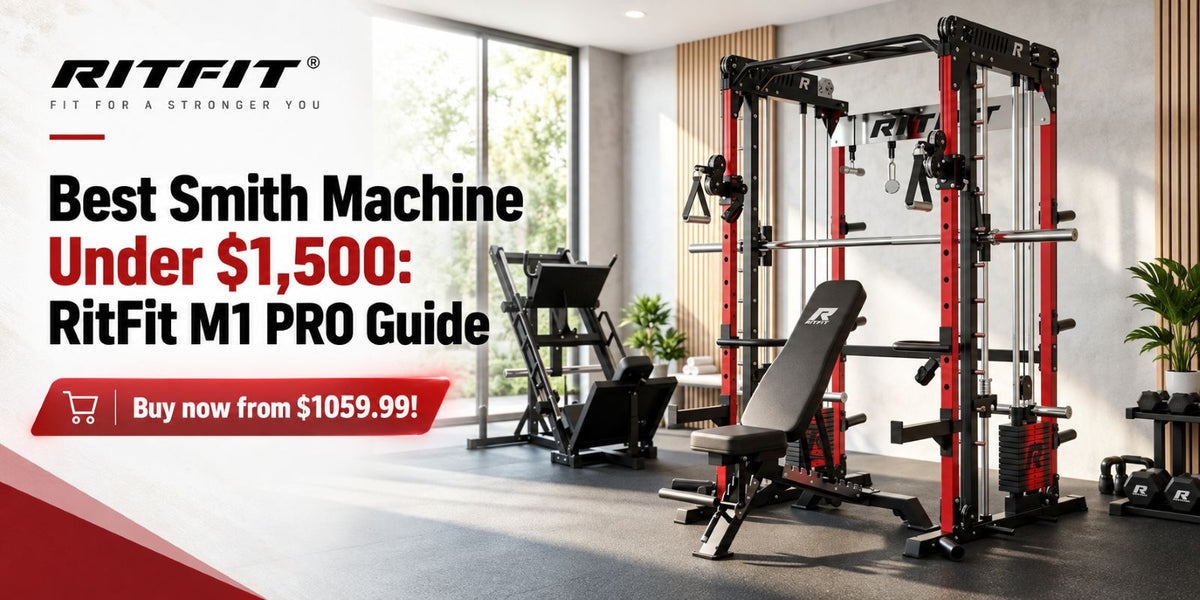
The RitFit M1 PRO is one of the strongest choices under $1,500 if you want guided bar work, dual cables, and rack utility in one frame. It fits buyers who want safer solo lifting, broad exercise variety, and a realistic home gym footprint, but it should be judged by room fit, cable convenience, and upgrade plans rather than price alone.
Quick Answer: The RitFit M1 PRO is a strong pick for the best Smith machine under $1,500 because it combines a guided Smith bar, dual cables, and rack utility in one frame. It suits safer solo lifting, broad exercise variety, and a compact home gym footprint, with an 85.3-inch height and a listed 1,600-pound frame capacity.
Key Takeaways
- All in one frame: The RitFit M1 PRO combines a Smith bar, dual cable system, and rack style training in one compact home gym frame.
- Room fit first: The published rack height is 85.3 inches, so room fit and usable clearance matter just as much as the listed footprint.
- Core numbers: The listed Smith bar weight is 33 pounds, the pulley ratio is 2 to 1, and the published frame capacity is 1,600 pounds.
- Assembly reality: The manual calls for two person assembly, staged bolt tightening, and lubrication of guide rails and bearings as needed.
- Best fit buyers: The value case is strongest for buyers who want safer solo training and all in one versatility without stepping into a much higher budget tier.
Who This Machine Fits Best
The M1 PRO fits home users who want one frame to handle guided compounds, cable accessories, and rack style work without filling the whole room. Resistance training supports strength, lean mass, and cardiometabolic health across adult populations, which is part of why a well chosen all in one home setup can be a practical long term investment.[1]
- Safer solo training: It is a strong fit if you want more control for squats, presses, lunges, and accessory lifts when no spotter is around.
- Broad exercise coverage: It is a strong fit if you want Smith work, cable work, and rack utility in the same station.
- Compact home gym planning: It is a strong fit if you want vertical storage and one central frame instead of several separate stations.
- Upgradeable setup: It is a strong fit if you want to start with a plate loaded system and add official upgrades later.
What Makes the Best Smith Machine Under $1,500?
The best Smith machine under $1,500 is not the one with the longest feature list, it is the one that gives the most useful training range, safety, and room efficiency for the money. In novice lifters, both machine based and free weight training can drive meaningful progress, so the better budget choice is often the system you can use consistently and safely in your real space.[2]
- Build quality: The frame should feel stable enough for controlled compound lifts, repeated cable use, and daily home training.
- Movement quality: A guided bar only feels valuable when the path is smooth and predictable under working loads.
- Training versatility: In this price tier, a Smith only unit is usually less compelling than a frame that also gives you cable work and rack support.
- Space efficiency: A practical footprint, vertical storage, and standard room compatibility matter more than showroom size.
- Ownership value: Good manuals, logical assembly, attachment compatibility, and realistic support matter just as much as headline specs.
If you are still comparing categories, the Smith machine vs power rack decision usually comes down to guided safety versus free weight priority. If your main question is broader function coverage, the functional trainer with Smith machine format is the most relevant comparison.
Overview of the RitFit M1 PRO
The RitFit M1 PRO is designed as an all in one home gym that merges guided bar training, adjustable dual cables, and rack style support into one station. It targets buyers who want more exercise coverage than a basic Smith machine without moving into a much higher price bracket.
Key Specs at a Glance
These are the core published details that shape how the machine fits, feels, and functions in a home gym. They matter more than marketing language because they affect room planning, cable feel, and day to day usability.
- Type: Hybrid Smith machine, cable system, and rack style home gym.
- Height: Published at 85.3 inches.
- Footprint: Published at 20.9 square feet.
- Frame capacity: Listed at 1,600 pounds.
- Pulley ratio: Listed at 2 to 1.
- Smith bar weight: Listed at 33 pounds.
- Core use case: Safer solo compounds, cable accessories, and general full body home training.
For buyers who want to view the current family of related options first, the RitFit Smith Machine collection is the cleanest starting point. If you already know you want the featured unit, you can compare this guide against the current RitFit M1 PRO product page.
"Great product. Still holding up beautifully over a year later even with rough use. Have had some great lifts on this and the hassle of going to a crowded gym/constant gym fees is not an issue anymore."
Mal, Verified Buyer, RitFit M1 PRO Multi-Functional Smith Machine with Cable Crossover System and Squat Rack for Home Gym
Design, Construction, and Build Quality
The M1 PRO is built for buyers who want one serious home frame instead of a room full of separate stations. Its design value comes from balancing rigidity, exercise range, and footprint efficiency rather than chasing oversized commercial proportions.

- Guided bar feel: The listed linear bearing Smith system is one of the most important build signals because it directly affects pressing, squatting, and controlled hypertrophy work.
- All in one frame logic: The main value is not just the Smith bar, it is the fact that the frame also covers cable work and rack style use.
- Room efficiency: Vertical plate storage and a combined structure help protect floor space in garages, spare rooms, and compact training areas.
- Budget realism: This is a value focused home gym frame, not a claim of oversized commercial club hardware.
Features and Training Versatility
The M1 PRO matters most because it gives you three useful training lanes in one machine, guided bar compounds, adjustable cable work, and rack style support. That is the reason it feels more complete than a budget Smith only frame.

- Guided compound training: It supports controlled squats, bench variations, overhead work, split squats, hip thrusts, and lunges.
- Adjustable cable work: The dual pulley setup expands chest, back, shoulders, arms, and rehab style movement options.
- Rack style flexibility: J hooks and safeties add free weight utility outside the Smith path, which broadens long term use.
- Exercise variety: The frame works well for strength work, hypertrophy work, and practical home gym circuits.
If cable convenience is one of your main decision points, read weight plates loaded vs weight stack smith machines before you buy. If you want more training examples, the Smith machine with cable system complete workout guide shows how this format expands exercise coverage.
"A functional trainer ranks high for its versatility, allowing you to recreate nearly any movement pattern you want, from curls and tricep pushdowns to face pulls and side lateral raises."
Jeff Cavaliere, MSPT, CSCS, Physical Therapist and Strength Coach, founder of ATHLEAN-X, Athlean-X
Space Needed for the RitFit M1 PRO
You need more than the listed footprint, because real training space includes plate loading room, bench travel, and front working clearance. The rack itself is listed at 85.3 inches tall, so an 8 foot room is the practical minimum, not the comfort target.
- Ceiling height: Plan around the full rack height plus real user clearance for pull up attempts, top reach, and hand placement.
- Side clearance: Leave enough room to load plates comfortably without scraping walls or storage items.
- Front clearance: Leave enough room for a bench, incline setup, lunges, and cable movements.
- Traffic flow: Keep enough open space to move around the frame safely during setup and transitions.
If low ceilings are part of your buying decision, compare this size profile with the best Smith machine for low ceilings. If your room is more flexible, a compact all in one frame still benefits from measured clearance rather than guesswork.
"This is the perfect home gym for my family to use and fits great in our space. Exceptional customer service throughout the selection process. They were very responsive to questions with quick follow up. Would recommend to anyone."
Daniel T. Verified Buyer, RitFit M1 PRO Multi-Functional Smith Machine with Cable Crossover System and Squat Rack for Home Gym
Installation and Assembly Guide Based on the Manual
The assembly guide below is meant to complement the manual, not replace it. Follow the manual as the main source of truth for part order, hardware, and safety steps.
Before You Start
Assembly goes more smoothly when the room is cleared first and the hardware is sorted before the frame goes up. The manual repeatedly points to two person assembly, and that is the right expectation for a machine of this size.
- People: Use two adults for lifting, aligning, and stabilizing major frame sections.
- Tools: Use the included tools and keep lubricating oil ready for the guide system and moving parts as needed.
- Floor prep: Build on a level surface with enough open space around all sides of the frame.
- Fastener control: Lay out bolts and accessories first so similar parts do not get mixed up.
Assembly Sequencing Rules
The most important sequencing rule is simple, do not fully tighten the main frame too early. Hand tightening first and final tightening only after the structure is squared helps prevent twist, warp, and misalignment.
- Main frame first: Build the primary structure before chasing small finishing steps.
- Stage tightening: Snug the bolts, check level and alignment, then tighten fully once the frame is sitting correctly.
- Smith parts: Install the Smith guide components carefully and test bar engagement across the available hook positions before loading weight.
- Cable check: Confirm pulley travel, cable routing, and smooth adjustment after the main build is complete.
First Adjustment and Break In
Your first goal after assembly is not a heavy session, it is a clean function check. Test bar engagement, cable travel, hardware tightness, and guide smoothness before you load plates for real work.
- Guide test: Rack and unrack the Smith bar at multiple heights to confirm predictable engagement.
- Cable test: Move through the adjustment range and confirm pulleys spin freely with no drag or twist.
- Lubrication: Lubricate guide rails and bearings as needed, especially if you notice noise or rough travel.
- Recheck: After the first week, recheck bolt tightness and cable routing once the frame has settled into use.
Safety, Durability, and Maintenance
The M1 PRO is most appealing when you want more control for solo training, because the guided path and safety setup reduce decision stress under fatigue. Traditional strength training also shows a favorable safety profile when progression and exercise selection are managed well, which supports a calm, controlled setup approach at home.[3]

- Safety stops: Set the travel limit before hard sets so a missed rep does not turn into a guessing game.
- Load discipline: Start with conservative loads until you understand the guide feel, racking rhythm, and cable resistance.
- Maintenance rhythm: Wipe the guide surfaces, inspect the cables, and lubricate moving parts as needed.
- Real world safety: Even a guided system still depends on correct setup, range control, and sensible progression.
If solo training is one of your top reasons for shopping this category, read why a Smith machine is ideal for safe solo workouts at home. That context helps explain why guided bar systems remain so popular in garage and spare room gyms.
Value for Money, Is the RitFit M1 PRO Worth It?
The M1 PRO is worth shortlisting if your goal is maximum training coverage per square foot and per dollar. Its value is strongest when you want guided bar training, adjustable cables, and rack style support in one machine rather than buying several separate pieces.
- Best value case: Solo lifters, space limited buyers, and users building a serious first home gym usually see the clearest return.
- Less ideal case: Buyers who care more about instant cable changes than upfront savings may prefer moving up to a selectorized option later.
- Practical value: One complete frame can simplify planning, save floor space, and reduce the need for overlapping equipment purchases.
If you already know convenience is your top priority, compare this plate loaded setup with a selectorized alternative through best Smith machine with weight stack. If you are comparing all in one formats more broadly, the M1 PRO usually makes the most sense when space and budget have equal importance.
"Love it. Definitely worth every penny. Easy to build. Highly recommend all their products."
Marc L. Verified Buyer, RitFit M1 PRO Multi-Functional Smith Machine with Cable Crossover System and Squat Rack for Home Gym
Alternatives and Competitors Under $1,500
Under $1,500, most alternatives force a tradeoff, not a miracle. Basic Smith only frames often cut versatility, while simpler rack first setups improve free weight focus but give up the guided bar and integrated cable convenience that make the M1 PRO category attractive.
| Buying Priority | RitFit M1 PRO Style Setup | Simpler Budget Alternative |
|---|---|---|
| Exercise Variety | Higher, because you get guided bar, cables, and rack style work in one frame | Usually lower, because one lane of training is often missing |
| Space Efficiency | Stronger for one frame home gyms | Varies, and may require more separate pieces over time |
| Cable Convenience | Good, but plate changes still take time | Often limited or absent at this budget level |
| Best For | Buyers who want a balanced all in one setup | Buyers with a narrower training focus or a simpler starter plan |
If your comparison is really about training style, the sharper question is often not brand versus brand, but guided versatility versus rack first freedom. That is why this price tier should be judged by tradeoffs, not by spec inflation alone.
Buying Guide, How to Choose the Right Smith Machine Under $1,500
The right choice starts with how you actually train, not with which model sounds most impressive on a product card. Expert consensus for novices favors stable and easy to learn exercise choices first, which is one reason guided bar and cable combinations appeal to many first time home buyers.[4]
- Measure ceiling height first: Confirm the full rack height and your usable hand clearance before you fall in love with a machine.
- Measure real working space: Count room for plate loading, bench movement, front stance work, and cable reach.
- Choose your cable preference: Decide whether lower price or faster cable changes matters more to your daily training flow.
- Check included parts: Review whether safeties, hooks, attachments, and accessories are included or still on your shopping list.
- Think about solo use: If you train alone most of the time, guided bar confidence and safety setup matter more than abstract spec talk.
- Plan the full setup: Budget for a bench, plates, flooring, and the attachments you already know you will want.
If you are shopping for a first serious setup, the best comparison may be best Smith machine for beginners. If you already own free weight basics, your decision may lean more toward whether the cable and Smith combination fills a real gap.
Setup Suggestions and Sample Workouts
The best setup uses the machine as a transition friendly home training hub, not just a bar on rails. Beginners can still gain strength from relatively low weekly training doses when effort and consistency are solid, which makes an efficient home station especially practical for busy schedules.[5]
Pair the frame with an adjustable bench, a practical plate set, and enough clearance for cable angles and bench travel. The RitFit GATOR adjustable bench is the type of add on that makes the station feel more complete for pressing, rowing, and incline work.
Sample Full Body Workout
This format works well when you want one efficient session with low setup friction. It covers lower body strength, upper body pressing, pulling volume, and simple accessory work.
- Smith Squat: 3 sets of 8 to 10 reps.
- Incline Press: 3 sets of 8 to 12 reps.
- Cable Row: 3 sets of 10 to 15 reps.
- Overhead Press: 3 sets of 8 to 10 reps.
- Tricep Pushdown: 3 sets of 12 to 15 reps.
Sample Push Focus Workout
This version is useful when you want more chest, shoulders, and triceps volume with fewer exercise changes. It is also a practical template for home users who train with limited time and limited stations.
- Smith Flat Bench Press: 4 sets of 6 to 10 reps.
- Cable Chest Fly: 3 sets of 10 to 15 reps.
- Smith Overhead Press: 3 sets of 8 to 10 reps.
- Cable Lateral Raise: 3 sets of 12 to 15 reps.
- Cable Pushdown: 3 sets of 12 to 15 reps.
Sample Pull Focus Workout
This version is useful when you want upper back, lats, rear delts, and arm work from one station. It works especially well when you value smooth exercise transitions over moving around a crowded gym.
- Pull Up or Assisted Pull Up Variation: 3 sets close to technical fatigue.
- Cable Row: 4 sets of 8 to 12 reps.
- Single Arm High Cable Pull: 3 sets of 10 to 12 reps per side.
- Cable Rear Delt Fly: 3 sets of 12 to 15 reps.
- Cable Curl: 3 sets of 10 to 15 reps.
RitFit M1 PRO Compatible Attachments Overview
The official attachment path is one of the M1 PRO's strongest ownership advantages because it lets you improve convenience or exercise coverage without replacing the whole frame. The smartest first upgrade is usually the one that removes your biggest daily bottleneck.
- Weight and resistance upgrade: The WSM1 weight stack set is the most practical add on if you already know faster cable changes will matter to your weekly training flow.
- Lat pulldown and leg support: The LPM1 bundle is a strong early upgrade if you want more dedicated back work and better hold down support.
- Lever style expansion: The LAM1 and TAM1 style upgrades make more sense after your base setup is already complete and regularly used.
- Frame and rack accessories: Items like upgraded J hooks and the FUM1 upright expansion are more useful when you know exactly how you want to expand your training layout.
If attachments are central to your buying decision, the best next read is RitFit Smith machine attachments, best home gym upgrades guide. It helps you decide whether convenience, pulldown capacity, or expansion versatility should come first.
"Couldn't ask for a better machine. Bought during Novembers specials. Came with extras. Install took approx. 2 hours. Pulleys do not get caught, and are smooth. All attachments seem to work as intended, not one for using extremely heavy weight."
josh g. Verified Buyer, RitFit M1 PRO Multi-Functional Smith Machine with Cable Crossover System and Squat Rack for Home Gym
FAQs About the Best Smith Machine Under $1,500
What makes the RitFit M1 PRO a strong smith machine under 1500 dollars?
The M1 PRO stands out because it combines guided bar training, dual cable work, and rack utility in one compact frame. That mix gives many home users more exercise coverage per dollar than a single purpose smith machine, especially when space, solo training, and upgrade flexibility matter most.
Is the RitFit M1 PRO enough for a full home gym?
Yes.
The RitFit M1 PRO can cover most full body home training needs, because it supports squats, presses, rows, pulldown style work, and many cable accessories.
It is less ideal only for buyers who want instant selectorized cable changes or a larger commercial style training station.
How much space does the RitFit M1 PRO smith machine need?
The listed rack height is 85.3 inches, so an 8 foot room is the practical minimum, not the comfort target. You should also leave side clearance for plate loading and front clearance for bench movement, lunges, and cable work, so real usable space matters more than the stated footprint alone.
Should you choose a plate loaded or weight stack smith machine?
It depends on your budget and training style. Plate loaded systems usually cost less and keep the frame more affordable, while weight stacks make cable changes faster and easier, which can improve workout flow if you do many accessory movements in the same session.
Can beginners use the RitFit M1 PRO safely at home?
Yes.
Beginners can use the RitFit M1 PRO safely when they set safeties correctly, load conservatively, and learn the bar path before training hard.
The guided smith track can reduce setup stress for solo users, but it does not replace careful technique, range control, and progressive loading.
How hard is RitFit M1 PRO assembly for first time buyers?
The assembly is manageable, but it is not a one person quick build. Two people, careful hardware sorting, staged bolt tightening, and a final alignment check make a big difference, because rushing the main frame or smith parts can create avoidable frustration and slower first use.
Which RitFit M1 PRO attachments are most worth buying first?
The best first attachment depends on what your program lacks most. Choose the weight stack if convenience is your main pain point, choose the lat pulldown and leg holder bundle if you need better back training support, and choose lever style add ons only after your base setup is already complete.
Conclusion
The RitFit M1 PRO is one of the best value focused Smith machine options under $1,500 for buyers who want more than a basic guided bar. It makes the most sense for solo lifters, compact home gym planners, and users who want broad training coverage now with room to upgrade later.
If you are building a compact home gym and want a guided bar, dual cables, and rack utility in one frame, start by measuring your ceiling height and working footprint before you buy. You can explore current options and pricing through the RitFit sales page.
Disclaimer
This guide is informational and should not replace the official manual, product support, or professional coaching. Always measure your room, confirm current product specifications, assemble the frame exactly as instructed, and start with conservative loads until setup, bar path, and safety positions feel fully dialed in.
References
1. Paluch AE, Boyer WR, Franklin BA, et al. Resistance Exercise Training in Individuals With and Without Cardiovascular Disease: 2023 Update: A Scientific Statement From the American Heart Association. Circulation. 2024;149(3):e217-e231. doi:10.1161/CIR.0000000000001189
2. Aerenhouts D, D'Hondt E. Using Machines or Free Weights for Resistance Training in Novice Males? A Randomized Parallel Trial. Int J Environ Res Public Health. 2020;17(21):7848. doi:10.3390/ijerph17217848
3. Serafim TT, Oliveira ES de, Maffulli N, Migliorini F, Okubo R. Which resistance training is safest to practice? A systematic review. J Orthop Surg Res. 2023;18:296. doi:10.1186/s13018-023-03781-x
4. Kompf JM, Rhodes RE, Lee S. Selecting Resistance Training Exercises for Novices: A Delphi Study with Expert Consensus. Am J Lifestyle Med. 2022;19(3):437-449. doi:10.1177/15598276221115662
5. Behm DG, Granacher U, Warneke K, Aragão-Santos JC, da Silva-Grigoletto ME, Konrad A. Minimalist Training: Is Lower Dosage or Intensity Resistance Training Effective to Improve Physical Fitness? A Narrative Review. Sports Med. 2024;54(2):289-302. doi:10.1007/s40279-023-01949-3





