Table of Contents
A squat rack is usually the better choice for unrestricted bar path, free weight skill, and maximum carryover to barbell strength, while a Smith machine is usually the better choice for solo safety, movement stability, and controlled hypertrophy work. The right answer depends on your goal, training age, mobility, home gym setup, and how confident you feel training alone.
Key Takeaways
- Choose a squat rack for free weight skill: A rack trains bar control, balance, and full stabilization under load.
- Choose a Smith machine for solo safety: A guided bar path and quick re racking can make hard home gym sets feel more manageable.
- Both can build muscle: The better hypertrophy tool is the one that lets you apply enough effort, volume, and progression consistently.
- Neither tool fits every body the same way: Limb length, mobility, stance, and comfort all influence which setup feels better.
- A combo setup can make the most sense at home: Many lifters use a rack for primary strength work and a Smith machine for controlled accessory volume.
The Biomechanics: Stability vs Functionality
A squat rack lets the bar move freely, while a Smith machine guides it along a fixed track. That one difference changes how much stabilization, balance, and bar path control your body must provide on every rep.
The Squat Rack: More Freedom, More Stabilization
A squat rack usually feels more athletic because it lets you find your own bar path and coordinate the lift in open space. That freedom is a major advantage for lifters who want better transfer to barbell sport, general strength, and real free weight proficiency.
- Why it works: Your trunk, hips, feet, and upper back must all help keep the bar centered and moving efficiently.
- Who it suits best: It is usually the better fit for powerlifters, strength focused lifters, and anyone who wants to master barbell squats rather than machine constrained variations.
- Main tradeoff: That added freedom also raises the balance and technique demand, which can make hard solo sets feel riskier.
The Smith Machine: More Constraint, More Stability
A Smith machine usually feels easier to standardize because the bar path is guided and repeatable from rep to rep. Research comparing squat variations under different stabilities found higher peak force in the more stable Smith machine condition, which helps explain why many lifters feel more confident pushing hard there.[1]
- Why it works: The machine removes much of the balance task, so more attention can go to bracing, foot pressure, and target muscle effort.
- Who it suits best: It is often a strong option for solo home gym training, higher rep leg work, and lifters who want more setup consistency.
- Useful next reads: Start with what is a Smith machine, then review the ultimate guide to Smith machine squats and how to do a Smith machine front squat.
Hypertrophy: Which Builds More Muscle?
Both tools can build muscle very well, but they get there through slightly different strengths. A squat rack usually supports long term free weight progression, while a Smith machine often makes controlled high effort sets easier to repeat and recover from.
Why a Squat Rack Still Matters for Size
A squat rack remains excellent for muscle gain because heavy compound lifting can drive progressive overload across the legs, trunk, and upper back. It is often the better first choice when you want one main lower body lift that builds strength and size together.
- Big advantage: Free barbell squats let you train coordination and loading skill alongside muscle growth.
- Best use case: Use a rack when your program is built around back squats, front squats, and other foundational barbell patterns.
- Main limitation: Many lifters stop sets earlier than they need to when they train alone and do not feel confident failing safely.
Why a Smith Machine Works So Well for Hypertrophy
A Smith machine is highly effective for hypertrophy because it can make foot placement, tempo, and range of motion easier to repeat under fatigue. A recent meta analysis reported that proximity to failure can support hypertrophy outcomes, which is one reason stable, solo friendly setups appeal to physique focused lifters.[3]
- Big advantage: It is easier to bias quads or glutes with stance changes and keep constant tension on the target area.
- Best use case: Use it for hard squats, split squats, lunges, heel elevated quad work, and finishers after heavier free weight training.
- Useful next reads: Explore best Smith machine squat exercises and can you build muscle effectively with a Smith machine.
If you want more lower body variations on the machine side, check out the best Smith machine squat variations.
The Rehab and Adaptive Angle: When Stability Matters
A fixed path is not automatically better for every joint or every body, but it can be easier to manage when confidence, balance, or movement tolerance is limited. Clinical commentary on stable and unstable resistance training notes that stable environments generally preserve force output better, while less stable setups may be more useful when the goal is added trunk challenge or progressive rehabilitation exposure.[2]
When a Smith Machine May Be the Better Tool
A Smith machine may fit better when you train alone, feel uneasy under a free bar, or want a more repeatable squat pattern while rebuilding confidence. It can also help some lifters stay more upright and shift more emphasis toward the quads through stance and foot placement changes.
- Important caution: A fixed path can feel excellent for one lifter and awkward for another, so body proportions and setup still matter.
- Beginner support: Review is a Smith machine good for beginners and why a Smith machine is ideal for safe solo workouts at home.
- Best practice: If pain, surgery history, or active rehab is part of the picture, exercise selection should be cleared by a qualified clinician or coach.
Buying Guide: Which One Fits Your Home Gym?
Your best choice depends less on which tool sounds tougher and more on what you actually need from your home gym. A broad review of resistance training loading shows that heavier loading is especially relevant for maximal strength, while hypertrophy can be built across a wider loading range, which helps explain why both tools can make sense in different programs.[4]
| If Your Main Goal Is | Better First Choice | Why It Usually Wins |
|---|---|---|
| Maximal barbell strength | Squat Rack | You need unrestricted bar path, full stabilization demand, and direct practice with free loads. |
| Solo training safety | Smith Machine | A guided track and easier re racking make hard sets feel more controlled at home. |
| Beginner confidence | Smith Machine or Combo Unit | A more stable setup lowers the learning barrier and can make regular practice easier to start. |
| Bodybuilding leg volume | Smith Machine | It standardizes technique and makes hard fatigue work easier to repeat. |
| Long term free weight progression | Squat Rack | It teaches the exact coordination demands that matter most for barbell performance. |
Choose a Squat Rack First If
You want unrestricted barbell practice, long term strength carryover, and a simpler lower cost setup built around foundational free weight lifts. A rack is usually the smarter first purchase when training skill is as important to you as the weight on the bar.
- Best fit: Strength focused lifters, experienced barbell users, and home gym owners who already trust their spotting and safety setup.
- Typical add ons: A solid bench, safeties, plates, and enough clearance to load and unload confidently.
Choose a Smith Machine First If
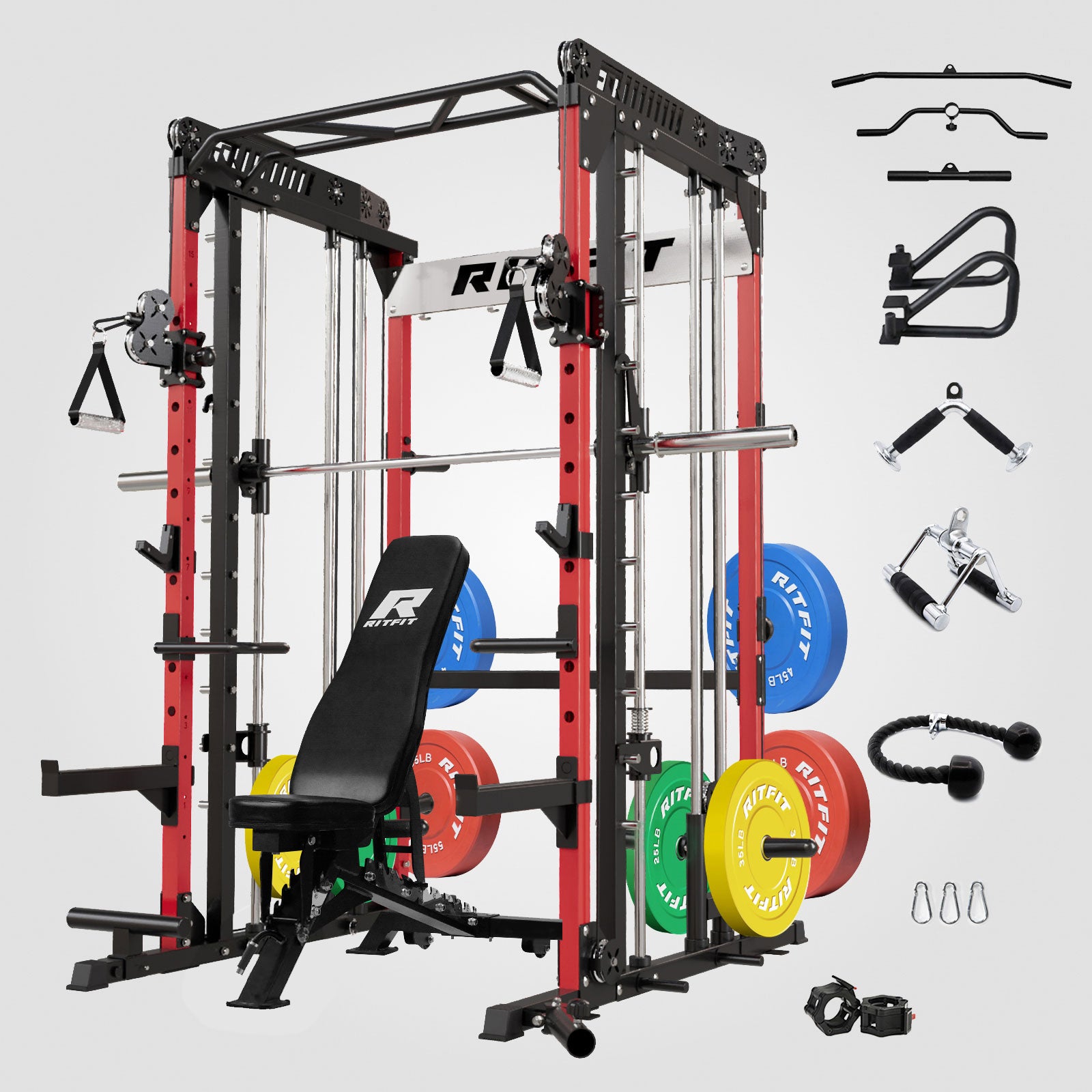
You train alone, value stable mechanics, or want one machine that lets you move between hard lower body work and more controlled upper body accessories. This is often the best fit for home gym owners who prioritize consistency, convenience, and confidence over pure free bar practice.
- Best fit: Beginners, physique focused lifters, and solo trainees who want easier failure management.
- Shopping path: Browse the Smith machine collection if you want to compare compact and all in one home gym options.
FAQs
What is better for beginners, a Smith machine or a squat rack?
A Smith machine is usually easier for beginners because the guided path lowers balance demands and can make solo practice less intimidating. A squat rack becomes more valuable when a beginner is ready to learn free bar control, bracing, and natural bar path mechanics.
Can a Smith machine build as much muscle as a squat rack?
Yes. A Smith machine can build plenty of muscle if you train hard, progress consistently, and choose exercises that match your goal. A squat rack may offer better free weight carryover, but muscle growth still comes from effort, volume, recovery, and sound exercise selection.
Is a squat rack better for strength than a Smith machine?
Usually. A squat rack is the better first choice for maximal barbell strength because it teaches you to control load in open space. A Smith machine can still improve leg strength, but the guided path changes the stabilization demand and limits direct transfer.
Does a Smith machine hurt your knees or back more than a squat rack?
No. A Smith machine is not automatically worse for your knees or back, but the fixed path can feel better for some lifters and worse for others. Your stance, proportions, mobility, and exercise setup matter more than the machine label alone.
Should I buy a Smith machine or a squat rack for a home gym?
Buy a Smith machine first if solo safety, stable training, and all in one convenience matter most in your home gym. Buy a squat rack first if you want unrestricted barbell practice, long term free weight progression, and a simpler lower cost strength setup.
How do I choose between a Smith machine and a squat rack for leg day?
Choose a squat rack when your main goal is free weight proficiency, heavy barbell progress, and full movement freedom on lower body lifts. Choose a Smith machine when you want repeatable technique, controlled hard sets, and easier access to quad focused accessories and finishers.
The Bottom Line
A squat rack is usually better for lifters who want unrestricted bar path, higher stabilization demand, and the strongest carryover to free barbell strength. A Smith machine is usually better for lifters who train alone, want more stability, or need a more controlled path for high effort hypertrophy work.
The best tool is not the one that sounds harder. It is the one that lets you train safely, progress consistently, and keep showing up in your actual home gym.
Disclaimer: This article is for general education and does not replace medical, physical therapy, or individualized coaching advice. If you have active pain, a recent injury, or a surgical history, get exercise clearance and technique guidance from a qualified professional before progressing your load.
References
- van den Tillaar R, Larsen S. Kinematic and EMG comparison between variations of unilateral squats under different stabilities. Sports Med Int Open. 2020;4(2):E59-E66. doi:10.1055/a-1195-1039. PMC7365712
- Behm DG, Colado JC. The effectiveness of resistance training using unstable surfaces and devices for rehabilitation. Int J Sports Phys Ther. 2012;7(2):226-241. PMC3325639
- Refalo MC, Helms ER, Trexler ET, Hamilton DL, Fyfe JJ. Influence of resistance training proximity to failure on skeletal muscle hypertrophy: a systematic review with meta analysis. Sports Med. 2023;53(3):649-665. doi:10.1007/s40279-022-01784-y. PMC9908800
- Schoenfeld BJ, Grgic J, Van Every DW, Plotkin DL. Loading recommendations for muscle strength, hypertrophy, and local endurance: a re examination of the repetition continuum. Sports (Basel). 2021;9(2):32. doi:10.3390/sports9020032. PMC7927075