A smith machine workout routine plan gives you a complete weekly structure, not just a list of isolated lifts. This guide lays out a follow-along 3-day full-body program with exact sets, reps, rest, weight selection, and progression.
It suits beginner and intermediate lifters training at home or in the gym. You will learn how to start, when to add load, what to swap, and when to stop a set safely.
Quick Answer
A smith machine workout routine plan works best as a 3-day full-body split done on non-consecutive days. Each session pairs compound lifts like squats, presses, and rows at 3 sets of 8 to 15 reps, with weight added gradually through progressive overload as your form and strength improve.
Key Takeaways
- Full-body, 3 days: Train every major muscle group three non-consecutive days per week for balanced progress.
- Guided path helps form: The fixed bar lets you load compound lifts while learning movement patterns safely.
- Start light, then add: Begin with manageable loads and use progressive overload to drive strength and size.
- Swaps keep you moving: Every lift has a substitution so awkward or uncomfortable movements never stall your session.
- Form before weight: Stop a set when technique breaks down or sharp pain appears, not when the rep count ends.
Why a Smith Machine Suits a Structured Routine
The Smith machine suits a structured routine because its guided bar path lets you focus on effort and reps instead of balancing the load. This stability makes it easier to follow a fixed weekly plan and progress consistently.
- Predictable loading: The fixed track means you can repeat the same movement pattern session after session and track small weight jumps.
- Beginner confidence: New lifters can attempt squats and presses without fear of dropping a free barbell.
- Built-in safety stops: The hook system lets you rerack mid-rep, so you can train near your limit more safely.
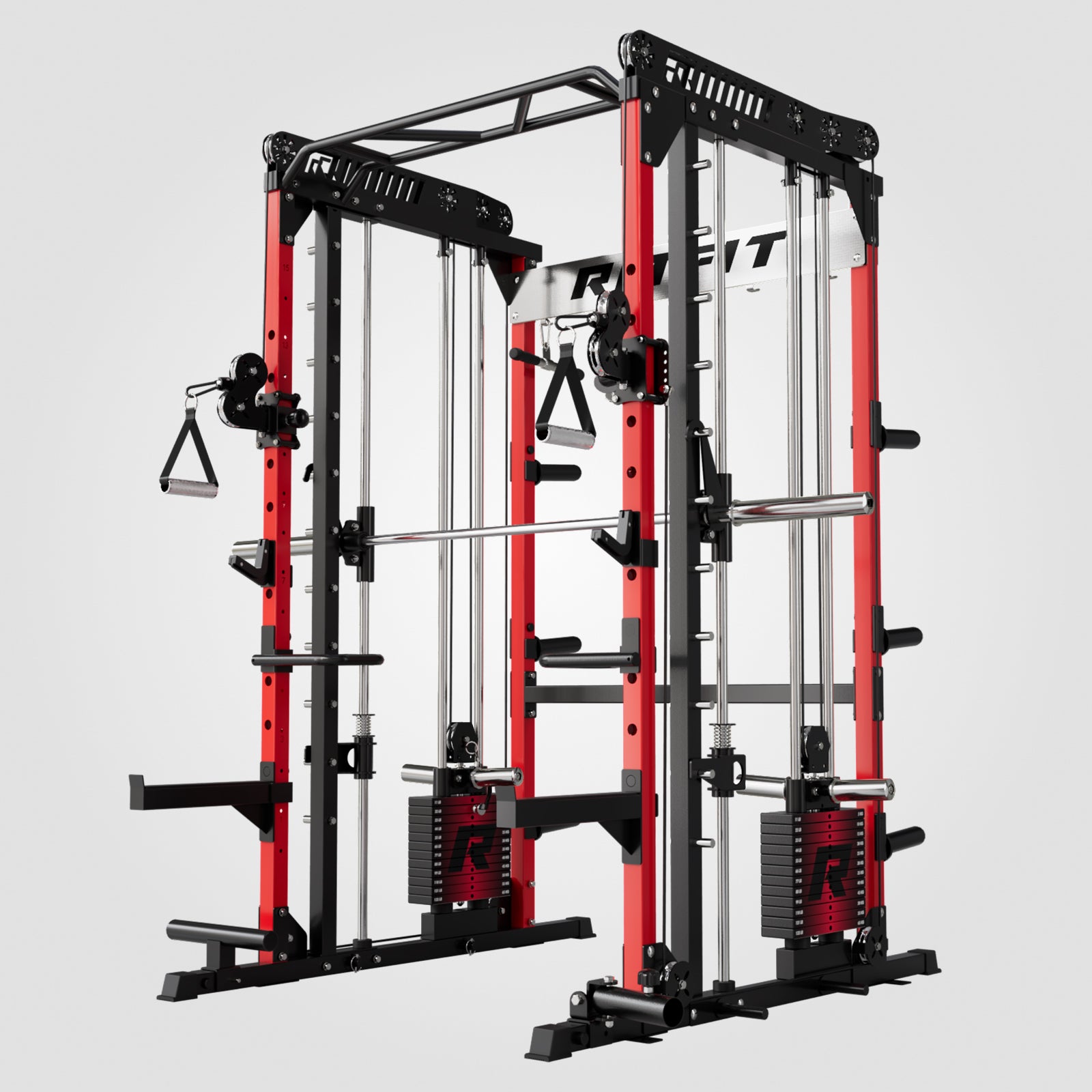
This makes it a strong base for a full program. Start with the versatile multifunctional Smith machine, and if you are new, read what a Smith machine is first.
What the Evidence Says About Machine Training
Machine-based training can build muscle and strength comparably to free weights over a typical training block. This means a Smith machine routine is a legitimate path to results, not a watered-down option.
One study found that free-weight-only and machine-only training produced similar increases in muscle size and strength over 8 weeks in subjects with about 2 years of training experience.[1] Researchers also noted that the more stable Smith machine bench press suits untrained participants who have not yet developed the stabilization needed for free-weight pressing.[1]
In one study of trained sprinters, squat jump heights were similar between Smith machine and free-weight execution across loads from 40 to 120 percent of body mass.[2] The takeaway is that the guided path does not automatically blunt your output.
"Both machines and free weight movements have a place in a hypertrophy-oriented routine as they complement each other in terms of their strengths and weaknesses."
Brad Schoenfeld, PhD, Exercise Science Researcher, CUNY Lehman College
The 3-Day Full-Body Smith Machine Routine
The 3-day routine trains your whole body across three sessions, each built around stable Smith machine compounds. Run it on non-consecutive days, such as Monday, Wednesday, and Friday, for 8 weeks before changing it.
Warm up for 5 to 10 minutes with light cardio and one empty-bar set of each lift. The video below demonstrates a similar full-body flow on the machine.
Day 1: Lower Emphasis
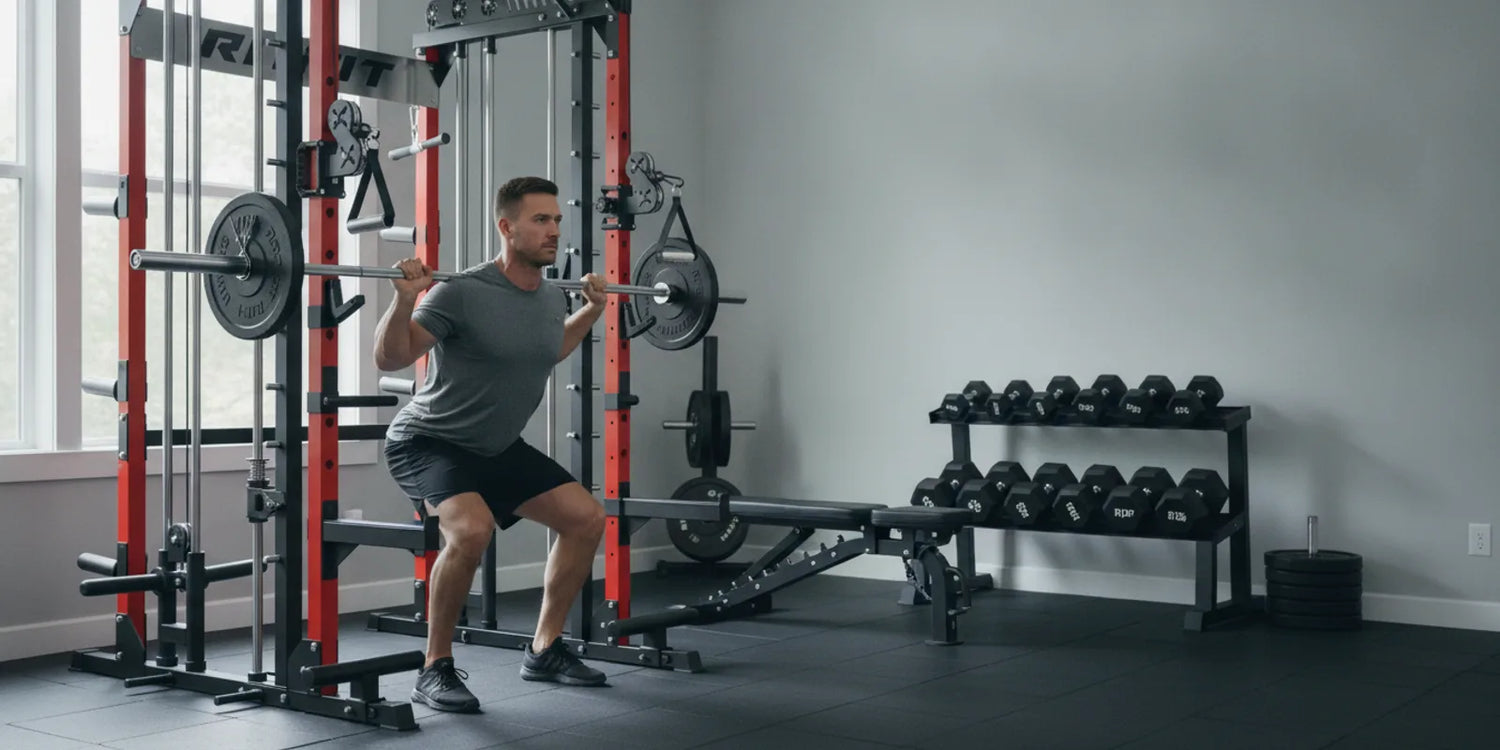
Day 1 builds your legs and posterior chain with squats, hinges, and calf work.
| Exercise | Sets | Reps | Rest |
|---|---|---|---|
| Smith Machine Squat | 3 | 8-12 | 2-3 min |
| Romanian Deadlift | 3 | 10-12 | 2 min |
| Reverse Lunge | 3 | 10 per leg | 1-2 min |
| Bent-Over Row | 3 | 10-12 | 1-2 min |
| Calf Raise | 3 | 12-15 | 1 min |
For deeper form cues on the lower-body lifts, see our guide to Smith machine leg workouts and the recommended Smith machine warm-up exercises.
Day 2: Push Emphasis
Day 2 targets your chest, shoulders, and triceps with stable pressing patterns.
| Exercise | Sets | Reps | Rest |
|---|---|---|---|
| Flat Bench Press | 3 | 8-12 | 2-3 min |
| Incline Bench Press | 3 | 10-12 | 2 min |
| Shoulder Press | 3 | 10-12 | 1-2 min |
| Close-Grip Bench Press | 3 | 10-12 | 1-2 min |
| Smith Machine Squat (light) | 2 | 12-15 | 1-2 min |
To refine your pressing setup, review our Smith machine chest workouts for muscle growth.
Day 3: Pull and Glutes
Day 3 finishes the week with rows, hip thrusts, and shoulder accessory work.
| Exercise | Sets | Reps | Rest |
|---|---|---|---|
| Bent-Over Row | 3 | 10-12 | 2 min |
| Hip Thrust | 3 | 10-12 | 2 min |
| Upright Row | 3 | 12-15 | 1-2 min |
| Lateral Raise (Smith assisted) | 3 | 12-15 | 1 min |
| Shrug | 3 | 12-15 | 1 min |
Dial in the hinge with our Smith machine hip thrust guide and our Smith machine back workouts for rowing detail.
How to Use This Plan Each Week
Schedule the three sessions on non-consecutive days so each muscle group recovers for about 48 hours. This spacing supports recovery while keeping weekly training frequency high.
- Frequency: Train 3 days per week, with full rest or light activity on the days between.
- Session length: Plan for 45 to 60 minutes including warm-up and rest periods.
- Beginner start: If you are new, run only Day 1 and Day 2 for the first two weeks, then add Day 3.
- Tracking: Log every weight and rep so you can apply progressive overload accurately.
For a complementary layout, compare this with our best full-body Smith machine home-gym workout.
How Do You Choose Your Starting Weight?
You choose your starting weight by picking a load you can lift for the target reps while keeping two to three reps in reserve. This leaves room for clean form and steady progress.
- Learn empty first: Do one set of each lift with the bare bar to groove the pattern.
- Add small jumps: Increase in modest increments until the final reps feel challenging but controlled.
- Err on the light side: Starting too light is easy to fix, while starting too heavy risks form breakdown.
Machines with a cable stack let you load accessory moves precisely. See our Smith machine with cable system guide for those options.
When Should You Add More Weight?
You should add weight once you can complete all prescribed sets and reps with clean form and a couple of reps still in reserve, for two sessions in a row. This is the core of progressive overload.
- Smallest increment: Add the lightest plates available, usually 2 to 5 pounds per side.
- Rebuild reps: After adding load, work back up to the top of the rep range before progressing again.
- Other levers: If you cannot add weight, add a rep, slow the lowering phase, or shorten rest slightly.
Progress steadily rather than chasing big jumps. Consistency across the 8-week block matters more than any single heavy session.
Which Exercises Can You Swap or Modify?
You can swap any lift that feels awkward for a similar pattern that trains the same muscles. Substitutions keep your session productive without forcing a movement your body is not ready for.
- Squat alternative: Use a leg press pattern or a goblet-style squat if the bar position bothers your shoulders.
- Press alternative: Swap flat bench for incline or a seated press if your shoulders feel pinched.
- Hinge alternative: Replace the Romanian deadlift with hip thrusts to reduce lower-back demand.
A study found that Smith machine squat and leg press loads can be converted to elicit similar quadriceps activation and perceived exertion, though with a moderate margin of error.[3] That supports treating the leg press as a reasonable squat substitute when needed.
Common Mistakes and When to Stop a Set
The most common mistake is chasing weight before form is solid, which raises injury risk and stalls progress. Knowing when to stop a set protects both your joints and your long-term consistency.
- Stop on form breakdown: End the set when your back rounds, hips shift, or the bar path drifts.
- Stop on sharp pain: Rack the bar immediately if you feel sharp or pinching pain, not normal muscle burn.
- Avoid ego loading: Leaving a rep or two in reserve usually drives better long-term gains than grinding to failure every set.
- Do not skip warm-ups: Cold joints under a fixed bar path can feel less forgiving than they should.
When in doubt, lower the weight and rebuild. Smart stopping points keep you training week after week.
FAQs About Smith Machine Workout Routine Plans
Is a Smith machine good for building muscle?
Yes, it can build muscle effectively. One study found that machine-only and free-weight-only training produced similar gains in size and strength over eight weeks in experienced lifters. The guided bar path also lets beginners load compound lifts safely while learning movement patterns, making it a solid foundation for a structured routine.
How many days per week should I do this Smith machine routine?
Train three non-consecutive days per week, such as Monday, Wednesday, and Friday, with rest days in between. This full-body split hits every major muscle group each session while leaving 48 hours for recovery. Beginners can start with two sessions weekly and add the third once they adapt to the workload.
How do I choose my starting weight on a Smith machine?
Pick a load you can lift for the prescribed reps while keeping two to three reps in reserve on your final set. Begin with the empty bar to learn each pattern, then add small increments until the last reps feel challenging but your form stays clean. It is better to start light and build up steadily.
When should I add more weight to the bar?
Add weight once you can complete all prescribed sets and reps with clean form and a couple of reps still left in the tank for two sessions in a row. Increase the load by the smallest available increment, usually two to five pounds per side, then rebuild your reps before progressing again.
Can beginners follow this Smith machine plan?
Yes. The fixed bar path reduces balance demands, so beginners can focus on form. Start with lighter loads, use the listed substitutions for any movement that feels awkward, and keep full rest days between sessions. Progress gradually, and consider transitioning some lifts to free weights once your technique and confidence improve.
Conclusion
A smith machine workout routine plan delivers structured, full-body progress when you train three days a week and apply progressive overload patiently. The guided bar path keeps form honest while you build strength and size.
Start light, log your lifts, and add weight only when form holds. Browse the full Smith machine collection to build your home setup and begin your first week.
Disclaimer
This article is for general educational purposes only and does not replace personalized advice from a qualified fitness or medical professional. Consult a doctor or certified trainer before starting any new training program, especially if you have an existing injury or health condition.
Save on your next RitFit order
Tap the button to copy your code, then paste it at checkout.
References
1. Lu Z, Li X, Xuan R, et al. A comparison of muscle activation and concomitant intermuscular coupling of antagonist muscles among bench presses with different instability degrees. Front Physiol. 2022;13:951589. https://pmc.ncbi.nlm.nih.gov/articles/PMC9486837/
2. Janicijevic D, Garcia-Ramos A, et al. Squat and countermovement jump performance across a range of loads: a comparison between Smith machine and free weight execution modes in elite sprinters. Int J Environ Res Public Health. 2022;19(19):12191. https://pmc.ncbi.nlm.nih.gov/articles/PMC9536377/
3. Biscarini A, Contemori S, Busti D, Riccardo R, Botti FM. Leg press and Smith machine squat: quadriceps activation and overall perceived effort profiles. Front Physiol. 2018;9:1481. https://pmc.ncbi.nlm.nih.gov/articles/PMC6206431/