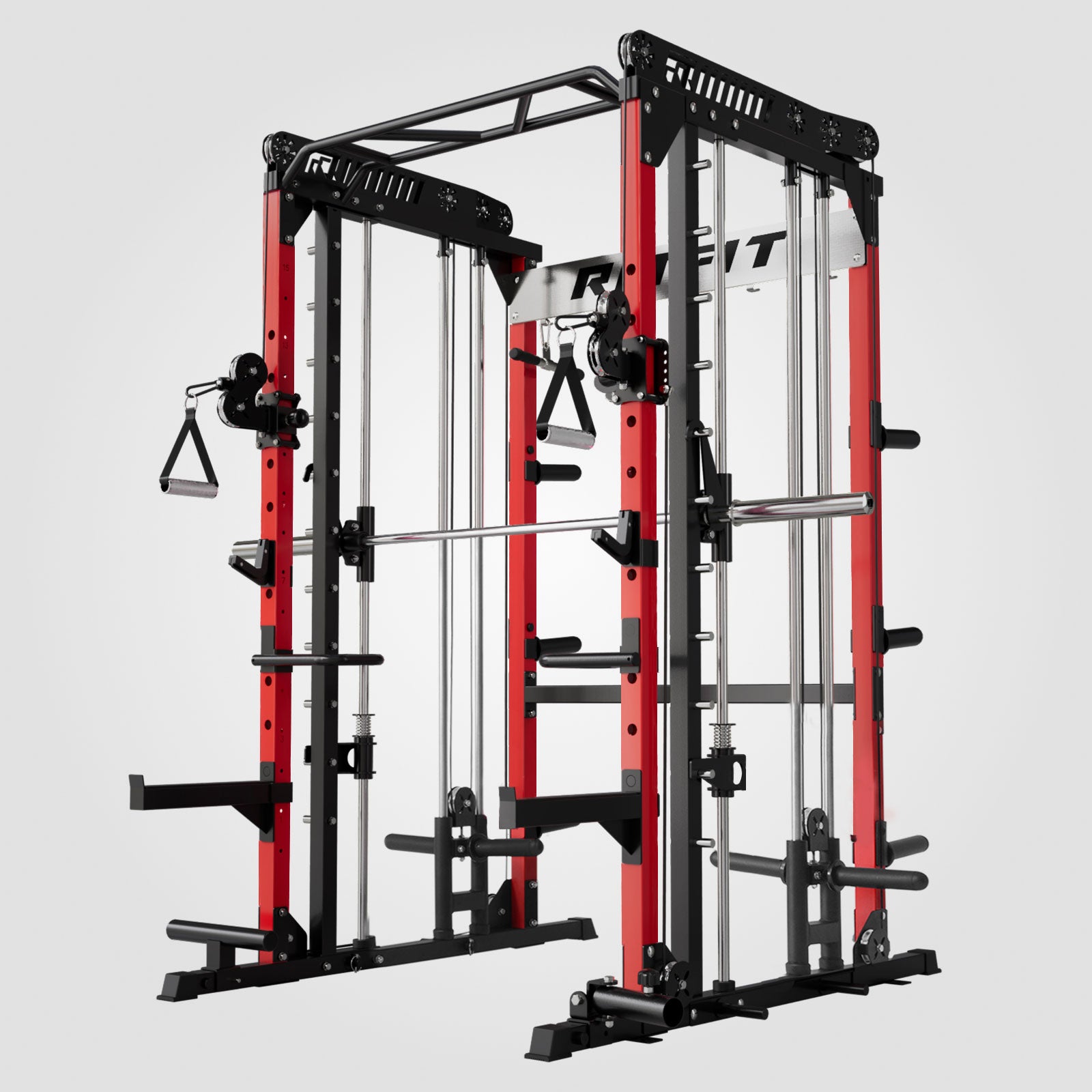
A Smith machine with weight stacks combines a guided Smith bar with selectorized resistance for the cable system. The stacks speed up cable changes, while the Smith bar usually remains plate loaded.
This guide explains pulley ratios, real resistance, room requirements, and the differences among the RitFit M1 PRO, BPC06, and M2 Pro 3D. It is designed to help home gym buyers choose by training needs instead of marketing numbers.
Quick Answer:The M1 PRO is the compact and upgradeable choice, the BPC06 delivers the highest estimated cable resistance, and the M2 Pro 3D offers the widest Smith movement range. Compare pulley ratio, usable resistance, ceiling clearance, footprint, and future training needs before choosing a Smith machine with weight stacks.
Table of Contents
- What Is a Smith Machine With Weight Stacks?
- How Do Weight Stacks Compare With Plate Loaded Systems?
- Why Does Pulley Ratio Matter?
- How Should You Choose a Weight Stack Smith Machine?
- How Were the Three RitFit Models Compared?
- Which Three RitFit Models Are Compared?
- Who Should Choose the M1 PRO?
- Who Should Choose the BPC06?
- Who Should Choose the M2 Pro 3D?
- How Do the Three Models Compare?
- Which Model Is Right for Your Home Gym?
Key Takeaways
- Stack function: The selectorized stacks power the cable stations, while the Smith bar is loaded separately with Olympic plates.
- Pulley ratio: A 1 to 1 system provides resistance close to the selected stack weight, while a 2 to 1 system provides about half before friction.
- Compact choice: The M1 PRO has the smallest official footprint among the three models at about 20.9 square feet.
- Heaviest cable feel: The BPC06 has the highest estimated single side handle resistance because it uses a 1 to 1 pulley ratio.
- Movement variety: The M2 Pro 3D adds horizontal Smith movement to the traditional vertical path.
What Is a Smith Machine With Weight Stacks?
A Smith machine with weight stacks combines guided bar training with selectorized cable resistance in one frame. The selector pin changes cable resistance quickly, but it does not normally change the load on the Smith bar.
The guided bar reduces the balance demands found in unrestricted barbell movement. Research comparing Smith, free weight, and unstable bench press conditions shows that changing stability also changes muscle activation and coordination demands.[1]
- Guided Smith bar: The bar moves along fixed vertical rails or along vertical and horizontal rails on a 3D system.
- Selectorized cable stations: A pin changes resistance without moving Olympic plates between exercises.
- Dual pulley columns: Independent left and right cables support bilateral and unilateral exercises.
- Rack functions: Uprights, J hooks, safety arms, pull up bars, and storage expand exercise options.
- Plate loaded Smith sleeves: Olympic plates are still required for Smith squats, presses, rows, and hinges.
Machines and free weights can both support muscle growth, while strength improvements tend to be specific to the equipment used for testing and training.[2] A buyer should therefore choose the system that supports the movements they will perform consistently.
How Do Weight Stacks Compare With Plate Loaded Systems?
Weight stacks are faster and easier to adjust, while plate loaded cable systems usually provide lower entry cost and greater loading flexibility. The better choice depends on budget, training pace, available plates, and how many people use the machine.
Weight Stack Cable System
A weight stack system is best for fast transitions, supersets, drop sets, partner workouts, and users who do not want to move plates between cable exercises.
Plate Loaded Cable System
A plate loaded system is best for buyers who already own Olympic plates, want a lower initial equipment cost, or need more loading flexibility.
- Adjustment speed: A selector pin changes stack resistance in seconds.
- Shared use: Different users can change resistance without unloading a carriage.
- Noise and organization: Stacks reduce repeated plate handling around the cable station.
- Maximum resistance: Plate loaded carriages can exceed a fixed stack when the frame capacity allows it.
- Upgrade cost: Selectorized stacks increase purchase price and total machine weight.
For a more detailed buying decision, review the plate loaded versus weight stack Smith machine guide. It explains where convenience provides real value and where plate loading remains practical.
Why Does Pulley Ratio Matter?
Pulley ratio determines how much of the selected stack weight reaches the handle. A 1 to 1 system delivers resistance close to the selected weight, while a 2 to 1 system delivers approximately half before friction and cable routing are considered.
- 1 to 1 ratio: A selected 100 pounds produces about 100 pounds of nominal handle resistance.
- 2 to 1 ratio: A selected 100 pounds produces about 50 pounds of nominal handle resistance.
- Cable travel: A 2 to 1 layout usually provides longer cable travel for flys, raises, chops, and functional movements.
- Resistance increments: A 10 pound stack increase on a 2 to 1 system changes nominal handle resistance by about 5 pounds.
- Real world feel: Bearings, pulley diameter, cable angles, lubrication, and friction can change actual resistance.
Do not compare two machines by total stack weight alone. The complete pulley ratio guide explains how to estimate cable resistance and travel.
How Should You Choose a Weight Stack Smith Machine?
Choose a weight stack Smith machine by matching its real cable resistance, room requirements, Smith path, attachment system, and upgrade options to your training plan. The largest stack or highest frame rating is not automatically the best fit.
1. Budget and Total Setup Cost
Compare the complete cost of the machine, stack configuration, bench, plates, flooring, delivery, attachments, and assembly. A lower machine price can become less attractive when essential components are sold separately.
2. Floor Space and Ceiling Clearance
Measure the lowest finished ceiling point, floor mats, lighting, beams, ducts, and garage door tracks. Leave additional room for bench travel, plate loading, cable movement, walking access, assembly, and pull ups.
Buyers with limited overhead space should review the Smith machine guide for low ceilings before ordering. A frame can fit under a ceiling while still leaving too little space for comfortable pull ups.
3. Pulley Ratio and Cable Strength
Choose 1 to 1 when heavier rows and pulldowns are the priority, or choose 2 to 1 when longer cable travel and smaller resistance changes matter more. Strong cable users should calculate nominal handle resistance before comparing stack totals.
4. Smith Movement Style
A traditional Smith system moves vertically, while a 3D Smith system also allows horizontal travel. The traditional path feels more fixed, while the 3D path provides more freedom for users who prefer a less restricted bar path.
5. Training Goals
Strength, hypertrophy, and muscular endurance can be developed across a broad range of training loads when effort and programming match the goal.[3] Choose a machine that supports the exercises, loading range, and movement patterns you will repeat.
6. Household Use
Selectorized stacks are especially useful when beginners, experienced lifters, and family members share one station. Fast adjustments reduce setup friction and make partner workouts easier to organize.
7. Future Progression
Progressive overload can come from additional load or additional repetitions, not only larger stack numbers.[4] Buyers should still confirm whether the machine provides enough long term resistance for their strongest rows, pulldowns, presses, and lower body cable exercises.
How Were the Three RitFit Models Compared?
The three models were compared using current RitFit technical specifications reviewed on July 16, 2026. The comparison focuses on stack configuration, pulley ratio, nominal handle resistance, footprint, height, Smith movement, frame design, and intended user.
- Specification source: RitFit technical information pages and product pages.
- Resistance calculation: Stack weight per side divided by pulley ratio.
- Space calculation: Official footprint and rack height, without estimating room specific clearance.
- Product scope: This is a comparison of three RitFit models, not every Smith machine available in the market.
- Testing limitation: Nominal handle resistance is a mathematical estimate, not a dynamometer measurement.
Product configurations, included attachments, titles, and availability can change. Confirm the live product page and manual before purchase.
Which Three RitFit Models Are Compared?
The comparison covers the compact M1 PRO, the direct resistance BPC06, and the modular M2 Pro 3D. Each machine combines Smith training, cable exercises, rack functions, and storage, but each prioritizes a different buyer.
Who Should Choose the M1 PRO?
The M1 PRO is the strongest fit for buyers who want the smallest footprint of the three models and the flexibility to use a plate loaded cable carriage or add selectorized stacks. Its 2 to 1 cable system favors smooth movement and longer cable travel.
M1 PRO With Weight Stack Option
The M1 PRO combines a traditional Smith bar, power rack, dual cable system, pull up station, storage, and an optional 264 pound stack set in a footprint of about 20.9 square feet.
- Best for: Compact garages, spare rooms, beginners, intermediate lifters, and buyers who value future upgrades.
- Official footprint: About 20.9 square feet.
- Official height: 85.3 inches.
- Weight stacks: Optional 264 pounds total, approximately 132 pounds per side.
- Pulley ratio: 2 to 1.
- Estimated handle resistance: Approximately 66 pounds per side before friction.
- Frame: 2 inch by 2 inch, 14 gauge steel.
- Frame capacity: Listed at 1,600 pounds.
- Main limitation: Advanced users may find the nominal single side cable resistance too light for heavy rows or pulldowns.
Why Choose the M1 PRO?
Choose the M1 PRO when compact dimensions, exercise variety, and an upgrade path matter more than maximum direct cable resistance. Its optional stack system improves training speed without requiring buyers to replace the full rack.
See the current RitFit M1 PRO Smith machine configuration before ordering, because stack packages and included attachments may vary.
Who Should Choose the BPC06?
The BPC06 is the best fit among these three models for lifters who prioritize heavier direct cable resistance, a 1 to 1 pulley ratio, and a vertical leg press attachment. It also requires the most floor space and has the greatest assembled weight.
BPC06 With Dual Selectorized Stacks
The BPC06 combines a traditional Smith system, dual 1 to 1 cable columns, a 13 gauge frame, storage, rack functions, and a vertical leg press attachment.
- Best for: Heavy cable users, lower body focused lifters, larger home gyms, and buyers who want direct resistance.
- Official footprint: About 27.2 square feet.
- Official height: 87.1 inches.
- Current stack specification: 26 plates at 11 pounds each, totaling 286 pounds.
- Per side stack: Approximately 143 pounds.
- Pulley ratio: 1 to 1.
- Estimated handle resistance: Approximately 143 pounds per side before friction.
- Frame: 2 inch by 2 inch, 13 gauge steel.
- Smith capacity: Listed at 700 pounds.
- Main limitation: The 707 pound machine weight and larger footprint make delivery, placement, and relocation more demanding.
Specification note: The current BPC06 technical page lists 26 plates at 11 pounds each, which equals 286 pounds total. Some older product titles and URLs still reference 260LB, so confirm the current package configuration before ordering.
Why Choose the BPC06?
Choose the BPC06 when heavy cable rows, pulldowns, direct resistance, and lower body versatility are higher priorities than compact dimensions. Its 1 to 1 ratio provides substantially more nominal handle resistance than the two 2 to 1 systems in this comparison.
Review the current RitFit BPC06 product configuration for package details, delivery information, and current stack specifications.
Who Should Choose the M2 Pro 3D?
The M2 Pro 3D is the strongest fit for experienced users who want vertical and horizontal Smith travel, dual selectorized stacks, plate carriage capacity, and modular attachments. It offers the broadest movement selection of the three systems.
M2 Pro 3D With WSM2 Weight Stacks
The M2 Pro 3D combines a multidirectional Smith bar, power rack, dual 2 to 1 cable columns, storage, and the WSM2 weight stack plus plate carriage attachment.
- Best for: Experienced lifters, functional training, athletic cable work, modular expansion, and users who prefer a less restricted Smith path.
- Official footprint: About 22.8 square feet.
- Official height: 86.14 inches.
- Weight stacks: 286 pounds total, with 143 pounds per side.
- Stack composition: 13 plates at 11 pounds per side.
- Pulley ratio: 2 to 1.
- Estimated handle resistance: Approximately 71.5 pounds per side before friction.
- Plate carriage capacity: Listed at 309 pounds per side on the WSM2 attachment.
- Smith movement: Vertical and horizontal travel on the Pro 3D configuration.
- Main limitation: The wider feature set increases setup complexity and may exceed the needs of users who want a simple fixed path Smith machine.
Why Choose the M2 Pro 3D?
Choose the M2 Pro 3D when movement variety, modular expansion, and a more adaptable Smith path matter more than maximum selectorized cable resistance. The plate carriage also creates a progression path beyond the fixed stack load.
Review the current RitFit M2 modular Smith machine page carefully, because M2, M2 3D, M2 Pro, and M2 Pro 3D configurations include different components.
How Do the M1 PRO, BPC06, and M2 Pro 3D Compare?
The M1 PRO leads on compact dimensions, the BPC06 leads on estimated selectorized cable resistance, and the M2 Pro 3D leads on movement variety. The table compares current official specifications and calculated nominal handle resistance.
| Model | Best For | Footprint | Height | Stack Per Side | Pulley Ratio | Estimated Resistance Per Side | Smith Path | Main Watchout |
|---|---|---|---|---|---|---|---|---|
| M1 PRO | Compact rooms, modular upgrades, general home training | About 20.9 square feet | 85.3 inches | About 132 pounds | 2 to 1 | About 66 pounds | Vertical | Limited selectorized resistance for advanced heavy pulls |
| BPC06 | Heavy cable work, leg press training, direct resistance | About 27.2 square feet | 87.1 inches | About 143 pounds | 1 to 1 | About 143 pounds | Vertical | Largest footprint and 707 pound assembled weight |
| M2 Pro 3D | Movement variety, modular training, experienced users | About 22.8 square feet | 86.14 inches | 143 pounds | 2 to 1 | About 71.5 pounds | Vertical and horizontal | More complex configuration and lower stack resistance than BPC06 |
Nominal resistance equals listed stack weight per side divided by the pulley ratio. Actual resistance can vary because of cable routing, friction, bearings, attachments, maintenance, and measurement method.
Which Model Is Right for Your Home Gym?
Choose the M1 PRO for compact flexibility, the BPC06 for heavy direct cable resistance, or the M2 Pro 3D for the widest movement selection. Your room, strongest cable exercises, preferred Smith path, and upgrade plan should make the final decision.
- Choose M1 PRO: Your room is smaller, you want a traditional Smith path, and you value an optional stack upgrade.
- Choose BPC06: Heavy rows, pulldowns, leg training, and direct 1 to 1 resistance are your main priorities.
- Choose M2 Pro 3D: You want horizontal Smith travel, modular accessories, and both stack and plate carriage resistance.
- Choose plate loaded instead: You already own many plates, have a limited budget, and do not mind manual resistance changes.
Browse the full RitFit Smith machine collection to compare current configurations. For programming ideas after purchase, use the full body Smith machine exercise guide.
FAQs About Smith Machines With Weight Stacks
What is a Smith machine with weight stacks?
A Smith machine with weight stacks combines a guided Smith bar with selectorized cable resistance. The stacks usually power the cable stations, not the Smith bar itself, so users still load Olympic plates on the Smith sleeves for squats, presses, rows, and other guided bar exercises.
How does a weight stack Smith machine differ from a plate loaded system?
A weight stack system changes cable resistance with a selector pin, while a plate loaded system requires users to move plates on and off the cable carriage. Weight stacks improve workout speed and shared use, while plate loaded systems can cost less and provide more loading flexibility.
How does a one to one pulley ratio compare with a two to one ratio?
A one to one pulley ratio delivers resistance close to the selected stack weight, while a two to one ratio delivers about half before friction and cable routing are considered. One to one systems suit heavier pulls, while two to one systems provide longer cable travel and smaller resistance changes.
Can the weight stack change the resistance of the Smith bar?
No. On the RitFit models compared here, the selectorized stacks operate the cable system, while the Smith bar is loaded with Olympic plates. Buyers should not assume that moving the stack pin changes Smith bar resistance, unless a product manual clearly describes a separate connection system.
How much ceiling height does a Smith machine with weight stacks need?
Most full size models in this comparison stand about eighty five to eighty seven inches tall. Measure the lowest ceiling point, flooring, lights, beams, ducts, and garage door hardware, then leave extra room for assembly and pull ups, because fitting the frame does not guarantee usable overhead clearance.
Which RitFit Smith machine has the highest estimated cable resistance?
The BPC06 has the highest estimated single side cable resistance among these models because its current specification page lists a one to one ratio and thirteen eleven pound plates per side. The M1 PRO and M2 Pro 3D use two to one systems, which reduce nominal handle resistance.
Is a weight stack upgrade worth the extra cost?
Yes. A weight stack upgrade is often worth the cost for users who perform supersets, drop sets, partner workouts, or frequent cable exercises. Plate loading remains practical for buyers with a tighter budget, existing plates, and no concern about changing resistance manually between sets.
Which Smith machine with weight stacks is best for a small home gym?
The M1 PRO is the most compact option in this comparison, with an official footprint of about twenty point nine square feet and a height of eighty five point three inches. Room shape still matters, so measure bench travel, plate loading access, cable movement, and walking clearance before ordering.
Conclusion
A Smith machine with weight stacks can reduce cable setup time while preserving guided Smith training, rack exercises, storage, and cable variety. The M1 PRO suits compact flexibility, the BPC06 suits heavy direct cable work, and the M2 Pro 3D suits users who want the broadest movement options.
Measure the room, calculate nominal cable resistance, and confirm the live product configuration before ordering. Compare all current options in the RitFit Smith machine collection.
Disclaimer
This article provides general equipment and fitness education and does not replace guidance from a qualified trainer, physical therapist, medical professional, installer, or product manual. Use appropriate loads, position safety stops correctly, inspect cables and hardware, follow current manufacturer instructions, and seek professional advice when managing pain, injury, rehabilitation, or unfamiliar heavy training.
Save on your next RitFit order
Tap the button to copy your code, then paste it at checkout.
References
1. Wang L, Qiao M, Tao H, Song X, Shao Q, Wang C, Yang H, Niu W, Chen Y. A comparison of muscle activation and concomitant intermuscular coupling of antagonist muscles among bench presses with different instability degrees in untrained men. Front Physiol. 2022;13:940719. doi:10.3389/fphys.2022.940719
2. Haugen ME, Vårvik FT, Larsen S, Haugen AS, van den Tillaar R, Bjørnsen T. Effect of free-weight vs machine-based strength training on maximal strength, hypertrophy and jump performance: a systematic review and meta-analysis. BMC Sports Sci Med Rehabil. 2023;15:103. doi:10.1186/s13102-023-00713-4
3. Schoenfeld BJ, Grgic J, Van Every DW, Plotkin DL. Loading recommendations for muscle strength, hypertrophy, and local endurance: a re-examination of the repetition continuum. Sports (Basel). 2021;9(2):32. doi:10.3390/sports9020032
4. Plotkin D, Coleman M, Van Every D, Maldonado J, Oberlin D, Israetel M, Feather J, Alto A, Vigotsky AD, Schoenfeld BJ. Progressive overload without progressing load? The effects of load or repetition progression on muscular adaptations. PeerJ. 2022;10:e14142. doi:10.7717/peerj.14142