Starting a weight loss workout plan for obese beginners does not require intense cardio or a gym membership. This guide gives you a safe, low-impact 4-week plan built on walking, seated exercises, and light dumbbell work you can do at home.
You will learn how often to train, which joint-friendly moves protect your knees and back, how to pair exercise with diet, and when to check with your doctor. Every step is paced so you stay comfortable and keep going.
Quick Answer: A weight loss workout plan for obese beginners starts with 10 to 15 minutes of low-impact movement like walking or seated exercise, three days a week. Add two short full-body strength sessions with light dumbbells, then increase slowly. Check with your doctor first if you have heart, blood, or joint concerns.
Key Takeaways
- Start gentle: Begin with 10 to 15 minutes of low-impact movement such as walking or seated exercise, three days a week.
- Follow the guidelines: Global physical activity guidelines suggest working toward 150 minutes of moderate activity each week plus two strength days.
- Protect your joints: Choose no-jump moves like sit-to-stand, seated presses, and wall push-ups that limit strain on knees and back.
- Pair diet with training: Home-based exercise combined with diet supports cardiometabolic health more reliably than exercise alone.
- Progress slowly: Add a few minutes or a little more dumbbell weight only when a session feels comfortable.
Why a Gentle, Consistent Start Wins for Weight Loss
A gentle, consistent start is safer and more sustainable than a hard push, because obese beginners are more prone to joint strain and early burnout. Small wins each week build the habit that makes long-term fat loss possible.
- Your joints adapt slowly: Extra body weight increases load on knees, ankles, and the lower back, so low-impact options give these joints time to adjust.
- Consistency beats intensity: Three doable sessions a week outperform one exhausting session that you quit after a month.
- You build self-trust: Finishing an easy workout on schedule teaches your body and mind that this routine is repeatable.
Think of this phase as a foundation, not a sprint. When movement feels automatic, you can layer on more time and resistance without risking burnout.
Is It Safe to Start Exercising When Overweight?
Starting light exercise while overweight is safe for most people, but you should check with a doctor first if you have heart disease, high blood pressure, diabetes, or joint problems. Your doctor can confirm which movements fit your health history.
- Get clearance first: Ask your care provider about heart, blood pressure, blood sugar, or joint conditions before you begin.
- Know the warning signs: Stop and seek advice if you feel chest pain, severe breathlessness, dizziness, or joint pain that does not settle.
- Consider supervision: A physical therapist or certified trainer can build a plan around your specific limits.
This article offers general safety guidance, not a diagnosis. Speaking with your care provider is always the safest first step toward a weight loss workout plan for obese beginners.
Start with Low-Impact Movement: What and How Much
Low-impact movement is any exercise that keeps at least one foot on the floor, such as walking, seated marching, or stationary cycling. It raises your heart rate without the jarring impact of running or jumping, which protects knees and ankles.
- Walking is the best starting point: Take a 10 to 15 minute walk at a pace where you can still talk.
- Seated options work too: Use seated marching or seated arm moves if you have low-back or mobility limits.
- Build toward guidelines: According to global physical activity guidelines, adults should aim for at least 150 minutes of moderate activity each week plus muscle-strengthening activities on two or more days.
| Effort level | How it feels | Example |
|---|---|---|
| Light | You can sing while moving | Slow walk, easy seated march |
| Moderate | You can talk but not sing | Brisk walk, marching, light band work |
| Vigorous | Talking becomes difficult | Fast walk or cycling hills, only after you build up |
Stay in the light to moderate range during your first weeks so your joints and stamina can adapt.
A guided session can help you feel how a complete workout is paced. This RitFit video walks through a full-body machine routine you can follow at a steady, comfortable pace.
Beginner Workout Plan for Weight Loss: A 4-Week Sample Schedule
A sensible 4-week start trains three days on low-impact movement and adds two short strength sessions, with each week rising in time or light resistance. The goal is to finish every session feeling like you could repeat it tomorrow.
| Week | Cardio | Strength | Focus |
|---|---|---|---|
| Week 1 | 3 walks, 10 to 15 minutes | 2 sessions, 20 minutes | Learn the movements |
| Week 2 | 3 walks, 15 minutes | 2 sessions, 25 minutes | Move a little longer |
| Week 3 | 4 walks, 15 to 20 minutes | 2 sessions, 25 to 30 minutes | Add bands or dumbbells |
| Week 4 | 4 walks, 20 minutes | 2 sessions, 30 minutes | Build a steady routine |
Rest days between sessions give joints time to recover and keep soreness manageable.
Week 1-2: Walk, Sit-to-Stand, and Light Resistance
Start each strength day with the basics: sit-to-stand, wall push-ups, and glute bridges for two sets of eight to ten reps.
- Sit-to-stand: From a firm chair, stand up slowly and sit back down. Builds leg strength with your feet planted.
- Wall push-up: Place hands on a wall, bring the chest toward it, and push back. Builds upper-body strength without floor impact.
- Glute bridge: Lie on a mat, lift the hips, and lower. Strengthens the hips and the lower back.
Week 3-4: Add Bands or Adjustable Dumbbells
Keep the same movements and add light resistance, such as resistance bands or a light pair of adjustable dumbbells.
- Seated dumbbell press: Sit on a bench or chair and press dumbbells overhead for three sets of ten.
- Dumbbell row: Lean on a bench with one dumbbell in hand and row for three sets of ten per side.
- Box squat: Use a chair as your target and control the lowering phase for three sets of ten.
Gentle strength tools like a medicine ball workout for beginners can also add variety to these sessions.
For a complete low-impact session you can follow along at home, try this 15 minute routine built specifically for obese beginners.
Strength Moves That Protect Your Joints with Dumbbells and a Bench
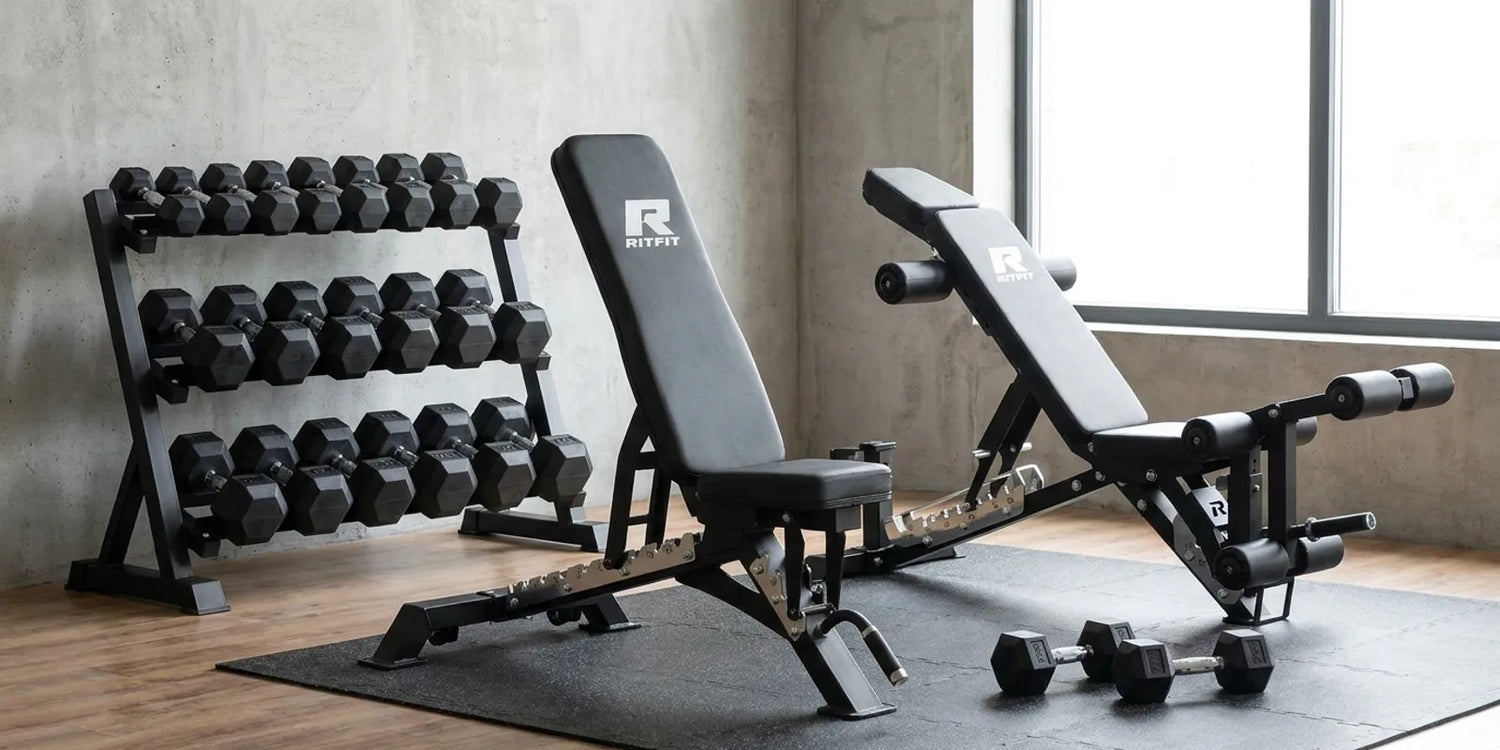
Joint-friendly strength moves use a stable, supported position so you can build muscle without pounding your knees and back. A low adjustable bench and light dumbbells let you perform seated and supported exercises safely at home.
- Sit-to-stand: Strengthens the legs while your feet stay planted, which is kinder to the knees than deep squats.
- Seated dumbbell press: A supported back is safer than standing overhead presses when you are building coordination.
- Dumbbell row: Leaning on a bench takes stress off the lower back while you work the upper body.
- Glute bridge: Activates the hips and lower back with no load on the knees.
- Wall push-up: Builds pressing strength without the strain of a full floor push-up.
Start with a weight you can lift for 10 to 15 reps with clean form. A bench like the RitFit 1300lb adjustable weight bench gives you a stable seat for seated presses and rows.
"If your space is limited, a good set of adjustable dumbbells might be your better option. They will allow you to progress to heavier weight as you get stronger."
Jeff Cavaliere, MSPT, CSCS, Physical Therapist and Strength Coach, creator of ATHLEAN-X, Athlean-X
How Nutrition and Exercise Work Together for Fat Loss
Exercise and nutrition work as one system for fat loss, because training creates a calorie deficit and preserves muscle while diet controls intake. Research found that home-based training combined with diet improved cardiometabolic health markers in adults, while exercise alone did not match those results[1].
- Calories still matter: Fat loss happens when you eat a little less than your body burns each day.
- Protein protects muscle: Eating enough protein alongside strength training helps you keep muscle while losing fat.
- Diet makes exercise work harder: A modest calorie-controlled diet paired with training supports sustainable fat loss better than training alone.
- Make small changes: Swap one snack, add a vegetable, and keep your walks on schedule.
You do not need a strict diet to start. Small, consistent food changes are enough to support your weight loss workout plan for obese beginners.
Common Mistakes Obese Beginners Make and How to Avoid Them
The most common mistakes are starting too hard, skipping rest days, and giving up after a tough first week. Each one is avoidable with a paced plan and realistic expectations.
- Starting too hard: Intense cardio or heavy weights cause deep soreness and quitting. Keep intensity light to moderate.
- Ignoring pain: Sharp pain is a signal to stop and adjust, not to push through.
- Skipping strength training: Cardio alone misses the muscle-preserving benefits of resistance work.
- Expecting fast results: Energy and sleep often improve before the scale moves, and those are real signs of progress.
- Comparing to others: Progress is personal, and a consistent 20 minute routine beats a sporadic hard one.
Expecting immediate change is the fastest way to quit. Build the habit first, and let the results follow.
Home Gym Setup for Comfortable Weight-Loss Workouts
A comfortable home setup needs a flat, stable area, a low bench for seated moves, and light dumbbells that stay within easy reach. You do not need a full rack to start losing weight.
- Light adjustable dumbbells: A set that covers small to medium loads is enough for presses, rows, and bridges. Browse the RitFit weights collection to find the right pair.
- A stable low bench: Seated and supported exercises are safest for beginner joints. The RitFit Gator adjustable weight bench lets you change angles as your range of motion grows.
- Dumbbell storage: Keep weights out of the way so sessions are easy to start. The RitFit PWR05 dumbbell rack organizes a full set, and RitFit weights storage has more options.
- Comfort items: A mat, a water bottle, and supportive shoes reduce friction on your joints and keep you consistent.
Your setup only needs to remove friction. When equipment is ready and visible, you are far more likely to use it.
When to Increase Intensity: Signs You Are Ready
The right time to increase intensity is when your current session feels comfortably repeatable and your breathing stays steady throughout. Then add a few minutes, an extra set, or a little more dumbbell weight rather than doubling your effort at once.
- Signals you are ready: You finish sessions without deep fatigue, recover by the next day, and feel eager to train.
- Add in small steps: Add five minutes to a walk or two pounds to a dumbbell, one change at a time.
- Progress your cardio: When a brisk walk feels easy, explore higher-intensity options like best HIIT workouts for beginners or battle rope workouts for beginners.
Increase only one variable at a time so you can tell what your body is adapting to, and back off if soreness lingers.
Final Checklist: Start Your Weight-Loss Plan This Week
Use this checklist to begin your weight loss workout plan for obese beginners this week without overthinking the details.
- Get clearance: Ask your doctor if you have heart, blood pressure, blood sugar, or joint conditions.
- Set your baseline: Take a comfortable 10 minute walk today.
- Block three days: Schedule three low-impact sessions and two short strength sessions.
- Pick a light weight: Use a dumbbell you can lift for 10 to 15 reps with good form.
- Track how you feel: Note your energy, sleep, and soreness, not just the scale.
If you want a similar step-by-step schedule, the beginner workout plan for females is a useful next read. The most important move is the first one, so lace up and walk for ten minutes today.
FAQs About Weight Loss Workout Plans for Obese Beginners
How should an obese beginner start working out safely?
Begin with low impact movement you can do comfortably, like a ten to fifteen minute walk or a short seated routine, three days a week.
Keep intensity light enough that you can still talk, and focus on form rather than effort.
Check with your doctor first if you have heart disease or joint pain.
How much exercise should an obese beginner do per week?
Global guidelines suggest building toward at least 150 minutes of moderate activity each week, which is about thirty minutes on five days. Beginners often start with three shorter sessions and add time gradually, such as ten minutes the first week and five more minutes every week until they reach the target.
What is the best workout for obese beginners to lose weight?
There is no single best workout, but a mix of low impact aerobic movement like walking plus light resistance training with dumbbells is effective and sustainable. Consistency matters more than intensity, and combining exercise with a moderate calorie-controlled diet supports meaningful fat loss.
Should obese beginners lift weights or just walk?
Doing both is ideal.
Walking builds cardiovascular fitness and burns calories, while light strength training with dumbbells or bands preserves muscle and raises daily energy use.
A simple plan is walking on most days plus two short full body strength sessions each week.
How quickly will I see results with a beginner weight loss plan?
Fat loss takes time, and a healthy pace is roughly one to two pounds per week when you combine a modest calorie deficit with regular exercise. In the first weeks you may notice improved energy, sleep, and endurance before the scale moves, which are real signs of progress to keep going.
Conclusion
A weight loss workout plan for obese beginners works best when it starts gentle, stays low-impact, and pairs movement with smart eating. Four weeks of walking and light dumbbell work build the habit, protect your joints, and set a pace you can actually keep.
Start with a 10 minute walk today and add one strength session this week. When you are ready to upgrade your home setup, browse RitFit sales for adjustable dumbbells and benches that grow with you.
Disclaimer
RitFit provides general fitness information, not medical advice, and this content is not a substitute for a professional evaluation of your health or treatment for any condition. Always consult a qualified doctor or physical therapist before starting a new exercise program, especially if you have heart disease, high blood pressure, diabetes, or joint problems.
References
1. Roberts CK, Segovia DE, Lankford DE. Effects of Home-Based Exercise Training Systems, Combined with Diet, on Cardiometabolic Health. Int J Exerc Sci. 2019;12(2):871-885. PMCID: PMC6533109