








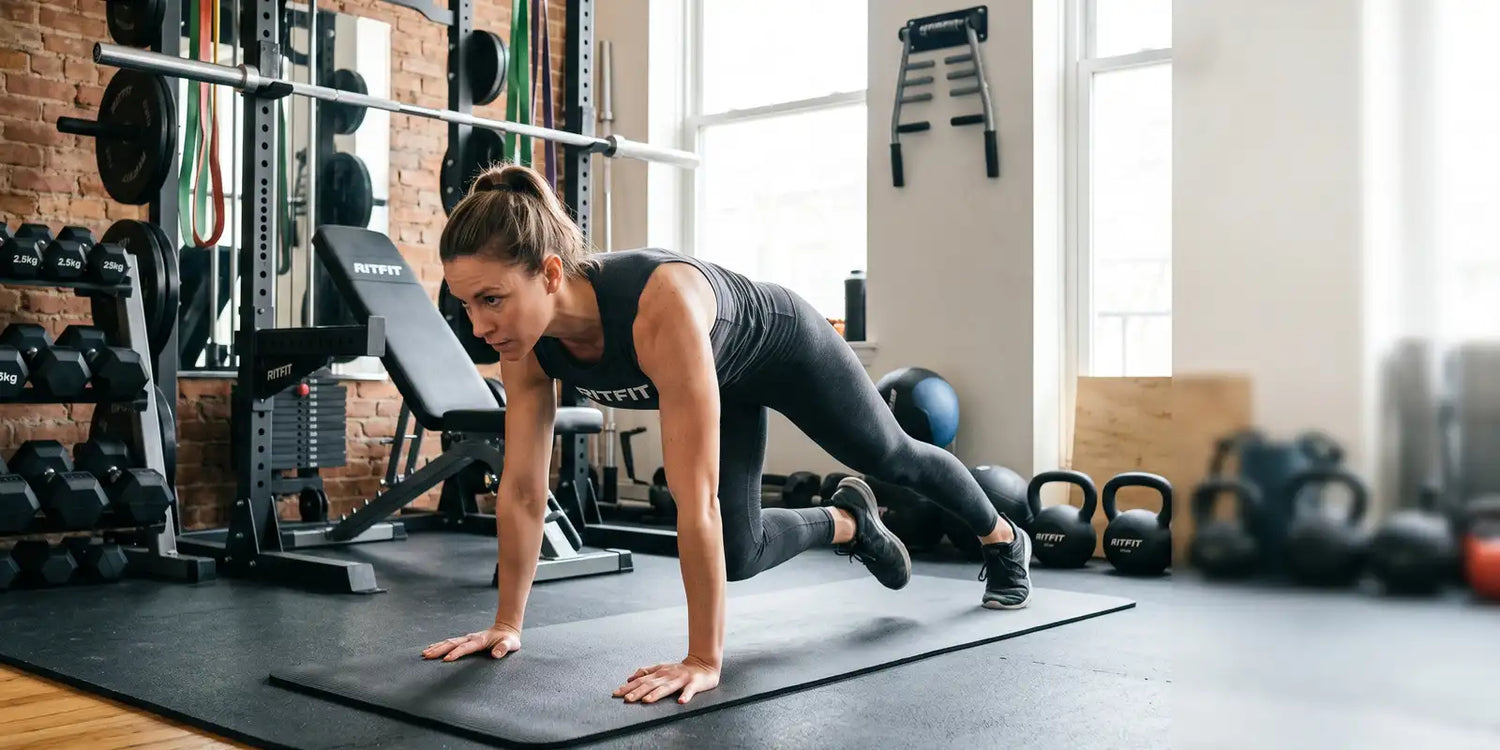
Mountain climbers are a bodyweight exercise that turns a plank into moving cardio, training your core, shoulders, and legs all at once. This guide explains exactly what they work and how to do them well.
You will learn the muscles involved, step by step form, common mistakes, easier and harder variations, a sample routine, and when to stop if something hurts.
Table of Contents
- What Do Mountain Climbers Actually Work?
- Which Muscles Do Mountain Climbers Train?
- How Do You Do Mountain Climbers With Proper Form?
- What Are the Most Common Mountain Climber Mistakes?
- Which Mountain Climber Variations Should You Use?
- How Many Mountain Climbers Should You Do?
- When Should You Add Difficulty or Stop?
- How Do Mountain Climbers Fit Into a Home Workout?
Key Takeaways
- Full body move: Mountain climbers train your core, shoulders, chest, and legs in one continuous movement.
- Core does the most work: Your abs and obliques fire constantly to keep your hips level in the plank.
- Cardio and strength: Fast tempo raises your heart rate, while a slow tempo builds control and stability.
- Form beats speed: A flat back and stacked shoulders matter far more than how fast you go.
- Scalable for all levels: Incline and on knees versions ease you in, cross body and slider versions challenge you.
What Do Mountain Climbers Actually Work?
Mountain climbers work nearly your entire body, with your core acting as the main worker and your shoulders, arms, and legs supporting the movement. Performed from a high plank, you drive your knees toward your chest one at a time while your trunk stays braced.
- Primary worker: The abdominal muscles stabilize your spine and resist your hips dropping or piking.
- Supporting cast: Shoulders, chest, and triceps hold the plank while hips and legs power each knee drive.
Because the legs move quickly, the exercise also raises your heart rate, so it doubles as conditioning. That blend of stability and cardio is why so many bodyweight CrossFit workouts include them.
Which Muscles Do Mountain Climbers Train?
Mountain climbers train two groups at once, stabilizers that hold the plank and movers that drive the legs. The upper body and core resist gravity while the hips, thighs, and calves create the running motion.
Core Stabilizers (Abs and Obliques)
Your rectus abdominis and obliques work hardest, contracting continuously to keep your torso steady as each leg moves. A systematic review of core muscle activity during fitness exercises supports prescribing plank based movements like this for core stability[1].
- Anti extension role: Surface EMG work on common training and rehab exercises shows the rectus abdominis and obliques recruit strongly in plank type positions to stabilize the trunk while the limbs move[2].
- Transverse abdominis: This deep wrapping muscle braces the spine, which is why a tight core feels safer than a sagging one.
Upper Body Stabilizers (Shoulders, Chest, Triceps)
Your deltoids, pectorals, triceps, and serratus anterior hold your upper body up against gravity in the plank position. They work isometrically, meaning they stay tense without changing length to keep your shoulders stacked over your wrists.
Lower Body Movers (Hip Flexors, Quads, Glutes, Hamstrings, Calves)
Your hip flexors and quads drive each knee forward while your glutes and hamstrings extend the leg back, and your calves help push off. EMG of a climbing pattern Pilates movement found the thigh muscles activate in moderate to high ranges with strong quad and hamstring co contraction[3].
- Why it feels like running: The alternating knee drive mimics a sprint, recruiting the same leg chain that powers stairs and jumps.
The Cardio and Conditioning Effect
The rapid leg switching pushes your heart rate up, so mountain climbers also build cardio endurance and agility. According to one guide, fitness sources describe them as a near total body move that combines stability work with a calorie burning cardio stimulus.
That makes them a natural fit inside interval circuits, much like the moves in these HIIT cardio routines and timed Tabata workout formats.
How Do You Do Mountain Climbers With Proper Form?
To do a mountain climber, start in a high plank with hands under your shoulders, then drive one knee toward your chest and switch legs while keeping your hips level. Your body should hold a straight line from head to heels throughout.
- Set your base: Place hands shoulder width apart, spread your fingers, and stack your shoulders directly over your wrists.
- Brace and align: Engage your core and glutes so your back stays flat, with your gaze just in front of your hands.
- Drive the knees: Pull one knee toward your chest, return the foot, then immediately bring the other knee in.
- Control the tempo: Start slow to groove the pattern, then speed up only once your hips stay quiet and level.
Keep breathing steadily, exhaling as each knee drives in. Quality reps with a stable trunk beat fast, sloppy reps every time.
What Are the Most Common Mountain Climber Mistakes?
The most common mistakes are letting the hips pike up, bouncing on the toes, and rounding the lower back as you tire. Each one reduces core engagement and raises the chance of strain.
- Piking the hips: Raising your hips turns it into a different move, so keep them in line with your shoulders.
- Bouncing on toes: Bouncing feels harder but uses less core, so focus on a controlled knee drive instead.
- Sagging or rounding: Drop or rounding in the lower back strains the spine, so draw your shoulders down and brace.
- Shoulders out of stack: Hands too far forward stress the wrists, so keep shoulders over wrists.
If your form breaks down, stop and reset rather than pushing through. A clean march is more valuable than a fast collapse.
Which Mountain Climber Variations Should You Use?
Choose a variation that matches your current strength, easier regressions if you cannot hold a steady plank, and harder progressions once your form is solid. The right level keeps your hips level and your core engaged.
Easier Regressions (Incline, On Knees, Slow March)
Beginners can elevate their hands on a bench or countertop, which reduces the load on the core and shoulders. A slow, deliberate march that focuses on technique is a smart entry point before adding speed.
Harder Progressions (Cross Body, Slider, Feet Elevated)
Once steady, try cross body climbers, driving each knee toward the opposite elbow to hit the obliques harder. Slider and feet elevated versions add instability and demand even more core control.
- Add load carefully: Weighted or dumbbell supported variations exist, but only add resistance once your bodyweight form is flawless.
How Many Mountain Climbers Should You Do?
A practical starting point is 3 sets of 20 to 30 seconds, resting 30 to 60 seconds between sets, 2 to 3 times per week. Progress by adding time, speed, or harder variations rather than chasing huge rep counts.
- Beginner: 2 to 3 sets of 20 seconds slow and controlled, prioritizing a level pelvis.
- Intermediate: 3 to 4 sets of 30 to 40 seconds, blending steady and faster tempos.
- Progression cue: Add roughly 5 to 10 seconds per set only when your form holds the whole way through.
They also slot neatly into circuits, pairing well with bodyweight strength moves like a bench ab workout or broader MetCon workouts guide sessions.
When Should You Add Difficulty or Stop?
Add difficulty when you can complete your sets with level hips and no lower back strain, and stop immediately if you feel sharp pain. Discomfort in the wrists, shoulders, or lower back is a signal to regress or rest.
- Ready to progress: You finish every set with steady hips, controlled breathing, and zero form breakdown.
- Back off when: Your hips sag, your back rounds heavily, or your shoulders shake before time is up.
- Stop entirely if: You feel sharp or pinching pain in a joint or the spine rather than normal muscle fatigue.
Wrist discomfort often eases by gripping dumbbells or dropping to forearms. Persistent pain means it is time to rest and reassess.
How Do Mountain Climbers Fit Into a Home Workout?
Mountain climbers fit home workouts perfectly because they need almost no equipment and pack cardio and core into one move. They work as a warm up finisher, an interval station, or a quick standalone burst between strength sets.
The video below shows a home friendly cardio HIIT flow where moves like mountain climbers keep your heart rate high.
- Minimal kit: All you need is floor space, which suits the priorities in this minimum home gym equipment guide.
- Loaded options: For weighted variations, a set of adjustable dumbbells kept tidy on a dumbbell rack stand adds resistance.
To build out a fuller routine, see these ideas for small home gym essentials and how to pick your best dumbbell sets for a home gym.
FAQs About Mountain Climbers
What do mountain climbers work the most?
Mountain climbers work your core the most, because your abdominals and obliques fire constantly to keep your hips level in the plank position. At the same time your shoulders, chest, and triceps stabilize your upper body, while your hip flexors, quads, and glutes drive each knee toward your chest, making it a full body move.
Are mountain climbers cardio or strength?
Mountain climbers are both. The fast, alternating leg drive raises your heart rate for a cardio and conditioning effect, while holding the plank and stabilizing your trunk builds muscular endurance in your core, shoulders, and hips. Slowing the tempo emphasizes strength and control, whereas speeding up emphasizes the cardio component.
How many mountain climbers should a beginner do?
Beginners can start with 2 to 3 sets of 20 to 30 seconds of slow, controlled mountain climbers, resting 30 to 60 seconds between sets. Focus on keeping your hips level and core tight rather than going fast. As your form and stamina improve, gradually add time, speed, or extra sets before trying harder variations.
Do mountain climbers burn belly fat?
No single exercise burns fat from one spot, so mountain climbers will not target belly fat directly. However, they are an efficient calorie burning, heart rate raising movement that strengthens the abdominal muscles underneath. Combined with a consistent routine and a balanced diet that creates a calorie deficit, they can support overall fat loss and a stronger looking midsection.
Why do my wrists hurt during mountain climbers?
Wrist pain usually comes from too much pressure on the heel of the hand or wrists bent at a sharp angle in the plank. Spread your fingers wide and press through your whole hand, stack your shoulders over your wrists, and keep a neutral spine. If discomfort continues, try the move on your forearms, on dumbbells, or stop and rest.
Conclusion
Mountain climbers are a compact, full body exercise that builds core stability, upper body endurance, and leg drive while raising your heart rate. Their value comes from a braced trunk and level hips, not raw speed.
Start slow with controlled reps, master your plank, then layer in harder variations as your form holds. A few focused sets a week is enough to feel stronger and more conditioned.
Disclaimer
This article is for general fitness education only and is not medical advice or a treatment plan for any injury. Consult a qualified healthcare or fitness professional before starting new exercises, especially if you have pain or a medical condition.
References
1. Oliva-Lozano JM, Muyor JM. Core Muscle Activity During Physical Fitness Exercises: A Systematic Review. International Journal of Environmental Research and Public Health. 2020;17(12). https://pmc.ncbi.nlm.nih.gov/articles/PMC7345922/
2. Khaiyat OA, Norris J. Electromyographic activity of selected trunk, core, and thigh muscles in commonly used exercises for ACL rehabilitation. Journal of Physical Therapy Science. 2018;30(4):642-648. https://pmc.ncbi.nlm.nih.gov/articles/PMC5909019/
3. Panhan AC, Gonçalves M, Cardozo AC. Electromyographic Activation and Co-contraction of the Thigh Muscles During Pilates Exercises on the Wunda Chair. Journal of Chiropractic Medicine. 2023;22(4):322-327. https://pmc.ncbi.nlm.nih.gov/articles/PMC10774615/





