








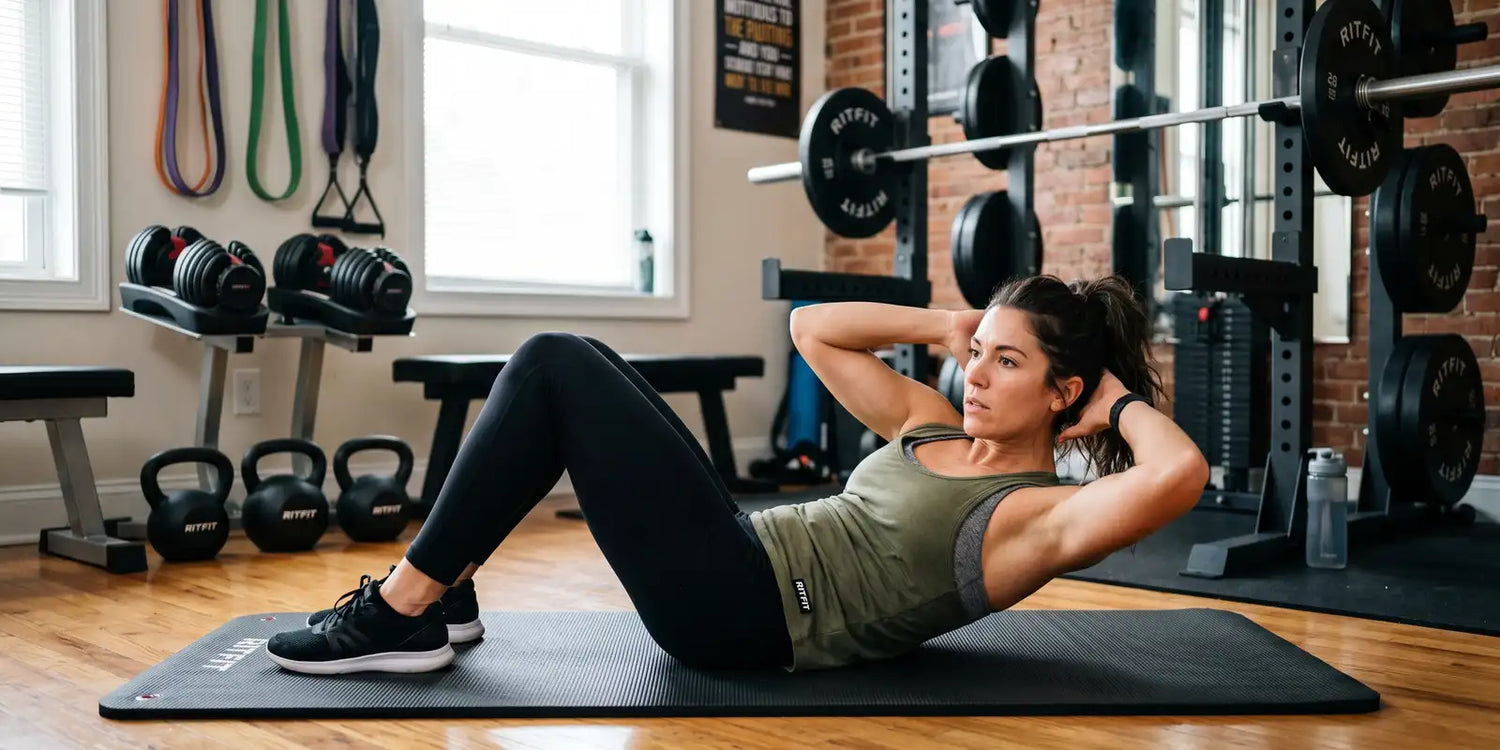
A crunch is a simple, controlled core exercise that curls your ribcage toward your pelvis to train the abdominal muscles. This guide explains what a crunch is, the muscles it works, exact step by step form, common mistakes, and how to progress.
It suits beginners and general gym goers who want a safe first crunch and a sensible place for it in a balanced core routine. If you have back or neck issues, read the safety section first.
Table of Contents
- What Is a Crunch Workout?
- Which Muscles Does a Crunch Work?
- What Is the Difference Between a Crunch and a Sit-Up?
- How Do You Do a Crunch With Proper Form?
- What Are the Most Common Crunch Mistakes?
- What Crunch Variations Should You Try?
- How Many Crunches Should You Do and How Often?
- When Should You Skip or Stop Crunches?
- How Do Crunches Fit Into a Balanced Core Routine?
Key Takeaways
- What it is: A crunch is a short spinal flexion move that lifts only your shoulder blades, keeping your lower back on the floor.
- Muscles worked: It mainly trains the rectus abdominis, with the obliques assisting and the hip flexors contributing only slightly.
- Not a sit-up: A crunch uses a small range and stays grounded, while a sit-up moves further and recruits more hip flexors.
- Form first: Curl the ribs toward the pelvis, exhale on the way up, and never yank your neck with your hands.
- Program it well: Pair crunches with planks and dead bugs, and skip them if you have back pain or other red flags.
What Is a Crunch Workout?
A crunch is a bodyweight core exercise in which you lie on your back with bent knees and curl your ribcage toward your pelvis, lifting your shoulder blades a few inches off the floor. The defining feature is a short range of spinal flexion that keeps your lower back pressed down.[1]
- Setup: Lie on a mat with knees bent and feet flat, hip width apart.
- Movement: Lift only the shoulder blades, then lower with control.
- Equipment: None needed, though a mat adds comfort and a adjustable weight bench enables decline and loaded versions later.
Because it isolates the front of the abdomen, the crunch is a starting point rather than a full core program. Explore more ab focused moves in our bench ab workout guide.
Which Muscles Does a Crunch Work?
A crunch primarily works the rectus abdominis, the long six pack muscle running down the front of your abdomen. The internal and external obliques assist as synergists, while the transversus abdominis and hip flexors contribute only a little.[2]
- Primary mover: Rectus abdominis, responsible for flexing the trunk.
- Synergists: Internal and external obliques along the sides of your waist.
- Minor helpers: Hip flexors, which take over if you sit up too high.
In an EMG study of 20 healthy adults, a traditional crunch produced significantly higher activation of the upper and lower rectus abdominis and internal oblique than an abdominal rise on a ball. Browse supportive gear in our core training equipment collection.
What Is the Difference Between a Crunch and a Sit-Up?
The main difference is range of motion. A crunch lifts only the shoulder blades while the lower back stays on the floor, whereas a sit-up brings the whole torso up toward the knees and recruits the hip flexors much more.
- Crunch: Small range, abs isolated, lower back grounded.
- Sit-up: Full range, more hip flexor and momentum involvement.
- Progression: Many people master the crunch first, then advance to sit-ups.
Neither is universally better, since each serves a different goal. Choose based on your comfort, control, and training experience.
How Do You Do a Crunch With Proper Form?
To do a crunch with proper form, lie on your back with knees bent, brace your abs, then exhale and curl your ribcage toward your pelvis until your shoulder blades leave the floor. Lower slowly and keep a fist sized gap between your chin and chest.
- Step 1: Lie down, bend your knees, and plant your feet hip width apart.
- Step 2: Place fingertips lightly behind your ears or cross arms on your chest.
- Step 3: Exhale and lift the shoulder blades by drawing ribs toward pelvis.
- Step 4: Squeeze for one second at the top, then lower with control.
The video below from a certified trainer demonstrates the neutral neck and grounded lower back cues in real time.
What Are the Most Common Crunch Mistakes?
The most common crunch mistakes are pulling on the neck, sitting all the way up, and using momentum instead of the abs. Each one shifts the work away from the rectus abdominis and can strain the neck or lower back.
- Pulling the neck: Yanking your head forward strains the cervical spine, so press your head gently into your hands instead.
- Turning it into a sit-up: Going past shoulder blade lift loads the hip flexors, so stop once the blades leave the floor.
- Rushing reps: Momentum reduces ab work, so move slowly and exhale on the lift.
- Tucking the chin: Keep a fist sized gap between chin and chest to protect the neck.
Fixing form usually matters more than adding reps. A few clean crunches beat many sloppy ones.
What Crunch Variations Should You Try?
Effective crunch variations include the reverse crunch, the bicycle crunch, the supported crunch, and the weighted crunch. Each changes the angle or load so you can keep progressing once the basic crunch feels easy.
- Reverse crunch: Curl the knees toward the chest to involve the lower abs.
- Bicycle crunch: Add a twist to engage the obliques along with the rectus abdominis.
- Supported crunch: Place hands under the lower back to keep the spine in a neutral position.
- Weighted crunch: Hold a small plate on the chest once bodyweight reps feel controlled.
Setup details matter too. Researchers observed that a curl-up with 90 degrees of hip flexion and maximal expiration increased oblique activation compared with other positions and breathing patterns.[3]
A Gator adjustable bench lets you set a decline for loaded versions, and our workout benches collection covers more options.
How Do You Choose the Right Variation or Add Resistance?
Pick the variation that lets you keep strict form, and add resistance only after you control 3 sets of about 20 clean reps.
- Start light: Begin loaded crunches with a 2.5 to 5 lb plate held on the chest.
- Progress gradually: Add small increments rather than jumping to heavy plates.
- Match your goal: Use bicycle crunches for obliques and reverse crunches for lower ab focus.
How Many Crunches Should You Do and How Often?
A practical starting point is 2 to 3 sets of 10 to 15 slow, controlled reps, performed 2 to 3 times per week with rest between sessions. Quality of each rep matters more than chasing a high number.
- Beginner: 2 sets of 10 reps with a one second squeeze at the top.
- Intermediate: 3 sets of 15 to 20 reps with full shoulder blade lift.
- When to add load: Once you can do 3 sets of about 20 reps with perfect form.
Train your core like any other muscle, allowing recovery between hard sessions. You can fit crunches into interval formats such as a Tabata workout or a circuit from our metcon workouts guide.
When Should You Skip or Stop Crunches?
You should skip or stop crunches if you feel sharp pain in your neck or lower back, since the movement loads the spine into repeated flexion. Some people are better served by anti extension moves instead.
- Stop signals: Sharp pain, numbness, or tingling rather than normal muscle fatigue.
- Common cautions: Acute back pain, disc issues, active diastasis recti, or recent abdominal surgery.
- Safer swaps: Planks, dead bugs, and bird dogs that train the core without spinal flexion.
One training guide notes that anyone in these situations should substitute anti extension patterns until cleared by a clinician. When in doubt, check with a qualified professional before continuing.
How Do Crunches Fit Into a Balanced Core Routine?
Crunches fit best as one part of a balanced core routine, not the whole plan. Because they train flexion only, you should pair them with anti extension, anti rotation, and rotation work for complete trunk strength.
- Flexion: Crunches and reverse crunches for the rectus abdominis.
- Anti extension: Planks and dead bugs to resist arching.
- Rotation: Bicycle crunches and similar moves for the obliques.
This mix builds a core that supports daily movement, not just a visible six pack. Add bodyweight core finishers from our bodyweight workouts or a military-style workout for endurance carryover.
FAQs About Crunches
What is a crunch workout?
A crunch is a controlled core exercise where you lie on your back with bent knees and curl your ribcage toward your pelvis, lifting only your shoulder blades off the floor. It mainly trains the rectus abdominis, the front six pack muscle, through a short range of spinal flexion. Unlike a sit-up, your lower back stays pressed into the ground.
Which muscles does a crunch work?
A crunch primarily targets the rectus abdominis, the long muscle running down the front of your abdomen. The internal and external obliques on the sides of your waist assist as synergists, and the hip flexors contribute only slightly. Because the movement is short and controlled, it isolates the abs more than a full sit-up.
Is a crunch better than a sit-up?
Neither is universally better, since they serve different goals. A crunch keeps your lower back on the floor and isolates the abs through a small range, which many people find easier on the spine. A sit-up moves through a larger range and recruits the hip flexors more. Beginners often master the crunch first.
How many crunches should I do?
A reasonable starting point is two to three sets of ten to fifteen slow, controlled reps, focusing on quality over quantity. Once you can complete three sets of about twenty reps with perfect form and a one second squeeze at the top, you are ready for harder variations. Train your core two to three times per week.
Are crunches bad for your back?
Crunches load your spine into repeated flexion, so they may not suit everyone. Done with poor form, such as yanking the neck or arching the back, they can strain the neck and lower back. People with acute back pain, disc issues, diastasis recti, or recent abdominal surgery should choose planks and dead bugs and check with a clinician first.
Conclusion
A crunch is a focused move that trains the rectus abdominis through a small, controlled range of spinal flexion. Done well, it builds a strong foundation for everyday movement and more advanced core work.
Start with strict form, master 2 to 3 sets of clean reps, then add variations like reverse and bicycle crunches. Pair them with planks and dead bugs, and skip crunches if pain appears.
Disclaimer
This article is for general educational purposes only and does not replace personalized medical or fitness advice. Consult a qualified healthcare provider or certified trainer before starting new exercises, especially if you have back, neck, or other health concerns.
References
1. Piering AW, Janowski AP, Wehrenberg WB, Moore MT, Snyder AC. Electromyographic analysis of four popular abdominal exercises. Journal of Athletic Training. 1993;28(2):120-126. https://pmc.ncbi.nlm.nih.gov/articles/PMC1317695/
2. Dolenec A, Svetina M, Strojnik V. Electromyographic Comparison of an Abdominal Rise on a Ball with a Traditional Crunch. Sensors (Basel, Switzerland). 2022;22(5). https://pmc.ncbi.nlm.nih.gov/articles/PMC8915105/
3. Kim SH, Park SY. Effect of hip position and breathing pattern on abdominal muscle activation during curl-up variations. Journal of Exercise Rehabilitation. 2018;14(3):445-450. https://pmc.ncbi.nlm.nih.gov/articles/PMC6028217/





